Prof. Olga Sorkine Hornung is a Full Professor of Computer Science at ETH Zürich, leading the Interactive Geometry Lab. She holds a BSc and PhD from Tel Aviv University (2000 and 2006) and conducted postdoctoral research at Technical University Berlin. Her research focuses on computer graphics, geometric modeling, and geometry processing, with applications in shape editing, digital fabrication, and animation. She has received numerous accolades, including the ACM Fellowship (2020), ERC Consolidator Grant (2020), and the Golden Owl Teaching Award (2021). Her work bridges theoretical foundations and practical algorithms, addressing challenges in parameterization, surface compression, and interactive design tools. Her research interests span: Computer Graphics & Visualization Geometric Modeling & Processing 3D Content Creation & Digital Fabrication Garment Design & Simulation Human Motion Analysis & Animation Awards and grants include: 2024: Best Paper Honorable Mention (EUROGRAPHICS) 2023: Member of Swiss Academy of Engineering Sciences (SATW) 2020: ERC Consolidator Grant 2017: Rössler Prize (ETH Zurich) Her lab focuses on developing novel methods for interactive geometry processing, with recent advancements in garment modeling (e.g., AIpparel, Rags2Riches) and motion retargeting systems like WalkTheDog. She actively collaborates on interdisciplinary projects, including biomedical applications and sustainable fashion technology.
Nils Fleischhacker is an Assistant Professor for Cryptography at Ruhr University Bochum, where he leads the Theoretical Cryptography group within the Faculty of Computer Science. His research focuses on foundational aspects of cryptography with particular emphasis on zero-knowledge proofs, digital signatures, and secure computation. Prior to joining Ruhr University, he held postdoctoral positions at Johns Hopkins University and Carnegie Mellon University. Dr. Fleischhacker received his PhD in Computer Science from Saarland University in February 2017, advised by Dominique Schröder. During his doctoral studies, he was a research intern at Microsoft Research with Chris Brzuska and a research visitor at the University of Maryland, College Park with Jonathan Katz and Dana Dachman-Soled. His research spans theoretical cryptography with significant contributions to zero-knowledge proofs, multi-signature schemes, property-preserving hash functions, and security proofs for cryptographic primitives. Fleischhacker's work often addresses fundamental questions about the limits and possibilities of cryptographic constructions, with particular attention to black-box separations and lower bounds. His recent publications demonstrate a strong focus on lattice-based cryptography and post-quantum secure protocols. Fleischhacker's publications over the past five years reveal a consistent research trajectory focused on improving the efficiency and security of cryptographic primitives, with particular emphasis on signature schemes, zero-knowledge protocols, and secure computation frameworks. His work frequently appears in top-tier cryptography venues including CRYPTO, EUROCRYPT, and CCS. Dr. Fleischhacker actively mentors PhD students, with numerous successful graduations spanning from 2010 to 2024. His former PhD students include Önder Askin (2024), Floyd Zweydinger (2023), and Lars Schlieper (2022), among others. His research is supported through various academic channels and collaborations. He is affiliated with several prominent research organizations including the Horst Görtz Institute (HGI) for Information Security, the DFG Excellence Cluster CASA, the EU Marie Curie Network QSI, and the International Association for Cryptologic Research (IACR). These affiliations provide a strong institutional framework for his theoretical cryptography research.
Vassilis Zikas is an Associate Professor at the School of Cybersecurity and Privacy and holds a courtesy appointment in the School of Computer Science at Georgia Tech. He previously held positions at Purdue University, the University of Edinburgh, and Rensselaer Polytechnic Institute (RPI). His research focuses on cryptography, blockchain technologies, cryptocurrencies, game theory, and distributed computing. He leads the Blockchain Lab at Georgia Tech and serves as Chief Scientist at Sunday Group, where he contributes to the Mobby blockchain architecture. His work is supported by the NSF, DoD, Swiss NSF, and industry partners like Sunday Group and Algorand Foundation. He has organized major conferences including PKC 2020 and has served on program committees for EUROCRYPT, CRYPTO, and TCC. He advises PhD students in cryptography and related fields and has mentored postdocs and master’s students. Zikas’ publications span topics like secure multi-party computation (MPC), blockchain security, and cryptographic protocol design. His recent work includes advancements in privacy-preserving protocols, adaptive security frameworks, and composability in blockchain systems. Notable awards include the 2023 Leadership Award from Purdue College of Science and an AnlytiXIN Fellowship. He actively contributes to both theoretical and applied aspects of cybersecurity and privacy through academic and industrial collaborations.
Kristofer Pister is a Professor in the Department of Electrical Engineering and Computer Sciences at the University of California, Berkeley. He co-directs the Berkeley Sensor and Actuator Center (BSAC) and the Ubiquitous Swarm Lab. His career spans groundbreaking innovations in Micro/Nano Electro Mechanical Systems (MEMS), Control Systems, and Low-Power Circuits, with a focus on Smart Dust and synthetic insects. Education: Ph.D. and M.S. in EECS from UC Berkeley (1992, 1989); B.A. in Applied Physics from UC San Diego (1986). His research areas include MEMS , Control Systems , Robotics , and Integrated Circuits , with recent work on self-powered micro-sensors, crystal-free radios, and interplanetary swarm networks. Key awards include the ISA Albert F. Sperry Founder Award (2009) , Alexander Schwarzkopf Prize (2006) , and the NSF CAREER Award (1996) . He has authored numerous influential publications in wireless sensor networks and microrobotics. His lab, Ubiquitous Swarm Lab , explores distributed robotics and swarm intelligence. Pister emphasizes open collaboration in research, ethical conduct in academia, and efficient resource utilization for graduate students.
Aggelos Kiayias FRSE is Chair in Cyber Security and Privacy and Director of the Blockchain Technology Laboratory at the University of Edinburgh. He is also Chief Scientist at blockchain technology company Input Output. His academic work spans over two decades with more than 200 publications in cryptography, blockchain, and security. Dr. Kiayias received his Ph.D. from the City University of New York and was an undergraduate at the University of Athens Mathematics department. His research focuses on computer security, privacy, applied cryptography, and foundations of cryptography with particular emphasis on blockchain technologies, distributed systems, e-voting, secure multiparty protocols, and identity management. His recent work demonstrates continued innovation across multiple dimensions of blockchain technology, with publications spanning theoretical foundations, practical implementations, economic modeling, and privacy-preserving techniques. The research output shows strong emphasis on security analysis, consensus protocols, transaction processing, and economic incentives within decentralized systems. His work bridges theoretical cryptography with real-world blockchain applications. Among his notable recognitions are an ERC Starting Grant, Marie Curie fellowship, NSF Career Award, Fulbright Fellowship, election as Fellow of the Royal Society of Edinburgh in 2021, and the BCS Lovelace Medal in 2024. He has served as program chair for major conferences including the Cryptographers' Track of RSA (2011), Financial Cryptography (2017), Real World Crypto Symposium (2020), and Public-Key Cryptography Conference (2020), and as general chair of Eurocrypt 2013. Professor Kiayias has supervised over 20 PhD students, many of whom have gone on to academic positions at institutions including Imperial College, Stanford University, Royal Holloway University London, University of Glasgow, University of Sydney, and Virginia Commonwealth University. His current advisees include Yu Shen, Amirreza Sarencheh, and Christina Ovezik with expected graduations between 2025-2026. He leads the Blockchain Technology Laboratory at the University of Edinburgh and is involved in several major blockchain research projects including Panoramix and Fentec. His research has received significant funding from the European Union (Horizon 2020, ERC), UK research councils (EPSRC), US agencies (NSF, DHS, NIST), and Greek research bodies.
James Aspnes is the Harold W. Cheel Professor of Computer Science at Yale University, specializing in distributed algorithms and randomized methods. He holds a PhD from Carnegie Mellon University and degrees from MIT. His research focuses on distributed systems, peer-to-peer networks, and sensor networks, emphasizing tools for efficient data management and fault-tolerance. Education: PhD (CMU, 1992), SM & SB (MIT, 1987) Affiliations: Yale since 1993, IBM Almaden Research Center (1992–1993) Research interests include distributed algorithms, randomization, and applications in biology and economics. Notable contributions include skip graphs, population protocols, and consensus algorithms. He has received the ACM-EATCS Dijkstra Prize (2020) and Dylan Hixon Prize (2000). Publications span distributed computing, algorithms, and cryptography. Recent work explores consensus protocols and privacy in population models. Grants include NSF awards totaling over $2M. Active in editorial roles (Algorithmica, Distributed Computing) and conference organization (PODC 2005, DCOSS 2007).
Alastair F. Donaldson is a Professor and Director of Research in the Department of Computing at Imperial College London, where he leads the FastPL research group. His work bridges formal methods, software testing, and programming languages, with a focus on enhancing the reliability of high-performance and parallel software systems. He has held key roles including Director of Research (since 2023) and previously served as Lecturer (2011–2014), Senior Lecturer (2014–2017), and Reader (2017–2020) before being promoted to Professor in 2020. His research interests include formal verification, compiler testing, GPU programming, concurrency, and fuzzing. He has made significant contributions to the verification of GPU kernels, metamorphic testing of graphics drivers, and the development of tools like GPUVerify and GraphicsFuzz. His work combines theoretical rigor with practical impact, demonstrated by the acquisition of his startup GraphicsFuzz by Google in 2018 and his subsequent roles as Senior Software Engineer and Visiting Researcher at Google. His recent publications reflect a sustained focus on compiler and system reliability, with trends in fuzzing, formal specification, and automated testing of complex systems such as WebGPU, CXL cache coherence, and large language models for code generation. His work increasingly integrates empirical validation with formal techniques to uncover subtle bugs in real-world systems. Scientific awards and recognitions include: 2017 BCS Roger Needham Award EPSRC Early Career Fellowship Fellow of the British Computer Society Best Paper awards at EuroSys 2024, MET 2021, IISWC 2019, IWOCL 2019, and ICST 2016 Best Industry Paper at ICST 2024 ACM SIGSOFT Distinguished Paper at ISSTA 2023 ACM SIGPLAN Most Influential OOPSLA Paper Award (2012 paper), awarded in 2022 Best Student Paper at PPoPP 2014 He has advised numerous PhD students and leads a vibrant research group. He has secured significant research funding and collaborates extensively with industry and academia. His service includes leadership roles such as General Chair of PLDI 2020, PC Chair of ECOOP 2019, and Steering Committee Chair of PLDI (2022–2025). He also serves on the advisory board of PACM-PL and on program committees for top venues including POPL, OOPSLA, PLDI, ICSE, and ISSTA. He leads the FastPL research group, which focuses on the design and implementation of programming tools and techniques for reliable software. The group conducts cutting-edge research in compiler testing, formal methods, and high-performance systems, fostering collaboration across academia and industry.
Arrvindh Shriraman is an Associate Professor and Program Director of Software Systems at Simon Fraser University's School of Computing Science in Surrey. His research focuses on energy-efficient software, multicore memory systems, and optimizing hardware/software interfaces for parallel programming. He holds a Ph.D. (2010) and M.S. (2006) in Computer Science from the University of Rochester, and a B.Eng. (2004) from the University of Madras. He teaches courses on parallel programming and energy-conscious software design. His research interests include synchronization mechanisms for domain-specific architectures, cache optimization, and FPGA-based acceleration. He has contributed to frameworks like Mu-grind for HLS-generated RTL instrumentation and TAPAS for parallel accelerator generation. Notable projects include RANGE-BLOCKS for synchronization in domain-specific systems and TapeFlow for gradient computation in neural networks. His work emphasizes real-time verification of autonomous systems and safety-critical trajectory planning for underwater vehicles. Shriraman collaborates closely with the Tangent Lab, exploring cutting-edge solutions in hardware-software co-design and embedded systems. His teaching and research bridge theoretical computer science with applied engineering challenges, addressing scalability, efficiency, and safety in modern computing systems.
Professor Dahlia Malkhi is a leading academic and researcher in distributed systems and blockchain technology. She currently holds a faculty position at the University of California, Santa Barbara (UCSB), where she heads the Foundations of Financial Technology (FfTech) research lab. Her work focuses on reliability, security, and consensus mechanisms in distributed systems, with a recent emphasis on blockchain innovations like HotStuff, which underpins Diem, Aptos, and other blockchains. She has held influential roles at industry leaders such as Chainlink Labs, Diem Association, VMware, and Microsoft Research. Education: Ph.D. in Computer Science from The Hebrew University of Jerusalem. Past roles include CTO of Diem Association (2019–2022), Principal Researcher at VMware (2014–2019), and Partner Principal Researcher at Microsoft Research (2004–2014). Research Interests: Blockchain consensus algorithms (e.g., HotStuff, Flexible Paxos), Byzantine Fault Tolerance (BFT), secure multi-party computation (FairPlay), and distributed database systems (CorfuDB). Her work bridges academic theory with industrial applications, emphasizing practical scalability and security. Awards: ACM Fellow (2011), IEEE TCDP Outstanding Technical Achievement Award (2021), IBM Faculty Award (2003/2004). She has also held leadership roles in conferences like Usenix ATC and program chairs for multiple distributed systems events. Advising & Grants: Advises projects at Space Computer, Lyquor Labs, and Chainlink Labs. Her research labs and collaborations include work on BBCA-Chain, Lumiere, and BFTBrain, advancing consensus mechanisms in decentralized systems. Labs/Teams: Leads UCSB’s FfTech lab, co-founded VMware Research, and contributed to foundational blockchain projects like DiemBFT and Espresso Systems. Her work impacts technologies such as NSX-T control planes and distributed financial infrastructure.
Professor David Thomas holds the position of Professor in Computer Engineering at the University of Southampton's Electronics and Computer Science Department. His research focuses on the intersection of software and hardware, particularly leveraging FPGAs for novel digital architectures and event-driven computing. He has a notable academic trajectory, having previously served as a Lecturer and Senior Lecturer at Imperial College London before joining Southampton in 2021. Dr. Thomas is actively involved in supervising PhD students and contributes to interdisciplinary research projects funded by the EPSRC, such as the SONNETS initiative exploring scalable event-triggered systems. Education: BSc in Computer Science (Imperial College London), PhD in Digital Architectures (Imperial College London). Postdoctoral roles included Research Associate and Research Fellow at Imperial's Department of Computing. Research Interests: Event-driven computing, FPGA-based systems, high-level synthesis, and high-performance computing. His work emphasizes practical implementations of theoretical models, such as custom processors and application-specific accelerators. Current projects include optimizing random number generation for FPGAs and exploring meta-programming techniques for hardware design. Advising and Grants: Supervises multiple PhD students in areas like neuromorphic computing and algorithm optimization. Active in securing funding for distributed system architectures and FPGA-based solutions. Labs/Teams: Member of the Cyber Physical Systems research group. Collaborates with interdisciplinary teams on projects like POETS (Partially Ordered Event-Triggered Systems) for large-scale parallel computing.
Rachid Guerraoui is a Full Professor at the École polytechnique fédérale de Lausanne (EPFL) where he leads the Distributed Computing Laboratory (DCL) within the School of Computer and Communication Sciences. He holds appointments in multiple departments including IC-SSC and IC-SIN for teaching, and serves on the IC Academic Evaluation Committee. A Moroccan/Swiss/French researcher, Guerraoui has previously been affiliated with Commissariat à l'Energie Atomique in Saclay, Hewlett-Packard Labs in Palo Alto, the Massachusetts Institute of Technology in Boston, and Collège de France in Paris. Guerraoui's research focuses on distributed and concurrent computing across various scales, from multiprocessors to wide-area networks. His work spans Byzantine fault tolerance, distributed machine learning, blockchain technologies, transactional memory, and consensus algorithms. His recent publications reveal a strong emphasis on Byzantine-resistant machine learning, decentralized learning systems, and the theoretical foundations of distributed consensus. The research demonstrates significant contributions to making distributed systems more robust, efficient, and secure against adversarial conditions. Guerraoui has received numerous prestigious awards including ACM Fellow (2012), Professor at College de France (2018), Nygaard-Dahl Award (2024), and Barroso Award (2025). His work has earned multiple best paper awards at top conferences including DISC, ICDCS, IPDPS, and ACM Middleware. He serves as Associate Editor of the Journal of the ACM (2010-2025) and has chaired program committees for major conferences such as PODC, DISC, and Middleware. As an educator, Guerraoui supervises numerous doctoral students and has mentored many successful researchers who now work at leading institutions and companies including Meta, Oracle Labs, Chainlink Labs, and Protocol Labs. He teaches courses on Distributed Algorithms and Concurrent Algorithms at EPFL, emphasizing both theoretical foundations and practical implementations. His educational initiatives include Wandida, a library of scientific e-synopses, and Zettabytes, projects aimed at making computer science accessible to broader audiences.
Simon Moore is a Professor of Computer Engineering at the University of Cambridge's Department of Computer Science and Technology. He leads the Computer Architecture research group, focusing on secure processors and subsystems, particularly the CHERI project. His work emphasizes formal verification, hardware-software co-design, and scalable security solutions. He is a Fellow and Director of Studies at Trinity Hall, overseeing undergraduate admissions and mentoring in Computer Science. Research Interests: Moore's primary focus is the CHERI secure processor architecture, integrating RISC-V cores with formal verification. His work spans secure hardware design, memory safety, and embedded systems. Notable contributions include the CHERI-RISC-V microarchitecture, CheriABI, and formal verification frameworks. Key Projects: CHERI, CheriBSD, Morello (ARM collaboration) Recent Achievements: Test of Time Award (IEEE Security & Privacy 2025), finalist for Bhattacharyya Award (2022) Grants: Innovate UK Digital Security by Design, DARPA Mission Oriented Resilient Clouds Publications: Over 200 papers on secure architectures, including influential work on CHERI's capability model, formal verification, and hardware security. Recent focus areas include temporal memory safety, embedded system security, and GPU-based capability systems. Labs/Teams: Directs the Computer Architecture Group and collaborates with industry partners like ARM and Microsoft on CHERI implementations.
Sean Ovens is a Postdoctoral Fellow at the University of Waterloo, specializing in distributed computing theory. His research focuses on proving lower bounds for time and space complexities of distributed algorithms, with interests in concurrent data structures, randomized algorithms, and performance profilers for multithreaded applications. PhD in Computer Science (2023), University of Toronto MSc in Computer Science (2019), University of Calgary BSc in Computer Science (2017), University of Calgary Sean has received Best Paper Awards at the 2024 and 2022 ACM Symposiums on Principles of Distributed Computing (PODC). He has extensive teaching experience as a Teaching Assistant and Instructor at the University of Toronto, contributing to courses in data structures, distributed computing theory, and computability. His professional activities include organizing workshops for underrepresented groups in AI research, mentoring graduate applicants, and participating in competitive programming initiatives. Sean is also a certified educator with training in hybrid teaching strategies and cultural humility.
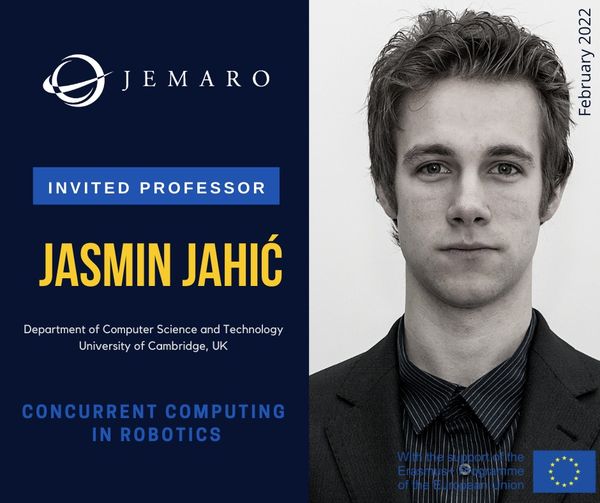
Jasmin Jahic is a Researcher at the Computer Architecture Group of the University of Cambridge, working under Timothy M. Jones. She holds a PhD in 'Supervised Testing of Embedded Concurrent Software' from the University of Kaiserslautern (2020) and has extensive experience as a researcher and project manager at the Fraunhofer Institute for Experimental Software Engineering. Her research focuses on concurrency in embedded systems, software engineering, AI integration, and low-power systems. Education: PhD in Computer Science from the University of Kaiserslautern (2020). Prior roles include Project Manager at Fraunhofer IESE and Coordinator of the European Master Program in Software Engineering. Research Interests: Concurrent computing, embedded systems architecture, AI applications in software engineering, and low-power system design. She explores concurrency bugs, synchronization mechanisms, and software architecture evolution in the context of Industry 4.0 and autonomous systems. Professional Activities: Co-Organizer of SAMOS workshops (2018–2021), Reviewer for IEEE/ACM conferences, and contributor to European Strategic Research Agendas for embedded systems. Teaches courses on software architectures for embedded systems and supervises numerous graduate students. Key Contributions: Frameworks like BOSMI for multithreaded software testing, FERA for concurrency bug detection, and research on AI adoption in traditional embedded systems. Active in HiPEAC conferences and industry partnerships.
Alastair F. Donaldson is a Professor and Director of Research in the Department of Computing at Imperial College London, where he leads the FastPL research group. His academic career spans over a decade at Imperial, progressing from Lecturer (2011-2014) to Senior Lecturer (2014-2017), Reader (2017-2020), and Professor (2020-present). He has also held significant industry positions, including Founder and Director of GraphicsFuzz Ltd. (acquired by Google in 2018), Senior Software Engineer at Google (2018-2021), and Visiting Researcher at both Google and Microsoft Research Redmond. Donaldson earned his PhD from the University of Glasgow under Alice Miller, following a BSc (hons, First Class) in Computing Science and Mathematics. His postdoctoral work included an EPSRC Postdoctoral Research Fellowship at the University of Oxford and a Research Fellowship at Wolfson College Oxford. His research focuses on formal analysis, software testing and programming languages techniques for improving software reliability, with special emphasis on high-performance systems. Donaldson's work bridges theoretical foundations with practical applications, particularly in compiler testing, GPU programming verification, and metamorphic testing. His research has significantly influenced both academia and industry, as evidenced by the acquisition of his startup GraphicsFuzz by Google. Analysis of his recent publications reveals a strong focus on fuzz testing techniques applied across diverse domains including compilers, GPUs, cryptographic protocols, and large language models. His work consistently combines formal methods with practical testing approaches, addressing challenges in compiler correctness, memory models, and API verification across multiple platforms. 2017 BCS Roger Needham Award EPSRC Early Career Fellowship Best Paper Award, EuroSys 2024 Best Paper Award, MET 2021 Best Paper Award, IWOCL 2019 Best Paper Award, IISWC 2019 Best Paper Award, ICST 2016 ACM SIGSOFT Distinguished Paper Award, ISSTA 2023 ACM SIGSOFT Distinguished Paper Award, FSE 2017 ACM SIGPLAN Most Influential OOPSLA Paper Award, 2022 (for GPUVerify) As Director of Research in the Department of Computing, Donaldson oversees research strategy and development. His FastPL research group investigates novel techniques for programming, testing and reasoning about high performance systems. He has served on numerous program committees and held leadership roles including PLDI Steering Committee Chair (2022-2025) and PACM-PL Advisory Board member. His industry engagement includes testifying as an Expert Witness in the IBM UK Ltd v LzLabs GmbH & Ors case. The FastPL research group, which Donaldson leads, focuses on formal analysis, software testing and programming languages. The group has made significant contributions to compiler testing, GPU verification, and metamorphic testing techniques, with practical impact demonstrated by the acquisition of GraphicsFuzz. Current research directions include fuzzing for zero-knowledge proof circuits, randomized testing of decompilers, and systematic testing of large language models for code generation.