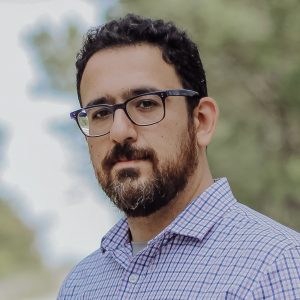
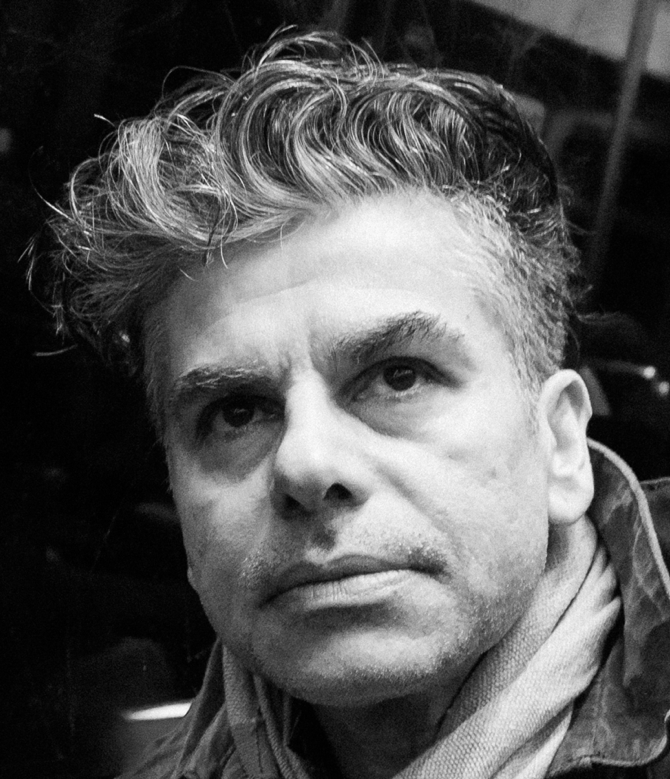
Ali Karjoo-Ravary is the Richard W. Bulliet Assistant Professor of Islamic History at Columbia University, specializing in the intellectual, social, and visual histories of premodern Islam through Arabic, Persian, and Turkic sources. His research intersects historical writing, cosmology, Sufism, and multilingual poetry in the Islamic East (Mashriq). Education: Ph.D., University of Pennsylvania (2018) M.A., University of Pennsylvania (2016) B.A., SUNY Stony Brook (2011) His current book project, Muhammad’s Song: Politics, Performance, and Cosmology in the Fourteenth Century , examines post-Mongol Islamic monarchy through Kadi Burhaneddin's life and rule. He also explores Sufi visual iconography, science fiction's relationship to religion, and architecture's role in evolving Islamic discourses. Scientific Awards and Fellowships: Bard Graduate Center Visiting Fellow (Fall 2020) Wolf Humanities Center Graduate Research Fellow (2016-2017)
Frank Griffel is the Louis M. Rabinowitz Professor of Religious Studies at Yale University, where he has been teaching since 2000. His academic work is deeply rooted in Islamic intellectual history, focusing on theology, philosophy, and the interplay between reason and revelation. He holds a PhD from the Freie Universität Berlin and previously worked as a research fellow at the Orient Institute in Beirut. University: Yale University Department: Department of Religious Studies Academic Rank: Professor His research expertise lies in classical and post-classical Islamic philosophy, particularly the works of al-Ghazālī, Fakhr al-Dīn al-Rāzī, Avicenna, and Averroes. He has made significant contributions to understanding how philosophical discourse evolved in the Islamic world after the so-called classical period, challenging the notion of decline and highlighting the emergence of new genres such as ḥikma . His scholarship bridges theology and philosophy, examining how Muslim thinkers reconciled Aristotelian and Neoplatonic ideas with Islamic doctrine. Griffel’s most recent major work, The Formation of Post-Classical Philosophy in Islam (2021), redefines the field by demonstrating the continuity and innovation in 12th-century Islamic thought. His earlier book, Al-Ghazali’s Philosophical Theology (2009), is widely regarded as a seminal study. He has also published extensively on topics such as apostasy, virtue ethics, and the reception of philosophical texts, with articles spanning from 2011 to 2025. His work often appears in major academic handbooks and journals, and he has edited and translated key texts into German, Arabic, and Turkish. Islamic Philosophy Islamic Theology (Kalām) Post-Classical Islamic Thought Al-Ghazālī Studies Fakhr al-Dīn al-Rāzī Avicenna and Averroes Griffel has contributed to collaborative volumes such as Shari’a: Islamic Law in the Contemporary Context and Islam and Rationality , and his research engages with both historical and contemporary debates in Islamic thought. He has no listed scientific awards or students in the provided texts, but his influence is evident through citations and scholarly engagement. He maintains an active research profile, with recent publications addressing ambiguity, contradiction, and the popularization of philosophy in medieval Islam. He has held affiliations with the University of Oxford as a Faculty Member in the Faculty of Theology and Religion, indicating a strong international academic presence. His work continues to shape the understanding of Islamic intellectual history, particularly in the West.
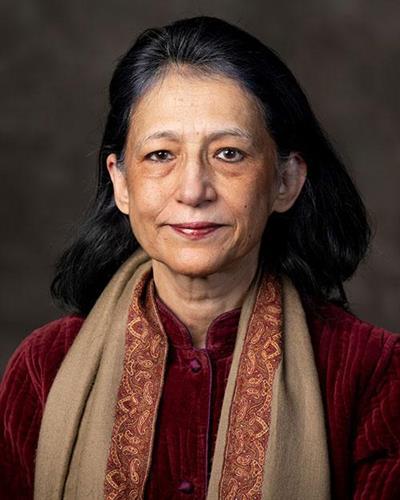
Ayesha Jalal is a distinguished Professor of History at Tufts University's School of Arts and Sciences and holds a joint appointment at The Fletcher School of Law and Diplomacy. She currently serves as the Mary Richardson Professor and directs the Center for South Asian and Indian Ocean Studies. With a career spanning over three decades, Professor Jalal has established herself as a leading scholar in South Asian history, particularly focusing on Pakistan studies, the partition of India, and Muslim political thought in the region. Professor Jalal's academic journey began with a double major in History and Political Science from Wellesley College in 1978. She then pursued doctoral studies at the University of Cambridge, earning her PhD in History in 1983. Her early career included prestigious fellowships at Trinity College, Cambridge (1980-84), the Centre of South Asian Studies (1984-87), the Woodrow Wilson Center for International Scholars (1985-86), and the Harvard Academy for International and Area Studies (1988-90). Professor Jalal's research primarily centers on South Asian history with special emphasis on Pakistan, the partition of India, and Muslim political thought. Her work explores the complex interplay between religious identity, nationalism, and state formation in the region. She has made significant contributions to understanding democratic development in Pakistan, sectarian dynamics in South Asia, and the historical connections between the Indian subcontinent and the wider Indian Ocean world. Her recent scholarship has focused on 'Oceanic Islam,' examining transregional Muslim networks and universalist aspirations that transcended colonial boundaries. Professor Jalal's extensive publication record demonstrates a consistent focus on South Asian political history, with particular attention to Pakistan's formation and development. Her recent works show a progression from studies of partition and state formation toward broader examinations of Muslim intellectual history and transregional connections. The 2020-2024 publications reveal a sophisticated engagement with themes of democratic erosion, sectarianism, and the historical roots of contemporary political challenges in South Asia, while also exploring more cultural and religious dimensions through works on Muslim enlightened thought and oceanic connections. Patrus Bukhari Award for the best English language book, The Pity of Partition , Academy of Letters, Government of Pakistan (2015) Britannica Book of the Year recognition (2015) MacArthur Fellowship (1998-2003) As an educator, Professor Jalal has mentored numerous graduate students through thesis supervision and directed research projects. Her teaching portfolio includes courses on Modern South Asia, Contemporary South Asia, Islam and the West, and specialized seminars on South Asian history. She has taught at several prestigious institutions including the University of Wisconsin-Madison, Columbia University, and Harvard University before joining Tufts in 1999. In her role as Director of the Center for South Asian and Indian Ocean Studies, she has fostered interdisciplinary research and provided guidance to emerging scholars in the field. Professor Jalal directs the Center for South Asian and Indian Ocean Studies at Tufts University, which serves as a hub for interdisciplinary research on South Asia and its connections to the wider Indian Ocean world. The center facilitates collaborative projects, hosts visiting scholars, and organizes events that bridge historical, political, and cultural perspectives on the region. Under her leadership, the center has become a prominent institution for South Asian studies, promoting dialogue between academic research and contemporary policy issues.
Noah D. Gardiner serves as Associate Professor and Director of Undergraduate Studies in the Department of Religious Studies at the University of South Carolina's College of Arts and Sciences. His academic journey includes a Ph.D. in Near Eastern Studies from the University of Michigan (2014), followed by positions as Lecturer in Islamic Studies at Michigan and a postdoctoral fellowship at Annemarie Schimmel Kolleg, Rheinische Friedrich-Wilhelms Universität Bonn. Gardiner's scholarly focus centers on Islamic thought and culture with particular emphasis on Sufism, esotericism, occult sciences, and manuscript culture in the 12th-15th century Arabic-speaking Mediterranean. His research explores the 'science of letters and names' (ʿilm al-huruf wa-al-asmaʾ), religious cosmology, and apocalypticism, examining how mystical ideas move between religious margins and centers. His work reveals significant connections between Islamic occult traditions and other esoteric systems like Jewish Kabbalah. His extensive publication record includes the monograph Ibn Khaldūn versus the Occultists at Barqūq's Court (2020), co-editing the special issue Islamicate Occultism: New Perspectives (2017), and numerous articles in leading journals. His current research focuses on the 13th-century Sufi occultist Aḥmad al-Būnī and the broader occult renaissance in 14th-15th century Cairo. Gardiner actively contributes to the scholarly community through his role as co-organizer of the international online workshop 'Islamic Occult Studies on the Rise' and administrator of the scholarly resource site islamicoccult.org, which showcases emerging scholarship in Islamic esotericism. He teaches courses spanning foundational religion studies to specialized topics including Islam, Qur'an, Hadith, Islamic Theology, Sufism, and Religion and the Fantastic.
Nicholas Boylston is an Assistant Professor of Near Eastern Languages and Civilizations at Harvard University's Faculty of Arts and Sciences (FAS). His research focuses on classical Persian literature and Persianate Islam, exploring themes of diversity and unity in Sufi, philosophical, and literary works. He holds a BA from Harvard College, MA from the University of Tehran, and PhD from Georgetown University (2017). Previously, he served as a College Fellow/Lecturer at Harvard (2018-21) and Assistant Professor at Seattle University (2021-23). His scholarship examines interactions between Twelver Shiʿism and Sufism in Quranic commentaries, as well as perspectivist thought in classical Persian literature. Current projects include a book on pluralistic modes of thought in Persian literature's formative phase. Education: B.A., Harvard College M.A., University of Tehran Ph.D., Georgetown University (2017) Publications emphasize Quranic exegesis, Sufi philosophy, and medieval Persian intellectual history. His work bridges theological debates, literary analysis, and historical contextualization.
Dr. Cyril Uy II is an Assistant Professor of Religion at James Madison University since 2021. He holds a Ph.D. from Brown University, an M.A. from Stanford University, an M.Phil. from the University of Cambridge, and a B.A. from Yale University. His research focuses on medieval Sufism, Islamic philosophy, and the intersections of knowledge, identity, and embodiment. He explores how Muslim thinkers navigated authority and exclusion in knowledge production, with a specialization in Mongol-era Sufi figures like Saʿd al-Dīn Ḥamūya. His work bridges historical texts with contemporary theories of identity and social dynamics. His award-winning dissertation led to his first book, Lost in a Sea of Letters (Brill, 2025), analyzing Ḥamūya’s deconstructive ethos and its implications for pluralism. His current project employs jazz improvisation as a framework to study Sufi intellectual and social practices. Dr. Uy teaches courses on mysticism, science-religion intersections, gender/sexuality, and music in religious experience, emphasizing student engagement with personal and academic perspectives. Before JMU, he was the inaugural Mellon Teaching Fellow in Global Islamic Studies at Connecticut College. His scholarly contributions include co-editing On God and the World (Oxford UP, 2019), a critical edition and translation of medieval Islamic texts. He actively bridges historical scholarship with contemporary interdisciplinary dialogue.
Professor Ahmet T. Karamustafa serves as Professor and Department Chair of History at the University of Maryland, College Park, and holds affiliations with the Roshan Institute for Persian Studies and the School of Languages, Literatures, and Cultures. He also serves as Senior Advisor to PersDig@UMD. His research focuses on medieval and early modern Islamic intellectual history, Sufism, and Ottoman Turkish religious texts. Key works include Sufism: The Formative Period (2007) and God’s Unruly Friends (1994), exploring ascetic movements and mystical literature. Current projects include The Flowering of Sufism and Vernacular Islam . His academic contributions span editorial roles in major publications like Cartography in the Traditional Islamic and South Asian Societies (1992). Research expertise bridges religious studies theory, Ottoman manuscript analysis, and medieval Anatolian religious dynamics. Administrative experience includes directing Washington University's Religious Studies Program and co-chairing the American Academy of Religion’s Study of Islam Section (2008–2011). Research interests emphasize comparative religious frameworks, Sufi textual traditions, and the interplay between Islamic intellectual history and regional cultural contexts. His work critically engages Western models of religion through Islamic conceptual frameworks like 'din,' offering new methodologies for studying premodern Muslim thought.
University of California , Santa Barbara (UCSB)United States
Adam Sabra is a Professor and King Abdul Aziz Ibn Saud Chair in Islamic Studies at the University of California, Santa Barbara (UCSB). He holds a Ph.D. from Princeton University (1998). His research focuses on pre-modern Middle Eastern history, particularly Egypt, with emphasis on medieval and early modern periods. Key areas include social/cultural history of Cairo, poverty/charity systems, legal history, and Islamic mysticism. Education: Ph.D. in History, Princeton University, 1998 Research Interests: Medieval Egyptian urban society and economy Sufi orders and spiritual lineages Legal and charitable institutions under Mamluk and Ottoman rule Families and social mobility in early modern Egypt Recent Scholarship Trends: Recent work examines aristocratic families in Ottoman Egypt (1500–1800) and integrates hagiography into social history analysis. His publications span topics like waqf systems, artisan-scholar networks, and gender dynamics in Sufi literature. Scientific Awards & Activities: Cleveland Bayard Dodge Distinguished Visiting Professorship at AUC (2014–15) Member, Institute for Advanced Study, Princeton (2012–13) National Endowment for the Humanities Fellow Advising & Grants: Advises graduate students Nicholas Liu and Ibrahim Mansour. His research has been supported by fellowships from NEH and the American Research Center in Egypt. Labs/Teams: Collaborates with scholars in Islamic studies through edited volumes and international research networks.
Dina Le Gall serves as Associate Professor of History at the Graduate Center, City University of New York (CUNY), and concurrently holds the position of Deputy Director and Associate Professor of Middle Eastern Studies at the Middle East and Middle Eastern American Center (MEEMAC). Her research specializes in Middle Eastern and Islamic History with concentrated expertise in Sufism, Ottoman religious dynamics, and the socio-cultural roles of saints in Muslim societies. She has pioneered extensive scholarship on Naqshbandi Sufi brotherhoods within the Ottoman Empire, examining their institutional evolution and spiritual practices from the 15th through 17th centuries. Her publication trajectory reveals deep engagement with pre-modern Islamic mysticism, intra-Sufi theological conflicts, and the adaptation of religious traditions across historical contexts. This scholarly focus bridges rigorous historical analysis with contemporary discourse on religious identity and community formation in Muslim-majority regions. Dr. Le Gall's research excellence has been recognized through prestigious accolades: Annemarie Schimmel Scholarship from the Institute of Ismaili Studies (2011) National Endowment for the Humanities Faculty Research Award (2009/10) Lehman College Faculty Development Award and Scholar Incentive Award (2009/10) Multiple PSC-CUNY Research Awards As Deputy Director of MEEMAC, she advances interdisciplinary Middle Eastern studies through academic programming and research initiatives. Professional service includes editorial advisory roles for the Journal of Sufi Studies and committee positions with the American Research Institute in Turkey and Middle East Studies Association. No graduate student advising details or specific grant projects beyond the listed awards appear in the source materials.
Ali Anooshahr is a Professor in the History Department at the University of California, Davis, specializing in early modern Persianate and Mughal Indian history. He holds a Ph.D. from UCLA (2005) and has held academic positions at Saint Xavier University (2007-2008) before joining UC Davis. His research focuses on empires, Indo-Persian culture, historiography, slavery, and economic history, supported by fellowships from the Guggenheim, Mellon, and Hellman Foundations. Education: Ph.D., History, UCLA, 2005 M.A., History, UCLA, 2002 B.A., Humanities, University of Texas at Austin, 1998 Research interests include the political, cultural, and economic dynamics of early modern empires, particularly Mughal India and the Persianate world. He has authored influential works such as Slavery in the Early Mughal World (2025) and Turkestan and the Rise of Eurasian Empires (2018). His articles explore topics like the Arghun state in Qandahar, Safavid campaigns, and the role of elephants in imperial symbolism. Awards and recognitions include the Guggenheim Fellowship (2021), UC Davis Hellman Fellowship (2009-10), and CLIR/Mellon Postdoctoral Fellowship (2005-6). He serves on the editorial board of the Journal of the Economic and Social History of the Orient . Teaching focuses on medieval and Mughal India, Safavid Iran, and Islamic history. His interdisciplinary work bridges economic, social, and cultural approaches to early modern empires, with a particular emphasis on Persianate manuscripts and historiography.
Thibaut d’Hubert is an Associate Professor at the University of Chicago in the Department of South Asian Languages & Civilizations . His research focuses on Middle Bengali poetry and Indo-Persian literature , with an emphasis on textual criticism, literary hermeneutics, and multilingualism in premodern South and Southeast Asia. Specializes in Bengali-Persianate literary interactions Co-organizer of Middle Bengali language/literature retreats Recipient of Zukunftsphilologie fellowship (2013-14) His monograph In the Shade of the Golden Palace (2018) examines Middle Bengali poet Ālāol’s translation practices, while Meaningful Rituals (2022) explores Persian-Arabic-Bengali multilingualism through the Nūrnāma tradition. Current projects include critical editions of Ālāol’s epic Saẏphulmuluk Badiujjāmāl (supported by NEH grant) and annotated translations of Persian ghazals. Supervises students in premodern South Asian literature Teaches courses on Bengali/Sanskrit/Persian literatures Works on musicology and text performance His research interests span: Perso-Arabic poetics in Bengal History of literary multilingualism Sufi and Gauḍīẏa Vaiṣṇava literature Cultural interactions between South/Southeast Asia Traditional philology and scribal practices Didactic/ritual uses of Persian texts in rural Bengal Key scientific awards : Zukunftsphilologie fellowship (2013-14) NEH Scholarly Editions and Translations grant
Professor Muhammad Qasim Zaman is the Robert H. Niehaus '77 Professor of Near Eastern Studies and Religion at Princeton University. He joined the Department in 2006 and holds dual appointments in Near Eastern Studies and Religion. His work focuses on the interplay between religious and political institutions in Islamic history, medieval and modern legal thought, and transnational intellectual networks between South Asia and the Arab Middle East. Key research areas include the evolution of religious authority in contemporary Islam, the socio-legal dimensions of South Asian Islam, and the historical trajectory of Islamic educational institutions. He has authored seminal works such as Islam in Pakistan: A History (2018), Modern Islamic Thought in a Radical Age (2012), and Religion and Politics under the Early Abbasids (1997). He is also an editor of influential volumes like Schooling Islam (2007) and Princeton Readings in Islamist Thought (2009). His current project explores South Asia’s engagement with the broader Muslim world during the 18th and 19th centuries. While no specific grants or awards are listed, his scholarship has shaped academic discourse on Islamic modernity and tradition. Advising and mentorship details are not explicitly provided in the text.
Fatemeh Keshavarz is a Professor and Department Head at the University of Maryland, serving as Program Chair of the Roshan Institute for Persian Studies and Senior Advisor to PersDig@UMD. She holds dual affiliations with the School of Languages, Literatures, and Cultures and the Roshan Institute. Her academic journey includes studies at Shiraz University and the University of London, followed by a 20-year tenure at Washington University in St. Louis where she chaired the Asian and Near Eastern Languages and Literatures Department. Her research focuses on Persian literature, Sufi traditions, and cultural education. Notable works include Reading Mystical Lyric (1998), Recite in the Name of the Red Rose (2006), and Jasmine and Stars (2007). Keshavarz’s interdisciplinary approach bridges literature, religion, and social justice, reflected in her Peabody Award-winning NPR series on Rumi and her advocacy at the UN General Assembly. Her awards include the Herschel Walker Peace and Justice Award (2008) and the Peabody Award (2008). Keshavarz is also a poet and activist, emphasizing peacebuilding through cultural dialogue. Her roles as institute director and department head underscore her leadership in advancing Persian studies and fostering academic innovation. Her scholarship spans medieval Sufi poetry, diasporic Iranian literature, and the intersection of spirituality with modern Iranian identity. Ongoing projects include exploring Saʿdi’s ethical cosmopolitanism and the role of Persian poetry in global cultural discourse.
Jamal J. Elias serves as the Walter H. Annenberg Professor of the Humanities and Professor of Religious Studies at the University of Pennsylvania, where he teaches courses on Islamic intellectual history and culture with a focus on Western and South Asia. He was also a Wolf Humanities Center Penn Faculty Fellow during the 2019-2020 academic year, contributing to the Forum on Kinship. His research spans Islamic intellectual history, visual culture, and Sufism, with particular attention to the intersections of material culture, emotion, and identity in Islamic societies of Western and South Asia. Elias's work often examines historical and contemporary expressions of Islamic art, religious practice, and the construction of spiritual authority, as evidenced by his extensive publications on topics ranging from childhood in Islam to truck art in Pakistan. An analysis of Elias's recent publications reveals a trajectory deeply engaged with the sensory and material dimensions of Islamic life. His books consistently explore how visual and material culture shape religious experience and identity, moving from the study of individual artifacts (like Aisha's cushion) to broader cultural phenomena (such as truck art), and delving into the historical foundations of Sufi orders. This body of work underscores a commitment to understanding Islam through its diverse cultural expressions across time and space. His notable recognition includes: Wolf Humanities Center Penn Faculty Fellow (2019-2020) While the source text does not detail specific grants or advising activities, Elias's role as a full professor at a major research university implies significant mentorship of graduate students and potential involvement in funded research projects, though explicit information is absent from the provided material. No information regarding laboratory or team affiliations was provided in the source text.
Carolyn G. Baugh serves as Associate Professor of History and Director of the Gender Studies Program at Gannon University, where she teaches Middle Eastern history, Islamic civilization, Arabic language, and African American history. Her interdisciplinary work bridges historical scholarship with contemporary human rights advocacy through the Refugee Oral History Program she directs. Education: Ph.D. in History, University of Pennsylvania, 2011 M.A. in History, University of Pennsylvania, 2008 A.B. summa cum laude in History, Duke University, 1995 Her research centers on Islamic jurisprudence with groundbreaking work on child marriage in early Islamic legal texts, culminating in her 2017 monograph Minor Marriage in Early Islamic Law . She actively explores intersections of gender, law, and human rights across historical and modern contexts, recently expanding to statelessness and human trafficking through community-engaged oral history projects with Erie's refugee populations. Professor Baugh's publication trajectory reveals a consistent focus on gender within Islamic legal tradition, evolving from classical jurisprudence toward applied human rights research. Her current work integrates academic scholarship with community service through the Refugee Oral History Program, training students in oral history methodologies while documenting refugee experiences to foster cross-cultural understanding in Erie. She mentors students through hands-on research in the Refugee Oral History Program, serves on Gannon's Liberal Studies Committee, and contributes to community initiatives as a board member of the Multicultural Community Resource Center. Her teaching extends beyond campus through planned educational trips to Cairo and past excursions to the National Museum of African American History and Culture.