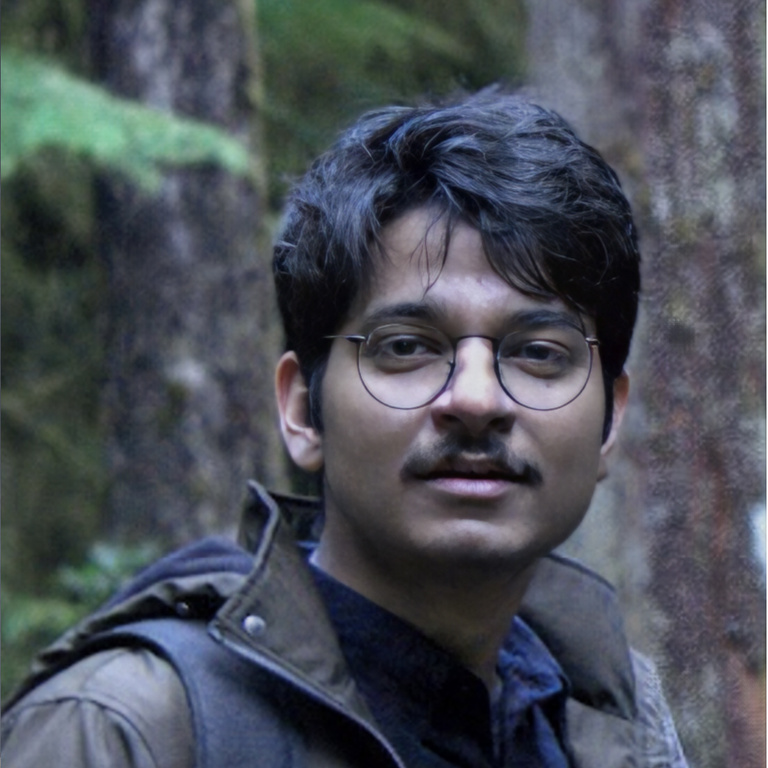
Nima Anari is an Assistant Professor of Computer Science at Stanford University and member of the Theory Group. He holds a Ph.D. in Computer Science from UC Berkeley (2015) and dual B.Sc. degrees in Computer Engineering and Mathematics from Sharif University of Technology (2010). His research focuses on theoretical computer science with emphasis on sampling algorithms, Markov chains, and combinatorial optimization. Research explores parallel sampling methods, log-concave polynomials, high-dimensional expanders, and applications in machine learning. Recent publications develop efficient algorithms for determinantal point processes, diffusion models, and optimization on discrete domains. Honors include the Michael and Sheila Held Prize (2025), Frontiers of Science Award (2023), Sloan Research Fellowship (2021), NSF CAREER Award (2021), and Best Paper Award at STOC 2019. He mentors 13 graduate and undergraduate students in theoretical computer science.
Tianyi Zhang is a Researcher at the Professorship for Theoretical Computer Science, ETH Zurich, located at OAT Z 29, Andreasstrasse 5. His research focuses on advancing fundamental algorithms in graph theory, with particular expertise in dynamic graph problems, efficient spanner constructions, edge coloring optimizations, and shortest-path computations. Dr. Zhang develops both theoretical frameworks and practical implementations for complex computational challenges. His core research areas include the design of near-linear and subquadratic time algorithms for graph optimization problems, fault-tolerant network structures, streaming-optimized graph coloring, and geometric graph embeddings. Recent work emphasizes breakthroughs in Vizing's theorem implementations, dynamic set cover deamortization, and space-efficient distance oracles. Dr. Zhang's publications demonstrate consistent innovation in algorithm efficiency for planar graphs, Euclidean spaces, and dynamic network settings. His 2023-2025 articles reveal concentrated efforts on: 1) Optimizing edge coloring through multi-step Vizing chains and streaming adaptations, 2) Enhancing spanner constructions for doubling metrics and planar environments, and 3) Developing failure-resistant path algorithms with improved time/space complexity. These contributions address scalability challenges in large-scale network processing. He collaborates within the Theoretical Computer Science research group at ETH Zurich, contributing to the institution's leadership in algorithmic innovation. No information about awarded grants, supervised students, or educational background is available in the source materials.
Roles and Affiliations: Professor of Computer Science at Indiana University Bloomington, Adjunct Professor in Mathematics. Previously at IBM Almaden Research Center and Aarhus University's Center for Massive Data Algorithmics. PhD from HKUST in Computer Science and Engineering. Education: PhD in Computer Science, HKUST, advised by Mordecai Golin and Ke Yi Research Interests: Focuses on algorithms for big data, including communication-efficient distributed computation, streaming/sketching algorithms, and quantum data management. Explores theoretical foundations of machine learning, particularly distributed learning. Leads projects funded by NSF grants on parallel reinforcement learning, distributed graph algorithms, and noisy data processing. Publications and Awards: Over 100 papers in top venues like FOCS, SIGMOD, and NeurIPS. Won the Best Paper Award at SPAA 2017 for distributed clustering work. Invited to special journal issues for top conferences. Teaching and Grants: Teaches advanced courses on sublinear algorithms and algorithm design. PI on NSF grants totaling over $2M, including collaborative projects on distributed computing and epidemiological modeling. Advises PhD students in areas like quantum algorithms and reinforcement learning. Service: Served on program committees for SIGMOD, NeurIPS, ICML, and PODS. Organizes theory seminars and Midwest Theory Day workshops.
Omri Ben-Eliezer is a Senior Lecturer (Assistant Professor) and Taub Fellow at the Faculty of Computer Science in the Technion — Israel Institute of Technology. He holds a PhD from Tel Aviv University (2020, supervised by Noga Alon), followed by postdoctoral positions at the Weizmann Institute (hosted by Moni Naor), Harvard University (mentored by Madhu Sudan), and a research fellowship at the Simons Institute. He also served as an instructor in applied mathematics at MIT. His research focuses on the theoretical and algorithmic foundations of big data, including sublinear-time algorithms, privacy in machine learning, beyond worst-case analysis, and complex networks. He has contributed to topics such as adversarial robustness, approximation algorithms, and knowledge representation. Ben-Eliezer's work spans algorithm design and analysis, with notable awards including the PODS 2020 Best Paper Award and the 2021 ACM SIGMOD Research Highlight Award. His publications appear in top venues like FOCS, SODA, and ITCS, and he frequently serves on program committees for conferences such as FOCS and PODS. He actively mentors students interested in algorithmic research bridging theory and practice and is affiliated with multiple academic institutions and collaborative projects.
Manolis Zampetakis is an Assistant Professor of Computer Science at Yale University. Previously, he was a postdoctoral researcher in the EECS Department at UC Berkeley working with Michael Jordan. He earned his Ph.D. and M.S. from the EECS Department at MIT, where he was advised by Constantinos Daskalakis. His undergraduate education was completed at the National Technical University of Athens (NTUA). His research interests span Theoretical Machine Learning, Statistics, Optimization, Computational Complexity, Game Theory, Mechanism Design, and Sublinear Algorithms. His work bridges theoretical computer science with practical applications in machine learning and economics. His research consistently appears in top-tier conferences such as STOC, FOCS, COLT, NeurIPS, and EC, with a strong focus on the theoretical foundations of machine learning and game theory. Zampetakis has received numerous prestigious awards including the ACM SIGEcom Doctoral Dissertation Award and the Google Ph.D. Fellowship. His publications from 2023-2025 demonstrate a consistent output of high-quality research across multiple domains, with a notable emphasis on bridging statistical theory with algorithmic approaches. His work shows increasing integration of robust statistics with mechanism design and game-theoretic approaches. ACM SIGEcom Doctoral Dissertation Award Google Ph.D. Fellowship Special Issue at SAGT 2015 Special Issue at WINE 2013 Second Prize in IMC 2012 Top 5 in Panhellenic Physics Competition 2008 Zampetakis actively advises multiple graduate students including Anay Mehrotra, Jane Lee, Vikram Kher, Katerina Mamali, Shuchen Li, and Nikolaos Koumpis. He has served on program committees and organized workshops including the Workshop on Algorithms for Learning and Economics (WALE 2019, WALE 2022). His research has been supported by grants from Google and likely other major funding agencies given his publication record in top venues. His research group focuses on theoretical aspects of machine learning with connections to statistics and game theory. He collaborates extensively with researchers across institutions including MIT, UC Berkeley, and Yale colleagues.
Hu Ding is a pre-tenure Professor in the School of Computer Science and Engineering at the University of Science and Technology of China (USTC), where he directs the Data Intelligence, Algorithms, and Geometry (DIAG) research group. He previously held positions as a tenure-track Assistant Professor at Michigan State University (2016-2018) and a Simons-Berkeley Research Fellow jointly at Tsinghua University and UC Berkeley (2015-2016). Education: • Ph.D. in Computer Science, State University of New York at Buffalo (2015) • B.S. in Mathematics, Sun Yat-Sen University (2009) Research Interests: Hu Ding's research focuses on developing efficient algorithms for geometric optimization problems with applications in machine learning, big data, and biomedical imaging. His work bridges theoretical computer science (especially computational geometry) with practical challenges in distributed systems, outlier detection, and high-dimensional data analysis. Key areas include constrained clustering, truth discovery in crowdsourced data, and geometric methods for biomedical image analysis. Publication Trends: His recent publications demonstrate a strong focus on scalable algorithms for high-dimensional geometric optimization, particularly in distributed environments with noisy data. A consistent theme is developing theoretically-grounded solutions with practical efficiency, evidenced by work on sublinear-time algorithms, coreset constructions, and approximation frameworks for problems like k-center clustering and SVM optimization with outliers. Awards and Honors: Young Investigator Award, Ministry of Science and Technology (2021) Simons-Berkeley Research Fellowship (2015-2016) CCF Committee Member for Theoretical CS and Big Data (2021) Grants and Projects: USTC Innovation Group Grant: 'Toward Electronic Design Automation: Theories and Algorithms from AI' (2021) MOST Young Investigator Grant: 'Optimal Transportation in Medical Imaging' (3M RMB, 2021) Research Group: Leads the DIAG group with focus on geometric algorithms for data intelligence. Current team includes 6 PhD students and 15 Master's students working on problems in clustering, distributed optimization, and biomedical applications. Former students hold positions at Alibaba, ByteDance, and academic institutions.
Sourya Roy is an Assistant Professor in the Department of Computer Science at the University of Iowa. Prior to his academic career, he worked as a Data Scientist at Foursquare. He earned his PhD in Computer Science from the University of California, Riverside in 2022, advised by Silas Richelson and Amey Bhangale. Education: PhD in Computer Science (University of California, Riverside, 2022) His research spans theoretical and applied domains, focusing on pseudorandomness, coding theory, and cryptography in theoretical computer science, while also contributing to computer vision and machine learning applications. Recent publications emphasize expander graph theory, coding algorithms, and spatio-temporal modeling. Dr. Roy is actively seeking PhD students to collaborate on theoretical computer science projects. His publications highlight expertise in pseudorandomness, expander graphs, and scalable unsupervised learning techniques. Key conferences include FOCS, ECCV, and IEEE Transactions on Information Theory.
Michel Ménard is a Teacher-Researcher at the University of La Rochelle, affiliated with the Mathematics and Computer Science departments. His research focuses on image and signal processing, particularly in cardiovascular imaging, dynamic texture analysis, and UWB radar applications for through-wall imaging. Key projects: ANR DIAMS, FISC consortium, A.Gaugue project Applications: Cardiovascular imaging, environmental monitoring, mobile application programming Research Interests Ménard's work centers on modeling information ambiguity, imprecision, and uncertainty in image analysis, pattern recognition, and information fusion. He has developed generalized fuzzy coalescence methods, non-parametric Bayesian approaches for trajectory analysis, and variational formulations for image filtering inspired by quantum physics. His team focuses on: Dynamic texture modeling via spatio-temporal decomposition Low-level image processing with information theory Through-wall imaging systems using UWB radar Information fusion techniques with minimal a priori assumptions Applications in coastal environment monitoring and biomedical imaging Publications Ménard's publications reflect his expertise in advanced image processing techniques applied to diverse domains. Notable contributions include: Theoretical works on total variation and sublinear functionals Algorithm developments for multistatic radar systems Applications in 3D bee tracking and cardiovascular flow analysis Extensions of Chambolle's algorithm to color images Decomposition methods for dynamic textures Integration of quantum physics concepts in image filtering Collaborations He collaborates with: Laboratoires: L3i, MIA, CLDG/BQR, IRPHE CNRS, ETIS, LASIE Institutions: University Hospitals of Poitiers and Angers, ONERA, LEAT, Tronico Researchers: Abdallah El-Hamidi, Alain Gaugue, Damien Coisne, Gilles Aubert Teaching Ménard teaches across eight departments/programs including: Electronics and Industrial Computing Automation Network Security and Cryptography Video Game Programming Smartphone Programming Digital Media Distribution He has developed new educational initiatives in mobile application programming since 2010.
Victor Lagerkvist is an Associate Professor at the Department of Computer Science (IDA) , Linköping University, Sweden. He is affiliated with the Theoretical Computer Science Laboratory (TCSLAB) and the Artificial Intelligence and Integrated Computing Systems (AIICS) division. His research focuses on the algebraic method for analyzing computational complexity , particularly in constraint satisfaction problems (CSPs), SAT, and graph homomorphism problems. PhD in Computer Science (2016, Linköping University) Habilitation (2020, Linköping University) His recent work investigates fine-grained complexity , twin-width , and universal algebra to improve algorithms for NP-hard problems. Publications span topics like propositional abduction, Allen's interval algebra, and semiring-based dynamic programming. His scientific awards include the Swedish Research Council Starting Grant (2020) and the 2017 Young Researcher Prize from the Ruth and Nils-Erik Stenbäck Foundation. He supervises PhD students such as Leif Eriksson and serves as a secondary supervisor for others at Linköping University and Université de Lorraine.