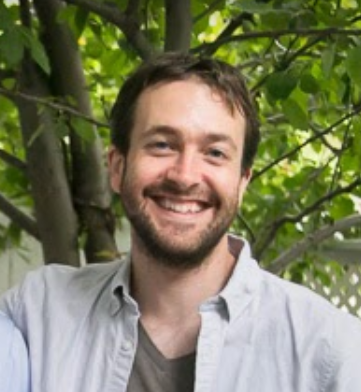
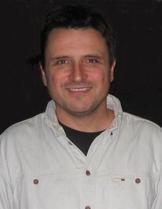
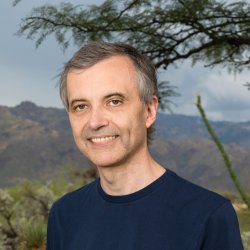
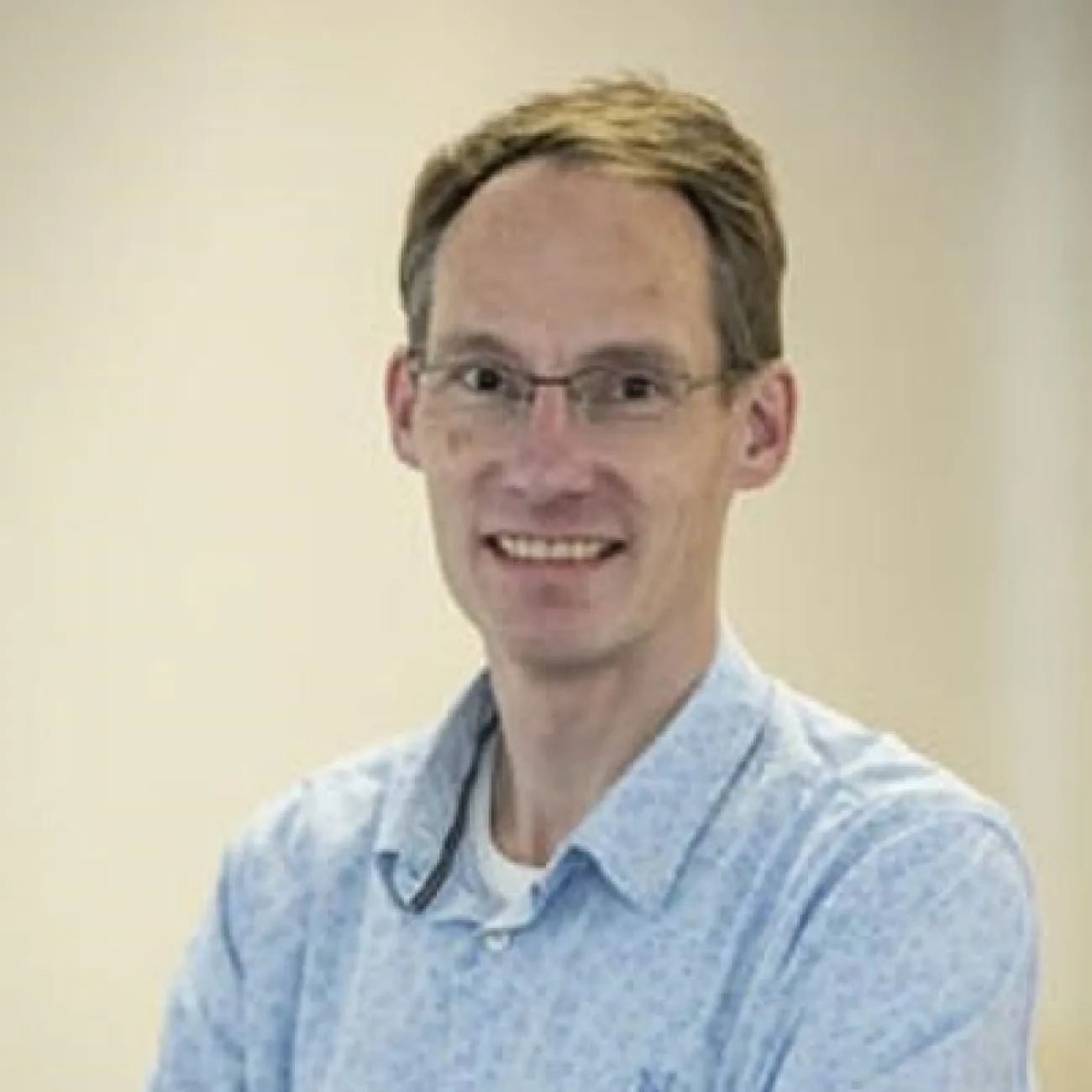
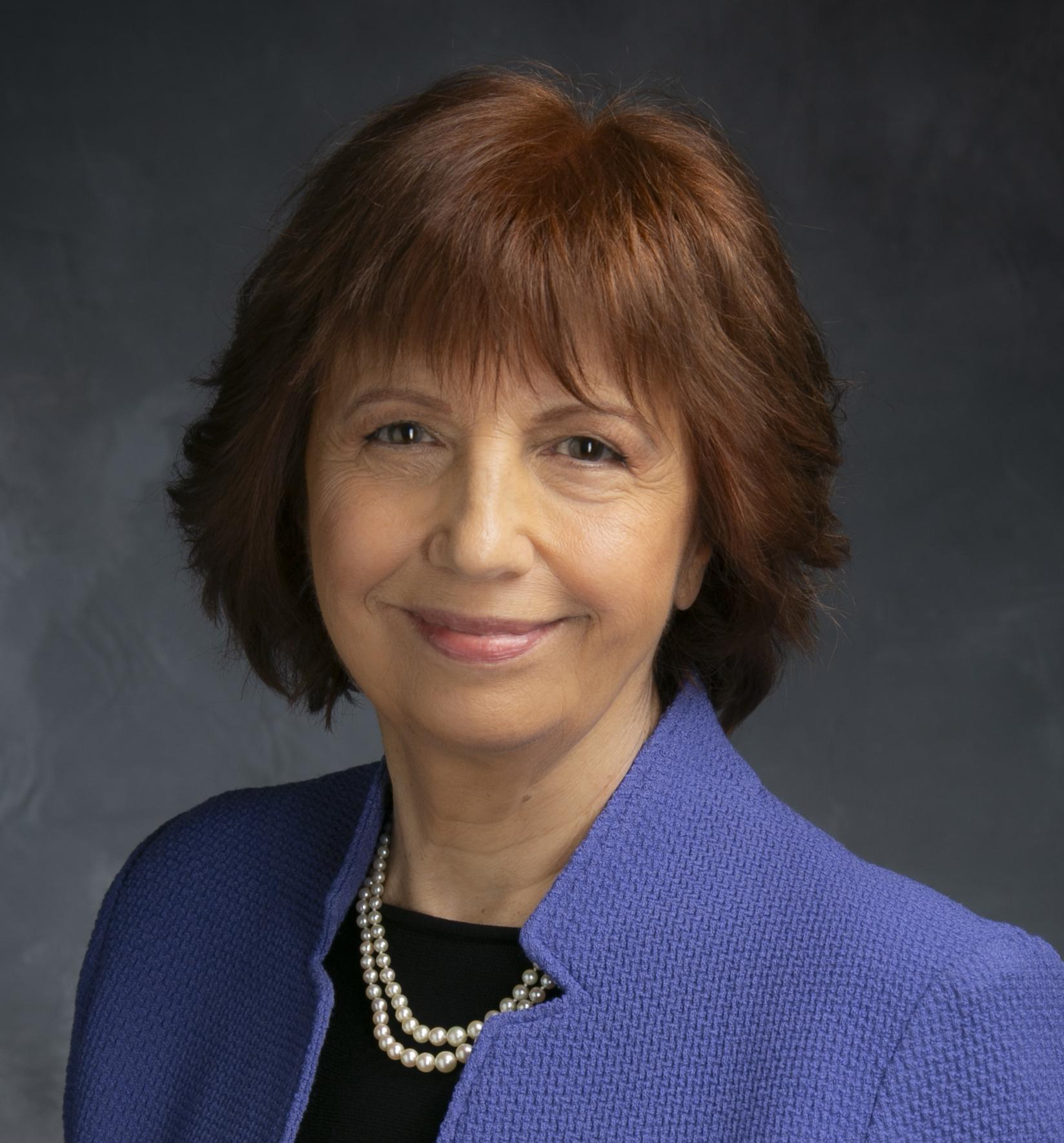
Adam Runions is a researcher in the Department of Computer Science at the University of Calgary, leading the MPG Partner Group in computational analysis of leaf development through collaborative work with Miltos Tsiantis. His group is embedded in the Graphics Cluster, focusing on interdisciplinary problems at the intersection of computer science and developmental biology. University of Calgary - Department of Computer Science MPG Partner Group (2022) Graphics Cluster affiliation His research explores computational modeling and analysis of plant form and development across multiple scales, integrating geometric modeling, physically-based simulation, and computer-aided design. Key themes include plant morphogenesis, self-organization of natural forms, and cross-disciplinary applications in computer graphics and animation. Recent publications emphasize plant development (leaf shape, bark patterning), mathematical modeling (auxin-driven patterning), and geometric techniques (subdivision surfaces, PUPs). Collaborations span institutions like the Max Planck Institute for Plant Breeding Research. Scientific Awards Marie Sklodowska-Curie Fellowship Best Paper Award (International Conference on Cyberworlds 2015) Best Student Paper Award (Computer Graphics International 2011) The group actively recruits BSc, MSc, and PhD students with backgrounds in computer science and mathematics for projects on plant form simulation and digital content creation. Research integrates evolutionary biology, biomechanical modeling, and computational techniques.
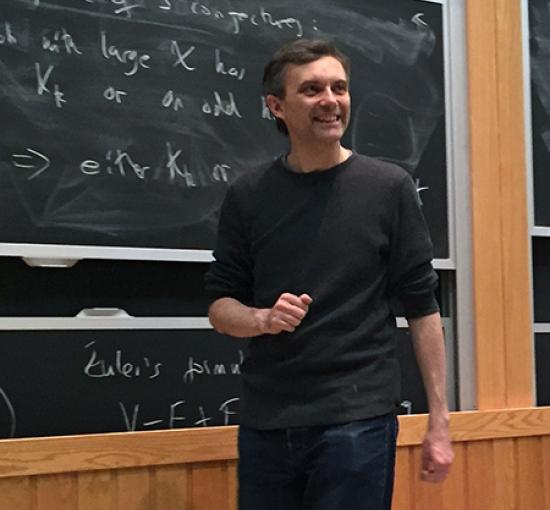
Professor Alexander Scott is a faculty member at the University of Oxford, holding positions as Professor of Mathematics and Dominic Welsh Tutor in Mathematics at Merton College. His research focuses on combinatorics, probability, algorithms, and graph theory, with a particular interest in the interplay between local and global structures in networks. He has organized the Oxford Combinatorics Seminar and co-founded the online Oxford Discrete Mathematics and Probability Seminar, fostering collaboration in these fields. Professor Scott’s work bridges theoretical foundations with applications in statistical physics and algorithmic design. He has supervised numerous graduate students in combinatorics and regularly teaches undergraduate courses in analysis and discrete mathematics. His contributions include advancements in extremal graph theory, probabilistic methods, and structural combinatorics, with over 150 publications in prestigious journals. He actively organizes academic events such as the annual One-Day Meeting in Combinatorics, hosting speakers from around the world. Despite the absence of explicit awards noted, his prolific research output and academic leadership reflect significant contributions to the field. His current interests continue to explore the Erdős-Hajnal conjecture, induced subgraph densities, and algorithmic challenges in combinatorial structures.
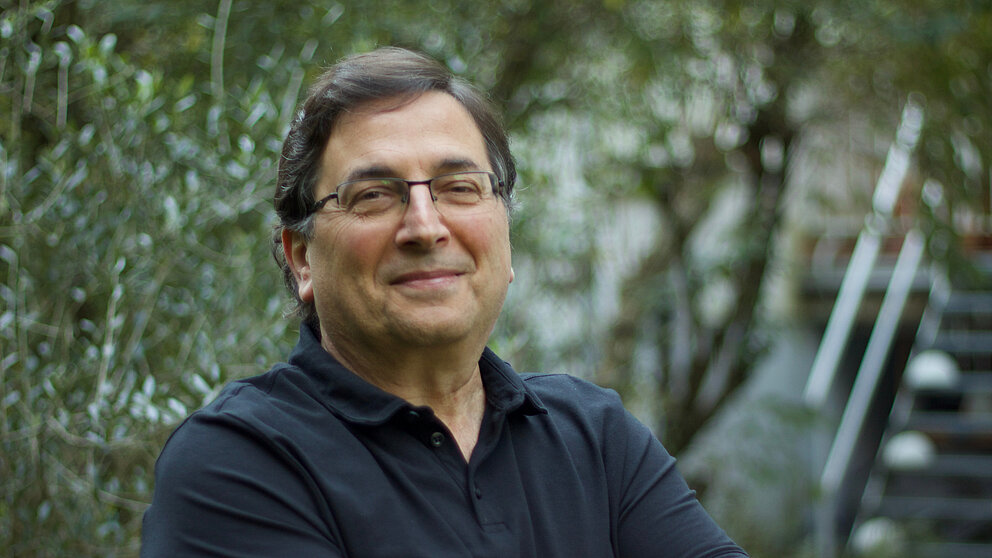
Peter Schroeder is the Shaler Arthur Hanisch Professor of Computer Science and Applied and Computational Mathematics at the California Institute of Technology (Caltech). He holds a B.S. from the Technical University of Berlin (1987), M.S. from MIT (1990), M.A. and Ph.D. from Princeton University (1992–1994). His academic roles at Caltech include Assistant Professor (1995–1998), Associate Professor (1998–2001), Professor (2001–2013), and Hanisch Professor since 2013. He served as Division Deputy Chair (2012–2015) and Acting Director of the Center for Advanced Computing Research (2013–2014). Schroeder’s research focuses on numerical algorithms for computer graphics, geometric modeling, and physical simulation. His work emphasizes Discrete Differential Geometry, rebuilding classical differential geometry for computational applications. Key areas include cloth deformation, fluid dynamics, and vortex simulations. Notable contributions include 'Schrödinger’s smoke' and fluid visualization techniques using Clebsch maps. His publications span ACM Transactions on Graphics and address topics like constrained Willmore surfaces, filament-based plasma models, and shape reconstruction from metrics. He has received the ACM Fellowship and Best Paper in Geometry Processing Award. His research often bridges computational mathematics with artistic and engineering challenges, such as simulating ink chandeliers and solar flares. Schroeder’s academic leadership includes co-founding the ACM SIGGRAPH Academy and mentoring students like James R. McLaughlin and Yanke Song, both recipients of the Henry Ford II Scholar Award.
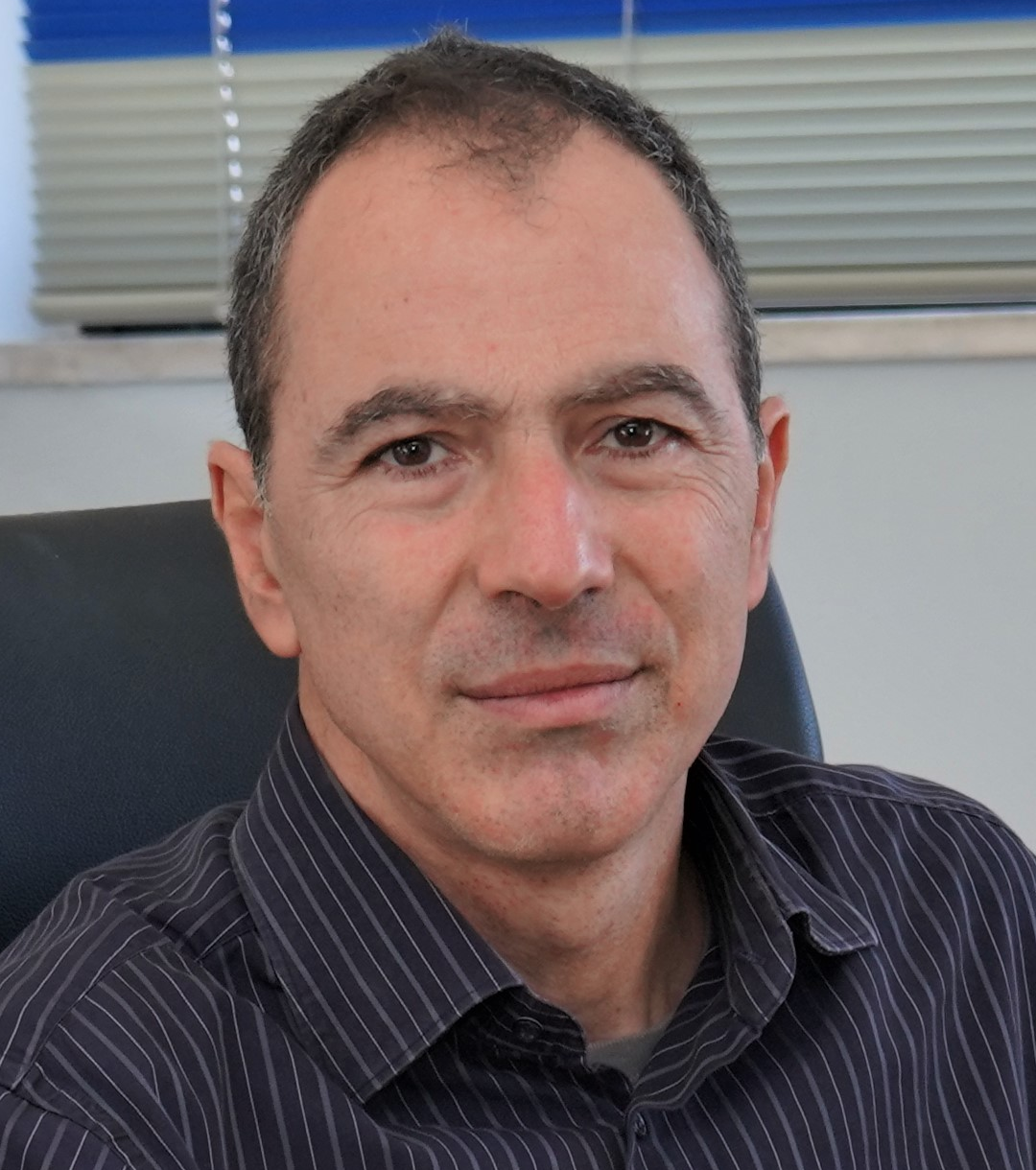
Johan Driesen is a full Professor at KU Leuven's Faculty of Engineering Sciences, where he serves as Department Head of Electrical Energy Systems and Applications (ELECTA) and Director of the KU Leuven Institute for Energy and Society (KIEM). He also holds leadership positions at EnergyVille as Division Head and Subdivision Head. His work spans both academic and applied research in electrical energy systems. His research interests focus on renewable energy integration, power electronics, electrical drives, electric vehicles, and smart grids. Driesen's work particularly emphasizes distributed generation of electricity, with significant contributions to floating photovoltaics, offshore wind integration, and low-voltage DC systems. His research group actively investigates the optimization of grid integration for renewable energy sources and the development of advanced power electronic converters. Driesen's recent publications reveal a strong emphasis on practical applications of renewable energy systems, with particular focus on reliability analysis of low-voltage DC systems, optimization of PV-battery systems, and integration of electric vehicles with renewable energy sources. His work bridges theoretical analysis with real-world implementation challenges. Laureate prize of the Belgian Royal Society of Electrotechnics (KBVE/SRBE) 'Research and Development' for master theses 1996 2nd place in final round IEEE Region 8 Student Paper Contest 1997 in München, Germany Laureate biannual prize 'R.Sinave' of the Belgian Royal Society of Electrotechnics (KBVE/SRBE) for best PhDs 2002 Driesen has supervised numerous students and researchers, including J. Despeghel who completed work on residential PV-battery system optimization. His current research portfolio includes substantial projects such as Flux50 (working on the future energy system), solar and wind energy in the Belgian marine zone, and smart charging solutions that integrate e-mobility with renewable energy. He serves as promoter or co-promoter on multiple major research initiatives with funding extending through 2028. At EnergyVille, Driesen leads research teams working on cutting-edge energy solutions, with particular focus on DC systems, grid integration challenges, and the development of innovative power electronic solutions for renewable energy applications. His work has significant industrial relevance and practical implementation potential.
Sepehr Hajebi is a Mathematics Instructor at Princeton University and a Postdoctoral Scholar at the University of Waterloo, where his position is funded by Sophie Spirkl. He completed his PhD in Combinatorics and Optimization at the University of Waterloo between 2020 and 2024 under the supervision of Sophie Spirkl. His research focuses on combinatorics and graph theory, particularly structural aspects such as induced subgraphs, graph minors, and algorithms. He also explores topology, number theory, and category theory. Education: PhD in Combinatorics and Optimization, University of Waterloo (2020–2024) Research Interests: His work delves into structural graph theory with applications to induced subgraphs, algorithmic problems, and graph minors. He investigates foundational questions in topology, number theory, and category theory, reflecting a commitment to interdisciplinary mathematical inquiry. Advising and Grants: His postdoctoral funding at Waterloo is provided by Sophie Spirkl, though no specific grants or advisees are detailed.
Hector Geffner is an Alexander von Humboldt Professor at RWTH Aachen University, leading the Chair of Machine Learning and Reasoning. He specializes in automated planning, machine learning, and reasoning, with a focus on representation learning for acting and planning. His work bridges symbolic and model-based AI, emphasizing general policies and subgoal decomposition. Education & Background : PhD from UCLA (1989), prior roles at IBM Watson Research Center and Universidad Simón Bolívar. Former ICREA researcher and professor at Universitat Pompeu Fabra (2001–2022). Research Interests : Classical and probabilistic planning, reinforcement learning, knowledge representation, and applications in robotics. His ERC-funded RLeap project explores learning generalized policies and symbolic representations for effective decision-making. Teaching : Courses include 'Actions and Planning in AI' and 'Social and Technological Change', emphasizing interdisciplinary AI applications. Awards & Recognition : Alexander von Humboldt Professorship (2023), AAAI/EurAI Fellowships, and editor of influential works on Judea Pearl’s contributions to AI. Grants & Projects : Advanced ERC grant (2020–2025), Humboldt Foundation support, and RWTH funding for research on planning and reasoning. Labs & Teams : Heads the Chair of Machine Learning and Reasoning at RWTH, focusing on interdisciplinary research in AI, robotics, and planning algorithms.
Ioannis Z. Emiris is a Professor in the Department of Informatics & Telecoms at the National & Kapodistrian University of Athens and concurrently serves as President and General Director of the ATHENA Research Center in Greece. He holds a BSc in Computer Science from Princeton University (1989) and a PhD in Computer Science from UC Berkeley (1994). His research spans computational geometry, algebraic algorithms, robotics, structural bioinformatics, and optimization. He is a leading expert in sparse elimination theory, geometric modeling, and algorithmic algebra. Affiliations: ATHENA Research Center, National & Kapodistrian University of Athens, INRIA Sophia Antipolis (France via joint AROMATH team). Education: BSc (Princeton), PhD (UC Berkeley). Research Interests Emiris's work focuses on geometric algorithms, algebraic systems, and their applications. His contributions include advancements in sparse elimination theory, computational geometry for high-dimensional data, and robotics. He has developed algorithms for polynomial system solving, Voronoi diagrams, and geometric predicates for ellipses. Articles Overview His recent work bridges theoretical advances with practical applications, such as deep learning for protein structure prediction (HydraProt) and geometric algorithms for high-dimensional data analysis. He explores intersections between algebraic geometry and computational methods, with applications ranging from robotics to bioinformatics. Scientific Awards Best Paper Award at ISSAC 2003 and 2010 MSCA Network GRAPES (2019-2023) Advising & Grants Emiris has supervised numerous students and researchers, contributing to interdisciplinary projects. He has secured grants for initiatives like the GRAPES network and has led teams in algorithm design and geometric software development. His work on MARS (Maple/Matlab/C Resultant-Based Solver) exemplifies his focus on practical algorithm implementation. Labs & Teams He directs the Lab of Geometric & Algebraic Algorithms and collaborates with the AROMATH team at INRIA. His research group develops open-source tools for computational geometry and algebraic computations.
Stefan Vandewalle is a full professor at the Department of Computer Science, Faculty of Engineering Sciences, KU Leuven. His research focuses on numerical analysis, applied mathematics, and computational methods for stochastic differential equations, wind energy modeling, and uncertainty quantification. Department Chair, KU Leuven Member, Subdivision Numerical Analysis and Applied Mathematics Member, iSi Health Institute Observer, Faculty Council of Sciences Chair, Department Council for Computer Science His recent work explores multiscale modeling, Monte Carlo methods, and data assimilation techniques. Projects include micro-macro Parareal algorithms, wind turbine aeroelasticity, and turbulent flow reconstruction for wind farms. He supervises PhD candidates and collaborates on interdisciplinary studies involving structural mechanics and renewable energy systems. Publications highlight advancements in parallel-in-time methods, stochastic optimization for tokamak reactors, and DNS-based control of turbulent flows. Key keywords: Multiscale numerical methods Uncertainty quantification Wind energy simulation Monte Carlo algorithms PDE-constrained optimization Stochastic differential equations He contributes to academic governance as a member of extended faculty boards and evaluation committees.
Jack Snoeyink is a Professor at the University of North Carolina at Chapel Hill, holding joint appointments in the Department of Computer Science (College of Arts & Sciences) and the School of Data Science and Society. His research focuses on computational geometry, with applications in molecular biology, geographic information systems (GIS), and geometric modeling. His work in computational geometry explores algorithmic design and analysis for problems in solid modeling, computer graphics, and robotics. Key application areas include terrain modeling in GIS, molecular structure validation in biochemistry, and computational topology. He has contributed to output-sensitive algorithms for convex hulls and Voronoi diagrams, and geometric search problems. Articles highlight his expertise in computational geometry, with trends spanning 1999-2000. Topics include contour tree algorithms (SODA'00), watershed extraction (ASPRS'99), and skeleton generation (Crust.pdf). His work bridges theoretical advancements with practical implementations in GIS and structural biology. Jack Snoeyink has collaborated with researchers like Marc van Kreveld, Christopher Gold, and Bettina Speckmann on projects related to Delaunay triangulation, regression depth computation, and geometric assembly problems. He previously served as a program director at the National Science Foundation's CISE division (2015-2018) and co-founded the TRIPODS program for data science foundations.
Tibor Szabó is a Professor in the Combinatorics and Graph Theory group at the Department of Mathematics, Freie Universität Berlin. He holds a PhD from The Ohio State University, advised by Ákos Seress. Prior to his current position, he held roles at McGill University, ETH Zürich, the Institute for Advanced Study (Princeton), and the University of Illinois (UIUC) as a J.L. Doob Research Assistant Professor. Research Interests: His work focuses on combinatorics and combinatorial optimization, including extremal problems, random structures and algorithms, pseudorandom graphs, positional games, and the combinatorics of linear programming. He explores tools from algebra, probability theory, and topology applied to combinatorics. Teaching: He teaches courses such as Algorithmic Combinatorics, Extremal Combinatorics, and runs the Combinatorics Seminar. His lecture notes include works on positional games and explicit constructions in extremal combinatorics. Students & Postdocs: Notable PhD advisees include Yamaan Attwa, Silas Rathke, Simona Boyadzhiyska, and Patrick Morris. Postdoctoral fellows include Olaf Parczyk and Anurag Bishnoi. His research has involved collaborations with over 50 co-authors. Funding & Grants: Supported by grants from the Swiss National Science Foundation (SNF) and German Research Foundation (DFG), focusing on topics like positional games and extremal graph theory.
Alex Scott is a Professor of Mathematics at the Mathematical Institute, University of Oxford, with active research contributions evidenced by publications through 2025. His work is centered within the university's Mathematical Institute, a key hub for theoretical mathematics research. Scott's research specializes in combinatorics, particularly graph theory and probabilistic methods. His investigations span structural graph theory, extremal combinatorics, and random graph models, addressing fundamental questions about graph minors, forbidden substructures, and combinatorial optimization. This focus reflects deep engagement with discrete mathematical structures and their theoretical applications. Analysis of his publication timeline (2014-2025) reveals consistent contributions to graph theory, with recent work emphasizing subdivisions, stable sets, and graph reconstruction algorithms. Earlier research examined Erdős-Hajnal properties, deviations in random graphs, and dimensional properties of posets, demonstrating both depth and evolution in his scholarly focus. No scientific awards were documented in the source material. The available information does not specify any advised students or research grants, though his extensive publication record suggests significant collaborative research activity. Scott is affiliated with the Combinatorics research group at Oxford's Mathematical Institute, contributing to one of the world's leading centers for discrete mathematics research through theoretical investigations and academic collaboration.
Tegoeh Tjahjowidodo is a Senior Lecturer at the Faculty of Industrial Engineering Sciences , KU Leuven , affiliated with the Department of Mechanical Engineering and the Manufacturing Processes and Systems (MaPS) unit at Campus De Nayer. He serves as Head of Education for Electromechanics programs and leads Subdivision 17 at the campus. Research Areas: Additive Manufacturing (Wire-Arc Additive Manufacturing), Process Monitoring, Control Systems, Laser Micromanufacturing, Wear Analysis, Robotics, and Condition Monitoring. Publication Trends: Focus on in-situ monitoring of laser micromanufacturing, machine learning for abrasive belt grinding, WAAM parameter optimization , and multi-sensor fusion for process control. Scientific Contributions: Co-promotor for MultiTRIBO (tribology), Promotor for WAAM structural integrity and pedicle screw surgical simulators . Active in international collaborations (e.g., 25th International Symposium on Laser Precision Microfabrication, Spain 2024).
Professor Stephen Theriault is a homotopy theorist at the University of Southampton since 2015. His research spans homotopy theory, Lie groups, gauge groups, and manifolds, with a focus on polyhedral products and toric topology. PhD and MSc from University of Toronto (1991-97) Postdoctoral Fellowships at MIT, University of Illinois at Chicago, and University of Virginia Previous roles at University of Aberdeen (2002-12) Research Interests include: Homotopy theory of spheres and Moore spaces Applications to Lie groups, gauge groups, and manifolds Polyhedral products and toric topology Current projects on loop space decompositions and homotopy types Publications emphasize homotopy classifications, geometric topology, and algebraic structures in distributed computing. Recent work explores Steenrod's problem , quasitoric manifolds , and open book decompositions . Teaching includes MATH1059 Calculus and supervision of BSc/MMath projects. PhD Supervision involves students like Briony Helen Eldridge and Lewis Richard Stanton.
Prof. Wim Desmet is a full professor at the Faculty of Engineering Science and head of the Department of Mechanical Engineering at KU Leuven . His research focuses on advanced modeling techniques for mechanical systems, including: noise and vibration control in automotive and industrial systems computational acoustics and interval field uncertainty modeling metamaterials for broadband vibroacoustic performance AI-driven diagnostic systems in renewable energy and manufacturing Current research projects address challenges in electric vehicle drivetrains, wind turbine monitoring, and multi-physical digital twin development. He actively contributes to academic governance as: Managing Director of KU Leuven Head of Subdivision HIST Chair of multiple executive committees Member of 15+ academic and administrative councils
Leila De Floriani is a Professor at the University of Maryland, with appointments in the Department of Geographical Sciences and the University of Maryland Institute for Advanced Computer Studies (UMIACS). She previously served as a professor at the University of Genova (Italy) since 1990, where she developed Italy's first undergraduate and graduate curricula in computer graphics and directed the Ph.D. program in Computer Science for eight years. Her professional activities include serving as the 2020 President of the IEEE Computer Society and currently as IEEE Division VIII Director for 2023-24. Professor De Floriani's research spans geometric modeling, data visualization, spatial data representation and processing, computer graphics, shape analysis, and topological data analysis. Her work focuses on developing mathematical models and algorithms for representing, analyzing, and visualizing complex spatial data, particularly through hierarchical models, mesh-based representations, and topology-based approaches. Her research group, the GeoVis group, investigates applications in terrain modeling, environmental data analysis, and forest structure mapping using LiDAR technology. Analysis of her recent publications reveals a strong focus on terrain representation and processing, with increasing emphasis on topological data analysis, machine learning integration, and efficient algorithms for large-scale spatial data. Her work bridges theoretical foundations in computational topology with practical applications in geospatial sciences, demonstrating consistent innovation in data structures and visualization techniques. Scientific Awards & Recognitions Fellow of IEEE (2016) for contributions to geometric modeling and scientific visualization Fellow of International Association for Pattern Recognition (IAPR) (1998) for contributions to geometric modeling and image analysis Fellow of Eurographics Association (2020) for outstanding contributions to computer graphics and visualization Pioneer of Solid Modeling Association (2017) for seminal work in solid and feature-based modeling Inducted Member of IEEE Visualization Academy (2020) IEEE Computer Society Golden Medal Award (2018) Inducted Member of IEEE Honor Society Eta Kappa Nu (2019) Multiple best paper awards at major conferences including Shape Modeling International (2015), IEEE/EG Symposium on Volume and Point-Based Graphics (2008), and ACM SIGSPATIAL (2008) Professor De Floriani has successfully advised numerous PhD students including Xin Xu, Yunting Song, and Noel Dyer, whose recent dissertations focused on topology-based individual tree mapping, efficient terrain analysis, and bathymetric data visualization respectively. Her research has been funded by prestigious agencies including the National Science Foundation, NASA, and the European Commission. As the leader of the UMD GeoVis group, she oversees a research program that develops open-source tools for spatial data analysis available on GitHub, with current projects focusing on forest point cloud processing and topology-based geospatial data visualization. The GeoVis group, affiliated with the Department of Geographical Sciences, UMIACS, and the Center for Geospatial Information Sciences, maintains a strong collaborative environment with ongoing projects in geometric modeling, spatial data structures, topology-based machine learning, and mesh-based terrain modeling. The group has received recent funding from NASA's HPOSS program for developing an open-source library for forest point cloud processing based on topological data analysis.