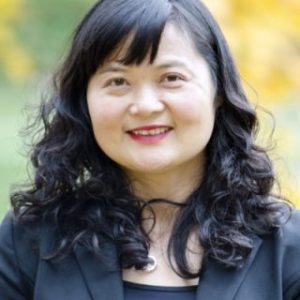
Professor Juliet Foster is Dean of Education at the Institute of Psychiatry, Psychology & Neuroscience (IoPPN), King's College London. Previously, she served as Deputy Dean of Education at the Psychology Department since 2018 and held academic roles at the University of Cambridge as Senior Tutor and Senior Lecturer. King's College London (2018–present) University of Cambridge (prior to 2018) Her research focuses on public understandings of mental health, student wellbeing, and sociocultural psychology. She employs qualitative and mixed-methods approaches, contributing to the development of the 'whole university' mental health strategy. Juliet collaborates with Student Minds, the UK student mental health charity, and serves as an Assessor for the University Mental Health Charter. Key projects include evaluating peer support systems, studying loneliness in students, and analyzing media representations of mental health and homelessness. Her work aligns with the UN Sustainable Development Goal of Quality Education. Scientific Awards: British Psychological Society Social Psychology Section Award for the Most Outstanding PhD She co-chairs King's College London's Steering Committee on Student Mental Health and Wellbeing and has served on the British Psychological Society's Education and Training Board. Her research has been funded by ESRC, AHRC, and NIHR.
Urban Johnson is a Professor at Halmstad University's School of Health and Welfare, specializing in sports psychology with a focus on sustainable participation in sports, health, and physical activity. His research examines psychological aspects of sports injury (pre- and post-injury) and healthy athletic engagement, particularly through pandemic-era studies of Swedish upper secondary sport students. Johnson's research interests center on: Psychological mechanisms in sports injury rehabilitation and prevention Adolescent athlete mental health and dropout dynamics Pandemic impacts on sport education systems Gender-specific responses to athletic challenges Longitudinal behavioral patterns in youth sports His work integrates qualitative analysis of student-athlete experiences with clinical psychology frameworks. His publication trends reveal intense focus on pandemic-related disruptions (2020-2025), with 12 of 15 recent articles examining COVID-19's impact on student-athletes, teachers, and sports systems. Key thematic clusters include: Sport injury psychology (ACL re-ruptures, prevention) Adolescent mental health during crises Fun/motivation dynamics in youth sports Cross-contextual leadership challenges Johnson actively supervises students at basic, advanced, and doctoral levels while teaching methodology courses. His collaborative projects include the Karolinska Football Injury Cohort Study and consensus statements on sport injury psychology. Current work emphasizes cocreation of injury prevention programs and psychological support services for elite handball.
Florent Cosandier serves as a Lecturer in the Section of Microtechnology and Research Associate at the Micromechanical and Horological Design Laboratory (INSTANT-LAB) within the School of Engineering at Swiss Federal Institute of Technology Lausanne (EPFL). His dual roles bridge precision engineering education and advanced research in mechanical systems design. His research centers on compliant and flexure mechanisms with applications spanning horology, space instrumentation, and micro-technology. Key focus areas include parasitic error minimization in translation stages, dynamic balancing for mechanical oscillators, and additive manufacturing of complex compliant systems. Recent work demonstrates experimental validation of zero-force mechanisms and novel pivot designs for high-precision positioning. Analysis of his 15 most recent publications reveals a dominant trend in rectilinear stage development (6 articles), horological applications (4 articles), and space telescope assembly systems (3 articles). His work consistently emphasizes experimental validation, large-range motion capabilities, and parasitic shift elimination through innovative parallel mechanism configurations. Cosandier has advised at least one PhD student at EPFL: Kruis Johannes Richard Cornelis Geerit. He contributes to teaching through courses like "Advanced mechanisms for extreme environments" within the SMT-ENS unit. As a core member of INSTANT-LAB, he collaborates on projects involving metallic additive manufacturing for damping systems, micro-vibration suppression platforms, and silicon-based flexure mechanisms. His current research trajectory shows increasing focus on space applications and bi-material additive manufacturing techniques.
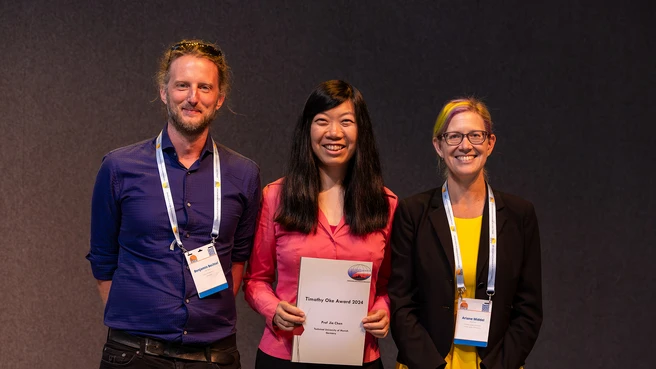
Professor Jia Chen is a Professor of Environmental Sensing and Modeling at the Technical University of Munich (TUM), holding positions in both the TUM School of Computation, Information and Technology (CIT) and the Department of Electrical and Computer Engineering, as well as the Department of Civil, Geo and Environmental Engineering. She also maintains an affiliation as an Associate at Harvard University. Her pioneering work focuses on developing novel optical sensors and atmospheric models to monitor and quantify greenhouse gas emissions in urban environments. Professor Chen's most significant contribution is the development of the differential column measurement method and the establishment of MUCCnet, the world's first permanent urban column sensor network. This groundbreaking work enables continuous, city-wide monitoring of greenhouse gases. Her research team has made notable discoveries, including quantifying methane emissions from events like the Munich Oktoberfest and identifying previously underestimated urban emission sources. Her research spans atmospheric science, environmental engineering, and climate change mitigation, with particular emphasis on: Urban greenhouse gas monitoring systems Advanced atmospheric modeling techniques Sensor network development for environmental monitoring Integration of machine learning with emission quantification Urban air quality assessment methodologies Professor Chen has received numerous prestigious awards including: Timothy Oke Award (2024) for original research in urban climatology ERC Consolidator Grant (2022) Arnold Sommerfeld-Award (2021) Germany's "Top 40 under 40" recognition by Capital Magazine (2020) Membership in the Global Young Academy (2021) She leads an extensive research group with numerous PhD students and postdoctoral researchers, and her work is supported by major funding from ERC, EU Horizon 2020, United Nations Environment Programme, NASA, ESA, German Federal Ministry of Education and Research, and German Research Foundation. Professor Chen has authored over 180 publications and 12 patents, with an h-index of 35.
Paul Dodds is Professor of Energy Systems at University College London's Bartlett School of Environment, Energy & Resources, where he holds joint appointments at the UCL Energy Institute and the Institute for Sustainable Resources. He serves as the Faculty Graduate Tutor for the Bartlett Faculty of the Built Environment, overseeing all doctoral research programs. His academic progression at UCL has been steady, moving from Research Associate (2011-2014) to Senior Research Associate (2014-2015), Lecturer (2015-2016), Senior Lecturer (2016-2018), Associate Professor (2018-2020), and finally to Professor. His educational background includes a PhD from the University of Leeds (2010) focused on climate change and agriculture in Senegal, where he developed a new crop model for adaptation research and created detailed meteorological datasets for West Africa. He also holds a Master of Natural Science (Honours) from the University of Nottingham (2000). Dodds specializes in energy systems modelling with particular expertise in hydrogen and bioenergy systems, and the importance of energy storage. His research examines the interactions between society and the environment, with a focus on energy and food systems. He has developed the UK TIMES energy systems model, which has replaced the UK MARKAL model and is now co-developed with the UK Department of Business, Energy and Industrial Strategy (BEIS). This model has provided underpinning evidence for the UK's Clean Growth Strategy and Net Zero Strategy. His methodological contributions include formalizing a theoretical approach to analyzing the evolution of energy system models using 'model archaeology'. Analysis of his recent publications reveals a strong focus on hydrogen energy systems, with multiple papers examining hydrogen trade pathways, integration methods, and environmental impacts. His work increasingly addresses the geopolitical dimensions of energy transition, as seen in studies about Russian gas pivots to Asia and global energy scenarios. He maintains expertise in energy system modeling techniques while expanding into practical applications for policy development, particularly regarding the UK's net-zero transition. Dodds has supervised 15 PhD students at UCL, with eight under his primary supervision. His professional activities include serving as the UK Alternate Delegate to IEA Hydrogen since 2017, acting as a PhD External Examiner at the University of Edinburgh, and participating in the EPSRC Peer Review College. He has contributed to multiple government initiatives, including the UKERC Future of the Gas Networks workshop and representing the UK Government at IEA ETSAP meetings. He teaches an undergraduate module on 'Energy and Environmental Systems Modelling' and guest lectures on several MSc courses. His research group focuses on energy system modeling, with particular emphasis on the UK TIMES model development and application. His work often involves collaboration with government bodies, particularly BEIS, and he has coordinated significant projects like seven reports on overshoot pathways for the UK Government.
Elyse Rosenbaum is the Melvin and Anne Louise Hassebrock Professor in Electrical and Computer Engineering at the University of Illinois at Urbana-Champaign. She also serves as the Acting Associate Dean for Research at the Grainger College of Engineering. She is the director of the NSF-supported Center for Advanced Electronics through Machine Learning (CAEML), a collaboration between the University of Illinois, North Carolina State University, and Penn State University. Education: Ph.D. in Electrical Engineering, University of California, Berkeley, 1992 M.S. in Electrical Engineering, Stanford University B.S. in Electrical Engineering, Cornell University (with distinction) Research Interests: Her research focuses on machine learning applications in electronics, ESD-robust high-speed I/O circuit design, compact modeling, behavioral modeling of circuits, and CDM-ESD protection for advanced packaging technologies. Scientific Awards: IEEE Fellow for contributions to electrostatic discharge reliability of integrated circuits Best Student Paper Award, IEDM Outstanding and Best Paper Awards, EOS/ESD Symposium Technical Excellence Award, SRC NSF CAREER Award IBM Faculty Award ESD Association’s Industry Pioneer Recognition Award Advising and Grants: She supervises graduate and undergraduate researchers, primarily focusing on those with strong academic records and relevant experience. Her work is supported by NSF and other prominent organizations. Labs and Teams: She leads the CAEML center, which aims to apply machine learning to optimize microelectronic circuits and systems, enhancing design automation and reliability.
Caterina Urban is a Research Scientist (Chargé de Recherche) at INRIA and École Normale Supérieure (ENS) in Paris, France. She is a member of the INRIA research team ANTIQUE (ANalyse StaTIQUE), where she focuses on formal methods and static analysis. Prior to her current position, she was a postdoctoral researcher at the Chair of Programming Methodology, led by Peter Müller at ETH Zurich. Dr. Urban holds a PhD in Computer Science (2015) from École Normale Supérieure, Paris, where she worked under the joint supervision of Radhia Cousot and Antoine Miné. She also earned a Master's degree (2011) and Bachelor's degree (2009) in Computer Science, both with full marks and honors (summa cum laude) from the Università degli Studi di Udine, Italy. Her research interests span the whole spectrum of formal methods with a focus on developing rigorous methods and tools to enhance the reliability of computer software, particularly data science applications. Her main area of expertise is static analysis based on abstract interpretation. Dr. Urban is currently engaged in several research projects including Lyra (focusing on data science software), Libra (fairness certification for neural networks), and SAIF (addressing safety concerns in machine learning-based systems). Dr. Urban's recent publications demonstrate her expertise in applying abstract interpretation to diverse areas including machine learning, data science, program verification, and security. Her work bridges theoretical foundations with practical applications, particularly in ensuring the reliability and trustworthiness of increasingly critical data science and machine learning systems. She has received recognition for her work through invitations to serve on program committees for major conferences including OOPSLA 2026, PLDI 2026, and CAV 2026. She is also the general chair of iFM 2025 in Paris. Dr. Urban actively mentors the next generation of researchers, supervising PhD students and postdoctoral researchers. She teaches courses on abstract interpretation and its applications at the Master Parisien de Recherche en Informatique (MPRI) and various international summer schools. She has developed several open-source software tools including Lyra (a static analyzer for data science applications), Libra (for fairness certification of neural networks), and Typpete (SMT-based static type inference for Python).
René Jr Landry is a full Professor in the Department of Electrical Engineering at École de technologie supérieure (ETS), Université du Québec, specializing in Global Navigation Satellite Systems (GNSS), avionics, and wireless communication technologies. His academic journey includes a B.Ing. from Polytechnique Montréal, M.Sc. from University of Surrey (UK), and Ph.D. from SupAréo in Toulouse. He maintains active research leadership through two key laboratories: LASSENA (Laboratory of Space Technologies, Embedded Systems, Navigation and Avionics) and LACIME (Communications and Microelectronic Integration Laboratory). His research spans critical aerospace navigation domains including GNSS signal processing, inertial navigation systems, software-defined radio for avionics, radio frequency interference mitigation, and indoor positioning technologies. Landry's work addresses real-world challenges in satellite navigation robustness, precision positioning in urban/denied environments, and next-generation avionic system security. His current projects focus on blockchain-enhanced IoT security, AI-driven GNSS disruption analysis, and adaptive RF front-ends for multi-band avionics applications. Analysis of his recent publications reveals strong emphasis on resilient positioning systems through multi-constellation integration (particularly Iridium-NEXT), blockchain applications for navigation security, and explainable AI techniques for GNSS signal quality assessment. His work increasingly bridges traditional navigation engineering with cutting-edge security and machine learning paradigms. 2014 Prix d'excellence du c.a. pour les services à la collectivité Landry has supervised over 100 graduate students across doctoral, master's, and research projects since 2005, with current supervision extending through Summer 2025. His research funding supports multiple industry partnerships focused on avionics certification, software-defined radio implementations, and next-generation navigation systems. The LASSENA laboratory under his leadership develops certified avionic products from open-source SDR platforms and advances multi-sensor fusion techniques for challenging navigation environments. His research infrastructure includes specialized facilities for GNSS signal simulation, avionics hardware testing, and multi-sensor integration. Current work emphasizes flight-tested validation of RF front-end technologies, blockchain-secured navigation data, and real-time interference mitigation systems for aviation applications.
Guofang Li is a Professor in the Department of Language and Literacy Education at the Faculty of Education, affiliated with the Centre for Early Childhood Education & Research (CECER). Her work centers on bilingual development and literacy education within multicultural contexts, particularly focusing on Chinese-Canadian communities. Her research interests include: Early bilingual development Family literacy practices Early literacy instruction methodologies Early education for minority learners Teacher education for multilingual classrooms Analysis of her 2021-2025 publications reveals a concentrated focus on Chinese-Canadian children's bilingual development, examining home literacy environments, digital technology impacts, and pandemic-related disruptions. She consistently advocates for equity-focused approaches in superdiverse educational settings, emphasizing translanguaging practices and critical perspectives on linguistic justice. Scientific Awards: No awards explicitly mentioned in source materials Advising and Grants: No specific student names or grant information provided in source materials Labs and Teams: Centre for Early Childhood Education & Research (CECER): An interdisciplinary hub facilitating collaborative research between academics, educators, and community partners focused on advancing evidence-based early childhood education practices through longitudinal studies and community-engaged projects.
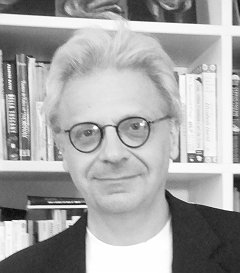
Victor Vianu is a Professor in the Department of Computer Science and Engineering at the University of California, San Diego, within the Jacobs School of Engineering. His work focuses on the intersection of database theory and verification techniques, particularly in the context of data-driven business processes and workflows. Research Interests Professor Vianu's primary research interests span database theory, verification of database-driven systems, and computational logic. His current work focuses on automatic verification of interactive data-driven web services and business processes, exploring how to provide customized workflow views for different stakeholders in organizational settings. His research addresses significant technical challenges at the intersection of data management and process modeling, requiring novel approaches that go beyond traditional relational algebra to handle both data and process aspects simultaneously. His work on data-driven business processes investigates how to specify, analyze, and synthesize views of workflows that expose only information relevant to specific user roles. This research has important applications in e-commerce, digital government, healthcare, and scientific infrastructure, where different stakeholders require varying levels of workflow abstraction and detail. Research Contributions and Trends Professor Vianu's recent publications demonstrate a consistent focus on the integration of data management and workflow processes. His work has evolved from foundational database theory to increasingly practical applications in business process management. A key trend in his research is the development of formal frameworks for workflow views that maintain consistency while providing appropriate abstractions for different user roles. His publications reveal a progression from theoretical foundations to more applied aspects of workflow verification and integration, often in collaboration with researchers from INRIA and other institutions. Advising and Research Support Professor Vianu leads the UCSD Database Laboratory, which conducts research on database systems and theory. He currently advises graduate student Marysia Tran and has likely mentored numerous other students throughout his career. His research is supported by the National Science Foundation under grant "Views of Data-Driven Business Processes: Foundations and Applications" (NSF Project III 1815247). This project brings together techniques from logic, automata theory, complexity theory, algorithms, and automatic verification to address challenges in workflow management. Research Environment Professor Vianu is an active member of the UCSD Database Laboratory, which maintains a regular research seminar series. He has collaborated extensively with researchers including Alin Deutsch (UC San Diego), Serge Abiteboul (INRIA and ENS-Paris), Pierre Bourhis (Univ. of Lille and CNRS), and Adrien Koutsos (ENS Cachan). His foundational work includes co-authoring the influential textbook "Foundations of Databases" with S. Abiteboul and R. Hull, which remains a standard reference in database theory.
Dr. Ronald P. Strauss serves as the Adams Distinguished Professor at the University of North Carolina at Chapel Hill in the Adams School of Dentistry, with additional appointments as Professor of Social Medicine in the School of Medicine and Clinical Professor of Epidemiology in the Gillings School of Global Public Health. He concurrently holds the position of Chief Global Officer for the Adams School of Dentistry and is an active member of the UNC Craniofacial Center Team. His academic credentials include: BA in Biology from Queens College New York DMD from the University of Pennsylvania PhD in Sociology from the University of Pennsylvania Dr. Strauss's research examines the social dimensions of chronic health conditions, with specialized focus on craniofacial differences and HIV/AIDS. His interdisciplinary approach integrates clinical practice, sociological theory, ethical frameworks, and health policy analysis to address stigma, healthcare access barriers, prenatal diagnosis implications, and community engagement strategies. Methodologically, he employs qualitative ethnography and survey research to investigate psychosocial impacts. His scholarly output demonstrates consistent thematic focus across decades, with recent publications revealing intensified examination of structural determinants of health, intersectional disparities in craniofacial care, and innovative community-based HIV/AIDS interventions. Key patterns include transdisciplinary collaboration, emphasis on patient-centered outcomes, and critical analysis of systemic inequities in healthcare delivery. Dr. Strauss directs the campus-wide HIV/AIDS Course annually since 1987 and teaches Social and Health Systems to medical students. As Faculty Director of the CFAR Office of Community Engagement and lead of the Thorp Faculty Engaged Scholars Program, he mentors faculty in community-engaged scholarship while maintaining active clinical and research supervision. He maintains leadership within the UNC Craniofacial Center Team and has conducted international fieldwork across five countries, reflecting his commitment to global health equity through partnerships in Brazil, Israel, Thailand, Moldova, and China.
Jonathan L. Rogers is a Professor in the Accounting Department at Leeds School of Business, University of Colorado Boulder. He maintains his office in Koelbel Building, room 433, and can be contacted at jonathan.rogers@colorado.edu or by phone at 303-735-6620. Dr. Rogers received dual bachelor's degrees from the University of Texas in 1996: one in Business Administration with a focus in finance, and another in Economics with a minor in accounting. He earned his PhD in Accounting from the Wharton School of the University of Pennsylvania in 2005. He is also a certified management accountant and certified in financial management, though both certifications are currently inactive. Dr. Rogers' research focuses on voluntary disclosure, market microstructure, multinational firms, insider trading, and stock return volatility . His work has been published in all three top accounting journals (Journal of Accounting Research, Journal of Accounting and Economics, The Accounting Review) and has received significant attention from major media outlets including The Wall Street Journal, The New York Times, Financial Times, Fortune, Reuters, Bloomberg TV, and CNBC. His research has also been cited by members of Congress. His recent publications span a diverse range of topics from accounting and finance to meteorology and healthcare, reflecting interdisciplinary collaborations. Major themes in his work include financial disclosure practices, market microstructure, insider trading, and the dissemination of financial information. His research on SEC dissemination in high-frequency trading environments has been particularly influential in both academic and regulatory circles. 2015 EKS&H Faculty Fellowship 2015 RAST Conference Best Paper Award 2011 Fama-Miller Center Research Grant 2010 William Ladany Faculty Scholar 2009 Ernest R. Wish Award 2009 Initiative on Global Markets Research Grant 2003 Deloitte Foundation Doctoral Fellowship European Accounting Association's 2003 Doctoral Colloquium Fellowship 2001 Geewax, Terker & Company Prize for Investment Research Dr. Rogers serves on the editorial board of the Journal of Accounting Research and works as an ad hoc reviewer for the Journal of Finance, the Accounting Review, the Journal of Accounting and Economics, the Review of Accounting Studies, Contemporary Accounting Research, American Accounting Association Midyear, and the Annual and FARS section meetings. His research has been supported by numerous grants including those from the Fama-Miller Center, Initiative on Global Markets, and the Deloitte Foundation. While specific information about his laboratory or research team is not provided in the available text, his extensive publication record and editorial roles suggest he likely collaborates with multiple researchers and potentially supervises graduate students in accounting research.
Brandon L. Velez is an Associate Professor of Counseling Psychology at the Graduate School of Education, Health & Psychology at Teachers College, Columbia University. His research examines the intersections of oppression and collective identity with mental health and career outcomes for sexual, gender, and racial/ethnic minority populations. He is affiliated with the Counseling & Clinical Psychology department and leads the Stigma, Identity, and Intersectionality Research Team. Ph.D. in Counseling Psychology, University of Florida, 2014 Predoctoral Internship, Georgia Institute of Technology Counseling Center, 2014 M.S. in Psychology, University of Florida, 2011 B.S. in Psychology (summa cum laude), B.A. in Religion (cum laude), Minor in Anthropology, University of Florida, 2009 Dr. Velez’s work focuses on minority stress , intersectionality , and the well-being of multiply marginalized groups, including LGBTQ+ people of color, transgender individuals, and women of color. His studies explore how systemic discrimination and coping strategies influence mental health , body image , and career development , often integrating theories like objectification and work adjustment. His recent publications analyze: Protective effects of womanist attitudes on women of color Minority stress in transgender communities and bisexual women Applications of work theory to racial and sexual minorities Resilience mechanisms against systemic oppression Scientific honors include graduating summa cum laude (B.S.) and cum laude (B.A.) from the University of Florida. He does not currently advise new Ph.D. students for the Fall 2025 cohort.
Michela Bertolotto is a Professor in the School of Computer Science at University College Dublin (UCD). Her research focuses on spatio-temporal data modeling, GIScience, and applications of geospatial technologies in fields like urban planning and health informatics. She leads a research group and has supervised 19 PhD and 8 MSc students. Her work includes innovations in LiDAR-based flood risk visualization, semantic web quality assurance, and open-source spatial data analysis. Bertolotto has held roles including College Lecturer at UCD (2000–2006) and postdoctoral research positions at the University of Maine and University of Genoa. Education: BSc and PhD in Computer Science from the University of Genoa (1993, 1998). Professional achievements include over 100 publications, 24 grants (e.g., Science Foundation Ireland-funded Urban ARK project), and editorial roles at journals like the International Journal of Geographical Information Science. Awards include the UCD President's Research Award (2001) and NATO Postdoc Fellowship (1998–1999). Research interests span map personalization, volunteered geographic information (VGI), and geospatial data quality. Her lab develops tools like the LAMSkyCam (low-cost sky imaging system) and dynamic flood risk viewers. She chairs international conferences and serves on program committees for GIScience events.
Julia Kurz is a Researcher at TU Dortmund University's Department of Sociology of Science and Technology, Faculty of Social Sciences. She leads the 'Visually Integrated Clinical Collaboration' project within the Collaborative Research Center (SFB) Media of Cooperation. Her work spans healthcare informatics, educational research, and disability studies. Education: M.A. in Sociology from the University of Siegen (2011), with prior studies at Philipps-University Marburg. Professional experience includes research roles at the University of Siegen (2012–2023) and support work with disabled populations (since 2001). Research focuses on information workflows in hospitals, collaborative data practices, and participatory technology design. Recent talks address topics like disempowerment in participation frameworks and challenges in transdisciplinary research. Her publications explore medical visualization tools, mentoring impacts, and role-playing pedagogy. Award recognition details are not explicitly listed, but her grants include SFB funding for the Media of Cooperation project. Advising activity is not documented here. She contributes to seminars on competence, knowledge theory, and educational innovation.