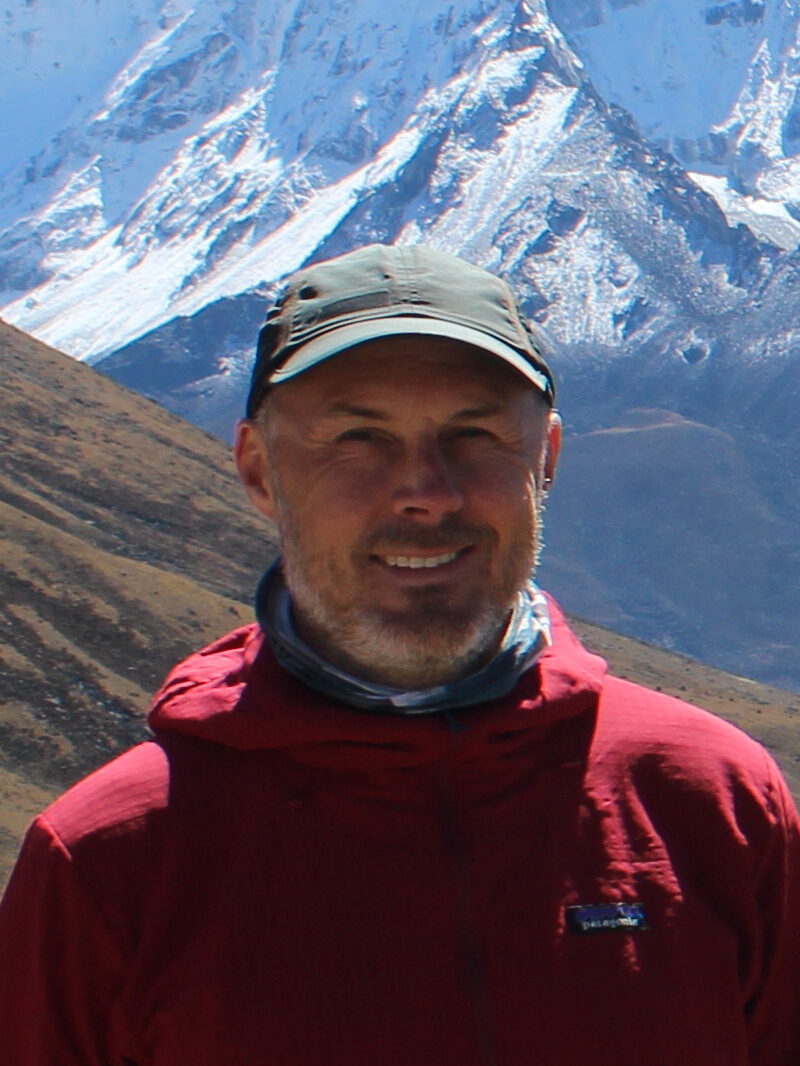
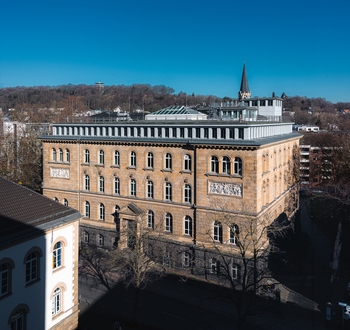
Dr. Hugo van Schrojenstein Lantman serves as a Researcher within the Structural Geology & EM group at the Department of Earth Sciences, Faculty of Geosciences, Utrecht University. His work bridges advanced microscopy techniques with geological deformation analysis to investigate Earth's crustal evolution. His research focuses on four core domains: Electron Microscopy for high-resolution rock analysis Structural Geology examining tectonic deformation patterns Metamorphism studying mineralogical transformations under pressure Rock Mechanics analyzing mechanical properties of geological formations This integrated approach enables precise microstructural characterization of rock samples, contributing to fundamental understanding of orogenic processes and subsurface resource modeling. His expertise supports both academic research and applied geotechnical investigations requiring microscopic deformation analysis.
Dr. Su Talavera Soza is a Researcher at the Faculty of Geosciences, University of Utrecht, specializing in the DES - Seismology group. Their work bridges seismology, machine learning, and geophysical inversion to study Earth's crust, mantle, and inner core. They employ seismic normal modes and surface waves with advanced instruments like superconducting gravimeters and ocean bottom seismometers. Key Expertise Areas: Seismology, Global Seismology, Earth's Deep Interior, Machine Learning, Inverse Problems, Tomography Skills: Python, Fortran, MATLAB, Data Analysis, Visualization Current research focuses on physics-informed machine learning for full-waveform inversion and planetary-scale structure analysis. They collaborate internationally across the USA and Europe, contributing to 15+ publications between 2020-2025, including high-impact journals like Nature and Nature Geoscience . Notably, they developed the FrosPy Python toolbox for normal mode seismology. While no formal awards are listed, their work on mantle attenuation models and inner core dynamics has been widely shared (214+ X posts) and discussed in Wikipedia. They hold a 2021 PhD from Utrecht University titled Observing seismic attenuation in the Earth’s mantle and inner core using normal modes , supervised by A. Deuss.
Simon Cuthbert is an Associate Professor at AGH University of Science and Technology's Faculty of Geology, Geophysics and Environmental Protection , affiliated with the Department of Mineralogy, Petrography and Geochemistry. His research focuses on tectonic processes, eclogite-facies metamorphism, and environmental geochemistry. Current Position: Associate Professor, AGH University of Krakow Research Themes: Ultrahigh-pressure rocks, Caledonian orogeny, gold mineralization, halogen geochemistry Key publication trends include: U-Pb zircon dating of Scandinavian Caledonides rocks Hydroxyl content analysis in eclogitic minerals Environmental impacts of potentially toxic elements Tectonic implications of gold mineralization in collision zones Laboratory collaborations include the Orogen Dynamics Team , with extensive work in Norway's Western Gneiss Region and Scotland's Caledonian belt.
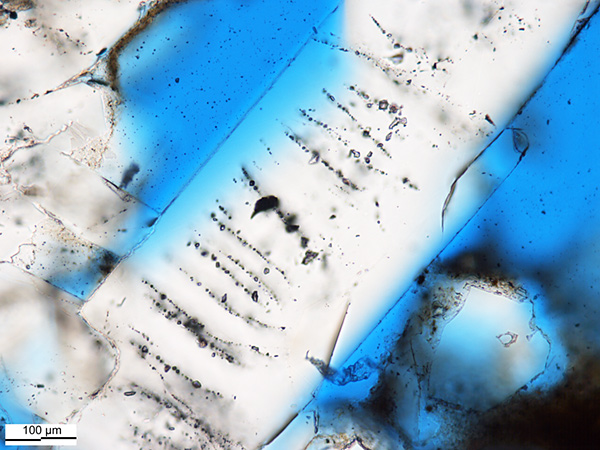
Dr. András Fall is a Research Associate Professor at the Bureau of Economic Geology (BEG) within the Jackson School of Geosciences at The University of Texas at Austin. He joined BEG as a Postdoctoral Fellow in 2008 and has since focused on fracture mechanics, fluid inclusion analysis, and structural diagenesis in sedimentary basins. His research integrates geochemical and mechanical processes to study fracture formation, cementation, and pore-pressure evolution in hydrocarbon and geothermal reservoirs. Fall holds a Ph.D. and M.Sc. in Geosciences from Virginia Tech, an M.Sc. in Geology from the University of Bucharest, and a B.Sc. in Geology-Geography from Babeş-Bolyai University. His professional experience includes roles as a Graduate Teaching/Research Assistant at Virginia Tech and laboratory work at Eötvös Loránd University in Hungary. His research explores the interaction of geochemical and mechanical processes in sedimentary rocks, with emphasis on: Fluid inclusion microthermometry and Raman spectroscopy for fracture timing Natural hydraulic fracturing in tight-gas reservoirs Experimental modeling of fracture cementation Diagenetic controls on reservoir quality His recent publications demonstrate a consistent focus on fracture dynamics, fluid-rock interactions, and reservoir characterization across global basins (e.g., Piceance Basin, Tarim Basin, Santos Basin). Notable scientific awards include the Tinker Family BEG Best Publication Award (2016) , AAPG and SEPM excellence certificates, and teaching honors from Virginia Tech. He currently benefits from a DOE Basic Energy Sciences grant supporting experimental fracture-diagenesis work. Fall collaborates with the Fracture Research and Application Consortium (FRAC) and seeks partnerships with low-temperature geochemistry experts to advance hydrothermal experiments. His work spans field sites in the U.S., Argentina, and Bolivia.
Dr. Michael Frietsch is a Researcher at the Geophysical Institute of the Karlsruhe Institute of Technology . His work focuses on seismic event analysis, fault network modeling, and distributed acoustic sensing (DAS) technology. He is based at Campus West in Karlsruhe, Germany. Email: michael.frietsch@kit.edu Research Interests: Frietsch investigates earthquake source mechanics, subduction zone dynamics, and fluid-induced seismicity. His recent projects include seismic monitoring of active fault systems and development of DAS-based detection methods. Publication Trends: His research spans seismology, tectonics, and geophysical data analysis, with a focus on multi-fault earthquake modeling and subduction interface processes.
Dr. Yajian Gao is a Researcher at the Geophysics group of the Karlsruhe Institute of Technology (KIT), focusing on seismic waveform inversion and subduction zone geodynamics. His work employs spectral element methods for 2D/3D modeling of crustal and upper mantle structures. Institution: Karlsruhe Institute of Technology (KIT) Department: Geophysics group at Geophysical Institute Research Interests: His studies center on subduction zones (Central Andes, Central Asia), mantle hydration/dehydration processes, and distributed deformation analysis using passive seismic data and ambient noise interferometry. Publication Trends: Recent articles emphasize full waveform inversion applications, mantle dynamics, and microseism source characterization, reflecting expertise in computational geophysics and tectonic-geodynamic interactions.
Dr. Sarah Mader is a researcher at the Geophysical Institute of the Karlsruhe Institute of Technology (KIT). Her work spans seismology, geophysics, and planetary seismology, with a focus on fault zone analysis and seismic monitoring in active tectonic regions. Research Interests: She investigates seismotectonic models, stress transfer mechanisms, and fault zone dynamics in the Alpine foreland, while also contributing to planetary seismology through Mars mission preparations like NASA's InSight. Scientific Collaborations: Dr. Mader collaborates with teams such as the AlpArray Working Group and the StressTransfer seismic network, which aim to improve understanding of seismically active regions through advanced instrumentation and modeling.
Katja Rinderspacher is a Researcher at the University of Stuttgart's Institute for Computational Design and Construction (ICD), where she coordinates the ITECH M.Sc. Programme since 2013. Holding a Master of Architecture (Hons) from Pratt Institute and a Diploma in Engineering from Fachhochschule Mainz, she is a registered architect in Germany. Her work bridges computational design, digital fabrication, and natural material systems. Educational Background: M.Arch. (Hons), Pratt Institute, New York Dipl.-Ing. (FH), Fachhochschule Mainz, Germany Her research focuses on erosion-based morphologies and hybrid building systems, with projects like the LivMatS Pavilion , Maison Fibre , and HygroSkin exemplifying her work in natural fiber composites and climate-responsive architecture. Publications since 2013 explore computational design workflows, robotic construction, and sustainable material integration. Scientific Awards: Fulbright Scholarship DAAD Scholarship Landesgraduierten-Scholarship She teaches courses such as Behavioral Design and Fabrication , Erosion-Based Morphologies , and Geometry and CAD , while coordinating thesis projects like Terra Incognita and Adaptive Intelligent Space . Collaborations with institutions like ACADIA and IASS highlight her interdisciplinary contributions.
Dr. Marion Jegen-Kulcsar is a Scientist and Research Group Leader for Marine Electromagnetics at GEOMAR Helmholtz Centre for Ocean Research Kiel, Germany. She has been with GEOMAR since 2005 and leads research within Research Unit: Marine Geodynamics under Research Division 4: Dynamics of the Ocean Floor. Her work focuses on applying electromagnetic methods to study ocean floor processes and resources. Dr. Jegen-Kulcsar's research spans marine electromagnetics (both natural and controlled source), geophysical investigation of tectonic processes including rifting, seafloor spreading, and subduction, and the investigation and quantification of marine resources such as offshore groundwater and seafloor ore deposits. She specializes in geophysical data integration and joint inversion techniques to create comprehensive subsurface models. Her recent publications reveal a strong focus on offshore freshened groundwater systems, seafloor massive sulfides, and gas hydrates using advanced electromagnetic methods. Her publications show a consistent research trajectory toward understanding coastal transition zones, with particular emphasis on electrical resistivity anomalies that indicate freshened groundwater offshore. Recent work employs sophisticated techniques including trans-dimensional Bayesian inversion, automated image segmentation, and multi-parameter joint inversion to characterize subsurface structures. Dr. Jegen-Kulcsar leads or participates in numerous research projects including AIQuifer (2023-2026), SMART (2019-2025), CLOCKS (2022-2025), DIGITAL EARTH (2020-2021), and several others dating back to 2005. Her research group develops and applies marine electromagnetic instrumentation and processing techniques to address questions in marine geoscience and resource exploration.
Dr. Jan Reder is a Lecturer in the Department of Geomorphology and Paleogeography at the Faculty of Earth Sciences and Spatial Management, Maria Curie-Skłodowska University in Lublin, Poland. Born in Lublin to parents Elżbieta Reder (hydrologist) and Jerzy Reder (legal historian), he represents a multi-generational academic family with deep connections to Polish scholarly traditions. His educational background includes dual Master's degrees: one in Archaeology from the Faculty of Humanities specializing in Polish and Universal Archaeology, and another in Geography from the Faculty of Biology and Earth Sciences specializing in Quaternary Geomorphology and Paleogeography. He completed his Ph.D. in glacial geomorphology at the same institution. Dr. Reder's scientific interests span glacial, structural, and dynamic geomorphology; geoarchaeology of southeastern Poland; and Holocene paleogeography with particular emphasis on the Lublin region. His research uniquely bridges natural sciences and archaeology, examining how environmental factors shaped historical settlement patterns and cultural development. He has made significant contributions to understanding the geoarchaeological context of archaeological sites in southeastern Poland, particularly through his analysis of environmental constraints on prehistoric and medieval settlements. His publication record demonstrates consistent research output since 2004, with recent work focusing on tectonic denudation concepts, medieval landscapes of Lublin region, geoarchaeological analyses of archaeological sites, and the natural conditions influencing prehistoric settlement locations. His articles reveal strong interdisciplinary connections between geomorphology, archaeology, and historical geography, with particular emphasis on the Lublin Upland and surrounding regions. As an educator, Dr. Reder has supervised 112 bachelor's theses and teaches a diverse range of courses including Geomorphology, Field Exercises in Geomorphology, Natural Aspects of Sustainable Tourism, and Archaeological Heritage in Tourism. His teaching spans multiple programs including Geography, Tourism and Recreation, and Spatial Management. Dr. Reder has also contributed approximately 30 geoarchaeological expert opinions commissioned by state conservation services for archaeological sites investigated during road construction projects, demonstrating the practical application of his academic expertise to cultural heritage preservation.
Erkan Toraman is an Assistant Professor in the Department of Geological Sciences at Salem State University. He teaches a range of undergraduate and graduate courses including Dynamic Earth, Earth Materials, Tectonics, and Field Geology, with recent offerings such as Forensic Microscopy and Petrochronology. Office: Meier Hall 331E Phone: 978.542.6493 Office Hours: Tuesday-Thursday 2:00-3:30 pm (by appointment) His research interests align with geological sciences, particularly in earth materials, tectonic processes, and forensic applications of geology. He supervises senior research projects in geology and advises on thesis work for graduate students.
Shaocheng Ji is a Full Professor in the Department of Civil, Geological and Mining Engineering at Polytechnique Montréal . He holds a B.Sc. from Nanjing, M.Sc. from Beijing, and Ph.D. from Montpellier, France. Research Interests: Structural geology and tectonics, focusing on crustal deformation mechanisms Seismic anisotropy and wave propagation in geological materials Rheology of rocks under high-pressure and high-temperature conditions Tectonophysics with emphasis on lithospheric dynamics and mantle processes Rock mechanics applications to earthquake fault zones and orogenic belts Recent Publications: His work spans structural geology, seismic properties, and tectonic modeling. Notable trends include 3D numerical simulations of microboudinage, analysis of pseudotachylyte-induced fault weakness, and studies on auxetic behavior in sandstones. Research frequently integrates field data with experimental and theoretical frameworks. Advising: Supervised 5 Ph.D. and 1 Master’s student, with thesis topics covering seismic anisotropy, rock deformation, and tectonic implications of mineral fabrics.
Douglas J. Hemingway is a Research Assistant Professor at the University of Texas Institute for Geophysics (UTIG), part of the Jackson School of Geosciences at the University of Texas at Austin. His research focuses on geophysical modeling of planetary bodies to understand their evolution and the diversity observed across the solar system. With extensive experience in both academic research and the space industry, he bridges practical engineering with theoretical planetary science. Education: PhD in Earth & Planetary Sciences, University of California Santa Cruz MSc, cum laude, Space Studies, International Space University, Strasbourg, France BASc, first class hon., Systems Design Engineering, University of Waterloo, Canada Research Focus: Hemingway's research primarily involves geodynamical modeling of planetary interiors, with constraints from spacecraft-based observations of gravitational and magnetic fields. He investigates magnetism, gravity, topography, elasticity/flexure/fracturing, heat production/transfer, and fluid dynamics across multiple planetary bodies. His work spans icy moons like Enceladus and Titan, as well as rocky bodies including the Moon, Mars, and Venus, with particular emphasis on understanding the processes that drive planetary evolution and diversity. Publication Analysis: Hemingway's recent publications demonstrate a concentrated focus on Saturn's icy moons, especially Enceladus and Titan, analyzing their gravity fields, interior structures, and potential subsurface oceans. His work integrates geophysical modeling with spacecraft data from missions like Cassini to develop comprehensive understanding of these planetary bodies. The research shows evolving sophistication in modeling techniques, increasingly incorporating multiple data sources to constrain interior properties, with significant contributions to understanding cryovolcanism, magnetic field generation, and surface evolution processes. Professional Background: Former Chief Scientist for Civil Space at Maxar Technologies Specialized in robotic servicing for International Space Station and Hubble Space Telescope Research positions at UC Berkeley's Miller Institute and Carnegie Institution for Science Teaching experience at UC Santa Cruz in geophysics Research Context: Working within UTIG's collaborative environment, Hemingway benefits from partnerships with the Bureau of Economic Geology, Department of Earth and Planetary Sciences, and Center for Planetary Systems Habitability. His research leverages planetary mission data and advanced computational resources to model complex geophysical processes across the solar system, with implications for understanding planetary habitability and evolution.
Florian M. Wagner is a full Professor of Geophysical Imaging and Monitoring at RWTH Aachen University since February 2023. His work bridges geophysical imaging, numerical modeling, and data integration for subsurface characterization. Key affiliations include Lawrence Berkeley National Laboratory (visiting scholar 2018), University of Bonn (postdoc 2016–2019), and GFZ German Research Centre for Geosciences (research associate 2011–2016). Dr. Wagner holds a Doctor of Sciences (Dr. sc.) from ETH Zurich (2012–2016) and a joint M.Sc. in Applied Geophysics from TU Delft, ETH Zurich, and RWTH Aachen (2009–2011). His research focuses on multi-method geophysical imaging , optimized experimental design , and monitoring subsurface fluid dynamics in contexts like permafrost degradation, geothermal systems, and radioactive waste repositories. He develops open-source software such as pyGIMLi for geophysical inversions. Recent publications highlight hybrid joint inversion frameworks combining transient electromagnetics, ERT, and seismic data, along with entropy-constrained inversion techniques for sharper subsurface imaging. Scientific awards include multiple best teaching awards at RWTH Aachen and research grants for innovative geophysical projects. Students mentored include Nino Menzel and Anton Ziegon, whose M.Sc. theses directly contributed to peer-reviewed publications. Public outreach projects like the Open AR-Sandbox and seismic wave exhibits engage both academic and general audiences. His work emphasizes uncertainty quantification in geophysical models and cross-disciplinary collaboration to address challenges in resource management and climate change impacts.
Shantanu Bhat is a Postdoctoral Research Fellow at UNSW Canberra, affiliated with the School of Engineering and Information Technology. His expertise spans fluid mechanics, vortex dynamics, insect flight aerodynamics, and boundary-layer flows. He has held research and teaching roles at the University of Adelaide and Monash University. PhD in Mechanical and Aerospace Engineering, Monash University (2018) MSc in Mechanical Engineering, Indian Institute of Science (2011) Bachelor of Technology in Mechanical Engineering, College of Engineering Pune (2007) His research focuses on bio-inspired aerodynamics, including insect-wing dynamics, turbulence control via micro-cavity arrays, and evolutionary shape optimization for flapping wings. His 2023-2024 publications explore pitch perturbations, power synchronization in hovering flight, and autonomous blimp applications. Scientific awards include GE's Engineering Excellence Award (2013), Best Outgoing Student Award (2007), and Fresh Science SA Finalist (2021). He has secured computational resource allocations from NCMAS, Pawsey, and NCI Australia. He has contributed to computational fluid dynamics education at UNSW, University of Adelaide, and Monash University, teaching courses on thermofluids, aerodynamics, and numerical methods.