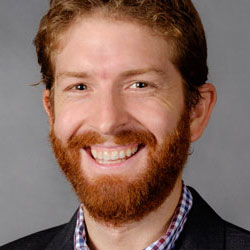
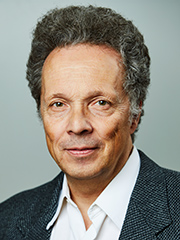
Brian Ziebart is a Professor in the Department of Computer Science at the University of Illinois at Chicago. He earned his Ph.D. in Machine Learning from Carnegie Mellon University in 2010. Research Interests: Machine Learning, Robotics, Assistive Technologies, Human-Computer Interaction, Adversarial Prediction, Inverse Optimal Control, Structured Prediction. Key Grants: NSF CAREER (RI)-1652530, NSF EAGER (SCH)-1650900, NSF IIS-1526379, NSF III-1514126, Future of Life Institute grant, NSF NRI-1227495. Notable Awards: Best Paper Runner-Up (ECCV, 2012), Best Paper Award (ICML, 2011), CMU School of Computer Science Dissertation Honorable Mention (2011). Teaching & Leadership: Senior Lecturer at CMU, actively involved in mentoring students and leading research teams.
Rudi A. Pendavingh is an Assistant Professor at Eindhoven University of Technology's Mathematics and Computer Science department, specializing in Combinatorial Optimization. He earned his PhD at the University of Amsterdam in topological graph theory and has since contributed to diverse areas of combinatorics and geometry, with recent focus on matroid theory. His teaching spans mathematical programming topics including linear, integer, and semidefinite optimization. Education: PhD in Topological Graph Theory (University of Amsterdam) His research integrates combinatorial structures with geometric and algebraic methods, particularly in matroid theory, graph embeddings, and tropical geometry. Key publication themes include optimization algorithms, excluded matroid minors, and geometric invariants. Collaborations extend to institutions in mathematics and applied sciences, with notable academic output (67 research items) and external partnerships. Recent research outputs (2022-2025) highlight his work on the Colin de Verdière parameter, Dressian bounds, and tropical amoebas. While no explicit awards are mentioned in the provided text, his contributions to combinatorial optimization and network collaborations underscore his academic impact. He has supervised 29 students and contributed to 7 courses, including Discrete Optimization Modeling and Mathematics II.
Vijay K Garg is a Professor at the University of Texas at Austin , holding positions in both the Department of Electrical and Computer Engineering and the Department of Computer Sciences . He serves as the Director of the Parallel and Distributed Systems Laboratory and has made significant contributions to distributed computing. Ph.D. in Electrical Engineering and Computer Science from University of California at Berkeley (1988) M.S. in Electrical Engineering and Computer Science from University of California at Berkeley (1985) B.Tech. in Computer Science & Engineering from Indian Institute of Technology, Kanpur (1984) His research focuses on Distributed Algorithms , Fault Tolerance , Multicore Computing , and Lattice Theory applied to computing problems. He has also contributed to areas like Distributed Debugging , Simulation , and Supervisory Control of Discrete Event Systems . His publications show a consistent focus on applying Lattice Theory to Distributed Systems , with recent work on Predicate Detection algorithms, Lattice Agreement , and applications to problems like Stable Marriage and Matching . His work bridges theoretical computer science with practical implementations in distributed systems. Among his scientific awards are: IEEE Fellow (2004) UT Outstanding Inventor (2011) Best Paper Award at 17th International Conference on Runtime Verification (RV'2017) Best Paper Award at 12th International Symposium on Stabilization, Safety, and Security of Distributed Systems (2010) Dean’s Fellowship at UT Austin (2002) Faculty Research Award at UT Austin (2000) Vijay has served on numerous program committees including ICDCS 2022 , SRDS 2021 , ICDCN 2020 , and DISC 2019 . He has also delivered keynote and invited talks at major conferences.
Prof. Dr. Rolf Wanka is a Professor at the Department of Computer Science, Friedrich-Alexander-Universität Erlangen-Nürnberg (FAU), specializing in efficient algorithms and combinatorial optimization. His research focuses on swarm intelligence, discrete optimization algorithms, and scheduling problems, particularly in timetabling and robotics applications. Education : Sc.D. (Dr. rer. nat.) in Computer Science His work includes theoretical and experimental analyses of particle swarm optimization (PSO) algorithms, addressing runtime complexity, stagnation behavior, and convergence properties. He has developed novel heuristics for timetabling and sorting problems, with applications in multi-robot systems and medical imaging. Notable collaborations include studies on Markov chain-based PSO and fairness in academic scheduling. Key trends in his recent publications span swarm intelligence , discrete optimization , and scheduling heuristics , with a focus on robust timetabling , runtime analysis , and stochastic algorithm behavior . While no explicit scientific awards are listed, his mentorship in the Max Weber-Programm highlights his advisory role in academia. His publications demonstrate interdisciplinary applications of algorithms in robotics , medical imaging , and parallel computing , leveraging both theoretical rigor and practical experimentation. The full description below provides exhaustive details on his academic contributions and affiliations.
Dr. Olga Varghese is a Lecturer and Academic Advisor at the University of Münster since 2025, with prior research roles at Heinrich-Heine Universität Düsseldorf (2023-2025) and OvGU Magdeburg (2021-2023) under DFG projects. She holds a PhD in Mathematics from the University of Münster (2010-2015) and has been a Postdoc there since 2015. Her research focuses on geometric group theory, particularly Coxeter groups, automorphism groups, and profinite properties, with significant contributions to group actions on CAT(0) spaces and graph products. Her recent work explores profinite rigidity, involutions in Coxeter groups, and automatic continuity in group actions. She has taught foundational and advanced courses in topology, algebra, and mathematics for natural sciences, with a strong emphasis on geometric group theory and algebraic structures. Current affiliations include the University of Münster's Department of Mathematics and Computer Science. Her publications span journals like Algebraic and Geometric Topology , Journal of Group Theory , and Geometriae Dedicata , reflecting her expertise in algebraic and geometric interplay.
Professor Felix Naumann is Chair for Information Systems at the Hasso Plattner Institute (HPI) at the University of Potsdam in Germany, where he leads the Information Systems research group. He is also Coordinator for MSc. Data Engineering and for the Data and AI track for MSc. Computer Science, and Speaker of the Research School on Data Science and Engineering. His extensive academic career includes visiting positions at CIRES Centre in Brisbane (2024-2025), SAP's Innovation Center (2020), AT&T Research (2016), and QCRI (2012). Professor Naumann's research focuses on data profiling, data cleansing, data integration, and data quality assessment with over 200 scientific publications. His work spans theoretical foundations and practical applications, with significant contributions to data quality metrics, metadata extraction, and AI-driven data preparation techniques. His research group develops prominent systems like Metanome for data profiling and Metis for data quality assessment. His recent publications demonstrate continued innovation in data management, with a growing intersection between traditional database research and AI applications. The 15 most recent papers show increasing focus on data quality for AI applications (KITQAR), multimodal data analysis (MELArt), and practical data cleaning frameworks that bridge database systems with machine learning pipelines. GI Dissertationspreis 2000 for best computer science PhD thesis IBM Research Division Award, 2002 Distinguished ACM member since 2021 Distinguished Reviewer Award - SIGMOD 2023 Best paper award at EDBT 2024 for Tasheeh paper Professor Naumann has successfully advised over 30 PhD students who now hold prominent positions at institutions like MIT, Google, Snowflake, and universities worldwide. His research has been funded by major grants including DFG Nachwuchsforschergruppe (2003-2008), IBM SUR Grant (2007), and DFG Forschergruppe Stratosphere (2010-2016). He leads the Information Systems research group at HPI, which includes PostDocs, PhD students, and student assistants working on projects like Metanome, Metis, KITQAR, and Janus, focusing on data profiling, quality assessment, and change exploration in data systems.
Pedro Paredes is a Lecturer in the Department of Computer Science at Princeton University . He completed his PhD in 2022 at Carnegie Mellon University under Ryan O'Donnell , following undergraduate and master's degrees from the University of Porto where he was advised by Pedro Ribeiro . He received the SEAS Excellence in Teaching Award in 2025. Education PhD, Carnegie Mellon University (2022) MSc & BSc, University of Porto (2017) Research Interests Specializes in Theoretical Computer Science , particularly Spectral Graph Theory , Pseudorandomness , Coding Theory , and Quantum Information Theory Contributes to Subgraph Analysis and Network Science through collaborative works Publication Trends Focuses on Expander Graphs and their applications in Quantum Computing , with recent works on Quantum LDPC Codes and Approximate Unitary Designs Develops algorithms for Spectral Graph Operations and Graph Expansion with mathematical rigor Engages in Interdisciplinary Research connecting Time Series Analysis with network theory Awards SEAS Excellence in Teaching Award (2025) Teaching & Outreach Teaches Algorithms and Data Structures at Princeton Organizes Competitive Programming Club at Princeton Active in Computer Science Education and Math Olympiads
Prof. Cornelia Drutu is a Professor of Mathematics at the Mathematical Institute , University of Oxford, specializing in geometric group theory, ergodic theory, and their applications to number theory. She holds a PhD and Habilitation, with significant contributions to the understanding of random groups, median structures, and divergence in Lie groups. Research Interests: Geometric Group Theory Ergodic Theory Number Theory Recent Publications Trends: Her work spans geometric analysis of random groups, Kazhdan projections, median geometries, and divergence functions in non-positively curved spaces. Scientific Awards: Whitehead Prize (2009)
Xiaoyang Wang is a Senior Lecturer in the School of Computer Science and Engineering (CSE) at the University of New South Wales (UNSW). He holds a Bachelor's and Master's degree in Computer Science from Northeastern University, China, and earned his PhD from CSE UNSW. Dr. Wang's research focuses on database systems with a special emphasis on query processing and data mining on large-scale graph, spatial, and streaming data. His expertise extends to data-driven machine learning, smart contract analysis on blockchain, and FinTech with financial network analysis. His work spans Graph Processing, Graph Neural Networks, Spatial Data Processing, AI for Databases (AI4DB), Database for AI (DB4AI), and FinTech applications. His publication record shows significant contributions to the field with 7 book chapters, 56 journal articles, 61 conference papers, 7 edited conference proceedings, and 4 conference abstracts. Recent publications (2022-2025) demonstrate his strong research trajectory in advanced graph processing techniques, neural network applications, and innovative database approaches. Key themes include hierarchical contrastive learning, robust attack frameworks, temporal graph processing, influence maximization, knowledge graph-enhanced reasoning, and rumor mitigation. Dr. Wang actively recruits PhD students interested in pursuing research in related fields and encourages current undergraduate and master's students at UNSW to contact him about research opportunities. He maintains an active research agenda with practical implications for industries dealing with large-scale network data, financial technology applications, and data-intensive systems. He can be reached at xiaoyang.wang1@unsw.edu.au and is located in Engineering building K17-501D at UNSW.
Dr. Grey Ballard is an Associate Professor in the Department of Computer Science at Wake Forest University . He earned a B.S. in Math and Computer Science (2006), M.A. in Math (2008) from Wake Forest, and PhD in Computer Science (2013) from the University of California, Berkeley. He was a Truman Fellow at Sandia National Laboratories before joining Wake Forest. Research Focus: Ballard develops communication-optimal algorithms for high-performance computing , particularly in tensor decompositions , symmetric matrix computations , and nonnegative matrix factorization . His work combines numerical linear algebra with parallel algorithm design to reduce data movement costs in distributed systems. Publications demonstrate expertise in communication lower bounds , randomized tensor rounding , and visualization tools for parallel algorithms. He has contributed software packages such as TuckerMPI , GentenMPI , and PLANC for large-scale data compression and clustering. Scientific Awards: Wake Forest Excellence in Research Award NSF CAREER Award SIAM Linear Algebra Prize Three Conference Best Paper Awards (SPAA, IPDPS, ICDM) C.V. Ramamoorthy Distinguished Research Award (UC Berkeley) ACM Doctoral Dissertation Award – Honorable Mention Teaching: Courses include Introduction to Computer Science , Numerical Linear Algebra , and Parallel Algorithms . He has developed educational tools using the Thread-Safe Graphics Library to visualize parallel dynamic programming and collective communication.
Jamie Ferrill is a Senior Lecturer and Discipline Lead of Financial Crime Studies at the Australian Graduate School of Policing and Security , Charles Sturt University. She holds a PhD in Organizational Behavior (Loughborough University), an MPS in Homeland Security Leadership (University of Connecticut), and a BCJ in Criminal Justice (Mount Royal University). Her research focuses on financial crime, money laundering, transnational organized crime, and national/economic security. 2025 : 7 publications including metaverse policing, cryptocurrency scandals, and cannabis regulations 2024 : 3 publications on AML law, green trade initiatives, and cannabis policy 2023 : 7 publications covering trade-based money laundering, cannabis legalization, and police wellbeing Jamie’s recent work includes systematic reviews on trade-based money laundering (2025) and metaverse policing (2025), alongside policy analysis of cannabis regulations (2024) and beneficial ownership registries (2025) to combat financial crime. She also contributed to the edited volume Dirty Money: Financial Crime in Canada (2022) as co-editor.
Christoph Schweigert is full Professor (W3) of Mathematics at the University of Hamburg , based in the Department of Mathematics within the Faculty of Mathematics, Informatics and Natural Sciences (MIN-Fakultät). Since 2003 he has held this permanent chair, and he currently serves as a Principal Investigator and Area Coordinator for Quantum Theories in the Cluster of Excellence “Quantum Universe” . In addition he is a member of the Centre for Mathematical Physics , the DFG Collaborative Research Centre SFB 1624 and the Research Training Group 1670 “Mathematics inspired by string theory and quantum field theory” . Education & Career Path: 1987–1992: Degree in Physics, Universität Heidelberg 1995: PhD in Mathematics, University of Amsterdam (supervisor: Robbert Dijkgraaf) 1995–1996: Postdoc, IHÉS, Bures-sur-Yvette 1997–1998: Fellow, CERN, Geneva 1999–2002: Lecturer (tenured), LPTHE, Université Paris 6; Habilitation 2000 2002–2003: Professor (C3) for Physics, RWTH Aachen Since 2003: Professor (W3) for Mathematics, Universität Hamburg Research Interests: Schweigert’s work lies at the intersection of algebra, category theory, topology and mathematical physics . He focuses on tensor categories , Hopf algebras and quantum groups , topological and conformal field theories , string-net models , and modular functors . These structures find applications in quantum topology, knot theory, 3-manifold invariants, quantum codes and quantum information theory . Editorial & Service Roles: Editor, Communications in Mathematical Physics (since 2017) Editor, Letters in Mathematical Physics (since 2009) Editor, Journal of Mathematical Physics (since 2006) Editor, Springer book series Algebra and Applications (since 2005) Spokesperson/Deputy spokesperson, DFG-RTG 1670 Member, steering committee, DFG Priority Program “Representation theory” Henriette-Herz scout for the Humboldt Foundation (since 2020) Teaching & Supervision: Schweigert regularly teaches advanced courses in linear algebra, Hopf algebras, quantum groups and topological field theory at bachelor, master and graduate levels. He organises the research seminar Algebra and Mathematical Physics and the joint seminar Quantum Physics and Geometry . Office hours are by appointment via email. Laboratory & Research Group: He leads an active research group based in the Geomatikum building (Room 313), collaborating closely with PhD students, postdocs and visiting researchers on projects in tensor categories, TQFT and related areas.
Ryan Grady is an Associate Professor in the Department of Mathematical Sciences at Montana State University, affiliated with the College of Letters & Science. His research bridges geometry, topology, and quantum field theory (QFT), with a focus on derived geometry and higher Lie theory. Research Interests: His work applies QFT techniques to geometric and topological problems, explores derived algebraic structures (e.g., L-infinity spaces, cosheaves), and investigates connections between renormalization group flows and sigma models. Recent publications address K-theoretic invariants, operadic structures in topology, and algebraic models for topological field theories. Scientific Awards: Stannard Award for Graduate Teaching (2021) NExT Fellow (2019) ICCM Best Paper Award (2018) Research Enhancement Grant (2018) Member, MSU Center for Faculty Excellence (2017) Education: Ph.D. and M.S. in Mathematics from the University of Notre Dame (2012, 2009), and B.S. in Mathematics from the Colorado School of Mines (2007). Students: Co-chaired Eric Berry (PhD 2021) and Adam Howard (PhD 2021), advised Garrett Oren (MS 2021), and mentored Bryce Morrow (BS 2023).
Dr Peter Braunsteins serves as a Lecturer in Statistics within the School of Mathematics and Statistics at the University of New South Wales (UNSW Sydney), operating under the Faculty of Science. His academic appointment focuses on advancing theoretical and applied probability through rigorous mathematical research. He completed his PhD at the University of Melbourne in 2018, followed by postdoctoral positions at the University of Amsterdam and King Abdullah University of Science and Technology (KAUST) before joining UNSW. His scholarly background bridges European and Middle Eastern research institutions with Australian academia. Braunsteins' research centers on stochastic processes , with pioneering contributions in three interconnected domains: branching processes (modeling population dynamics and extinction events), random graphs (analyzing network evolution and structural properties), and spatial extremes (studying rare events in geographical contexts). His work combines deep theoretical insights with applications in epidemiology, insurance risk modeling, and network science, often employing large deviation principles and parameter estimation techniques for complex systems. Analysis of his 15 most recent publications reveals a sustained focus on branching process theory, particularly population-size-dependent models and extinction probabilities, while simultaneously developing novel frameworks for dynamic random graphs. His research demonstrates increasing interdisciplinary reach, connecting probability theory with actuarial science through adaptations of the Cramér-Lundberg model and with network science through graphon analysis. No scientific awards or major honors are documented in the available materials. His collaborative network includes prominent researchers such as Sophie Hautphenne, Frank den Hollander, and Michel Mandjes across multiple continents. Professional activities include manuscript review for leading probability journals and participation in academic seminars at UNSW, though specific advising roles or grant funding details remain undisclosed in the source material. His office is located in Room 2056 of the Anita B. Lawrence Centre at UNSW Sydney.
Dr. Thomas Britz is a Senior Lecturer at the School of Mathematics and Statistics, UNSW Sydney . He is a member of the Combinatorics Research Group and serves as Chief Editor of Parabola and Managing Editor for the Australasian Journal of Combinatorics . PhD in Mathematics (Aarhus University, 2003) Research: Discrete Mathematics, Combinatorics, Graph Theory, Matroid Theory, Coding Theory, Design Theory, and applications to renewable energy, bioinformatics, criminology, and more His research has been supported by grants including an ARC Discovery Grant and international fellowships. He has supervised numerous PhD, Master’s, and Honours students across diverse projects. Recent publications focus on harmonic Tutte polynomials, group divisible designs, and closeness centrality in graphs, reflecting his expertise in foundational and applied combinatorics. Awards : Vice-Chancellor’s Award for Student Wellbeing (2021), Science Dean's Award for Excellence in Student Wellbeing (2021), Vice-Chancellor's Award for Contributions to Student Learning (2015) He contributes to outreach activities , editorial service, and university committees, including the Education Excellence Committee and Sustainability Committee at UNSW.