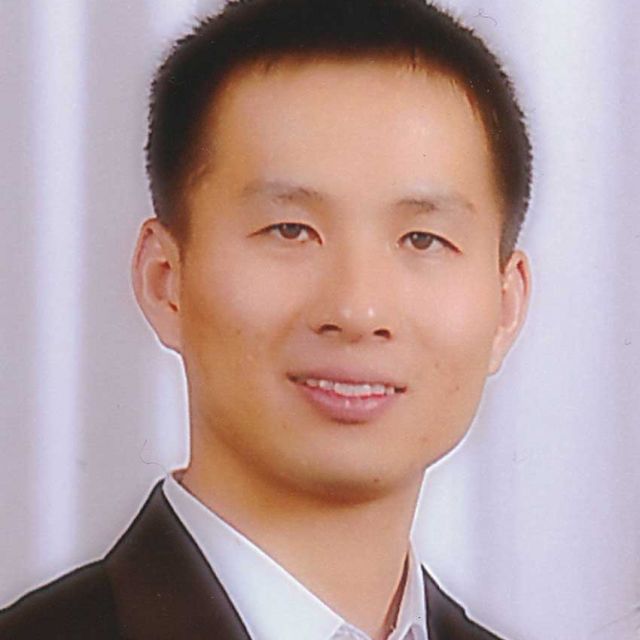
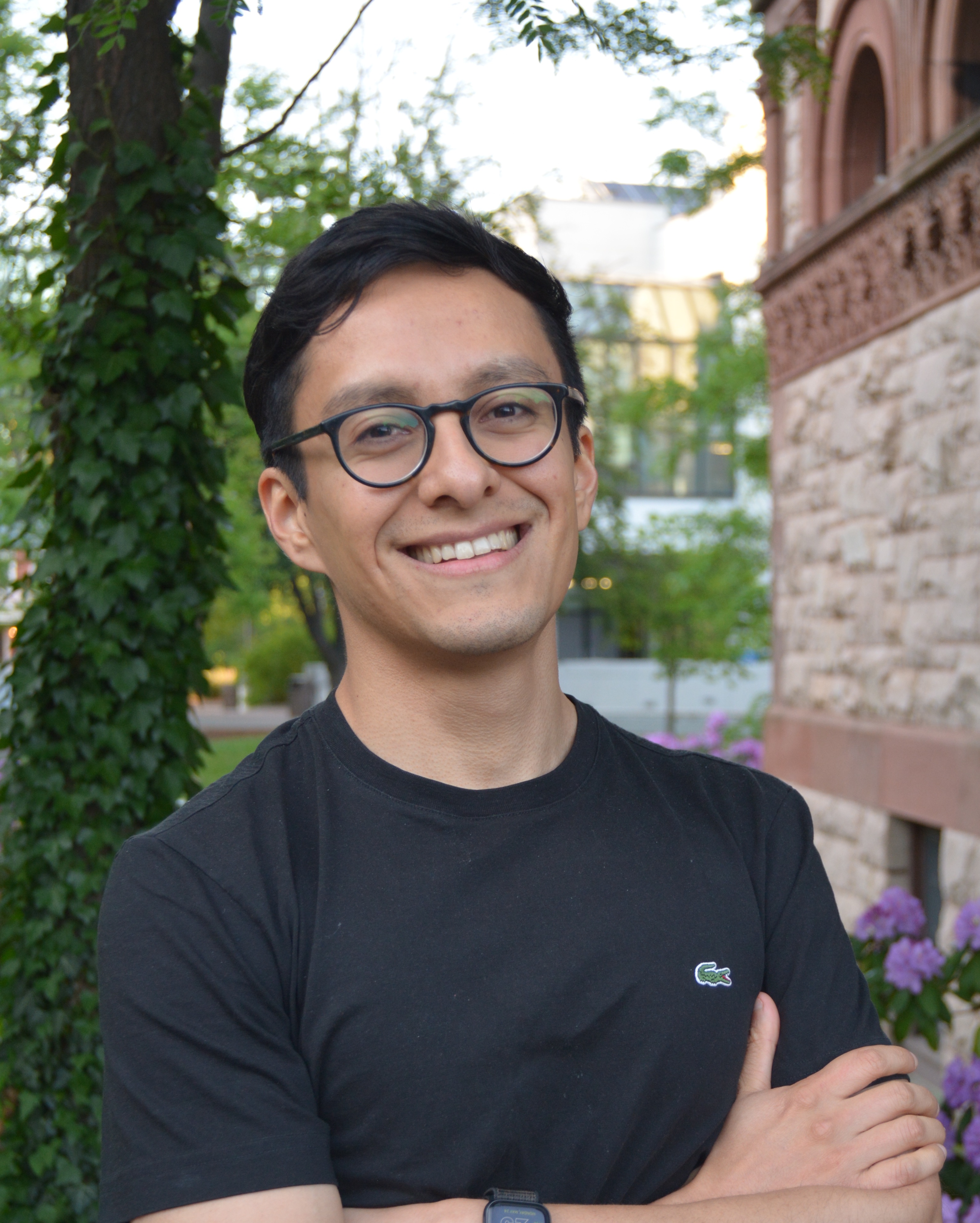
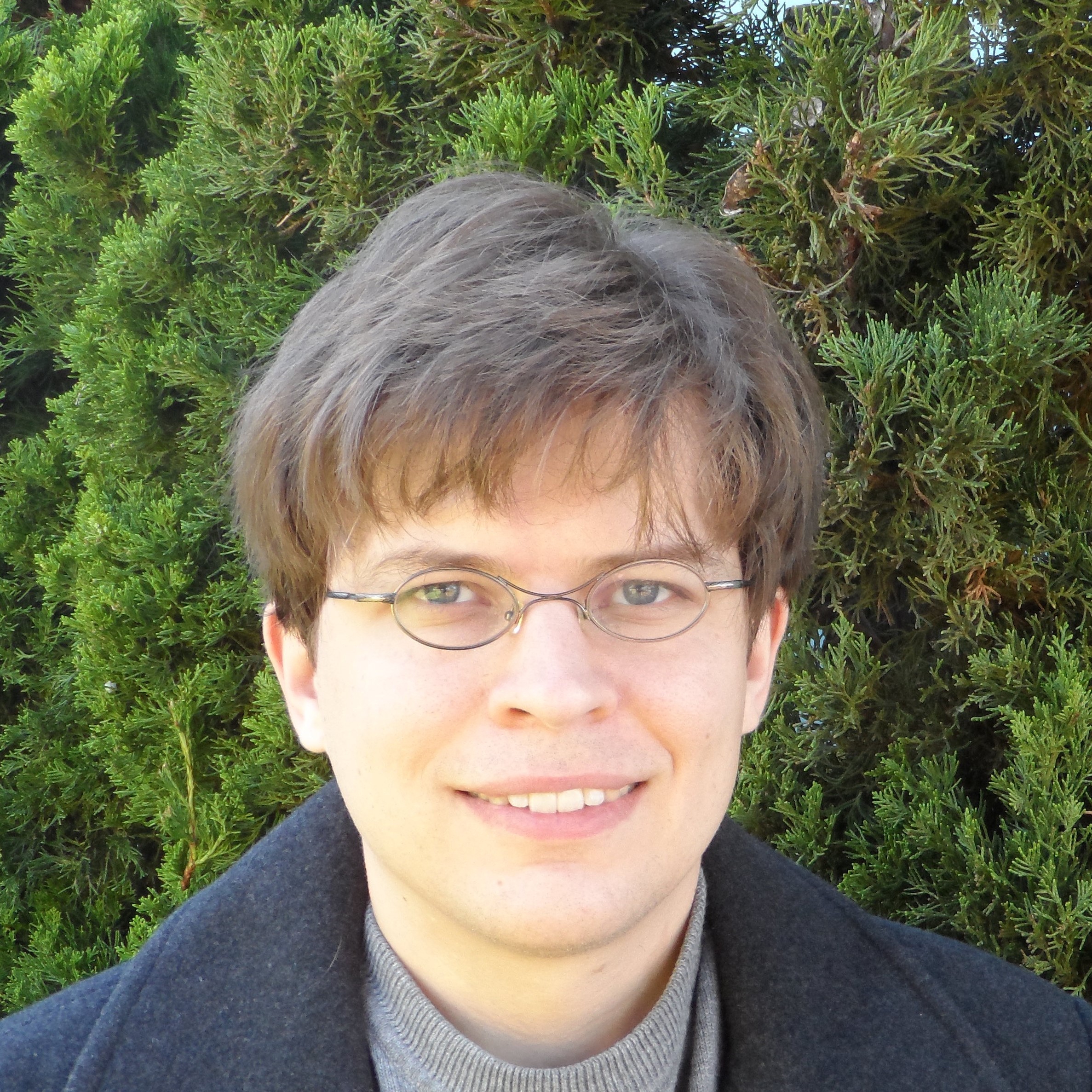
Alex Radcliffe holds a Doctor of Philosophy from King's College London and is active in theoretical physics and mathematical research. His work focuses on conformal field theory, quantum field theory, and effective field theory applications. Research interests include studying conformal defects, fusion processes, asymptotic behaviors in manifold structures, and holographic dualities. Recent work explores non-saturation phenomena in bootstrap bounds and hyperbolic orbifold geometries. His 2024 publications address foundational questions in conformal field theory and bootstrap methods, contributing to mathematical physics and high-energy physics.
Peter Schupp is a full Professor of Physics in the School of Science at Constructor University in Bremen, Germany, a position he has held since 2002. He previously served as visiting fellow and lecturer at Princeton University (1997-1999) and as assistant professor at the University of Munich (1994-1997, 1999-2002). His office is located in Research III, Room 65 on the Constructor campus. Education: PhD (Physics), University of California at Berkeley, 1990–1993 MSc (Physics), California Institute of Technology, 1989–1990 Vordiplom (Physics), University of Heidelberg, 1986–1989 Habilitation, University of Munich, 2001 Research Interests span a broad range of topics in mathematical and theoretical physics, including: Classical and quantum gravity Quantum field theory and string theory Generalized, graded and non-commutative geometry Coherent states, entropy and quantum information Non-geometric fluxes and nonassociative structures Cosmological data analysis (CMB anisotropy & non-Gaussianity) His publications reveal a steady focus on non-commutative and nonassociative extensions of geometry and gravity, as well as their implications for quantum field theory and cosmology. Recent work couples sophisticated algebraic techniques (graded Poisson algebras, Hopf algebras) to concrete physical problems such as CMB entropy measures and axion-gravity interactions. Scientific Awards & Fellowships : Heisenberg Fellowship, Deutsche Forschungsgemeinschaft (DFG), 2002 Studienstiftung des deutschen Volkes, 1986–1992 Max-Kade-Foundation Fellow, 1997–1998 Theodore S. Brown & Edith N. Brown Fellowship / Ephraim Weiss Scholarship, 1991–1992 Dora Garibaldi Scholarship, 1990–1991 Earl C. Anthony Fellowship, Caltech, 1989–1990 University Fellow, Renker GmbH & Co. KG, 1989–1991 International Physics Olympiad Silver Medal (Portorož 1985, 7th overall) International Physics Olympiad Bronze Medal (London 1986) Contact & Collaboration : Prof. Schupp welcomes inquiries at pschupp@constructor.university or by phone at +49 421 200-3224. While the text does not list specific PhD advisees, his long tenure and extensive publication record indicate active supervision of graduate researchers in theoretical and mathematical physics.
Carlos Alfonso Martin Ballon Bayona serves as an Associate Professor at the Institute of Physics, Federal University of Rio de Janeiro (UFRJ), where he conducts cutting-edge research in theoretical high energy physics. He holds a prestigious CNPq Research Productivity Scholarship Level 2 and received the CAPES Thesis Award in 2010 for his doctoral contributions. His research program focuses on fundamental connections between quantum field theories and gravitational physics through holographic frameworks. Key areas include: AdS/CFT correspondence and gauge/string duality Holographic modeling of quantum chromodynamics (QCD) Fluid/gravity correspondence applications Conformal field theory and string theory foundations Dr. Ballon Bayona's scientific recognition includes: CNPq Research Productivity Scholarship – Level 2 (ongoing research support) CAPES Thesis Award 2010 (distinguished doctoral work) His research is sustained by the CNPq productivity grant, enabling theoretical investigations into non-perturbative quantum phenomena. As core faculty in UFRJ's Physics Graduate Program, he mentors graduate students in theoretical physics despite no specific advisees being listed in available materials. His work operates within UFRJ's theoretical physics research ecosystem, advancing Brazil's contributions to fundamental physics through international collaborations in string theory and quantum gravity.
Prof. Niklas Beisert is a Professor in the Department of Physics at ETH Zurich, specializing in advanced theoretical frameworks at the intersection of quantum field theory and string theory. His research program centers on uncovering integrable structures within fundamental physical systems. His primary research domains include: Theoretical Physics with emphasis on non-perturbative methods AdS/CFT correspondence and holographic duality Algebraic structures in quantum integrability Planar gauge theories and exact solutions Yangian symmetries and Lie bialgebras Recent publications (2018, 2023) demonstrate sustained focus on algebraic approaches to integrability in gauge/string dualities, particularly examining contraction/reduction techniques for Lie bialgebras and Yangian-based correlation functions. This work advances the mathematical foundations of quantum field theories through rigorous algebraic frameworks. No scientific awards were documented in the provided materials. While student supervision and grant activities aren't specified in the source text, his publication record indicates active collaboration with researchers like Egor Im and Aleksander Garus on cutting-edge integrability problems. Laboratory or team affiliations remain unmentioned in the available documentation.
Joao Penedones is a Professor in theoretical physics specializing in quantum field theory and holographic dualities, with active research contributions evidenced by his 2021 publication in SciPost Physics. His work bridges high-energy theory and mathematical physics through advanced analytical methods. His research focuses on foundational aspects of quantum systems, particularly: Conformal symmetry and bootstrap techniques in field theory AdS/CFT correspondence applications to scattering processes Dispersion relations for correlators in critical systems Epsilon-expansion methods in renormalization group flows Amplitude structures in holographic models Non-perturbative approaches to quantum gravity duals The analysis of his sole provided publication indicates a concentration on dispersive sum rules within conformal field theory and holography, reflecting broader trends in modern theoretical physics toward unifying quantum mechanics and gravity. No scientific awards, student supervision records, or institutional affiliations were documented in the source material, and details regarding research grants or laboratory teams remain unspecified.
Elias Kiritsis is a Professor in the Department of Physics at the University of Crete, a position he has held since 1999. His academic career includes research fellowships at the University of California, Berkeley (1988-1991), Ecole Normale Superieure in Paris (1991-1992), and the CERN Theory Division (1992-1998). He is affiliated with the Crete Center for Theoretical Physics (CCTP), the Institute of Theoretical and Computational Physics, and the Crete Center for Quantum Complexity and Nanotechnology (CCQCN). His educational background includes: Undergraduate studies at the University of Athens (1984) Ph.D. in Conformal Field Theories from the California Institute of Technology (1988) Kiritsis's research is concentrated in Theoretical High Energy Physics and Cosmology, utilizing Quantum Field Theory and String Theory. His work focuses on non-perturbative aspects of Field Theory and M-Theory, including D-branes, Supersymmetry, Conformal Field Theory, Gauge Theories, Black Holes, and String Cosmology. He is particularly known for contributions to holographic QCD and the application of string theory to cosmological problems, with emphasis on de Sitter space and cosmological constant dynamics. Recent publications (2023-2025) demonstrate sustained focus on holographic methods in quantum field theory, particularly confining theories on curved backgrounds, phase transitions in symmetric holographic matter, and gravitational applications. Key trends include anomalies in effective theories, neutrino transport in dense matter, stability of spacetime geometries, and connections between string theory and Standard Model physics. His notable scientific awards include: ERC consolidator grant 'Gravity, Holography and the Standard Model' (2016) As principal investigator, Kiritsis has secured competitive research funding including the ERC grant, enabling advanced work in holographic QCD and quantum gravity. His leadership in collaborative research groups implies active mentorship of graduate students, though specific advisees are not listed in available sources. Research programs integrate theoretical exploration with computational methods across multiple physics domains. Kiritsis is integral to several research units at the University of Crete: the Institute of Theoretical and Computational Physics, the Crete Center for Theoretical Physics (CCTP), and the Crete Center for Quantum Complexity and Nanotechnology (CCQCN). These centers drive interdisciplinary work connecting string theory, quantum computing, condensed matter physics, and cosmology through holographic principles.
Davide Gaiotto serves as an Adjunct Assistant Professor in the Department of Physics & Astronomy within the Faculty of Science at McMaster University. His extensive scholarly activity spans over two decades with numerous publications in high-impact theoretical physics journals. His research focuses on the deep connections between quantum field theory, string theory, and advanced mathematical structures. Key areas include supersymmetric gauge theories (particularly N=2 and N=4), geometric Langlands program, holography, vertex operator algebras, and topological aspects of quantum field theories. His work often reveals profound mathematical structures underlying physical phenomena, bridging theoretical physics with pure mathematics. Analysis of his recent publications (2023-2025) shows continued exploration of quantum analytic Langlands correspondence, twisted holography, and the interplay between gauge theories and mathematical structures. His work demonstrates remarkable consistency in addressing fundamental questions at the physics-mathematics interface while maintaining technical rigor. Gaiotto has received significant scholarly attention with publications referenced across multiple platforms including Wikipedia pages, academic social networks, and research databases. His work shows strong interdisciplinary impact across theoretical physics and mathematics. His scholarly network includes collaborations across the theoretical physics community, with publications showing connections to leading researchers in mathematical physics and string theory. While specific grant information isn't provided in the text, the volume and quality of publications suggest sustained research support.
Xi Dong is an Assistant Professor in the Department of Physics at the University of California, Santa Barbara (UCSB). His research spans foundational questions in quantum gravity, quantum field theory, string theory, and cosmology, with a particular focus on the holographic duality between string theory and quantum field theories, and the role of quantum entanglement in the emergence of spacetime. Education and Career: Ph.D. in Physics, Stanford University B.S. in Mathematics and Physics, Tsinghua University Postdoctoral Scholar, Stanford University Member, Institute for Advanced Study, Princeton Assistant Professor, University of California, Santa Barbara (since 2017) Research Interests: Xi Dong's research lies at the intersection of quantum gravity and quantum information, exploring how spacetime and gravity might emerge from underlying quantum entanglement structures. His work includes: Understanding holographic entropy and the Ryu-Takayanagi formula Investigating quantum error correction in AdS/CFT Studying black hole interiors and the information paradox Exploring the role of replica wormholes and entanglement wedges Developing geometric and algebraic approaches to gravitational path integrals Publications: His recent work includes studies on geometric entropies, holographic entanglement negativity, gravitational path integrals, and the emergence of spacetime from entanglement. These publications are widely cited and contribute significantly to the theoretical physics community. Contact: Email: xidong@ucsb.edu Office: Broida 6103, UCSB Department of Physics Website: Xi Dong site
Peter van Nieuwenhuizen is a Dutch theoretical physicist and Professor at Stony Brook University, renowned for his foundational role in the discovery of 4D N = 1 supergravity. He has served as Director of the C. N. Yang Institute for Theoretical Physics and is celebrated for deep contributions to string theory, supersymmetry, and quantum field theory. Education: Ph.D. in Physics & Mathematics, University of Utrecht (1971) – supervised by Nobel laureate Martinus Veltman Research Interests: Van Nieuwenhuizen’s work centers on the mathematical structure of fundamental interactions. His pioneering construction of supergravity—the supersymmetric extension of Einstein’s general relativity—unified spacetime geometry with fermionic symmetries, opening new avenues in quantum gravity and string compactifications. Subsequent investigations span anomaly cancellations in superstrings, dualities in higher-dimensional field theories, and the geometric underpinnings of supersymmetric sigma models. Scientific Awards & Honors: Dirac Medal, ICTP Trieste (1993) Dannie Heineman Prize for Mathematical Physics, APS (2006) Ettore Majorana Medal, EMFCSC Erice (2016) Special Breakthrough Prize in Fundamental Physics (2019, shared with Sergio Ferrara and Daniel Z. Freedman) Fellow, American Physical Society Corresponding Member, Royal Netherlands Academy of Arts and Sciences (1994) Corresponding Member, Austrian Academy of Sciences Knight in the Order of the Dutch Lion (2004) Honorary Professor, Technical University of Vienna (2005) Advising & Institutional Leadership: At Stony Brook’s C. N. Yang Institute for Theoretical Physics, van Nieuwenhuizen has mentored numerous doctoral students, including Horațiu Năstase and Shoucheng Zhang. From 1999 to 2002 he succeeded Nobel laureate C. N. Yang as Director of the Institute, providing scientific leadership and fostering an environment for cutting-edge research in quantum field theory and string theory. Laboratories & Collaborations: Long-term affiliations include research stays at CERN (Geneva), the University of Paris–Orsay, and Brandeis University, culminating in his permanent position at Stony Brook University where he continues to guide theoretical investigations into the fundamental fabric of the universe.
Victor A. Rodriguez is a Research Fellow in the Department of Physics at the University of California, Santa Barbara , advancing theoretical physics through computational and analytical methods. Education B.S. in Physics & Mathematics from The University of Texas at Austin Ph.D. in Physics from Harvard University (2021), supervised by Xi Yin Current Position President's Postdoctoral Fellow, UC Santa Barbara , mentored by Clifford V. Johnson Research focuses on string theory , quantum gravity , and bootstrap techniques for strongly coupled systems, including non-perturbative effects in 2D gravity and cosmological applications of string theory. Scientific Awards: President’s Postdoctoral Fellowship
Xi Yin is a Professor of Physics at Harvard University's Department of Physics within the Faculty of Arts and Sciences. He is affiliated with the Center for the Fundamental Laws of Nature at Harvard and maintains an active research program in theoretical physics. Yin's research focuses on fundamental aspects of string theory and its applications across multiple domains of physics and mathematics. His work explores string theory as a framework for quantum gravity and a unified theory of everything, with particular interest in how string theory can provide insights into strongly coupled quantum field theories, conformal field theory, integrable systems, algebraic geometry, and hyperbolic geometry. His past research includes significant contributions to black holes, supersymmetric bound states in string theory, and three-dimensional conformal field theory and gauge theory. Current research directions emphasize quantum gravity in low dimensions and the holographic duality between gauge theory and string theory/gravity (AdS/CFT correspondence). Professor Yin has received numerous prestigious awards recognizing his contributions to theoretical physics, including the NSF CAREER Award, Sloan Research Fellowship, New Horizons in Physics Prize, and designation as a Simons Investigator. He serves as a principal investigator of the Simons Bootstrap Collaboration, which focuses on nonperturbative approaches to quantum field theory. Yin completed his undergraduate education at the University of Science and Technology of China, entering at age 12 and completing the 5-year bachelor program in 2001. He earned his PhD from Harvard University in 2006 under the supervision of Andrew Strominger. Following his doctorate, he was a Junior Fellow at the Harvard Society of Fellows and a Visiting Member at the Institute for Advanced Study before joining the Harvard faculty in 2008.
Aron Wall is a Professor of Theoretical Physics at the University of Cambridge, specializing in quantum gravity, black hole thermodynamics, and the holographic principle. He completed his BA at St. John's College (Santa Fe) and PhD in physics at the University of Maryland under Ted Jacobson. Postdoctoral roles at UC Santa Barbara (2011-2014), Institute for Advanced Study (2014-2017), and Stanford Institute for Theoretical Physics (2017-2019). Appointed Lecturer at Cambridge in 2019 and promoted to Professor in 2024. His research includes proposing a mechanism for traversable wormholes without exotic matter (2016 with Gao and Jafferis) via quantum entanglement, and key contributions to quantum extremal surfaces, holographic entanglement entropy, and the quantum focusing conjecture. His 2024 work explores background-independent string actions and cosmological CPT theorems, reflecting ongoing investigations into spacetime's fundamental structure. Notable scientific award: 2019 New Horizons in Physics Prize . His work intersects with philosophical and theological questions, documented on his blog Undivided Looking .
Assistant Professor Barış Efe serves in the Department of Mathematics at Yeditepe University's Faculty of Arts and Sciences, teaching undergraduate and graduate courses since 2012. His academic journey includes doctoral research at Michigan State University and prior research assistantships at Middle East Technical University. Education: PhD in Mathematics, Michigan State University (2004-2011), thesis: Calabi-Yau submanifolds of Joyce manifolds of the first kind BSc in Mathematics, Middle East Technical University (1997-2002) Research Focus: Dr. Efe specializes in geometric structures of manifolds, particularly Joyce manifolds and Calabi-Yau submanifolds , with interdisciplinary connections to theoretical physics. His work bridges differential geometry, algebraic topology, and string theory through investigations of mirror symmetry phenomena and higher geometric structures on Frölicher spaces. Publication Trends: His seminal 2010 work in Advances in Mathematics established foundational insights into mirror duality within Joyce manifolds, reflecting a consistent research trajectory exploring special holonomy and calibrated geometries. Current projects extend this work into homotopy-theoretic frameworks for non-standard geometric spaces. Administrative Leadership: Department Vice Chair (2019) Bologna Coordinator (2012) Supervision & Projects: He currently leads TÜBİTAK Project 3501 ( Homotopy theory for Frölicher spaces and higher geometric structures , 2024-ongoing, 664,000 TL budget) and has supervised master's research including ELİF's 2022 thesis on cancer modeling via partial differential equations. His extensive teaching portfolio spans linear algebra, differential equations, and advanced topics like Lie groups and differential geometry.
Toshiya Kawai is an Associate Professor at the Research Institute for Mathematical Sciences (RIMS) , Kyoto University. His work bridges physics and mathematics through rigorous explorations of quantum field theory and string theory. Research interests include: String duality phenomena and geometric correspondences 2D conformal field theory (2d CFT) Gromov-Witten invariants and brane counting Elliptic genus, cohomology, and Jacobi forms Borcherds products in algebraic geometry
Giuseppe De Luca is a Research Fellow at the Department of Physics and Chemistry - Emilio Segrè, University of Palermo. His work spans interdisciplinary domains including theoretical physics, biophysics, machine learning, and social dynamics. Research Themes : Model averaging techniques, liquid-liquid phase separation, quantum complexity, holography, and social exclusion effects in education. Methodologies : Bayesian inference, multiscale analysis, and machine learning optimization. Recent publications focus on weighted-average least squares estimation, structural degradation in biomaterials, and virtual reality applications in psychological research. He contributes to the SHARE project with statistical expertise in survey weighting and imputation strategies.