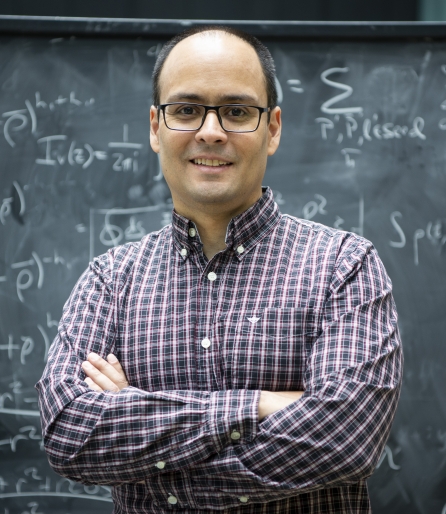
Silviu Pufu is a Professor of Physics at Princeton University, where he earned both his A.B. (2007) and Ph.D. (2011) in Physics. Prior to his faculty position, he was a Pappalardo Postdoctoral Fellow at MIT (2011–2013). His research focuses on quantum field theory, string theory, and gravity, with emphasis on conformal field theory, gauge/gravity duality, and lattice gauge theory. He has received the Alfred P. Sloan Research Fellowship (2017) and led the Simons Collaboration for Nonperturbative Bootstrap (2016–2023). His work explores advanced topics such as AdS/CFT correspondence, M-theory corrections, and non-perturbative bootstrap methods. Pufu advises three graduate students: Ross Dempsey, Debaditya Pramanik, and Benjamin Søgaard. His research outputs span theoretical frameworks like super-Yang-Mills theories, M-theory orbifolds, and lattice Hamiltonian formulations of QCD. His 2020–2025 publications highlight contributions to bootstrap techniques, holographic calculations, and precision studies of strongly coupled systems.
Professor Keshav Dasgupta holds the position of Professor in Physics at McGill University since March 2021. His academic journey includes a MSc from the Indian Institute of Technology, Delhi and a PhD from the Tata Institute of Fundamental Research, Mumbai. Postdoctoral research followed at the Institute for Advanced Study (Princeton, USA) and Stanford University (USA). He transitioned to faculty roles at McGill starting as an Assistant Professor (2005-2010), then Associate Professor (2010-2021), and currently as a full Professor. His research interests span Superstring Theory (focusing on flux compactifications and gauge/gravity dualities), String Cosmology (exploring de Sitter spaces and primordial phenomena), Quantum Field Theories (confinement dynamics in thermal QCD), and Mathematics (non-Kähler manifolds and Lie group applications in string theory). He also investigates Knot Theories within M-theory frameworks. Recent work emphasizes de Sitter vacua in string theory, leveraging Glauber-Sudarshan states and confronting swampland conjectures. His publications address topics like holographic QCD, quantum gravity equations, and non-perturbative string solutions. He teaches advanced courses such as PHYS 562: Electromagnetic Theory (Winter 2023).
Michał Pilipczuk is an Associate Professor at the Institute of Informatics, Faculty of Mathematics, Informatics and Mechanics of the University of Warsaw. His research focuses on theoretical computer science, particularly algorithms on discrete structures, parameterized algorithms, structural graph theory, and logic in computer science. He leads the ERC-funded project "BOBR: Decomposition Method for Discrete Problems" and previously led a grant on optimality in parameterized complexity funded by the Polish National Science Center. His research interests include parameterized algorithms , structural graph theory , graph algorithms , and computational complexity . He has made significant contributions to the understanding of problems such as Independent Set in restricted graph classes, graph editing problems, and structural decompositions. The recent publications highlight a strong focus on structural graph theory and exact algorithms . Key themes include quasi-polynomial time algorithms for Independent Set in claw-free graphs, diameter computation in bounded genus graphs, and kernelization in trivially perfect graphs. His work often bridges combinatorial insights with algorithmic applications, particularly in the context of parameterized complexity. Principal Investigator, ERC Grant BOBR: Decomposition Method for Discrete Problems (2021–2026) Principal Investigator, Polish National Science Center Grant on Optimality in Parameterized Complexity (2014–2017) He has advised or collaborated with several researchers, including Marcin Wrochna and Marcin Pilipczuk. His work is published in top venues such as STOC, SODA, ESA, and ICALP.
Olaf Kaczmarek is a researcher at the Faculty of Physics , Bielefeld University , specializing in Lattice Quantum Chromodynamics (QCD) and Strongly Interacting Matter . He leads projects related to QCD thermodynamics , quark-gluon plasma , and heavy quark transport . Principal Investigator in TRR 211/2 Subproject A06: Hadronic Excitations and Spectral Functions in the Medium (2025) Co-PI in TRR 211/2 Subproject Z02: Software Development Center (2025) Contributor to GPUHEP2014 and LATTICE2024 symposia Research Focus: Thermal QCD phase transitions, heavy quark diffusion , transport coefficients , lattice simulations , and quarkonium spectroscopy . His work bridges theoretical physics and high-performance computing , particularly in Multigpu Systems for QCD calculations. Recent Publications explore topics like the chiral crossover , spatial string tension , and thermal photon production , with keywords spanning Quantum Chromodynamics , Lattice Gauge Theory , and High Temperature Physics . Teaching: Offers courses in Lattice Field Theory , GPU Computing , and Gradient Flow for graduate students. Contributes to collaborative seminars in the CRC-TR211: Strong-interaction matter under extreme conditions .
Kaidi Yang is an Assistant Professor at the National University of Singapore (NUS) in the Department of Civil and Environmental Engineering, specializing in Intelligent Transportation Systems and related fields. He holds a PhD from ETH Zurich (2019), an M.Sc. in Control Science and Engineering from Tsinghua University (2014), and dual bachelor’s degrees in Automation and Mathematics from Tsinghua University (2011). His research focuses on advancing traffic control, connected/automated vehicles, shared mobility systems, and data privacy in transportation. He has contributed to developing algorithms for efficient traffic signal control, platooning coordination, and privacy-preserving data sharing in transportation networks. Education: Ph.D., Civil and Environmental Engineering (Transportation), ETH Zurich, 2019 M.Sc., Control Science and Engineering, Tsinghua University, 2014 B.Sc./B.Eng., Dual Degrees in Pure/Applied Mathematics and Automation, Tsinghua University, 2011 Yang has received prestigious awards including the Swiss National Science Foundation’s Postdoc Mobility Fellowship (2021–2022) and the IEEE ITS Conference Best Student Paper Award (2020). He serves as an Associate Editor for the IEEE Conference on Intelligent Transportation Systems (2024). His work bridges theoretical advancements in operations research, robotics, and machine learning with practical applications in urban mobility systems. Recent efforts emphasize integrating privacy-preserving techniques into traffic management and optimizing mixed-autonomy platoon control.
Cynthia Yan is a Visiting Professor in the Physics Department at Stanford University, affiliated with the School of Humanities and Sciences. Her academic appointment was noted for the 2019 academic year. Her research focuses on theoretical physics with an emphasis on quantum gravity, string theory, supersymmetry, and black hole physics. She explores topics such as BPS black hole microstates, entanglement in quantum systems, and holographic dualities. Her work bridges advanced mathematical techniques with foundational questions in high-energy physics, including studies on wormholes, topological quantum field theories, and the interplay between QCD effects and particle physics observables like the Z boson forward-backward asymmetry. While specific grants or awards are not listed, her publications reflect engagement with cutting-edge theoretical frameworks and interdisciplinary methods. Though no student advisees are explicitly documented here, her contributions to areas like matrix theory and emergent spacetime suggest involvement in graduate-level research training. Contact information specific to her role is not provided in the available data.
Konstantin Wernli is an Assistant Professor in the Department of Mathematics and Computer Science at the University of Southern Denmark, affiliated with the Quantum Mathematics research group. His research focuses on quantum field theory, geometric quantization, and mathematical physics, with a particular emphasis on topological field theories and perturbative methods. He has contributed to foundational work in Chern-Simons theories, BV-BFV formalisms, and geometric analysis. His research interests include quantum field theories, algebraic geometry, and the intersection of topology with physics. Notably, he explores combinatorial approaches to quantum field theory, geometric quantization frameworks, and the application of advanced mathematical tools to solve problems in theoretical physics. Recent work includes studies on partition functions, constrained dynamical systems, and the globalization of sigma models. His articles often bridge abstract mathematics with physical applications, such as analyzing heat kernels, theta invariants, and entanglement polytopes. Wernli is a project participant in the Sapere Aude grant 'FROM PERTURBATIVE TO NON-PERTURBATIVE QUANTUM FIELD THEORY BY CUTTING AND GLUING' (2024–2028), which aims to advance non-perturbative QFT techniques. He has advised on research projects involving heat kernel analysis and geometric quantization, though no formal student advisees are listed.
Rob Silversmith is a Warwick Zeeman Lecturer in the Warwick Mathematics Institute at the University of Warwick, with a focus on algebraic geometry and combinatorics. Starting Fall 2025, he will transition to an Assistant Professor role at Emory University. His academic journey includes a Ph.D. from the University of Michigan (2017), advised by Yongbin Ruan, and postdoctoral positions at Northeastern University and the Simons Center for Geometry and Physics. His research interests span algebraic geometry—particularly moduli spaces of curves, tropical geometry, and combinatorial structures—as well as connections to string theory, geometric rigidity, and dynamics. Key contributions include work on Gromov-Witten invariants, cross-ratio degrees, and the T-graph of Hilbert schemes. His recent publications (2021–2025) explore topics such as moduli spaces, tropical geometry, and combinatorial algebraic geometry, reflecting a blend of geometric and computational methods. Notable collaborations include work with R. Cavalieri, T. Kelly, and R. Ramadas on projects like Genus-zero r-spin theory and Equations at infinity for critical-orbit-relation families of rational maps . Rob has advised no listed graduate students but has contributed to interdisciplinary projects involving computer-aided conjecture-making. His scholarly activities include organizing seminars and maintaining an active presence in geometric research communities. He is affiliated with the Warwick Mathematics Institute and holds a position in the Zeeman Building. His work frequently intersects with combinatorial and computational approaches to algebraic geometry, emphasizing explicit polynomial constructions and data-driven conjectures.
Professor Ivo Sachs is a distinguished theoretical physicist at the Ludwig-Maximilians-Universität München (LMU), where he holds a position at the Arnold Sommerfeld Center for Theoretical Physics with a Chair on Cosmology. His research spans multiple areas of theoretical physics with a particular focus on string theory, quantum field theory, and cosmological applications. He maintains an active research program with numerous recent publications in prestigious journals. Professor Sachs' research interests center around fundamental theoretical physics, with significant contributions to string field theory, cosmological perturbation theory, and the mathematical structures underlying quantum gravity. His work often bridges abstract mathematical concepts with physical applications, particularly in understanding the early universe and quantum aspects of gravity. He has developed innovative approaches to studying cosmological correlators, spinning particles, and the relationship between quantum field theory and gravitational physics. Analysis of his recent publications reveals a strong focus on the intersection of cosmology and string theory, with particular attention to mathematical structures in quantum gravity. His work demonstrates consistent exploration of how quantum field theory techniques can be applied to cosmological problems, especially regarding correlation functions in the early universe. He frequently collaborates with researchers across Europe, indicating an active international research network. Martín Enríquez Rojo (PhD, 2022): Asymptotic symmetries in FLRW and deformations of gravitational symmetry algebras
Po-Shen Hsin is a Lecturer in the Department of Mathematics at King’s College London. He holds a BSc in Physics from National Taiwan University (2012), an MA in Physics from Princeton University (2016), and a PhD in Physics from Princeton University (2018). His research focuses on theoretical physics, particularly quantum field theory, strongly interacting systems, topological phases of matter, and the interplay of symmetries and anomalies. He explores topics such as non-invertible symmetries, higher-form anomalies, and their implications for topological phases and condensed matter systems. His work spans theoretical frameworks like gauge theories, topological defects, and quantum error correction codes, with applications to understanding exotic phenomena in materials and high-energy physics. Notable themes include symmetry-enriched topological phases, anomaly detection, and the classification of logical gates in quantum codes via cohomology operations. His research group at King’s College is part of the broader efforts in supersymmetry, string theory, and related areas within the Faculty of Natural, Mathematical & Engineering Sciences. His contributions bridge fundamental theoretical insights with potential applications in quantum technologies and condensed matter systems.
Christoph Schweigert is full Professor (W3) of Mathematics at the University of Hamburg , based in the Department of Mathematics within the Faculty of Mathematics, Informatics and Natural Sciences (MIN-Fakultät). Since 2003 he has held this permanent chair, and he currently serves as a Principal Investigator and Area Coordinator for Quantum Theories in the Cluster of Excellence “Quantum Universe” . In addition he is a member of the Centre for Mathematical Physics , the DFG Collaborative Research Centre SFB 1624 and the Research Training Group 1670 “Mathematics inspired by string theory and quantum field theory” . Education & Career Path: 1987–1992: Degree in Physics, Universität Heidelberg 1995: PhD in Mathematics, University of Amsterdam (supervisor: Robbert Dijkgraaf) 1995–1996: Postdoc, IHÉS, Bures-sur-Yvette 1997–1998: Fellow, CERN, Geneva 1999–2002: Lecturer (tenured), LPTHE, Université Paris 6; Habilitation 2000 2002–2003: Professor (C3) for Physics, RWTH Aachen Since 2003: Professor (W3) for Mathematics, Universität Hamburg Research Interests: Schweigert’s work lies at the intersection of algebra, category theory, topology and mathematical physics . He focuses on tensor categories , Hopf algebras and quantum groups , topological and conformal field theories , string-net models , and modular functors . These structures find applications in quantum topology, knot theory, 3-manifold invariants, quantum codes and quantum information theory . Editorial & Service Roles: Editor, Communications in Mathematical Physics (since 2017) Editor, Letters in Mathematical Physics (since 2009) Editor, Journal of Mathematical Physics (since 2006) Editor, Springer book series Algebra and Applications (since 2005) Spokesperson/Deputy spokesperson, DFG-RTG 1670 Member, steering committee, DFG Priority Program “Representation theory” Henriette-Herz scout for the Humboldt Foundation (since 2020) Teaching & Supervision: Schweigert regularly teaches advanced courses in linear algebra, Hopf algebras, quantum groups and topological field theory at bachelor, master and graduate levels. He organises the research seminar Algebra and Mathematical Physics and the joint seminar Quantum Physics and Geometry . Office hours are by appointment via email. Laboratory & Research Group: He leads an active research group based in the Geomatikum building (Room 313), collaborating closely with PhD students, postdocs and visiting researchers on projects in tensor categories, TQFT and related areas.
Larissa V. Bravina is a Professor of Theoretical Physics at the Department of Physics, University of Oslo (2003-present). Her career spans institutions across Russia, Norway, and Germany, including post-doctoral work at the University of Bergen and fellowships at the University of Frankfurt. Education PhD in Physics and Mathematics (1990, Moscow State University) Master Degree in Physics (1982, Moscow State University) Bravina specializes in theoretical modeling of relativistic heavy-ion collisions, focusing on Quark-Gluon Plasma formation, hydrodynamic evolution, jet quenching, and anisotropic flow. Her work integrates computational physics for simulating pp, Pb+Pb, and A+A collisions at LHC energies. Article Trends Her recent publications emphasize Monte Carlo simulations , shear viscosity , Unruh effect , and QCD phase transitions , with collaborations on laser-induced fusion and hyperon polarization . Key keywords include Nuclear Physics , Computational Modeling , and Quantum Chromodynamics . Scientific Awards Alexander von Humboldt Fellowship (1997) 3rd Prize, SINP MSU Young Scientists Competition (1989) 1st Prize (Group), SINP MSU Young Scientists Competition (1987) Advising & Collaborations She has supervised 4 doctoral students to completion (Konrad Tywoniuk, Ionut Arsene, Mads S. Nilsson, Gylnara Eyyubova) and currently mentors 2 unnamed students. Bravina organizes the annual international conference New Frontiers in Physics and collaborates with institutions like Los Alamos National Laboratory, Niels Bohr Institute, and ITEP Moscow.
Anastasia Volovich is a Professor of Physics at Brown University, specializing in theoretical physics with a focus on quantum field theory, string theory, general relativity, and their mathematical foundations. Her research explores hidden mathematical structures in scattering amplitudes to advance understanding of gauge and gravity theories. B.A. and M.A. in Physics, Moscow State University (1999) Ph.D. in Theoretical Physics, Harvard University (2002) Her work on scattering amplitudes involves cluster algebras, polylogarithms, and celestial holography. Recent publications address symbol alphabets, Landau singularities, and Yangian invariants in high-energy physics. Notable honors include: APS Fellowship (2019) IBM Einstein Fellowship (2017) Blavatnik National Finalist (2016-2018) Simons Investigator Award (2015) DOE Early Career Award (2011) NSF CAREER Award (2007) White House PECASE (2008) She has held editorial roles at Letters in Mathematical Physics and Physics Letters B , and her research is funded by the Department of Energy and Simons Foundation.
Dr. Mukund Rangamani is a Professor of Physics at the University of California, Davis. His research focuses on theoretical physics, particularly in String Theory , AdS/CFT Correspondence , and Quantum Gravity . Key affiliations: Department of Physics, UC Davis Research areas: Applications of string theory to quantum field theory and quantum gravity, holographic duality, non-equilibrium thermal systems Recent publications highlight his work on holographic thermal correlators , black hole thermodynamics , anomalous hydrodynamics , and Schwinger-Keldysh formalism in strongly coupled systems. His studies bridge quantum entanglement , relativistic hydrodynamics , and gravitational duals .
Freddy Cachazo is an Adjunct Professor at the University of Waterloo and Interim Deputy Director at the Perimeter Institute for Theoretical Physics. His research focuses on mathematical physics, quantum field theory, and scattering amplitudes, with significant contributions to the CHY construction and tropical geometry applications. He has held roles including Postdoctoral Member at the Institute for Advanced Study (2002–2005) and Member of the School of Natural Sciences (2009–2010). Research interests include massless particles (gluons, gravitons), twistor theory, and high-energy physics. His work bridges theoretical physics with algebraic geometry and combinatorics, exemplified by collaborations on generalized amplitudes and Feynman diagram structures. Awards include the 2014 New Horizons in Physics Prize and 2016 CAP-CRM Prize. Recent publications (2022–2024) explore tropical Grassmannians, NMHV gravity amplitudes, and planar Feynman diagrams. He advises graduate students at Perimeter Institute and collaborates internationally on advancing scattering amplitude frameworks.