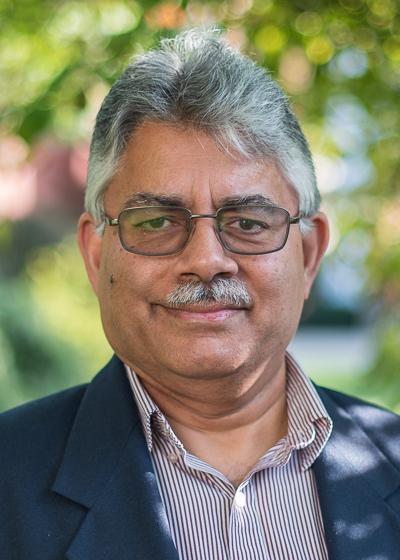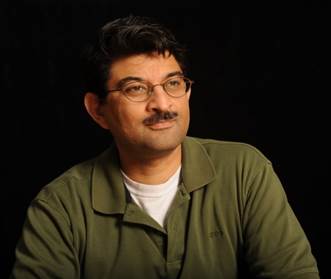
Khurram K. Afridi is a Professor in the Electrical and Computer Engineering Department at Cornell University's College of Engineering. With a BS from Caltech and SM/PhD from MIT, he leads the High-Frequency Power Electronics and Control (HFPEC) research group. His work focuses on high-frequency power electronics, wireless power transfer systems, and electric vehicle charging infrastructure. Dr. Afridi's research spans capacitive wireless power transfer systems for electric vehicles, high-frequency power converters , impedance control networks , and power density optimization . His team has developed innovative approaches for multi-MHz wireless power transfer, reduced-fringing-field systems, and high-efficiency power conversion architectures. Recent work emphasizes practical implementation challenges including thermal management, pavement-embedded systems, and dynamic charging applications. His publications reveal a strong focus on high-power-density systems , wireless charging technologies , and advanced power conversion techniques . The research spans both theoretical modeling and practical implementation, with numerous papers in top conferences like APEC, ECCE, and IEEE journals. Key themes include improving power transfer efficiency at multi-MHz frequencies, developing novel matching network designs, and creating practical systems for electric vehicle charging infrastructure. First Place Prize Paper Award, IEEE Journal of Emerging and Selected Topics in Power Electronics, 2023 First Place Best Contribution Award, IEEE WPTCE, 2023 Second Place Prize Paper Award, IEEE Transactions on Power Electronics, 2022 Distinguished Lecturer, IEEE Vehicular Technology Society, 2022 Cornell Engineering Research Excellence Award, 2021 NSF CAREER Award, 2016 Dr. Afridi has successfully advised numerous graduate students who have received multiple Outstanding Presentation Awards at major conferences. His research has been supported by significant funding including the NSF CAREER Award. The HFPEC group maintains strong industry connections and focuses on translating theoretical advances into practical power electronics solutions with real-world impact. Current research directions include electrified roadways, dynamic wireless charging systems, and high-power-density power conversion architectures for next-generation applications.