Dale Edward Squires is an economist affiliated with the Southwest Fisheries Science Center under the US NOAA Fisheries in La Jolla, California, and serves as an Adjunct Professor of Economics at the University of California San Diego . His work bridges economic analysis with marine conservation and fisheries policy. Research interests include: Marine economics and fisheries management Bycatch mitigation strategies Conservation agreements and policy frameworks Data-limited fisheries analysis Stakeholder-driven resource governance Deep sea mining regulations Recent publications focus on multidisciplinary approaches to bycatch reduction, sustainable tuna management, shark conservation frameworks, and stakeholder participation in deep-sea mining policies. His collaborations span institutions in the US, UK, Sweden, and international foundations.
Prof. Koh Lian Pin serves as Director of the National University of Singapore's Centre for Nature-based Climate Solutions, Vice President (Sustainability and Resilience), and Chief Sustainability Scientist. He holds the Kwan Im Thong Hood Cho Temple Chair Professorship in Conservation within the Department of Biological Sciences, Faculty of Science, where he leads university-wide sustainability initiatives bridging academia, policy, and industry. His academic credentials include: Ph.D. in Ecology and Evolutionary Biology from Princeton University B.Sc. (First Class Honours) and M.Sc. in Biological Sciences from the National University of Singapore Prof. Koh's research develops policy-relevant science to reconcile human development with environmental protection, specializing in conservation science, nature-based climate solutions, and sustainability in tropical developing regions. His work emphasizes practical decision-support tools for biodiversity conservation and climate mitigation, with particular focus on Southeast Asia's ecological challenges where rapid population growth intersects with extreme poverty and biodiversity richness. Recent publications (2020-2022) demonstrate consistent leadership in climate-biodiversity nexus research, particularly forest carbon projects, reforestation constraints, and palm oil impacts. His work frequently appears in Nature and Science journals, showing strong emphasis on spatially-explicit conservation planning and policy-relevant metrics for climate action in the tropics. Professional recognitions include being one of Asia's most highly cited conservation scientists, a World Economic Forum Young Global Leader, TED-Global speaker, and Founding Director of ConservationDrones.org. He also served as a Nominated Member of Singapore's 14th Parliament. Prof. Koh oversees NUS's sustainability research strategy through whole-of-university collaborations, having previously directed the Tropical Marine Science Institute and co-directed NUSDeltares. His leadership connects scientific research with real-world climate resilience solutions across Singapore and the Asia-Pacific region. He heads the Centre for Nature-based Climate Solutions, a multidisciplinary hub producing cutting-edge science for climate policies. The Centre coordinates research teams across ecology, policy, and social sciences to develop implementable nature-based solutions for regional climate challenges.
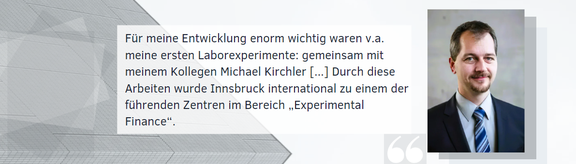
Jürgen Huber is a Full Professor in Finance and Head of the Department of Banking and Finance at the University of Innsbruck. He has been a central figure in experimental finance since 1998, founding the Society for Experimental Finance and leading international collaborations with institutions like Stockholm School of Economics and VU Amsterdam. Education: PhD in Political Sciences (2001) and Business Administration (Habilitation, 2007), both from University of Innsbruck. Research Interests: His work spans Experimental Economics , Behavioral Finance , and Meta Science , focusing on market microstructure, replicability of scientific research, and communication behavior. Recent projects explore: Climate change policy through CO2 taxation and climate dividends . Digital finance implications of cryptocurrencies and NFTs . Communication differences (face-to-face vs. online) and their impact on decision-making. Scientific objectivity in peer review via the Nobel and Novice project. Article Trends: His 2024 publications in Nature Human Behaviour and PNAS emphasize replicability crises, climate economics, and communication behavior. Earlier work in Management Science and Journal of Economic Behavior and Organization analyzes market microstructure, financial transaction taxes, and crowd-sourced research validation. Scientific Awards: Voted Professor of the Year by students (2019-2023), with multiple FWF and OeNB grants totaling over €1 million. Received the Pater Johannes Schasching SJ-Preis (2016) and Forschungspreis der Stiftung Südtiroler Sparkasse (2015). Teaching: Integrates research into interactive lectures, including lab-based simulations for stock market experiments. Taught at universities in Austria, Germany, USA, Thailand, Vietnam, and Indonesia.
George O. Aragon is a Professor of Finance at the W. P. Carey School of Business, Arizona State University. He specializes in the structure, efficiency, and risk management practices of financial services institutions, particularly hedge funds and mutual funds. His research has been published in leading journals such as the Journal of Financial Economics and the Review of Financial Studies , where he also serves as an associate editor. He has held visiting roles at the U.S. Securities and Exchange Commission and teaches courses on derivatives and risk management at both undergraduate and graduate levels. Education Ph.D. in Finance (Boston College, 2005) M.Sc. in Finance and Economics (London School of Economics, 1999) Research Interests Aragon’s work focuses on institutional investor behavior, liquidity management in volatile markets, and the interplay between regulatory frameworks and financial stability. His recent studies examine hedge fund strategies in crises, ESG investment dynamics, and the impact of investor attention on mutual fund performance. He employs empirical methods and machine learning to analyze large datasets, including SEC filings and market microstructure data. Teaching Regularly teaches FIN 427: Derivative Financial Securities and FIN 530: Derivatives . Courses emphasize practical applications of derivatives in risk management and portfolio optimization. Recent Research Trends His articles highlight themes such as liquidity mismatch in hedge funds, anticipatory trading during crises, and the costs/benefits of responsible investing for university endowments. The 2024 paper on ‘Hedge Fund Liquidity Management’ underscores the tension between crisis resilience and trading opportunities. The 2023 study on ESG preferences uses machine learning to decode investor priorities across 500+ metrics. Grants and Collaborations No specific grants are listed, but his editorial roles and SEC collaborations suggest active involvement in policy-relevant research. Lab/Team Affiliations No formal lab mentioned, but his SSRN and Google Scholar profiles indicate ongoing collaborations with industry and academic partners.
Professor Peter Macreadie is a global leader in marine science and sustainability at RMIT University, where he serves as Director of the Centre for Nature Positive Solutions and founder of the Blue Carbon Lab. He holds a professorial appointment in the School of Science and has held prior roles at Deakin University (2016–2024). His research focuses on leveraging nature-based solutions to mitigate climate change, including blue carbon ecosystems (mangroves, seagrasses, tidal marshes) and teal carbon innovations. He leads interdisciplinary projects in ecosystem restoration, coastal protection, and natural capital accounting, collaborating with governments, industries, and communities. Macreadie’s work spans over 250 publications in top journals like Science and Nature Climate Change , and he has attracted over $35M in research funding. His awards include the 2023 Frontiers Planet Prize and 2020 Premier’s Sustainability Award. He emphasizes translating science into actionable policies and practices, addressing challenges like microplastics, offshore infrastructure decommissioning, and citizen science engagement. Research Themes: Blue Carbon, Climate Mitigation, Ecosystem Restoration Key Projects: Mangrove restoration cost-benefit analysis, ocean alkalinity enhancement, and hybrid green-grey infrastructure He actively supervises PhD and industry projects, such as investigating microplastic impacts on blue carbon systems and feasibility of ocean alkalinity projects. His work aligns with UN Sustainable Development Goals 13 (Climate Action), 14 (Life Below Water), and 15 (Life on Land).
Dr. Young Jun CHO is an Associate Professor of Accounting at the Singapore Management University (SMU), School of Accountancy. He joined SMU in 2011 after completing his PhD at Cornell University. His research focuses on financial reporting, voluntary disclosures, corporate governance, and sustainability reporting. He teaches financial accounting, financial accounting for law, and financial statement analysis at both undergraduate and postgraduate levels. Education: PhD in Management (Accounting), Cornell University, US MS in Management, Cornell University, US MS in Accountancy, University of Illinois at Urbana-Champaign, US MBA, Yonsei University, South Korea BA, Yonsei University, South Korea His research interests include the interplay between corporate disclosures, managerial incentives, and market efficiency. Recent work examines XBRL adoption, green supply chain disclosures, and the impact of segment reporting on internal capital markets. He has been recognized with awards such as the School of Accountancy Research Award (2012) and the Lee Foundation Fellowship (2011). Dr. CHO's publications span top accounting journals like The Accounting Review and Journal of Accounting Research. His grants and advising contributions are integral to the School of Accountancy's strategic priorities in Corporate Reporting & Disclosure and Sustainable Living initiatives.
William Akoto is an Assistant Professor of Global Security in the Department of Foreign Policy & Global Security at the School of International Service, American University, and serves as Director of Research at the Center for Security, Innovation, and New Technology (CSINT). Previously, he taught at Fordham University, the University of South Carolina, and Nelson Mandela University in South Africa. Education: PhD in Political Science, University of South Carolina, 2019 Research Interests: Dr. Akoto's work centers on interstate cyber conflict dynamics , examining how states weaponize cyber capabilities for national security objectives. His research extends to the political economy of aid and trade , analyzing debt relief mechanisms and trade-sanction interactions, and military coups , investigating coup triggers and consequences through complex systems theory. He develops microfounded theoretical models to explore institutional and preference-based drivers of state behavior. Publication Trends: His 2020-2024 publications reveal a decisive shift toward cyber conflict research, with 80% of recent work focusing on state-sponsored cyber attacks, economic espionage, and cyber-proxy warfare. This builds on earlier expertise in trade-politics linkages (2013-2020), demonstrating consistent application of political economy frameworks across security domains. His methodology increasingly integrates complex systems science to analyze large-scale behavioral patterns. Scientific Awards: SIS Collaborative Research Award (June 2024) Outstanding Graduate Student Teacher Award (April 2019) Adam Smith Fellow, Mercatus Center (August 2016–July 2017) Thurmond-Atwater Fellowship (July 2015–May 2016) IAAR Research Fellow (August 2014–July 2015) Advising and Grants: Dr. Akoto has secured competitive research funding including the 2024 SIS Collaborative Research Award and Mercatus Center fellowship. His teaching excellence was recognized with the 2019 Outstanding Graduate Student Teacher Award. While specific advisees aren't documented, his course designs emphasize analytical skill development through constant feedback mechanisms, debate, and current events integration across undergraduate international relations curricula. Labs and Teams: As CSINT Director of Research, he leads interdisciplinary initiatives examining emerging technology-security intersections, with current focus on cyber warfare economics, satellite cybersecurity, and AI governance frameworks through structured collaboration between academic researchers and security practitioners.
Tim Baldenius serves as the Paul M. Montrone Professor of Private Enterprise in the Accounting Division of Columbia Business School at Columbia University. He rejoined Columbia in 2017 after serving as Chair of NYU Stern's Accounting Department (2011-2016), and previously held faculty positions at Columbia Business School (1998-2011) where he chaired the Accounting Division (2009-2011). His teaching portfolio includes MBA courses in Financial Planning & Analysis, PhD seminars on managerial accounting, and executive education programs. His academic credentials include a Diploma in Business Administration from the University of Hamburg and a PhD in Accounting from the University of Vienna. Baldenius maintains editorial leadership as Associate Editor of Management Science and serves on the editorial boards of The Accounting Review , Review of Accounting Studies , and Review of Managerial Sciences . Professor Baldenius's research centers on managerial accounting systems, performance measurement frameworks, and corporate governance structures. His work examines how accounting information drives organizational decision-making, incentive design, and resource allocation. Key themes include transfer pricing mechanisms, cost allocation methodologies, and the interplay between managerial and tax objectives within multidivisional firms. His theoretical models often integrate contract theory with organizational economics to address real-world coordination challenges. His publication record spans top-tier journals in accounting, finance, and economics, revealing consistent focus on performance measurement systems (35%), transfer pricing (25%), corporate governance (20%), and incentive design (20%). The research demonstrates strong methodological diversity, employing game theory (40%), mathematical modeling (30%), and empirical analysis (30%) to investigate organizational decision processes. Baldenius has held significant leadership roles including Accounting Division Chair at Columbia (2009-2011) and Accounting Department Chair at NYU Stern (2011-2016). His teaching spans MBA, MS, PhD, and executive education programs with courses covering Financial Planning & Analysis, Accounting for Consultants, and Analytical Models in Accounting. His case studies on Sub-Micron Devices Inc. and Beanie Kids Holiday Camp are widely used in accounting pedagogy.
Luann J. Lynch is the Almand R. Coleman Professor of Business Administration at the University of Virginia Darden School of Business, where she teaches Accounting in the First Year core MBA program and a Second Year elective in management accounting . With a B.S. from Meredith College , an MBA from Duke University , and a Ph.D. in Accounting from the University of North Carolina , she combines academic rigor with extensive industry experience from roles at Roche Biomedical Laboratories, Northern Telecom, and Procter & Gamble. Recipient of the University of Virginia Alumni Board of Trustees Teaching Award Held the Robert F. Vandell research chair at Darden (2006-2009) Awarded the Glen McLaughlin Prize for Research in Accounting Ethics (2006) Recognized as Outstanding Professor in BusinessWeek 's Guide to the Best Business Schools Her research focuses on incentive and compensation system design , particularly analyzing how these structures influence organizational behavior. Key areas include stock options , post-merger compensation , and the impact of financial reporting and regulation on incentive systems . She has published extensively in top-tier journals such as The Accounting Review , Journal of Financial Economics , and Review of Accounting Studies . Lynch served as associate dean for intellectual capital at Darden (2005-2008) and taught at the Wharton School during the 2004–05 academic year.
Seraina Anagnostopoulou is a full Professor and former Department Chair at the Department of Financial and Banking Administration, School of Finance and Statistics, University of Piraeus. She holds a PhD from Bayes Business School (London), M.Sc. in International Securities, and a BA in Economics from AUEB. She has held academic positions at ESCP Business School, Henley Business School, and Athens University of Economics, with visiting appointments at Queen Mary University of London and Universidad Carlos III de Madrid. CFA Charterholder Director, Green Finance and Banking Laboratory (Green FinB Lab) External Relations Committee, European Accounting Association (2024–2027) Research Affiliate, Adam Smith Observatory, University of Glasgow Her research focuses on earnings quality, financial accounting, classification shifting, IFRS adoption, corporate sustainability, and R&D valuation . She has published in top journals like Journal of Corporate Finance , European Accounting Review , and British Accounting Review . Her work examines how accounting practices influence corporate investment efficiency, loan pricing, and market responses. Scientific Awards : CFA Institute Affiliation She has served as Associate Editor for the International Journal of Accounting and on editorial boards of British Accounting Review and Sustainability Accounting Journal . Her Google Scholar publications reveal a focus on accounting flexibility, R&D investment, and crisis-era financial reporting .
Dr. Yuanto KUSNADI is an Associate Professor (Education) at the School of Accountancy (SOA), Singapore Management University (SMU), and serves as the Academic Director of SMU-X. With over ten years of teaching experience, he specializes in accounting for entrepreneurs, financial management, and experiential learning through real consultancy projects. His research focuses on corporate finance, accounting, corporate governance, and innovative teaching methodologies. He has published in prestigious journals such as the Journal of Corporate Finance , Journal of Business Ethics , and Journal of Contemporary Accounting and Economics . Education: PhD in Finance, Hong Kong University of Science and Technology Master of Science (Management), National University of Singapore Bachelor of Business Administration (Honours), National University of Singapore Research Interests: Dr. KUSNADI investigates corporate finance dynamics, international accounting practices, governance structures, and pedagogical innovations in higher education. His work emphasizes real-world applications, such as experiential learning through SMU-X programs and digital transformation strategies for SMEs. He has been recognized for contributions to teaching excellence and curriculum development, including the SMU Educational Research Fellowship (2021-2023). Recent Research Trends: His recent publications highlight digital transformation in education, governance challenges in politically connected firms, and the impact of insider trading regulations on corporate behavior. These studies bridge theoretical frameworks with practical industry applications. Awards & Grants: Recipient of multiple SMU Teaching Excellence Awards (2016-2021) SMU MOE-Tier 1 Research Grant (2013-2015, 2018-2020) Journal of Corporate Finance Reviewing Excellence (2015) Advising & Outreach: Dr. KUSNADI mentors SMU-X projects and serves on academic committees, including the SOA Undergraduate Admission Outreach and SMU Peer Coach program. He actively engages with industry partners to design curriculum aligned with global business needs. Labs & Initiatives: His work integrates SMU-X’s global student consulting programs, fostering partnerships that enhance cultural intelligence and digital literacy among students. These initiatives aim to prepare future accountants for evolving industry demands.
Christopher Costello is a Distinguished Professor and Director of the emLab at the Bren School of Environment, University of California, Santa Barbara. His research focuses on resource economics, environmental regulation, and natural-resource management under uncertainty. Specializing in marine policy, fisheries management, and climate policy, he examines how information and adaptive strategies influence decision-making in resource-intensive sectors. He holds a PhD from UC Berkeley and has mentored several PhD students in environmental economics and marine conservation. Education: PhD (UC Berkeley, Agricultural & Resource Economics), MS (Oregon State University, Agricultural & Resource Economics), BS (UC Berkeley, Environmental Economics & Policy). Research interests include the economics of marine reserves, subsidy reforms in global fisheries, and climate adaptation strategies for fisheries. His work often bridges theory and practice, advocating for policies that balance ecological sustainability with economic viability. Recent studies highlight the role of bilateral agreements in marine conservation and the impact of input subsidies on overfishing. Notable contributions include frameworks for designing effective marine protected areas (MPAs) and analyzing the co-benefits of conservation for food security and biodiversity. His lab collaborates on tools like SubsidyExplorer to assess subsidy reforms' ecological and economic effects. Students advised include Nestor Collado (fisheries and regulation), Nathan Grimes (ocean conservation), and Risa Lewis (climate policy and emissions reduction). Postdoctoral researcher Kaiwen Wang focuses on fisheries economics and management. Labs/Teams: emLab (Environmental Markets Lab) focuses on market-based solutions for environmental challenges, particularly in marine ecosystems and resource allocation.
Niklas Hanes is an Associate Professor at the Department of Economics within the Umeå School of Business, Economics and Statistics (USBE) at Umeå University. His research focuses on public economics, labor economics, regional development, and behavioral economics with particular attention to military policy impacts, childcare reforms, municipal amalgamations, and stock market participation behaviors. Research Projects: Lead researcher in the 2021-2023 project analyzing military deployment's labor market effects. Research Groups: Member of the Economic Policy Network. Research Interests His work examines the economic implications of public policies across multiple domains: Military training's civilian labor market returns Effects of childcare fee reforms on gendered employment patterns Economic efficiency of municipal mergers Psychological determinants of financial decision-making Historical analysis of municipal governance reforms Recent Research Trends Recent publications emphasize: Long-term economic effects of military service Regional policy impacts on local economies Behavioral factors in financial market participation Awards & Grants Recipient of the 2021-2023 research grant studying military deployment labor market outcomes. Active in securing multi-year research funding through collaborative projects. Labs & Teams Prominent contributor to the Economic Policy Network's initiatives analyzing regional development strategies and public sector efficiency.
Florian Eugster serves as Associate Professor of Auditing at the University of St. Gallen (HSG), Switzerland, where his research and teaching focus on auditing, financial accounting, and valuation. Based in St. Gallen at Tigerbergstrasse 9 (Office 57-106), he maintains an active academic profile with international collaborations and editorial responsibilities. His educational foundation includes a summa cum laude PhD in Finance from the University of Zurich (2009–2013), complemented by pedagogical training from the Stockholm School of Economics (2017) and CEIBS (2015). Earlier degrees comprise a Master of Arts in Business Administration (summa cum laude, 2007–2009) and Bachelor of Arts in Banking and Finance (2004–2007), both from the University of Zurich, with a visiting period at the University of Toronto’s Rotman School (2012–2013). Eugster’s research spans critical domains in accounting: Auditing : Investigating audit quality determinants, materiality judgments during crises, and digital transformation’s impact on assurance processes Financial Accounting : Analyzing valuation techniques, supply chain disclosures, and cross-cultural earnings reporting practices Contemporary Issues : Pioneering studies on climate-related disclosures, passive investor influences, and green bond verification mechanisms His scholarly output demonstrates increasing engagement with ESG factors and regulatory challenges in global markets. Analysis of his 15 most recent publications reveals a methodological emphasis on archival data spanning US, UK, Chinese, and Swiss contexts. Key trajectories include the growing intersection of digitalization with auditing standards, heightened scrutiny of climate disclosures, and the evolving role of institutional investors in financial oversight. His work consistently addresses regulatory gaps while maintaining technical rigor in accounting measurement. Eugster contributes to academic governance as a member of the European Accounting Review editorial board, reflecting peer recognition of his expertise. This service represents his primary documented scholarly contribution beyond publications. As an educator, he supervises doctoral research through courses like ‘Topics in Accounting Research’ and ‘Empirical Archival Methods’, while teaching bachelor/master courses in auditing, financial statement analysis, and valuation. His executive education involvement includes the CAS Internal Auditing program. Project leadership in ‘Weiterentwicklung IKS/RCM @ HSG’ demonstrates institutional engagement with risk control systems, though specific grant funding details remain undisclosed. While no dedicated laboratories are mentioned, his ‘Advanced Auditing & Audit Data Analytics’ course indicates integration of computational methods into assurance practices, suggesting emerging work in audit technology applications.
Peter Ritchken is a Professor of Banking & Finance at the Weatherhead School of Management, Case Western Reserve University, where he holds the Mario J. Gabelli Distinguished Professorship in Finance. He joined the faculty in 1981 after completing his PhD at Case Western Reserve University and has established himself as a leading scholar in finance, particularly in derivatives, risk management, and fixed income markets. His research interests span several key areas in finance: Fixed Income and Term Structure Models Risk Management in Financial Markets Contingent Claims Valuation Real Options Risk Management in Supply Chains Credit Risk Management Capital Structure Ritchken's scholarly work focuses on understanding price determination in capital markets, risk management strategies for firms across various dimensions (market risk, interest rate risk, credit risk, and operational risk), and the rationale for derivative usage. His research employs sophisticated mathematical finance techniques to address practical financial problems, with applications in banking regulation and supply chain management. He has developed influential models for pricing interest rate claims, implementing stochastic volatility option models, and solving real option problems. His publications appear in top finance journals including the Review of Financial Studies, Management Science, Journal of Finance, and Mathematical Finance. His recent work has increasingly focused on the intersection of operations management and finance, particularly examining how supply chain dynamics interact with financial decision-making. Ritchken has received significant recognition for his contributions: 2014 University Research Award, Weatherhead School of Management Weatherhead Excellence in Teaching Award, 2011 As an educator, Ritchken has made substantial contributions to finance education. He is the founder and director of the Weatherhead School of Management Master of Science in Management-Finance (MSM-Finance) program. He teaches across multiple programs including the MBA, executive MBA, MSM-Finance, and PhD of Finance and Operations Research. His courses cover Risk Management, Derivatives, Fixed Income, Mortgage and Credit Markets, Mathematical Finance, Investment Management, Real Options, and Quantitative Finance. He has also conducted executive education programs worldwide, including in the United States, Europe, Asia, and Australia. Ritchken serves as a research scholar for the Research Department at the Federal Reserve Bank in Cleveland and acts as Faculty Advisor for GARP (Global Association of Risk Professionals). He has consulted with large investment banks and brokerage firms, bridging academic research with practical industry applications.