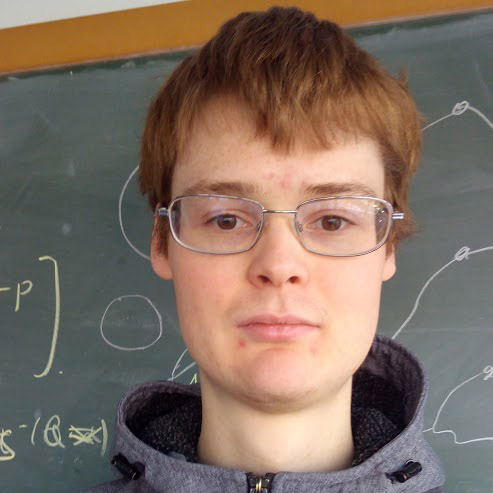
Ewain Gwynne is a Professor of Mathematics at the University of Chicago, affiliated with the Committee on Computational and Applied Mathematics (CCAM) and the Statistics Department. He previously held postdoctoral positions at the University of Cambridge and earned his Ph.D. from MIT in 2018 under Scott Sheffield. His research focuses on probability theory, particularly random geometric structures in statistical mechanics, including Schramm-Loewner evolution (SLE), Liouville quantum gravity (LQG), and random planar maps. Education: Ph.D. in Mathematics, MIT (2018); M.Sc., MIT (2015); B.Sc., Northwestern University (2013). Research Interests: Random geometric objects in statistical mechanics Liouville quantum gravity and its metric properties Random planar maps and their scaling limits SLE and its relationship with LQG Random walks on random planar maps Percolation and permutons His recent articles explore topics such as supercritical LQG, Gaussian curvature on random maps, and harmonic balls in LQG. He has advised multiple Ph.D. students and serves as an associate editor for Probability and Mathematical Physics . His work bridges probability theory, geometry, and mathematical physics, with applications to understanding critical phenomena in random systems.
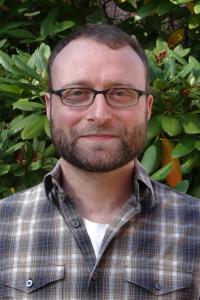
Tim G. J. Rudner is an Assistant Professor in the Department of Statistical Sciences at the University of Toronto, a Faculty Member at the Vector Institute, and a Title A Fellow at Trinity College, University of Cambridge. He was previously an Assistant Professor and Faculty Fellow at New York University. University: University of Toronto School: Faculty of Arts and Science Department: Department of Statistical Sciences Affiliation: Vector Institute, Trinity College (Cambridge) He holds a PhD in Computer Science and an MSc in Statistics from the University of Oxford, where he was advised by Yee Whye Teh and Yarin Gal, and a BS in Applied Mathematics and Economics from Yale University. PhD: Computer Science, University of Oxford MSc: Statistics, University of Oxford BS: Applied Mathematics and Economics, Yale University His research focuses on building robust, transparent, and trustworthy machine learning systems, particularly for high-stakes applications. He develops probabilistic models that improve generalization under distribution shifts, provide reliable uncertainty estimates, and enable fair and interpretable predictions. His work spans generative models, large language models, healthcare, and biomedical discovery. The recent publications highlight a strong trend toward function-space modeling, Bayesian regularization, and AI safety. Tim's work emphasizes principled uncertainty quantification, robustness to subpopulation and semantic shifts, and the development of frameworks for AI governance and specification. His research bridges theoretical advances with real-world applications, especially in safety-critical domains like medicine and defense. Tim has received numerous accolades including being named a Rhodes Scholar, Qualcomm Innovation Fellow, and 2024 Rising Star in Generative AI. He was awarded a $700,000 Foundational Research Grant and a $30,000 Apple Seed Grant for improving LLM trustworthiness. Rhodes Scholar Qualcomm Innovation Fellow AISTATS Notable Paper Award (2024) Outstanding Paper Award, ICLR GenAI4DM Workshop (2024) Apple Seed Grant ($30,000) Foundational Research Grant ($700,000) NeurIPS Spotlight Talk 2024 Rising Star in Generative AI He actively mentors students, particularly first-generation and low-income scholars, and has contributed to major policy frameworks including the OECD AI Classification Framework and a series of CSET issue briefs on AI safety. His work demonstrates a strong commitment to responsible AI development, combining technical rigor with societal impact. Tim leads research efforts at the intersection of machine learning theory and practical deployment, with ongoing projects in generative modeling, reliable LLMs, and AI governance. His lab produces high-impact work regularly published at top-tier conferences such as NeurIPS, ICML, and AISTATS.
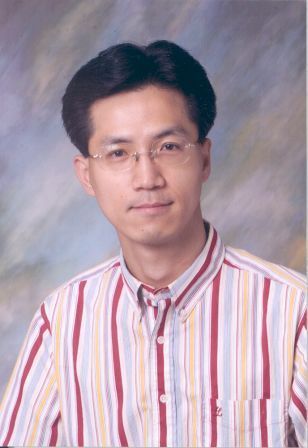
Prof. Dr. Melanie Zeilinger is an Associate Professor at the Department of Mechanical and Process Engineering at ETH Zurich, leading the Intelligent Control Systems group at the Institute for Dynamic Systems and Control. She holds a diploma in Engineering Cybernetics from the University of Stuttgart (2006) and a Ph.D. in Electrical Engineering from ETH Zurich (2011). Her postdoctoral research included stints at EPFL (2011–2012), a Marie Curie fellowship at UC Berkeley and the Max Planck Institute (2012–2015), and a professorship at the University of Freiburg (2018–2019). Her research focuses on learning-based control, distributed control systems, and robotics , with applications to medical devices (e.g., hydrocephalus shunts) and human-in-the-loop systems. She organizes the Conference on Learning for Dynamics and Control (L4DC) and contributes to initiatives like the "Algorithm on My Team" project. Her awards include the ETH Medal for her PhD thesis, a Marie-Curie IO Fellowship , and an SNF Assistant Professorship grant . She serves as an Associate Editor for IEEE Control Systems Letters and actively reviews for top journals/conferences like IEEE TAC, Automatica, and NeurIPS. Key projects include: VIEshunt: A smart ventricular shunt for hydrocephalus treatment, combining control systems and medical engineering. Autonomous Racing: Contextual tuning and safety-certified learning-based MPC for real-time obstacle avoidance. Data-Driven Control: Integrating Gaussian processes and state-space models into MPC frameworks for uncertain systems. Her work bridges control theory, machine learning, and robotics, addressing societal challenges such as healthcare and energy efficiency.
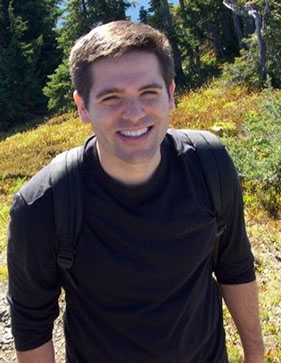
Markus Heinonen is an Academy Research Fellow at Aalto University's Department of Computer Science within the School of Science. His academic position is tied to Harri Lähdesmäki's Professorship, focusing on probabilistic machine learning. He holds a Doctoral degree in Engineering and Technology from the University of Helsinki (2013). His research integrates probabilistic modeling , deep learning , and differential equations , with applications in computational biology, drug discovery, and biophysics. Key themes include Gaussian processes, Bayesian inference, generative models, and their use in understanding complex biological systems like immune cell behavior (e.g., T cell receptor analysis in aplastic anemia) and molecular design. He leads major projects such as the Deep Learning with Differential Equations initiative (2020–2025), exploring continuous-time models and physics-informed neural networks. His work bridges theory and application, evidenced by collaborations in diffusion models , optimal transport , and single-cell analysis . Publications span over 65 peer-reviewed outputs, with recent emphases on robust neural network training, multi-target molecular prediction, and interpretable drug design frameworks. His research contributes to UN Sustainable Development Goal 3 (Good Health) through advancements in disease modeling and therapeutic development. He has undertaken visiting research roles at the University of California, San Francisco (2017) and Telecom ParisTech (2013–2014). Media highlights include recognition for work on TCR-epitope prediction and AI-driven enzyme engineering.
Jan de Gier is a Professor at the School of Mathematics and Statistics, The University of Melbourne . He is also the Founding Director of MATRIX , Australia’s residential research institute in the mathematical sciences, and a former Deputy Director and Chief Investigator in the Australian Research Council Centre of Excellence for Mathematical and Statistical Frontiers (ACEMS) . Additionally, he co-founded the Australian and New Zealand Association for Mathematical Physics (ANZAMP) in 2011 and served as its inaugural Chair. His research focuses on solvable lattice models at the intersection of mathematical physics and statistical mechanics . Key areas include the application of quantum integrability , algebraic structures like the Yang-Baxter equation, Hecke algebras, and quantum groups, as well as analytical methods such as complex analysis and elliptic curves. His work bridges pure and applied mathematics through connections between enumerative combinatorics , representation theory , and real-world phenomena like traffic flow modeling via exclusion processes . The 15 most recent articles reflect his expertise in integrable systems , non-equilibrium statistical mechanics , and algebraic combinatorics . Topics span Macdonald polynomials , stochastic duality , quantum spin chains , and traffic modeling , with methodologies involving matrix product forms , exact solutions , and critical phenomena analysis. He has contributed to editorial efforts through the AustMS Gazette and MATRIX Annals, and has been involved in public science communication via opinion pieces on mathematics funding and applications. His work emphasizes the importance of fundamental research in driving technological innovation, as highlighted in media articles discussing pi calculation , zero-knowledge proofs , and mathematics education .
Tim Cohen is an Associate Professor of Physics at the University of Oregon, with affiliations at CERN and EPFL's Lausanne Theory Physics Laboratory. He is based at the Institute for Fundamental Science within the Department of Physics at the University of Oregon's College of Arts and Sciences. His research focuses on theoretical particle physics, particularly exploring phenomena beyond the Standard Model. Dr. Cohen's research interests center on particle physics beyond the Standard Model, with specific expertise in Large Hadron Collider phenomenology, effective field theory, electroweak naturalness, and dark matter. His work bridges theoretical frameworks with experimental possibilities at major particle physics facilities. His research program encompasses both theoretical developments in quantum field theory and practical applications to collider physics and cosmology. Analysis of his recent publications reveals a strong focus on effective field theory applications, de Sitter space physics, and dark sector phenomenology. His work demonstrates sophisticated mathematical approaches to problems in quantum field theory while maintaining connections to observable phenomena at particle colliders and in cosmological settings. He frequently collaborates with researchers across institutions including CERN, EPFL, and various US universities. Dr. Cohen serves as a senior researcher with active roles at multiple institutions, contributing to major collaborative efforts such as the Snowmass community planning process for particle physics. His work appears in leading journals including Journal of High Energy Physics, Physical Review D, and Physics Letters B, demonstrating consistent productivity and impact in the field. His research group operates within the Institute for Fundamental Science at the University of Oregon, with additional connections to theoretical physics groups at CERN and EPFL. This international collaboration network enables him to work at the intersection of theoretical developments and experimental frontiers in particle physics.
Inseok Hwang is the Paul Stanley Professor of Aeronautics and Astronautics at Purdue University's School of Aeronautics and Astronautics. He earned his Ph.D. from Stanford University, specializing in multiple-vehicle control systems. His research focuses on hybrid systems, air traffic control, unmanned systems, and cybersecurity of cyber-physical systems. He leads the Flight Dynamics and Control/Hybrid Systems Laboratory and has received numerous awards, including the NSF CAREER Award and AIAA Associate Fellow designation. His work spans theoretical advancements in control theory and practical applications in aerospace systems. He has over 150 peer-reviewed publications and actively collaborates with industry and government agencies like NASA and the FAA. Education: B.S. (Seoul National University, 1992), M.S. (KAIST, 1994), Ph.D. (Stanford, 2004). Professional memberships include AIAA and IEEE. Research Interests: Hybrid systems analysis, air traffic surveillance and control, fault detection and isolation, spacecraft control, and cybersecurity for autonomous systems. His lab develops algorithms for safe and efficient operation of networked systems, including UAS traffic management and resilient control protocols against cyberattacks. Awards: NSF CAREER (2008), AIAA Associate Fellow (2012), University Faculty Scholar (2017), C.T. Sun Award (2019), multiple Seed for Success Awards (2020–2024), and Paul Stanley Professorship (2024). Grants and Collaborations: Active projects funded by NSF, NASA, FAA, and industry partners. Focus areas include resilient navigation, anomaly detection in air traffic systems, and cyberattack mitigation for autonomous vehicles.
Jason P. Miller is a Professor in the Statistics Laboratory at the Department of Pure Mathematics and Mathematical Statistics (DPMMS), University of Cambridge, and a Fellow of Trinity College, Cambridge. He previously held the Poincaré Chair at IHP in the 2015-2016 academic year and was a post-doctoral researcher at MIT and Microsoft Research. Miller's research focuses on probability theory, particularly stochastic interface models, random surfaces, Schramm-Loewner evolutions (SLE), Liouville quantum gravity, and random planar maps. His work bridges mathematical physics and probability, exploring deep connections between random geometry, conformal field theory, and statistical mechanics. He has made fundamental contributions to understanding the relationship between Liouville quantum gravity and the Brownian map, and has extensively studied the properties of Schramm-Loewner evolutions in various contexts. Miller's publication record shows a consistent focus on the intersection of probability theory and mathematical physics, with a particular emphasis on scaling limits of discrete models to continuum objects. His work often involves collaborations with prominent researchers like Scott Sheffield and Ewain Gwynne, and demonstrates a progression from foundational work on SLE and the Gaussian free field to more recent breakthroughs in Liouville quantum gravity and its connections to random planar maps. Scientific Awards Rollo Davidson Prize, 2015 Poincaré Chair, 2015-2016 academic year Whitehead Prize, 2016 Clay Research Award, 2017 ICM invited speaker (probability and statistics), 2018 Doeblin Prize, 2018 Eisenbud Prize, 2023 Fermat Prize, 2023 Miller has supervised numerous PhD students (though specific names aren't listed in the provided text) and has been involved in significant research grants supporting his work in random geometry and probability theory. His editorial service includes positions on the boards of Probability Theory and Related Fields and Bernoulli journals. While specific laboratory details aren't provided, Miller's research appears to be theoretical in nature, focusing on mathematical analysis of random geometric structures. His work has significant implications for theoretical physics, particularly in understanding quantum gravity and critical phenomena in statistical mechanics.
Dr. Quirin Thomas Simon Vogel is a Senior Lecturer at the Department of Statistics, University of Klagenfurt. He previously held postdoctoral positions at the Technical University of Munich, New York University Shanghai, and served as an Interim Professor at Ludwig-Maximilians University of Munich. His research bridges probability theory with statistical mechanics and algorithmic applications. Current role: Senior Lecturer (2025) Previous roles: Postdoc (TUM, NYU Shanghai), Interim Professor (LMU Munich) His research focuses on: Random walks and their geometric/stochastic properties Randomized algorithms with applications in statistical models Quantum-inspired probabilistic systems (e.g. interacting bosonic loop soups) Large deviation theory for complex systems Percolation and phase transitions in particle models The articles reflect trends in probability theory, mathematical physics, and algorithmic applications. Key topics include high-dimensional percolation, Bose gas models, neural network theory, and stochastic geometry. The work combines rigorous mathematical analysis with interdisciplinary applications in physics and computer science. Scientific awards and functions cannot be determined from the provided data, as they describe other researchers. The department's research activities include projects on statistical learning, quantum models, and algorithmic probability, though Vogel's direct involvement in these specific funded projects isn't explicitly stated.
Mikael Johansson is a Professor at Kungliga Tekniska Högskolan (KTH), specializing in Control Technology . He teaches and coordinates courses such as Distributed Optimization (FEL3311) and various advanced-level degree projects in computer science, electrical engineering, and systems engineering. His research spans Control Systems , Machine Learning , and Optimization , with a focus on asynchronous algorithms, federated learning, and applications in energy systems and construction. His work includes 15 recent publications on topics like neural networks, distributed optimization, and battery technology. Notable areas of contribution are in asynchronous learning, federated learning with privacy constraints, and quasi-Newton methods for optimization. His research bridges theoretical advancements with practical applications in urban design, healthcare, and autonomous systems.
Fei He is an Associate Professor at Tsinghua University's School of Software, where he leads the THUFV research lab focused on formal verification and program analysis. His research spans formal methods, automated reasoning, and program verification, with applications in concurrent systems, networking (P4 programs), and probabilistic systems. Education & Employment: PhD from Tsinghua University (2008) Visiting Scholar at Carnegie Mellon University (2010-2011) and Politecnico di Milano (2006-2007) Faculty positions at Tsinghua since 2008 (Assistant Professor 2008-2011, Associate Professor 2011-present) Research: He's developed innovative techniques in SMT solving for concurrency verification, termination analysis, and regression verification. His tools like Deagle have won gold medals at SV-COMP. Current work focuses on probabilistic program verification and network program analysis. Publications: His 80+ publications demonstrate consistent contributions across formal methods (PLDI, OOPSLA, ICSE), networking (NSDI, INFOCOM), and software engineering (TSE, TOSEM), with recent emphasis on data-driven verification and automated invariant inference. Awards: Gold Medals in SV-COMP ConcurrencySafety (2022, 2023, 2025) Best Paper Awards at PPoPP 2022 and SETTA 2022 Advising: Mentors 13 PhD/Master's students in THUFV lab, with graduates joining Huawei, MPI-SP, and research institutions. Secured multiple NSF China grants for trustworthy software research. Service: Associate Editor for Theory of Computing Systems, program committees for PLDI/ICSE/OOPSLA, and former Local Chair for ISSTA 2019.
Tianyi Lin serves as an Assistant Professor in the Department of Industrial Engineering and Operations Research (IEOR) at Columbia Engineering, Columbia University, a position he assumed in 2024. He holds dual affiliations as a verified Data Science Institute (DSI) Member and an Affiliated Member of both the Financial and Business Analytics Center and the Foundations of Data Science Center. His academic credentials include: Ph.D. in Electrical Engineering and Computer Science, UC Berkeley Postdoctoral Researcher, Laboratory for Information & Decision Systems (LIDS), MIT (2023-2024) M.S. in Operations Research, UC Berkeley M.S. in Pure Mathematics and Statistics, University of Cambridge B.S. in Mathematics, Nanjing University Dr. Lin's research spans optimization theory , game-theoretic models , and machine learning algorithms , with emphasis on nonconvex minimax problems , variational inequalities , and data science applications . His work bridges theoretical guarantees with practical implementations in high-dimensional settings, particularly focusing on convergence properties and computational efficiency in complex systems. Analysis of his 15 most recent publications (2022-2025) reveals dominant themes in high-order optimization methods , no-regret learning in games , and optimal transport algorithms . His contributions demonstrate consistent innovation in developing doubly optimal algorithms for monotone games, spectral regularization techniques for policy optimization, and structure-driven approaches for nonconvex problems, reflecting strong interdisciplinary connections between operations research, computer science, and applied mathematics. No scientific awards or honors were documented in the provided source material. Information regarding student advising and research grants remains unspecified in the current documentation, though his center affiliations suggest active participation in collaborative research initiatives. Dr. Lin maintains significant interdisciplinary engagement through his affiliations with Columbia's Data Science Institute and specialized research centers, positioning his work at the intersection of theoretical optimization and real-world data science applications.
Shahin Sirouspour is a Professor in the Department of Electrical and Computer Engineering at McMaster University. His research focuses on robotics, autonomous systems, control systems, and optimization, with applications in aerial robotics, teleoperation, haptics, medical robotics, and smart energy grids. He is affiliated with the Telerobotics, Haptics and Computational Vision Laboratory and teaches courses such as Non-linear Control Systems and Electrical Systems Integration Project. He holds a Ph.D. from the University of British Columbia and has supervised numerous graduate students. His lab includes advanced equipment like multi-axis robotic manipulators, haptic interfaces, and real-time computing systems. Education: B.Sc. and M.Sc. from Sharif University of Technology (Iran), Ph.D. from University of British Columbia (Canada). Current roles include accepting graduate students and leading research clusters in Digital & Smart Systems, Energy, and Transportation. Awards include the McMaster President's Award for Excellence in Graduate Supervision. His work bridges theoretical control systems with practical applications in healthcare, energy, and autonomous systems. Research highlights include developing control strategies for multi-agent robotic systems, smart grid optimization, and medical robotics. Collaborations with institutions like MacAUTO and industry partners (e.g., MDA Space Missions) enhance translational impact. His lab supports projects on asymmetric teleoperation, deformable tissue simulation, and microgrid energy management.
Evgeni Dimitrov is an Assistant Professor of Mathematics in the Department of Mathematics at the University of Southern California, housed within the USC Dana and David Dornsife College of Letters, Arts and Sciences. Before joining USC, he served as a Ritt Assistant Professor in the Mathematics Department at Columbia University. Education: PhD in Mathematics, Massachusetts Institute of Technology (MIT), advised by Alexei Borodin Undergraduate degree, Princeton University Research Interests: Dimitrov’s research sits at the intersection of probability, representation theory, and combinatorics, with a central focus on the asymptotic analysis of stochastic integrable systems . He develops hybrid techniques that blend algebraic methods from representation theory with analytic and combinatorial tools to study universal scaling limits—particularly those falling within the Kardar–Parisi–Zhang (KPZ) universality class . Key objects of study include Gibbsian line ensembles , random matrix models , log-gamma polymers , and exactly-solved stochastic particle systems such as ASEP and the six-vertex model. Publication Profile: Across 2021–2025, Dimitrov has produced a concentrated body of work addressing edge fluctuations , multi-level loop equations , and global large-deviation principles for discrete β-ensembles and related integrable systems. His papers repeatedly explore the convergence of discrete stochastic models to Airy-like universal processes, tightness questions for line ensembles, and the rigorous derivation of KPZ scaling laws, underscoring a cohesive research trajectory toward understanding universal random geometry. Scientific Awards: No awards are explicitly mentioned in the supplied material. Advising & Grants: No specific PhD students, grants, or funding details are provided in the text. Labs & Teams: No laboratory or research-group information is available from the supplied content.
David Garlan is a Professor at the Software and Societal Systems Department within the School of Computer Science at Carnegie Mellon University , where he also serves as Associate Dean for Master’s Programs . He received his Ph.D. from Carnegie Mellon in 1987 after working in industry as a software architect. His research focuses on controlling complexity in large software systems through formalized architectural design, self-adaptive systems, and cyber-physical systems. He developed AcmeStudio , a widely used architecture design environment, and pioneered formal representation and analysis of software architecture. Education : Ph.D. in Computer Science (Carnegie Mellon, 1987) Research Interests include: Software Architecture: Formal methods for architectural design, end-user composition, and architectural styles Self-Adaptive Systems: Stochastic planning, model checking, security adaptation, and uncertainty reduction Cyber-Physical Systems: Multi-view design methods, consistency checking, and automotive systems Recent Article Trends address microservice resiliency, hybrid planning (combining formal methods and ML), simulation-augmented robotics, and sustainable machine translation. Themes include stochastic modeling , probabilistic verification , and adaptive decision-making . Scientific Awards : Stevens Award Citation (2005) ACM SIGSOFT Outstanding Research Award (2011) Allen Newell Award for Research Excellence (2016) IEEE TCSE Distinguished Education Award (2017) Nancy Mead Award (2017) Fellow of IEEE and ACM Advising and Grants : He has advised 25+ graduate students and collaborated on projects with Toyota and the Software Engineering Institute. His work includes model-based adaptation, automated planning, and formal verification of adaptive systems. Labs & Teams : Affiliated with the Institute for Software Research and works on tools like AcmeStudio, Rainbow, and IPL for architectural modeling and self-adaptation.