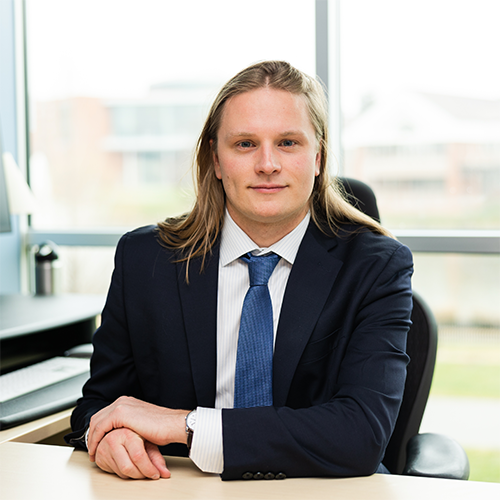
Kyle Nickodem serves as the Director of the Research Methodology Consulting Center at the University of Minnesota-Twin Cities , specializing in quantitative methods in education . He holds a PhD in Quantitative Methods in Education and a BA in Psychology. Degrees : PhD (University of Minnesota-Twin Cities), BA (University of Notre Dame) Research Interests span educational and psychological measurement , causal inferencing study design , and reproducible research tools . His work focuses on positive youth development through collaborations with school districts and educational organizations. Contributions include developing R packages like DIFreport and kfa for methodological rigor. He provides consultations on multilevel modeling , propensity scores , and study design , emphasizing data reproducibility and statistical programming . Current Projects involve analyzing social-emotional learning metrics , gender differences in violence perpetration , and measurement invariance across large-scale educational datasets. Contact: nicko013@umn.edu
Paolo Ghisletta is a Full Professor at the Faculty of Psychology and Educational Sciences, University of Geneva, affiliated with the LIVES Centre. His research focuses on quantitative psychology, cognitive aging, and lifespan development. Ph.D. in Quantitative Psychology, University of Virginia (1999) MA in Quantitative Psychology, University of Virginia (1996) BA in Mathematics and Psychology, Clarion University (1994) His work centers on multivariate data analysis, structural equation modeling, and multilevel modeling applied to lifespan development. He investigates cognitive aging in relation to health, sensory functioning, and psychological resource management. Recent publications address longitudinal changes in prospective memory, methodological challenges in aging research, and statistical techniques for mixed-effects models. These studies often employ longitudinal designs and interdisciplinary approaches. He is based at the LIVES Centre (Boulevard du Pont d'Arve 40, Geneva) with office contact +41 (0)22 379 91 31.
Nicholas C. Jacobson is an Associate Professor of Biomedical Data Science and Psychiatry at the Geisel School of Medicine, Dartmouth College. He serves as the Director of the Treatment Development & Evaluation Core within the Center for Technology and Behavioral Health (CTBH) and leads the AI and Mental Health: Innovation in Technology Guided Healthcare (AIM HIGH) Laboratory. His work bridges computational methods with clinical applications to transform mental healthcare through technology. Dr. Jacobson earned his PhD in Psychology from Pennsylvania State University in 2019, following an MSc in Psychology from the same institution in 2015. He completed his Postdoctoral and Clinical Fellowships in Psychology at Massachusetts General Hospital/Harvard Medical School in 2019. Dr. Jacobson's research focuses on harnessing artificial intelligence and passive sensor data from smartphones and wearable devices to develop scalable, personalized interventions for anxiety and depression. His work has three main pillars: (1) enhancing precision assessment of anxiety and depression using intensive longitudinal data, (2) conducting multimethod assessment utilizing passive sensor data from smartphones and wearable devices, and (3) providing scalable, personalized technology-based treatments utilizing smartphones. As a computational psychologist, he created the Differential Time-Varying Effect Model (DTVEM), an innovative statistical package in R that allows researchers to discover and model optimal lag times in intensive longitudinal data. His methodological expertise encompasses machine learning, structural equation modeling, multilevel modeling, time-series techniques, and dynamical systems modeling. His recent publications demonstrate a strong focus on digital phenotyping, machine learning applications in mental health, and personalized interventions. The research spans multiple domains including depression symptom networks, anxiety disorder assessment, eating disorder prevention, and the use of passive sensing to understand mental health conditions. A notable trend is the application of advanced computational methods to create more precise and personalized mental health assessments and interventions, with increasing emphasis on real-world implementation and accessibility. Principal Investigator of an R01 Award from the National Institute of Mental Health studying personalized deep learning models to predict rapid changes in major depressive disorder symptoms Secured over $6 million in funding as Principal Investigator and over $20 million as a co-Investigator Featured on NBC Nightly News and CBS Morning News for pioneering work in AI-powered mental health applications Dr. Jacobson has developed several impactful digital tools including Therabot, a generative AI therapy chatbot that demonstrated substantial reductions in symptoms of major depressive disorder, generalized anxiety disorder, and feeding and eating disorders in its first randomized controlled trial. He also developed Mood Triggers, a smartphone sensing platform that integrates ecological momentary assessment and intervention to help users identify and manage anxiety and depression triggers. His suite of smartphone applications has reached over 50,000 users in more than 100 countries. Dr. Jacobson is actively recruiting team members and encourages interested individuals to contact him through his personal website. He directs the AIM HIGH Laboratory, which focuses on advancing AI applications in mental healthcare. The lab develops innovative computational approaches to enhance mental health assessment and treatment through technology. Current projects include using passive sensor data to predict symptom changes, developing personalized just-in-time adaptive interventions, and creating quantitative tools that enable precision mental healthcare.
Joseph M. Kush is an Assistant Professor in the Department of Graduate Psychology at James Madison University. He also serves as an assistant assessment specialist at the Center for Assessment and Research Studies and is a faculty member in the Assessment and Measurement Ph.D. program and the Quantitative Psychology concentration of the Psychological Sciences M.A. program. Ph.D. in Educational Psychology - Research, Statistics, and Evaluation (2021), University of Virginia B.S. in Psychology (2016), Syracuse University, with minors in Applied Statistics and Philosophy His research focuses on advancing statistical methods in social sciences, including Multilevel Structural Equation Modeling , Propensity Score Matching/Weighting , and Moderated Nonlinear Factor Analysis . He explores applications in educational assessment, behavioral interventions, and psychological measurement. Recent publications highlight methodological innovations in clustered randomized trials , integrative data analysis , and racial/economic equity in education. He oversees the Program Assessment Support Services (PASS) team, evaluating program-level assessment reports at JMU.
Yukiko Maeda is an Associate Professor at the Department of Educational Studies within Purdue University's College of Education. Holding a Ph.D. in Quantitative Methods in Education from the University of Minnesota (2007), she has been at Purdue since 2008, progressing from Assistant Professor to her current role. Her work bridges educational psychology and advanced statistical methodologies. Education: Ph.D. — Quantitative Methods in Education, University of Minnesota (2007) B.A. — Psychology, Okayama University, Japan (1995) Research Focus: Professor Maeda specializes in promoting best practices for data use in educational research, with expertise in meta-analysis and multilevel modeling. Her recent contributions examine data-driven decision-making in schools and methodological improvements in educational data analysis, particularly in online learning environments and gifted education. Article Trends: Her recent publications (2023-2025) emphasize: Meta-analytic approaches to understanding self-regulated learning in online education Psychometric validation of educational assessment tools Quantitative analysis of charter school civic outcomes Improving adaptive learning systems through learner modeling Addressing imposter syndrome and psychological distress in STEM education Evaluating mathematics anxiety and achievement relationships Awards: Purdue University Discovery Award (2016) Purdue University Learning Award (2016) Dean's Award for Outstanding Faculty Scholarship (2014) Academic Roles: Associate Professor (2015–present), Assistant Professor (2008–2015) at Purdue University Research Associate at Michigan State University (2007–2008) Statistical Consultant at the University of Minnesota (2005–2007)
Prof. Dr. Michael Eid is a leading academic in the Department of Education and Psychology at the Free University of Berlin , where he has held the Professorship of Methods and Evaluation since 2006. His research focuses on advanced statistical modeling for psychological constructs, including change measurement , multimethod diagnostics , and item response theory , with applications to subjective well-being , mood regulation , and health psychology . Research Trends : His recent work explores biopsychosocial links (e.g., cortisol biomarkers and well-being) methodological innovations in latent state-trait models and bifactor modeling digital data collection via mobile sensing cross-cultural studies of spirituality and emotional clarity educational psychology, particularly teacher competence and student outcomes Scientific Contributions : Recipient of Dissertationspreis (University of Trier) and Jungwissenschaftlerpreis (German Psychological Association) Editor-in-chief of multiple journals including Methods of Psychological Research-Online and Diagnostica Over 150 peer-reviewed publications and 10 book authorships Teaching & Grants : Regularly teaches Statistics I/II and Structural Equation Modeling . Secures funding from organizations like the Deutsche Forschungsgemeinschaft and Swiss National Science Foundation , with industry partnerships (e.g., Beiersdorf AG for skin cancer prevention research).
Dr. Joran Jongerling is an Assistant Professor in the Department of Methodology and Statistics at Tilburg University's Tilburg School of Social and Behavioral Sciences. His academic work focuses on developing and applying advanced statistical methods for analyzing longitudinal and intensive longitudinal data, with particular expertise in multilevel AR(1) models and Bayesian statistics. Dr. Jongerling's research interests span several interconnected areas within quantitative methodology. He specializes in Bayesian Statistics , Multilevel Analysis , Dynamic Modeling , and the analysis of Longitudinal Data collected through Experience Sampling and diary methods. His methodological work addresses critical challenges in modeling individual differences in dynamic processes, measurement invariance across time, and appropriate statistical techniques for intensive longitudinal datasets. Analysis of his publication trends shows a significant increase in research output in recent years, with 11 publications in 2025 alone. His work spans both methodological development and substantive applications across psychology, education, and health sciences. His methodological contributions often focus on refining techniques for analyzing intensive longitudinal data, while his applied work demonstrates these methods in contexts ranging from multicultural personality assessment to motor development in children with Down syndrome. Dr. Jongerling actively contributes to advancing methodological standards in psychological research through his work on measurement invariance, simulation studies evaluating statistical techniques, and development of models that appropriately handle the complexities of real-world longitudinal data. His research has practical implications for researchers designing and analyzing intensive longitudinal studies across multiple domains of psychological science.
Friedemann Trutzenberg is a Researcher and PhD student at the Department of Methods and Evaluation within the Department of Education and Psychology at Free University of Berlin. Since March 2021, he has served as a Research Associate. He holds concurrent affiliations as Visiting Professor at the University of Graz (2024) and Visiting Fellow at the Polish Academy of Sciences (2025). Education: Master's in Psychology (Clinical & Health Psychology), Free University of Berlin (2017-2021) Bachelor's in Psychology, Free University of Berlin (2013-2017) Church Music C-Training, Archdiocese of Cologne & Berlin (2013-2015) Research Focus: Trutzenberg investigates distributive justice attitudes, global public health ethics, and social identification dynamics, particularly 'Identification With All Humanity' (IWAH). His work integrates psychometrics, cross-cultural comparisons, and longitudinal analysis of life events like childbirth. Secondary interests include music-based autism diagnostics and spirituality's role in psychological development. Publications: His recent articles demonstrate methodological rigor in psychometrics and applied social psychology, with recurring themes in global resource allocation, measurement validation, and life-event impacts on identity/spirituality. Work frequently employs advanced statistical modeling and multinational datasets. Awards: Preis für ausgezeichnete Lehre 2024 (Teaching Excellence Award) Affiliations: Collaborates with IWAH Lab (Polish Academy of Sciences) and maintains memberships in DGPs, EAPP, DGPH, EUPHA, and the German-Polish Society. Teaches statistics and research methods courses.