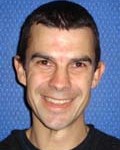
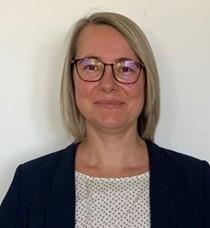
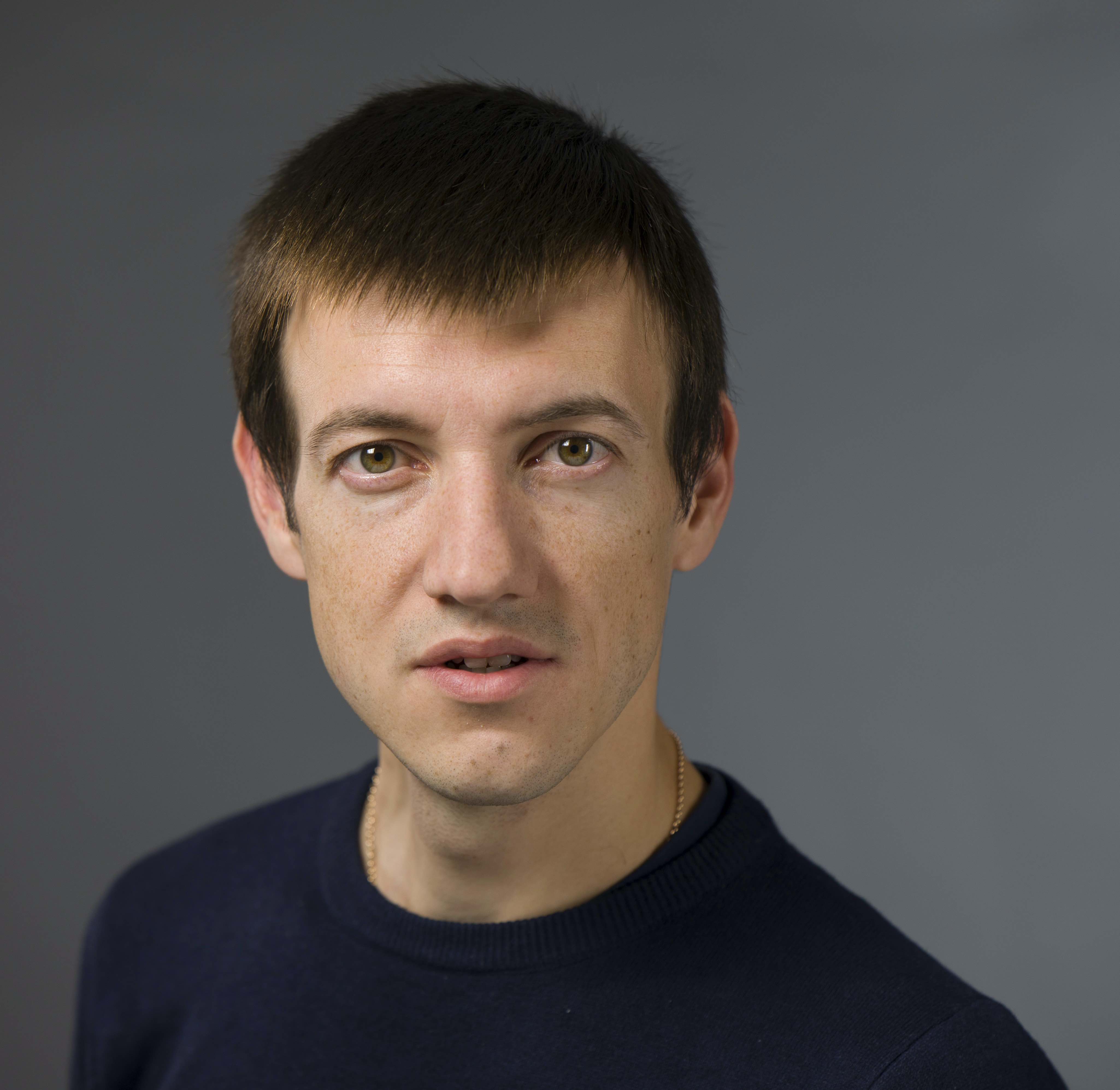
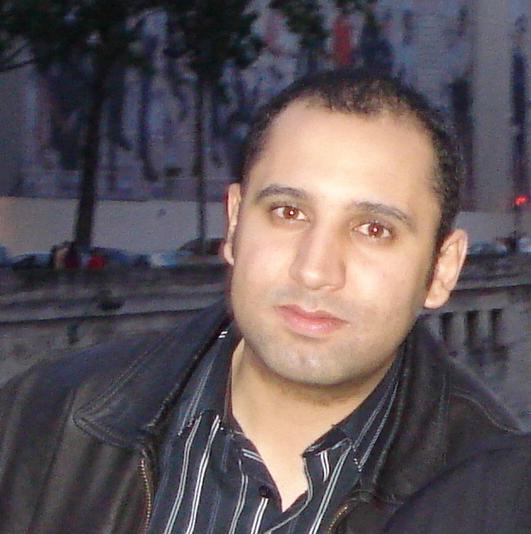
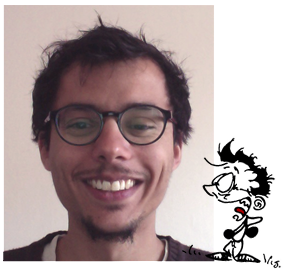
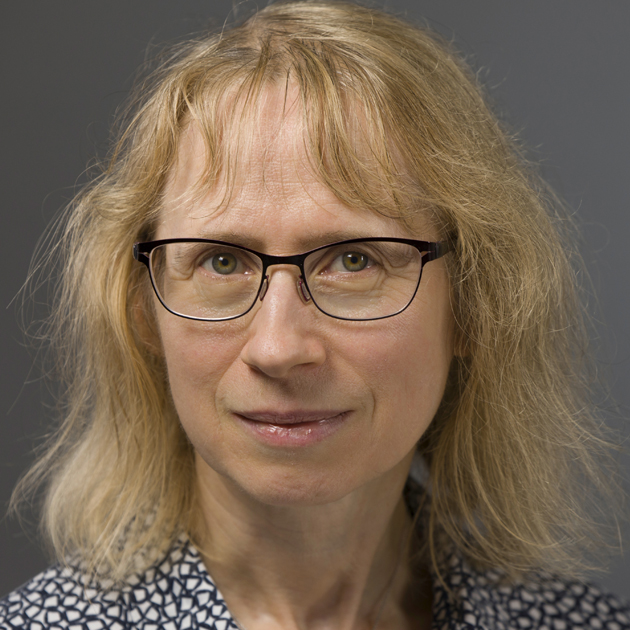
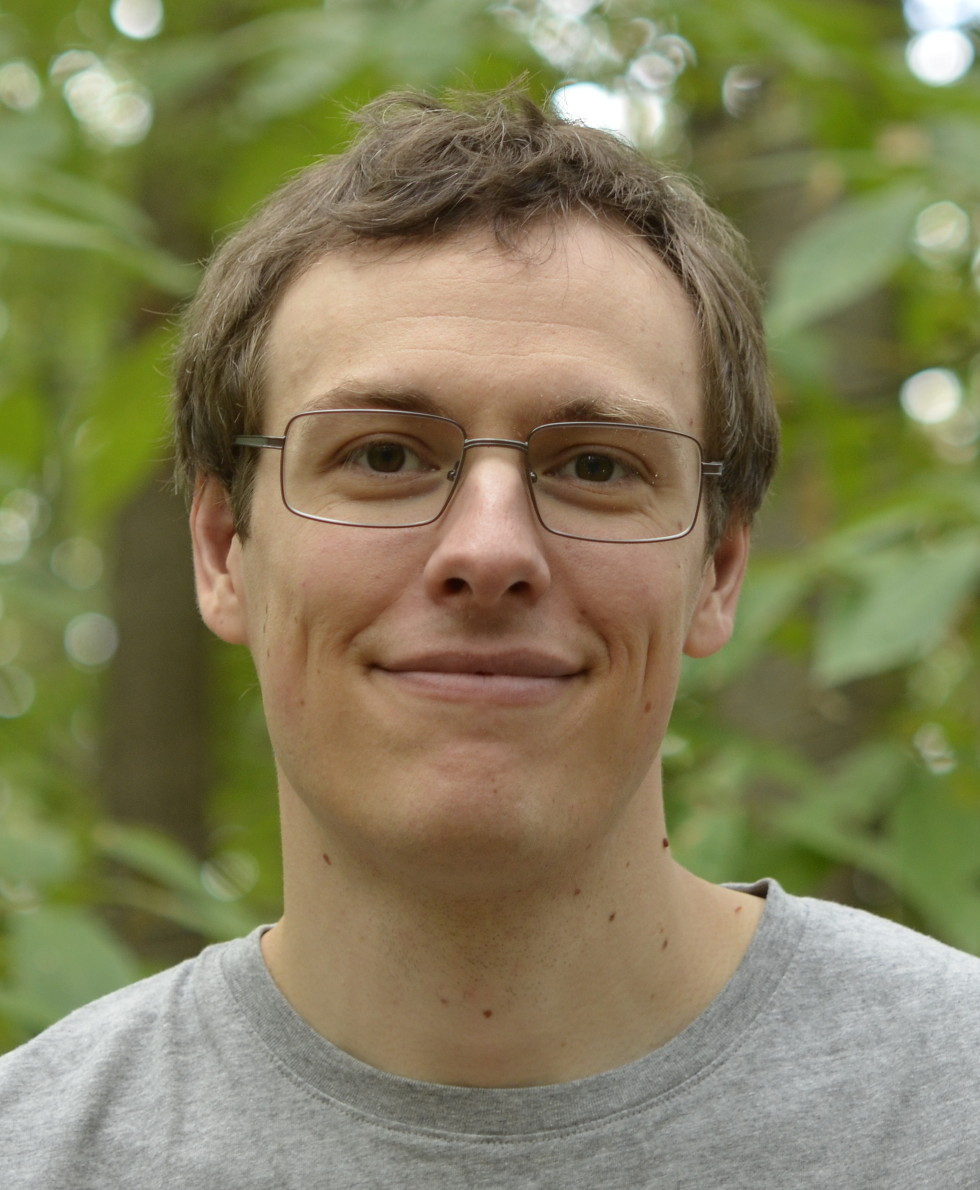
Aleksandra Walczak is a Professor of Biophysics at the École normale supérieure , leading research at the Laboratoire de Physique Théorique (LPENS). Her work bridges statistical physics and biology, focusing on understanding complex living systems through gene regulatory networks, immune system dynamics, and population genetics. Research Interests : Non-equilibrium biological systems, T-cell/B-cell receptor repertoires, stochastic molecular systems, and evolutionary dynamics. Funding & Collaborations : Supported by the Fondation Bettencourt Schueller, she co-organizes interdisciplinary workshops like the Paris Workshop on Immunology and contributes to GDRI Evolution, Regulation and Signaling network. Recent Publications explore gene regulatory principles, immune repertoire modeling, viral-immune coevolution, and collective behavior. She has secured competitive grants and mentors students in theoretical biophysics. Awards : Habilitation à diriger des recherches (2012), Princeton Center for Theoretical Physics Postdoctoral Fellowship (2007-2010). Students & Positions : Actively supervises PhD/Master projects; offers internships in biophysics and quantum engineering.
Julien Ah-Pine is a lecturer at Laboratoire d'Informatique, de Modélisation et d'Optimisation des Systèmes (LIMOS) under Université Clermont Auvergne , with affiliations at Institut national polytechnique Clermont Auvergne and École des Mines de Saint-Étienne . He also holds a Researcher position at CNRS. Research Interests His work spans machine learning , information fusion , aggregation functions , and multi-criteria decision support , with a focus on complex data types like graphs , functional data , and multi-view datasets . Recent publications emphasize anomaly detection in spectral data streams , online learning , and interpretable AI for industrial applications. Selected Publications 2025 work on OnlineBootKNN introduces a novel framework for real-time spectral anomaly detection, while 2024 research explores multiple kernel methods in functional data classification. Earlier studies cover graph-based clustering , relational data mining , and linguistic network models for NLP tasks. Laboratory & Collaborations Works within LIMOS laboratory at Université Clermont Auvergne, collaborating with institutions like Mines Saint-Étienne and CNRS. Key partnerships include Nicolas Rojas Varela and Engelbert Mephu Nguifo on data stream analysis projects.
Nicolas Labroche serves as a Researcher in the Department of Computer Science at the Polytechnic School of the University of Tours. He is affiliated with the Fundamental and Applied Computer Science Laboratory of Tours (LIFAT) within the UFR of Sciences and Technology. His academic work spans multiple research domains with significant contributions to machine learning methodology and applications. His primary research focuses on Explainable Artificial Intelligence , particularly for medical applications where model interpretability is critical. He has pioneered methods in clustering of local attributive explanations and discernibility in medical ML models . Additional expertise includes exploratory data analysis through mathematical programming for comparison queries, time series forecasting for environmental monitoring, and preference-based explanations in recommender systems. His work bridges theoretical computer science with practical applications in healthcare, environmental science, and business intelligence. Analysis of his publication trends reveals consistent innovation in making data exploration more efficient and interpretable. Recent work emphasizes user-centric explainability (2024-2025), mathematical optimization for analytics (2022-2023), and synthetic data generation (2022). His research demonstrates strong interdisciplinary connections between computer science, medicine, and environmental science. His laboratory affiliation with LIFAT provides the infrastructure for his computational research. While specific grant details aren't public, his publication record indicates sustained research productivity across multiple European-funded projects focused on data science applications.
Andrew Harris is a Professor at Université Clermont Auvergne (UCA) specializing in volcanology. He is part of the Volcanology Team based at LMV Cezeaux, with research focusing on regional geology, lava flow dynamics, and volcanic hazard assessment. His work bridges field observations with advanced remote sensing techniques to understand volcanic processes and improve risk management strategies for communities living near active volcanoes. Professor Harris's research spans multiple areas of volcanology with particular emphasis on lava flow dynamics , thermal remote sensing of volcanic activity , and volcanic hazard assessment . His work integrates field measurements with satellite data to track and model volcanic processes. He has made significant contributions to understanding lava rheology, volcanic plume dynamics, and the development of early warning systems for volcanic hazards. His research often focuses on European volcanoes like Stromboli, Etna, and Piton de la Fournaise, but also extends to volcanic systems worldwide. Analysis of Professor Harris's recent publications reveals a strong trend toward integrating machine learning techniques with traditional volcanological methods. His work increasingly combines field observations, satellite data, and computational modeling to create more accurate hazard assessments. Recent research shows particular focus on volcanic risk communication, the dynamics of lava-sea interactions, and the application of deep learning for detecting subtle thermal anomalies that might indicate volcanic unrest. Professor Harris maintains extensive international collaborations across Europe, the Americas, and Asia. His work involves significant fieldwork at active volcanoes and has contributed to the development of several important methodologies for volcanic monitoring. He has been involved in multiple effusive crisis response efforts, particularly at Piton de la Fournaise, where he has helped implement real-time monitoring systems that integrate satellite data with ground-based observations for improved hazard assessment.
Meryem Schalck is an Assistant Professor of Data Science at IPAG Business School in Nice, France. She earned her PhD in Economic Sciences from the University of Orléans (2022) and has over 15 years of professional experience in the insurance sector as a Data Scientist. Her research focuses on applying AI and machine learning techniques to financial fraud detection, survival analysis, and econometric models in insurance. Research and Publications: Her recent work includes developing fraud scores for automobile insurance using cross-data analysis and predicting SME failures in France with machine learning methods, published in journals like Research in International Business and Finance and Applied Economics . Teaching Expertise: She teaches courses on AI, digital technologies, and statistical analysis for business management across IPAG's PGE, BBA, and MSc programs. Her pedagogical interests include NO CODE tools and business games. Professional Background: Prior roles include Senior Manager at Addactis (pricing software expertise), consultant at Fraeris, and actuarial roles at GI Analytics (Aviva) and Tricast, specializing in predictive modeling and SAS-based statistical tools.
Virginie Ehrlacher is a Professor at CERMICS, École des Ponts ParisTech (ENPC), France. She specializes in applied mathematics with a focus on high-dimensional problems, numerical analysis, and computational modeling. Her work bridges quantum chemistry, materials science, and machine learning through innovative mathematical frameworks. Education includes: PhD in Mathematics (2012) from ENPC: Mathematical models in quantum chemistry and uncertainty quantification Habilitation (2020) from Université Paris-Dauphine: Mathematical and numerical analysis of high-dimensional and multiscale problems in materials science Research spans multiscale modeling, tensor decompositions for high-dimensional systems, cross-diffusion equations, and scientific machine learning. Her work frequently addresses challenges in quantum mechanics, materials science, and computational physics using advanced numerical techniques. Publications emphasize: Algorithms for high-dimensional PDEs and eigenvalue problems Model reduction techniques (tensor networks, reduced basis methods) Cross-diffusion systems with biological/physical applications Neural networks for scientific computing Awards and distinctions: Irène Joliot-Curie Prize (2023) Chevalier de l’Ordre National du Mérite (2025) Leadership includes: ERC Starting Grant HighLEAP (2023–2028) ERC Synergy project EMC2 (2020–2026) ANR JCJC project COMODO (2019–2023) She co-leads the EMS Topical Activity Group on Scientific Machine Learning. Affiliated with the CERMICS laboratory, she collaborates on interdisciplinary teams tackling multiscale and data-driven modeling challenges.
Pavlo Mozharovskyi is a Full Professor at Télécom Paris, affiliated with the Signal, Statistique et Apprentissage (S2A) team within the Information Processing and Communication Laboratory (LTCI). He previously completed postdoctoral research at the Centre Henri Lebesgue (Agrocampus Ouest, Rennes) and worked at the CREST laboratory of the National School of Statistics and Information Analysis (ENSAI). Educated at Kyiv Polytechnic Institute (automation control and informatics) and University of Cologne (PhD in nonparametric and computational statistics, 2014) Specializes in data depth, robust statistics, explainable AI, and computational methods for high-dimensional data
Hachem Kadri is a Professor of Artificial Intelligence in the Department of Computer Science at Aix-Marseille University and Head of the Data Science Department at LIS Lab since 2023. He was previously an Assistant Professor at the same institution from 2012 to 2019 and conducted postdoctoral research at INRIA Lille and LAGIS. He holds a PhD in Electrical Engineering from the National Engineering School of Tunis (2008) and completed his HDR (Habilitation) at Aix-Marseille University in 2019 on operator-valued kernel methods. His research spans machine learning with core expertise in kernel methods, functional data analysis, statistical learning theory, deep learning, and quantum machine learning, bridging theoretical foundations with applications in signal processing and quantum computing. Recent publications (2022-2024) demonstrate a strategic shift toward quantum machine learning and C*-algebraic frameworks, with significant contributions in implicit regularization for deep tensor factorization, quantum perceptron algorithms, and operator-theoretic kernel extensions. Key works appear in ICML, NeurIPS, and AISTATS, highlighting interdisciplinary innovation at the intersection of algebra, functional analysis, and ML. Professor Kadri leads the ANR Starting Grant QuantML (2019-2024) as Principal Investigator and co-led the Franco-Tunisian OPERA project (2019-2023). He was nominated to the National Universities Council (CNU) for 2024-2027 and elected Head of LIS Data Science Department in 2023, reflecting his leadership in French academia. As a core member of the QARMA machine learning group at LIS Lab, he co-organized the inaugural Quantum Machine Learning workshop at ECML-PKDD 2022 and serves as Vice-president of SSFAM (Société Savante Francophone d’Apprentissage Machine), actively shaping the European ML research landscape.
Nicolas Duchateau is an Associate Professor at Université Lyon 1 and researcher at the CREATIS lab in Lyon, France. He is also a Junior member of the prestigious Institut Universitaire de France (IUF) and serves as Associate Editor for the Neurocomputing journal. His academic career includes positions at Universitat Pompeu Fabra in Barcelona and INRIA Epione in Sophia-Antipolis, with his current role at Polytech Lyon's Biomedical Engineering department since 2016. His research focuses on characterizing diseases from medical imaging populations, with methodological development centered on statistical atlases and machine learning approaches to represent populations. On the applicative side, he concentrates on cardiac function and imaging modalities such as echocardiography and magnetic resonance. His work spans computational anatomy, pattern statistics, representation learning, manifold learning, auto-encoders, information fusion, cardiac imaging, shape and deformation analysis, risk stratification, and image synthesis. Duchateau's recent publications reveal strong trends in multimodal data fusion, particularly combining echocardiography with clinical records for patient stratification. He has made significant contributions to representation learning for cardiac population analysis, with increasing emphasis on diffusion models, uncertainty estimation, and domain adaptation techniques. His work bridges deep learning methodologies with clinical cardiology applications, focusing on interpretable AI solutions for cardiac function assessment. Junior Member of Institut Universitaire de France (2021) PhD prize for knowledge transfer from Universitat Pompeu Fabra (2014) Young Investigator Award at Euroecho conference (2010) Duchateau actively supervises numerous PhD and Master's students, including Anita Salvador, Thierry Judge, Pierre-Elliott Thiboud, and Romain Deleat-Besson. He has secured major research funding including a €75k grant from the Institut Universitaire de France (2021-2026), a €251k French ANR Young Researchers grant for the "MIC-MAC" project (2019-2024), and a €139k grant from the Fédération Française de Cardiologie for the "MI-MIX" project (2020-2023). He leads a vibrant research team at CREATIS lab focused on medical image analysis, where his group develops computational approaches to characterize cardiac diseases through population analysis. The team works at the intersection of machine learning, medical physics, and clinical cardiology, with ongoing projects spanning echocardiography analysis, MRI processing, synthetic data generation, and clinical decision support systems.
Yanlei Diao is a Professor of Computer Science at École Polytechnique (France) with a joint appointment at the University of Massachusetts Amherst. She received her PhD from UC Berkeley in 2005. Her research focuses on scalable data systems, particularly in big data analytics, cloud computing optimization, and real-time stream processing. Research Interests: Her work spans cloud infrastructure optimization (UDAO project), explainable anomaly detection in data streams (EXAD), interactive data exploration (AIDEme), genomic data analysis (GESALL), and uncertain data management (CLARO). She leads the CEDAR team at Inria/LIX focusing on cloud-scale data exploration. Awards & Honors: ERC Consolidator Grant (2017-2023) CRA-W Borg Early Career Award (2013) NSF CAREER Award (2008) Keynote speaker at ACM DEBS 2021 and SWIFT 2023 AI Forum Best Paper Award at SIGMOD 2011 ACM SIGMOD Dissertation Honorable Mention (2005) Advising & Leadership: Mentored over 20 PhD students and postdocs, currently supervising 7 researchers. Served as PVLDB PC Co-Chair (2025-2026) and ACM SIGMOD Editor-in-Chief (2014-2019). Leads multiple projects with industry partners including Alibaba Cloud.
Laurence Likforman-Sulem is an Associate Professor at Institut Polytechnique de Paris , affiliated with the Signal, Statistics and Learning (S2A) team in the Image, Data, Signal (IDS) department . She has been at Télécom Paris since 1991, where she teaches Pattern Recognition , Signal Processing , and Document Analysis . PhD from ENST-Paris (1989) HDR from Sorbonne University (2008) Her research integrates Markovian methods (HMMs, Bayesian Networks) and deep learning (BLSTMs, CNNs) for: Handwriting recognition in historical documents Character analysis in Byzantine seals Parkinson’s disease detection through multimodal signals Biometric authentication using hand shape Recent work focuses on Byzantine seal character recognition (BHAi project) and multimodal group cohesion analysis (IEEE ICMI 2021 Best Paper). She has supervised 10 PhD students and numerous Master internships. Scientific Awards Winning system at ICDAR 05 Arabic Hand-Written Word Recognition Competition Fondation Telecom Thesis Award 2014 (2nd prize for Olivier Morillot) Best Paper Award, ICMI 2021 Active in conference leadership, she chaired ICDAR 2015 and ICPR 2022 document analysis tracks. Her 15 most recent publications span Byzantine document analysis, Parkinson’s detection, and low-energy neural architectures.
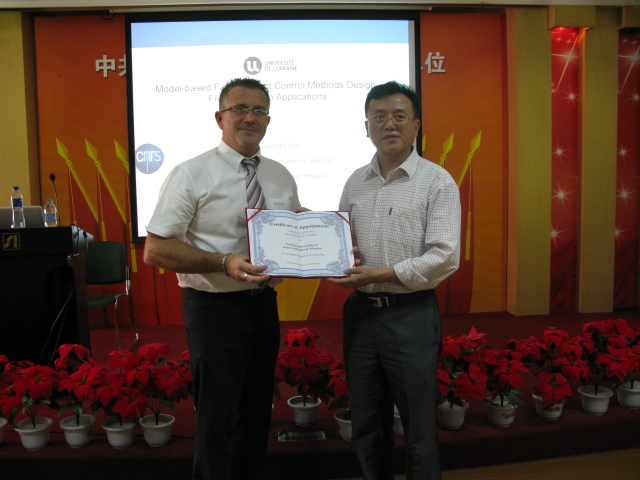
Didier Theilliol is a Professor of Control Engineering at the University of Lorraine, France, since 2004. He holds a Ph.D. in Control Engineering from Nancy-University (1993). He was awarded the CAS Visiting Professorship by the Chinese Academy of Sciences (CAS) in 2012, during which he collaborated with the Shenyang Institute of Automation (SIA) on flight control and fault-tolerant systems. His research focuses on model-based fault diagnosis (FDI), fault-tolerant control (FTC) for complex systems, and reliability analysis, with applications in aerospace, industrial automation, and robotics. Education: Ph.D. in Control Engineering (Nancy-University, 1993). Research interests include advanced control strategies for linear and nonlinear systems, multi-agent coordination, and safety-critical applications. His work integrates theoretical advancements with practical implementations across industries such as steel production, wastewater treatment, and aerospace. Notable contributions include methodologies for degradation management, distributed observer design, and health-aware control. Recent article trends emphasize fault-tolerant control in multi-agent systems, reinforcement learning for safety-critical tasks, and integration of physics-informed neural networks for system modeling. His publications span topics from model-based diagnostics to real-world applications in UAVs and propulsion systems. Awards: CAS Visiting Professorships for Senior International Scientists (2012). Collaborations include co-working with SIA’s rotorcraft UAV project team and leading European R&D initiatives. He serves as Associate Editor for ISA Transactions and Unmanned Systems , and chairs conferences on fault-tolerant control systems. His research also extends to Bayesian networks for system reliability and particle filter-based prognostics in industrial settings. Labs/Teams: Active in the State Key Laboratory of Robotics (visited during his CAS tenure) and coordinates projects within the German-French Institute for Automation and Robotics.
Sylvain Arlot is a Professor at the Mathematics Department of Université Paris-Saclay, affiliated with the Probability and Statistics team at Laboratoire de Mathématiques d'Orsay. He leads the Celeste INRIA Saclay project-team and is a junior member of the Institut Universitaire de France (IUF) since 2020. His research focuses on statistical learning theory, non-parametric methods, model selection, and change-point detection. Arlot has contributed to foundational work on cross-validation, penalization techniques, and random forests. He co-organizes the Séminaire Palaisien and serves as an associate editor for the Annales de l'Institut Henri Poincaré B. Education: PhD in Mathematics from Université Paris-Sud (2007), HDR (Habilitation) from Université Paris Diderot (2014). Research Interests: Core areas include statistical learning theory, resampling methods (e.g., cross-validation and bootstrap), and applications in high-dimensional data analysis. His work bridges theoretical guarantees with practical algorithm design, emphasizing data-driven model selection and robust estimation techniques. Grants & Projects: Leads the PEPR IA Project Causali-t-AI (2023–2028) and was a member of the ANR Fast-Big project (2018–2023). He coordinates the math-AI program under Labex Mathématique Hadamard. Awards: Junior IUF membership (2020–2025). Labs/Teams: Heads the Celeste team at INRIA Saclay, collaborating on statistical machine learning and data science challenges.
Mohammed Nabil EL KORSO is a Professor at CentraleSupélec, part of the University of Paris-Saclay. He is affiliated with the Laboratoire des Signaux et Systèmes (L2S). His research focuses on statistical signal processing, machine learning, detection/estimation theory, and robust signal processing, with applications in radioastronomy, radar systems, and source localization. He has contributed extensively to methodologies like Kalman filtering, covariance estimation, and array processing. His work emphasizes robust techniques for handling non-Gaussian noise and interference, particularly in radio interferometry and SAR imaging. Key contributions include algorithms for array calibration, RFI mitigation, and subspace estimation. His research also addresses challenges in distributed and adaptive signal processing, with applications to vital signs monitoring and robotic systems. He has published over 50 journal articles and conference papers, focusing on performance bounds (Cramér-Rao, Weiss-Weinstein), Bayesian methods, and practical implementations for large-scale systems. His recent work includes advancements in low-cost interferometric imaging and phase estimation for SAR time series. EL KORSO collaborates with international projects like the Square Kilometre Array (SKA), contributing to technological developments in radio astronomy. He supervises research in signal processing labs and actively participates in academic conferences such as EUSIPCO and ICASSP.
Zhiyang Shen is an Associate Professor at the IÉSEG School of Management, specializing in Economics with a focus on Environmental and Energy Economics, Efficiency Analysis, and Sustainable Development. He holds a Ph.D. in Economics from the University of Lille 1 (2016) and an HDR (Habilitation) in Economics from the University of Lille (2023). His research explores the intersection of digital technology, energy transitions, and environmental policy, with a particular emphasis on green productivity and climate resilience in developing economies. Education: 2023: HDR in Economics, University of Lille, France 2016: Ph.D. in Economics, University of Lille 1, France 2013: Master in Public Economics and Public Finance, University of Rennes, France 2012: Master of Business Administration, Rouen Business School, France Research Interests: Shen’s work centers on measuring and improving environmental and economic efficiency through advanced methodologies like Data Envelopment Analysis (DEA). He investigates topics such as energy transitions, carbon neutrality strategies, and the role of digital technologies in fostering sustainable growth. His studies often address policy-relevant questions in China and other Belt and Road countries. Publications: His recent work highlights themes such as green productivity decomposition, energy security, and the impact of digitalization on energy efficiency. Key contributions include analyzing agricultural productivity in Belt and Road nations and evaluating renewable energy policies in China. Professional Experience: 2022–present: Associate Professor, IÉSEG School of Management 2020–2022: Assistant Professor, Beijing Institute of Technology 2013–2022: Research and Teaching roles at IÉSEG 2017–2020: Economic Analyst/Manager, China Ex-Im Bank 2009–2011: Civil Servant, Bengbu Municipal Bureau of Finance Labs/Teams: Member of the Laboratory of Economics and Management (LEM) at IÉSEG.