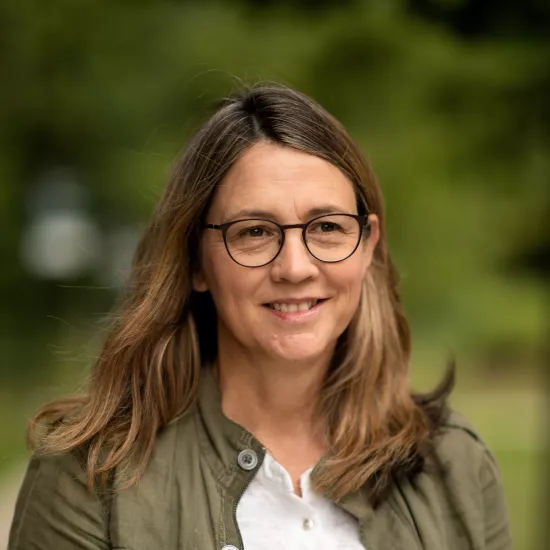
Ann B. Lee is a Professor and Co-Director of the PhD Program in Statistics at Carnegie Mellon University , with a joint appointment in the Department of Statistics & Data Science and the Machine Learning Department. Prior to joining CMU, she held positions as a J.W. Gibbs Assistant Professor at Yale University and a visiting research associate at Brown University. PhD in Physics, Brown University MSc/BSc in Engineering Physics, Chalmers University of Technology, Sweden Her research focuses on statistical methodology for complex data in the physical sciences , emphasizing trustworthy inference, uncertainty quantification, and integration of classical statistics with machine learning. Recent work includes likelihood-free inference, calibrated forecasting, and diagnostics for generative models. The STAMPS research group , which she co-founded in 2018, hosts weekly meetings and public webinars. In Fall 2024, STAMPS will transition into a CMU Research Center. Recent publications span likelihood-free inference , climate modeling , and astronomy . Notable collaborations include applications to hurricane intensity guidance , galaxy redshift estimation , and cosmological parameter biases . She mentors PhD students and has advised multiple award-winning researchers, including ASA Best Student Paper Award winners. Her teaching includes advanced courses on probability, regression, and AI for climate sciences.
Laurent Mydlarski is a Professor in the Department of Mechanical Engineering at McGill University, affiliated with the Faculty of Engineering. His research focuses on experimental fluid mechanics, particularly turbulent flows and scalar mixing. He holds a Ph.D. from Cornell University and B.A.Sc. from the University of Waterloo. Research interests include turbulence statistics, scalar dispersion, differential diffusion, and industrial cooling applications such as hydroelectric generators and microelectronics. His work combines experimental methods like hot-wire anemometry, laser-induced fluorescence, and particle-tracking velocimetry. Key contributions include studies on multi-scalar mixing in jets, wall shear stress in turbulent flows, and thermal anemometry probe design. His Mydlarski Lab at McGill explores both fundamental fluid dynamics and practical engineering solutions. Recent publications (2023-2025) address multi-scalar mixing metrics, electronic cooling innovations, and drag reduction on porous cylinders. Collaborations with industry focus on applying fluid mechanics principles to real-world thermal management challenges.
Soumya Dutta is an Assistant Professor in the Department of Computer Science and Engineering at the Indian Institute of Technology Kanpur (IITK), where he leads the INSIGHT: Intelligent Scientific and Visual Computing of Big Data Research Group. He joined IIT Kanpur in October 2022 after working as a Scientist II at Los Alamos National Laboratory (LANL) from July 2019 to August 2022, and previously as a Postdoctoral Research Associate at LANL from June 2018 to July 2019. His educational background includes a Ph.D. and M.S. in Computer Science and Engineering from The Ohio State University (2011-2018), where he was part of the GRAVITY research group, and a B.Tech. in Electronics and Communication Engineering from West Bengal University of Technology, India (2005-2009). Research Interests: Dr. Dutta's research focuses on the intersection of machine learning, visual computing, big data, and high-performance computing. His primary research areas include Machine Learning for Visual Computing and Image Analysis, Big Data Visualization and Analytics, Data Science and HPC, Machine Learning for Scientific Computing, and Explainability and Interpretability of AI Models. His work addresses various big data characteristics including the 5 Vs: Volume, Velocity, Variety, Veracity, and Value. He develops techniques that make complex machine learning models more interpretable and explainable, enabling their effective adoption in real-life applications across scientific domains, social media, IoT, healthcare, and industry applications. Dr. Dutta's research group has secured multiple funded projects including: DAVi: An Intelligent Data Analytics and Visualization Framework (funded by ISRO), Intelligent Visual Computing of Extreme-scale Data for Accelerating Scientific Discovery (IIT Kanpur Initiation Grant), Enabling Interactive Big Data Analytics and Visualization at Exascale (SERB), Development of AI-Enabled National Portal for Efficient Search of Missing People (C3iHub), and Proactive and Generalized Deepfake Defense Mechanisms (C3iHub). Best Reviewer, Honorary Mention Award for IEEE Transactions on Visualization & Computer Graphics (TVCG), 2021 Best Paper Award at ISAV 2021, co-located with Supercomputing (SC) LAAP Award at Los Alamos National Laboratory, 2021 Best Paper Award at TopoInVis 2019 Best Paper Award at ISAV 2018, co-located with Supercomputing (SC) Best Poster Award in 12th Annual CSE Student Poster Exhibition, The Ohio State University, 2018 Best Poster Award in 11th Annual CSE Student Poster Exhibition, The Ohio State University, 2017 Best Paper Honorable Mention Award at IEEE Visualization Conference (IEEE VIS) 2016 Dr. Dutta actively mentors a large group of students including Ph.D., M.Tech., and B.Tech. students. His current Ph.D. students include Shanu Saklani, Sankhadeep Bhowmick, Ananya Chaturvedi, Arpita Santra, Anubhav Dixit (co-supervised), and Robin Shah. He has supervised numerous M.Tech. students with thesis topics ranging from uncertainty-aware neural networks to deepfake detection. Dr. Dutta currently teaches courses including CS360 - Introduction to Computer Graphics and CS661 - Big Data Visual Analytics. The INSIGHT research group collaborates internationally with researchers from Meta, Oak Ridge National Laboratory, and National Taiwan Normal University. The group's work focuses on building machine learning and data science-based solutions to analyze large-scale multifaceted data in a scalable way, enabling interactive and interpretable analytics of complex data from scientific simulations, social media, IoT, healthcare, and other application domains.
Prof Terry O'Neill serves as Executive Dean at the Bond Business School , Bond University, while also holding the title of Professor and Director at the Centre for Data Analytics. His research spans applied statistics , big data analytics , and financial modeling , with over 80 publications (20% in A* journals). Grants: Lead investigator on five ARC Discovery/Linkage grants totaling $2.99M, including studies on retirement savings, climate change modeling, and financial crisis resilience. Research Trends: Focus on financial literacy , retirement economics , and myelopoiesis , bridging finance with computational biology through collaborations with his spouse Helen O'Neill. Academic Leadership: Established Bond University's University Centre in Actuarial and Financial Big Data Analytics to elevate institutional research prominence in data science.
Rebecca Willett is a Professor of Statistics and Computer Science at the University of Chicago and Faculty Director of AI at the Data Science Institute. She holds the Worah Family Professorship and is a member of the Wallman Society of Fellows. Her research focuses on machine learning, signal processing, and scientific computing, with applications in astronomy, climate science, and biochemistry. She has held visiting roles at institutions including UCLA and INRIA. Key roles include Deputy Directorships at the NSF-Simons Institute for Theory and Mathematics in Biology and the SkAI Institute. Education: PhD in Electrical and Computer Engineering from Rice University (2005), followed by faculty roles at Duke University (2005–2013) and the University of Wisconsin-Madison (2013–2018). Awards include the 2024 SIAM Data Science Career Award, NSF CAREER Award (2007), and AFOSR Young Investigator Award (2010). Research interests span inverse problems, optimization theory, and interdisciplinary applications. Her work bridges high-dimensional statistics and imaging science. Recent articles emphasize neural network theory, climate data assimilation, and biophysical modeling. Awards include SIAM Fellowship, IEEE Fellowship, and teaching excellence awards. She leads initiatives in AI ethics, broadening participation in STEM, and serves on key committees like the National Academies' CATS. Labs/Groups: Machine Learning Group at UChicago, CERES Center for Unstoppable Computing. Grants include NSF, DOE, and collaborations with Argonne National Laboratory.
Dr. Yang Liu is the Chair and Gangarosa Distinguished Professor in the Gangarosa Department of Environmental Health at Emory University's Rollins School of Public Health. His research focuses on satellite remote sensing applications for public health, climate change impacts, and air pollution exposure modeling. He leads federally funded projects integrating satellite data into health studies and serves as a PI for the NIH-funded Climate & Health Actionable Research and Translation (CHART) Center. Education: Ph.D. (Harvard University), M.S. (University of California), B.S. (Tsinghua University). Professional Affiliations include NASA mission science teams and the ORISE Faculty Fellowship at CDC. Research interests span satellite aerosol retrieval, climate-health linkages, and machine learning in environmental statistics. Notable work includes advancing wildfire smoke health impacts, PM2.5 modeling, and climate dashboard development for Georgia. Awards include Gangarosa Distinguished Professorship, ORISE CDC Fellowship, and leadership in NIH/NASA initiatives. His lab develops innovative tools for environmental health monitoring and policy translation.
Professor Jiti Gao is a Donald Cochrane Chair in Econometrics & Business Statistics at Monash University's Faculty of Business and Economics. He leads the Department of Econometrics and Business Statistics, specializing in non- and semi-parametric econometrics, time-series analysis, and panel data methodologies. His research focuses on developing statistical models for climate change, energy demand, and financial forecasting. Affiliations: Monash University, Impact Labs Grants: Multiple ARC Discovery Projects (e.g., 2020–2025 on climate-energy time series, 2017–2020 on econometric model building) Collaborations: CSIRO, Yale University, and international partners from China, Norway, and Singapore Research interests include climate econometrics, financial time series, and policy evaluation. Over 136 publications span econometric theory and applications, with recent work on nonlinear trending models and quantile regression. His grants emphasize methodological advancements in time series and panel data analysis. Awards: Not explicitly mentioned, but recognition includes Australian Professorial Fellow status and international research leadership roles. Advising/Grants: Primary Investigator on multiple ARC-funded projects, focusing on climate modeling and financial econometrics Labs/Teams: Part of Monash's Impact Labs and collaborates with global institutions on climate and econometric initiatives
Padhraic Smyth is a Distinguished Professor and Hasso Plattner Endowed Chair in Artificial Intelligence at the University of California, Irvine (UCI), holding joint appointments in the Department of Computer Science and Department of Statistics. He leads the DataLab research group, focusing on machine learning, AI, and their applications in climate science, healthcare, and education. His research spans probabilistic modeling, deep learning, and human-AI collaboration. Education: PhD in Electrical Engineering from the California Institute of Technology (1988), MSEE (1985), and BEng (1984). Prior to UCI, he worked at NASA's Jet Propulsion Laboratory (1988–1996). Research Interests: Machine learning, AI, pattern recognition, Bayesian methods, climate science applications, algorithmic fairness, and human-AI interaction. He has published over 200 papers and co-authored textbooks like Modeling the Internet and the Web . Awards: ACM Fellow, IEEE Fellow, AAAI Fellow, AAAS Fellow, and ACM SIGKDD Innovation Award recipient. He has held leadership roles in UCI's Center for Machine Learning and Data Science. Key Projects: Human-AI collaboration frameworks, robustness in deep learning, climate modeling using spatio-temporal data, and AI fairness with missing attributes. Collaborates with institutions like NASA and industry partners (e.g., Google, eBay). Labs/Teams: Director of UCI’s Data Science Initiative and HPI Research Center in Machine Learning. Supervises a vibrant PhD program with over 30 alumni in academia and industry.
Alfred O. Hero, III is the John H. Holland Distinguished University Professor of Electrical Engineering and Computer Science and the R. Jamison and Betty Williams Professor of Engineering at the University of Michigan, Ann Arbor. He is currently on leave from the University of Michigan as a Program Director in the CISE Directorate at the National Science Foundation. His primary appointment is in the Department of Electrical Engineering and Computer Science (EECS), with secondary appointments in the Department of Biomedical Engineering and the Department of Statistics. He is also affiliated with the UM Center for Computational Medicine and Bioinformatics (CCMB), the UM Graduate Program in Applied and Interdisciplinary Mathematics (AIM), the UM Applied Physics Program, and the Michigan Institute for Data Science (MIDAS), which he co-founded from 2015-2018. Hero's research focuses on data science, developing theory and algorithms for multimodality data collection, fusion, analysis and visualization that use statistical machine learning and distributed optimization. His work has applications in wearable technologies for personalized health and predictive medicine, spatio-temporal networks in biology, climate, and social discourse, anomaly detection, and data analysis for international security. His recent research interests include high dimensional spatio-temporal data analysis, multimodal data integration, statistical signal processing, and machine learning, with particular emphasis on predictive mathematical models for biological and physical sciences, social networks, network security and forensics, and personalized health and disease. His recent publications demonstrate a strong focus on high-dimensional statistical methods, contrastive learning, neural network optimization, change detection in temporal graphs, and applications in microbiome analysis and epidemic modeling. The research spans theoretical foundations in information theory and statistical learning while addressing practical applications across multiple domains. Scientific Awards: IEEE Signal Processing Society Best Paper Award (1998) Best Original Paper Award from Journal of Flow Cytometry (2008) Best Magazine Paper Award from IEEE Signal Processing Society (2010) SPIE Best Student Paper Award (2011) IEEE ICASSP Best Student Paper Award (2011) IEEE Signal Processing Society Technical Achievement Award (2014) IEEE Signal Processing Society Society Award (2015) IEEE Fourier Award (2020) University of Michigan Distinguished Faculty Achievement Award (2011) Hero has advised over 60 PhD students and 30 postdocs in areas including modeling, computation, and inference for large scale time varying data in the biosciences. He has received significant research funding from the Department of Energy, Army Research Office, Air Force Office of Scientific Research, and National Science Foundation. He has held leadership positions including President of the IEEE Signal Processing Society (2006-2007), Director of Division IX (Signals and Applications) on the IEEE Board of Directors (2009-2011), and Chair of the Committee on Applied and Theoretical Statistics of the US National Academies (2018-2020).
Tracey Galloway is an Associate Professor in the Department of Anthropology at the University of Toronto Mississauga (UTM), where she conducts critical research on Indigenous health disparities and policy interventions in northern Canada. Her work bridges medical anthropology, public health, and community-based participatory research to address systemic inequities affecting circumpolar populations. Education: PhD, McMaster University, 2008 MA (institution unspecified) BA (institution unspecified) BScN (institution unspecified) Dr. Galloway's research program centers on chronic disease risk assessment and health system improvement in Indigenous communities, with specific expertise in nutrition transition, food security, child growth patterns, and public health policy evaluation. She examines the impact of federal programs like Nutrition North Canada while developing community-led solutions for health equity. Her methodological approach combines quantitative analysis of health outcomes with qualitative community engagement, emphasizing Indigenous research sovereignty and decolonizing methodologies. Her publication record reveals consistent thematic focus across 15 recent articles, demonstrating interdisciplinary collaboration between anthropology, epidemiology, and health economics. Key trends include rigorous evaluation of colonial impacts on Indigenous food systems, innovative analysis of subsidy program effectiveness, and centering Indigenous patient experiences in healthcare design. Her work consistently prioritizes community-defined research questions and actionable policy recommendations. Dr. Galloway actively mentors graduate students including Darci Belmore, Carly Checholik, Neda Maki, and Hiliary Monteith, guiding research on Indigenous health determinants and policy interventions. While specific grant details aren't publicly enumerated, her collaborative projects involve partnerships with Indigenous communities across Northern Canada and interdisciplinary teams addressing complex health system challenges. She maintains strong community partnerships for her applied research, particularly in Nunavut and Northwestern Ontario, working directly with Anishinabeck and Inuit communities to translate findings into culturally safe health initiatives and policy reforms that address the root causes of health inequities.
Freddy Bouchet is a Directeur de Recherche at CNRS and a Professeur attaché at École Normale Supérieure de Paris (ENS-PSL). His work bridges mathematical physics, climate science, data science, and statistical mechanics , focusing on turbulent flows, climate extremes, and large deviation theory . He will lead the Laboratoire de Météorologie Dynamique (LMD) starting 2025. Research Themes : Statistical mechanics of geophysical flows (Jupiter's jets, ocean currents). Large deviation theory for rare events in turbulence and climate. Non-equilibrium phase transitions in atmospheric/oceanic systems. Ensemble inequivalence in systems with long-range interactions. Scientific Awards : Three Physicists Prize Collaborations : Tapio Schneider, Antoine Venaille, J. Laurie, O. Zaboronski, B. Dubrulle, A. Venaille. Labs & Teams : Climate and Statistical Mechanics group at ENS de Lyon Future director of Laboratoire de Météorologie Dynamique (LMD/IPSL) Publications span climate dynamics, turbulence, statistical mechanics, and large deviation theory , with applications to Jupiter's atmosphere, ocean vortices, and non-equilibrium systems . His work often challenges paradigms like Tsallis non-extensive statistics.
Zach Shahn is an Assistant Professor in the Department of Epidemiology and Biostatistics at the CUNY School of Public Health. He holds a PhD in Statistics from Columbia University and a BA in Mathematics from Stanford University. His research focuses on causal inference methods applied to healthcare data, particularly time-varying treatment effects and critical care applications. He has conducted postdoctoral work at Harvard School of Public Health and previously worked at IBM Research in Healthcare and Life Sciences. Education: PhD in Statistics and Probability, Columbia University BA in Mathematics, Stanford University Research interests include developing causal inference frameworks for evaluating treatment efficacy in dynamic healthcare settings, with a focus on critical care outcomes and methodological innovations. Recent work explores applications of causal diagrams, instrumental variables, and machine learning in healthcare decision-making. His studies often involve large-scale healthcare datasets to assess interventions' real-world impacts. Key trends in his articles include advancements in causal effect estimation under complex treatment regimes, bias analysis in observational studies, and methodological contributions to difference-in-differences and N-of-1 trial designs. His work bridges statistical theory with practical healthcare challenges, emphasizing reproducibility and policy relevance. No scientific awards are listed, though his contributions to causal inference methodologies are notable in academic circles. He has advised on healthcare data projects and published extensively without explicitly listed grants. His professional network includes collaborations with institutions like Harvard and IBM. He is affiliated with CUNY's public health programs and actively engages in academic discourse via Twitter and LinkedIn. His lab or team details are not explicitly mentioned in available materials.
Dr. Hyun Kyoung Ro is an Associate Professor in the Department of Counseling and Higher Education at the University of North Texas, affiliated with the College of Education. She previously served as a faculty member at Bowling Green State University and worked as a Research Designer and Analyst at Carnegie Mellon University’s Office of Institutional Research and Analysis. Ph.D. in Higher Education, The Pennsylvania State University (minor in Educational Psychology—Applied Measurement) M.A. and B.A., Korea University Her research centers on gender and racial equity in STEM education , learning experiences of marginalized students , and critical quantitative research and assessment . She employs rigorous methodologies to examine systemic inequities and institutional practices affecting underrepresented populations in higher education. Dr. Ro's recent publications span top-tier journals such as Journal of Engineering Education , The Review of Higher Education , and Research in Higher Education , reflecting a strong focus on equity, policy, and assessment in STEM and higher education contexts. Her work consistently emphasizes intersectionality, data justice, and institutional reform. She has received significant external funding, including: National Science Foundation ADVANCE Adaptation Track grant for gender equity on campus AccessLex Institute/Association for Institutional Research grant on law school access and enrollment among women of color Collectively, these grants total $1.1 million, supporting her leadership in advancing equity through research and institutional change. While no formal list of advisees or awards is provided, her role as a leading author and grant recipient highlights her active mentorship and scholarly leadership. Dr. Ro has not indicated any lab or research team affiliations in the provided text, but her research profile suggests collaboration with institutional research units and equity-focused initiatives.
Huiyan Sang is a Professor and Director of the Undergraduate Program in the Department of Statistics at Texas A&M University (College of Arts & Sciences). She earned her Ph.D. in Statistics from Duke University and a B.Sc. in Mathematics and Applied Mathematics from Peking University. Her research focuses on spatial statistics, Bayesian nonparametric methods, machine learning, computational statistics, and applications in environmental sciences, geosciences, urban planning, and biomedical research. Her interdisciplinary work integrates statistical methodologies with real-world challenges, such as analyzing extreme environmental events, optimizing urban infrastructure, and modeling complex systems like human mobility during pandemics. She has contributed to advancing spatio-temporal modeling, Gaussian processes, and Bayesian hierarchical frameworks for large datasets. Recent publications highlight innovations in nonparametric regression, spatial functional data analysis, and stochastic frontier analysis, often leveraging computational efficiency and scalability. Her work addresses critical societal issues, including the impact of community design on public health and environmental monitoring through remote-sensing data. No scientific awards are explicitly listed in the provided texts. She advises no students or grants in the current dataset but collaborates widely on interdisciplinary projects. Her research lab focuses on developing cutting-edge statistical tools with applications in engineering, public health, and environmental science.
Scientia Professor Gary Froyland is a Professor at the University of New South Wales (UNSW), affiliated with the School of Mathematics & Statistics. He leads the ARC Laureate Centre for Dynamical Systems and Data and holds an Einstein Visiting Fellowship from the Einstein Foundation Berlin. His academic credentials include a BSc (Hons 1, Medal) in Pure and Applied Mathematics from the University of Queensland and a PhD in Mathematics from the University of Western Australia. Professor Froyland's research spans two primary domains: dynamical systems and optimization. In dynamical systems, he investigates the interplay of probability and geometry in nonlinear and chaotic systems, employing tools from ergodic theory, functional analysis, and differential geometry. His work extends to applications in oceanography, atmospheric science, and granular flows. In optimization, he focuses on decision-making in complex systems with uncertain information, developing novel approaches in mathematical programming that have been applied to mining, logistics, and medical treatment planning. His recent publications demonstrate a strong focus on coherent structures in dynamical systems, linear response theory, and applications to geophysical phenomena. The research shows increasing interdisciplinary collaboration, particularly with climate scientists and data analysts, reflecting a trend toward applying advanced mathematical techniques to real-world problems in environmental science and engineering. J.D. Crawford Prize (2025) Elected Member of the Academy of Europe / Academia Europaea (2024) ARC Laureate Fellow (2024-2029) Fellow of the Society for Industrial and Applied Mathematics (SIAM) (2021) Fellow of the Australian Academy of Science (2020) Vice-Chancellor's Award for Teaching Excellence - Postgraduate Research Supervision (2015) Professor Froyland actively supervises PhD and honors students, with current advisees including Kevin Felipe Kühl Oliveira, Nicholas Peters, and Kathrin Völkner. His research is supported by multiple grants, including an ARC Laureate Fellowship (2024-2029) for "Breakthrough mathematics for dynamical systems and data," an Einstein Visiting Fellowship (2022-2026), and several ARC Discovery Projects. His work has practical applications in climate science, mining optimization, and medical treatment planning, particularly in radiotherapy. He leads the ARC Laureate Centre for Dynamical Systems and Data, which brings together researchers to develop new mathematical approaches for analyzing complex dynamical systems. The center focuses on creating methods to identify coherent structures in spatiotemporal data, with applications spanning environmental science, social science, health science, and engineering.