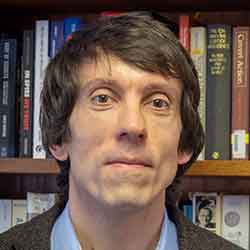
Richard J. Aldrich is a Professor of International Security at the University of Warwick. His research focuses on intelligence, cybersecurity, and digital politics, with notable contributions to understanding historical and modern security challenges. He has led major projects including the AHRC-funded study on the CIA and U.S. foreign policy, and co-edits journals like Intelligence and National Security . Aldrich advises governments on records management and declassification, notably assisting the German Bundestag inquiry into the NSA 'Snowden' affair. He holds a Distinguished Scholar award from the International Studies Association and has published extensively, including the acclaimed GCHQ: Centenary Edition . Teaching modules include 'Vigilant State: The Politics of Intelligence' and 'Cybersecurity: War, Spies, Crime, and Protest on the Internet.'
Moritz Wiese is a Researcher at the Chair of Theoretical Information Technology within the Department of Electrical and Computer Engineering at Technische Universität München (TUM) . His work focuses on information-theoretic security, quantum communication, and wireless networks, with significant contributions to interference modeling and secure coding schemes. Research Interests : Information-Theoretic Security, Quantum Wiretap Channels, MIMO Systems, 5G/6G Technologies, Physical Layer Security, and Network Coding. Key Grants : Involved in DFG-funded projects (Gottfried Wilhelm Leibniz Prize, UKoloS) and BMBF initiatives (6G-life, QuaDiQua). Collaborations : Worked with Prof. Holger Boche, Christian Deppe, and Rami Ezzine on secure communication and randomness generation. Labs : Active in the ACES Lab and 6G-life research hub, focusing on joint communication/sensing and neuromorphic computing. Publications : Over 20 papers on secure estimation, wiretap channels, and quantum secrecy, including top-tier journals like IEEE Transactions on Information Theory and Journal of Mathematical Physics .
Abhinav Goyal is a Professor of Finance and Director of Global Engagement at Birmingham Business School, University of Birmingham. He is affiliated with the Department of Finance and plays a leadership role in shaping the school's international strategy. His research is widely published in premier finance journals, and he serves on editorial boards including as Associate Editor for British Accounting Review . Education: PhD in Banking and Finance, University College Dublin, Ireland (2013) MA in Financial Risk Management, Simon Fraser University, Canada (2007) BE (Hons) in Computer Science, India (2006) His research focuses on corporate finance , particularly IPOs, corporate governance, privatization, and dividend policy, with a strong emphasis on institutional and emerging market contexts. His work explores how legal, political, cultural, and media factors influence corporate financial decisions, especially in initial public offerings and payout policies. Using empirical methods, he investigates global patterns in financial markets, often drawing on cross-country datasets to assess the impact of governance reforms, ownership structures, and socio-political events. The recent articles reflect a consistent focus on IPO pricing dynamics, influenced by democracy, media, terrorism, board reforms, and legal frameworks. His research integrates insights from political economy, behavioral finance, and institutional theory, demonstrating a multidisciplinary approach to understanding financial markets. A recurring theme is the role of transparency, governance, and external shocks in shaping corporate financial behavior. Scientific Awards and Editorial Roles: Associate Editor, British Accounting Review Area Editor (Frontier Markets), Research in International Business and Finance Dr. Goyal has advised doctoral and postdoctoral researchers in finance, though specific names are not listed. He has secured research funding through collaborative projects reflected in his co-authored publications with international scholars. His past academic appointments include positions at University College Cork and the University of Liverpool, along with visiting roles at Monash University, Xi’an Jiaotong-Liverpool University, and Manipal University, indicating a strong global academic network. He teaches advanced courses such as Contemporary Topics in Banking and Finance (MBA) and Private Equity and Venture Finance (MSc), contributing significantly to graduate education. He leads no named research lab or center in the provided text, but his editorial roles and global engagement position suggest active participation in research communities and international academic collaborations.
Cora Schmidt-Ott is a Postdoctoral Researcher at the Chair of Modern and Contemporary History (Prof. Dr. Jan Eckel) at the University of Freiburg . Her work focuses on the intellectual biography of Samuel P. Huntington and the broader intellectual history of the 20th century, particularly in relation to political stability, globalization, and the American Century. She collaborates with institutions like the German Historical Institute, Washington DC , and has led DFG-funded projects. Education: MA in Comparative Modern History (University of Freiburg & University of Bologna); BA in History and American Studies (University of Freiburg & Connecticut College) Her research explores the intersections of political theory, Cold War liberalism, and transnational historical processes, with a particular emphasis on Huntington's influence on postcolonial state-building and global order. She has contributed to debates on migration, museum narratives, and post-war societal transformations. Recent publications and lectures highlight her expertise in political history, American studies, and Cold War-era intellectual networks. She has received scholarships from the Bavaria Graduation Scholarship , Max Weber Fellowship , and Erasmus Program , among others. Scientific Awards: Bavaria Graduation Scholarship (2016) Max Weber Fellowship (2015) Erasmus Scholarship (2013) Baden-Württemberg Scholarship (2011) Cora Schmidt-Ott contributes to academic discourse through her leadership in workshops, teaching roles in seminars on decolonization and 20th-century history, and her ongoing project funded by the German Research Foundation on Samuel Huntington's intellectual legacy.
Jennifer D. Oliva is a Professor of Law at Indiana University Maurer School of Law where she holds the Val Nolan Faculty Fellow position. She maintains significant interdisciplinary affiliations as a Research Scholar at Georgetown University Law Center's O'Neill Institute for National & Global Health Law and as a Senior Scholar with the UCSF/UC Law Consortium on Law, Science & Health Policy. Her academic work bridges legal scholarship with practical health policy development, focusing on the intersection of constitutional protections, public health needs, and modern surveillance technologies. Professor Oliva's research interests center on health law, privacy law, and drug policy with particular expertise in prescription drug monitoring programs (PDMPs), health information privacy, and the legal dimensions of the opioid crisis. Her scholarship critically examines how law enforcement surveillance of prescription data impacts patient privacy rights, particularly for vulnerable populations including those with substance use disorders. She has developed significant expertise in how constitutional privacy protections apply to health data in the digital age, especially following the Supreme Court's decision in Carpenter v. United States. Her recent publications reveal a growing focus on algorithmic regulation in healthcare, examining how risk scoring systems and coverage algorithms can perpetuate health disparities. She has published extensively on the intersection of reproductive rights and health data privacy in the post-Dobbs landscape, analyzing how prescription monitoring systems could be weaponized against individuals seeking reproductive healthcare. Her work consistently connects doctrinal legal analysis with public health realities, advocating for evidence-based policy approaches that prioritize patient privacy and health equity over punitive enforcement. Dosing Discrimination: Regulating PDMP Risk Scores (2022) The "New" Drug War (2024) Prescription Drug Policing: The Right to Health Information Privacy Pre- and Post-Carpenter (2020) Opioid Multidistrict Litigation Secrecy (2019) Surveillance, Privacy, and App Tracking (2020) Professor Oliva actively engages with policymakers and has contributed to amicus briefs in significant cases including Ruan v. United States. Her scholarship has been cited in legal proceedings and she regularly presents at major academic conferences including the Association of American Law Schools Annual Meeting. She has collaborated with scholars across disciplines including public health researchers, medical ethicists, and data scientists to address complex challenges at the intersection of law, technology, and healthcare.
Gavan J. Fitzsimons is the Edward S. & Rose K. Donnell Distinguished Professor of Marketing and Psychology at Duke University's Fuqua School of Business , with a secondary appointment in the Department of Psychology & Neuroscience. He is a Faculty Network Member of the Duke Institute for Brain Sciences . His research bridges consumer psychology, behavioral decision-making, and social cognition, focusing on nonconscious influences on consumption patterns. Education: Ph.D., Columbia University (1995) Key research themes include subconscious consumer behavior , brand relationships , health-related consumption , and social dynamics in purchasing decisions . Recent work examines financial stress effects on purchase satisfaction, secret consumer behaviors in relationships, and pandemic-related decision-making. Notable trends in his 2023-2025 publications involve Marketing's subconscious influence (2025: Quality-Quantity Tradeoffs) Brand teasing as relationship-building (2025: Humor in Branding) Financial constraint effects on consumer happiness (2024: Opportunity Cost Analysis) Crisis behavior during pandemics (2024: Prosociality Across 39 Countries) Health behavior spillovers in families (2024: Parental Food Choices) Scientific Contributions include Foundational work on nonconscious consumer psychology (2008 JCP editorial) Methodological innovations in moderated regression analysis (2013 JMR ) Behavioral economics of brand sincerity effects (2015 JCR )
Mariane C. Ferme is a Professor in the Department of Anthropology at the University of California, Berkeley. Her research focuses on sociocultural dynamics in West Africa, particularly Sierra Leone, with expertise in political anthropology, legal studies, and material culture. She holds a PhD in Anthropology from the University of Chicago and has taught at prestigious institutions including the University of Cambridge and École des Hautes Études en Sciences Sociales. Education : PhD in Anthropology (University of Chicago), MA in Political Science (University of Milano), BA in Anthropology (Wellesley College). Ferme’s research spans the political imagination in conflict zones, agrarian transformations, and the interplay between humanitarian law and local justice systems. Her work has been supported by major grants from the National Science Foundation and the France-Berkeley Fund. She has published extensively on Sierra Leone’s post-war societies and the socio-cultural dimensions of the Ebola outbreak. Scientific awards include funding from the National Science Foundation, Hellman Family Faculty Fund, France-Berkeley Fund, Harvard Academy for International and Area Studies, and the Carter Woodson Institute for African and African-American Studies.
Dr Tim Aistrope is a Senior Lecturer in International Relations and Director of Graduate Studies (Taught) at the University of Kent's School of Politics and International Relations. Based in Canterbury, his research focuses on the intersection of political culture, security studies, and international relations theory. Key themes include the role of imagination, conspiracy theories in foreign policy, and the embodiment of political narratives. His notable work includes the book Conspiracy Theory and American Foreign Policy (2016), analyzing post-9/11 secrecy and power dynamics. He teaches courses on IR theory and security, supervising PhD students exploring topics like securitization and translation. Active in professional associations, he contributes to journals like International Studies Quarterly and International Affairs . His recent publications address pandemic governance, apocalyptic narratives, and cybersecurity. Research interests span IR theory, US/Australian foreign policy, international ethics, and cyber security. His work often bridges cultural studies and security, examining how narratives shape policy and public perception. He has advised on counter-radicalization strategies and explored the role of social media in counterterrorism. His academic contributions highlight interdisciplinary approaches to understanding global politics through lenses of culture, ethics, and critical theory.
Dr. Luca Trenta is an Associate Professor of International Relations at Swansea University's Department of Political and Cultural Studies. His research focuses on state-sponsored assassinations, US foreign policy, and covert operations, with a notable book The President’s Kill List: Assassination in US Foreign Policy since 1945 (2024). He holds grants from the British Academy and hosts the Out of the Shadows podcast. Trenta’s work bridges academia and public engagement, including media contributions to The Guardian , The New Yorker , and BBC programs. He advises PhD students on topics like Cold War interventions and international drug control. His research emphasizes historical analysis of covert actions and their legal/ethical implications, often appearing at major festivals like Hay-on-Wye and international conferences.
Professor Daniel Quevedo is a leading academic in Electrical and Computer Engineering at The University of Sydney. Previously, he held positions at Queensland University of Technology and Paderborn University, Germany, where he founded the Chair in Automatic Control. He earned his PhD from the University of Newcastle (Australia) and MSc/Ing. degrees from Universidad Técnica Federico Santa María (Chile). His research focuses on networked control systems, cyber-physical systems, and cybersecurity, with contributions to state estimation, control of power converters, and human-in-the-loop systems. He has pioneered work integrating machine learning, behavioral economics, and advanced mathematics to address challenges in interconnected digital-physical environments. Quevedo serves as Associate Editor for IEEE Transactions on Control of Networked Systems and IEEE Control Systems. He chairs the Committee of Experts for Germany’s Excellence Strategy on Digital Methods and has held leadership roles in IEEE technical committees. Notable awards include the IEEE Axelby Outstanding Paper Award (2018) and multiple fellowships. Teaching includes advanced control systems courses like Reinforcement Learning and Optimal Control. He is a Fellow of the IEEE and has published over 200 peer-reviewed articles, with recent work emphasizing privacy-preserving state estimation, resilient control systems, and energy-efficient wireless control. His research labs explore topics such as human-machine collaboration, cybersecurity in Industry 5.0, and data-driven control strategies. Current projects include secure remote state estimation frameworks and adaptive control under adversarial conditions.
James D. Long is a Professor of Political Science at the University of Washington and co-founder of the Political Economy Forum. He holds affiliations with multiple institutions including the Center for Statistics and the Social Sciences (CSSS) and the Technology and Social Change Group (TASCHA). His research focuses on electoral integrity, political violence, and ICT applications in development, particularly in sub-Saharan Africa and South Asia. He has observed elections in over a dozen countries and led field experiments on voter behavior and anti-corruption strategies. Long’s work is funded by USAID, NSF, and others. Education: PhD in Political Science, UC San Diego (2012) MSc in African Politics (Merit), SOAS, University of London (2004) BA in International Relations & History, College of William & Mary (2003) Research Interests: Elections in developing democracies, electoral fraud, technology for governance, insurgency impacts, and poverty reduction. His methods combine field experiments, ethnography, and election forensics. Recent Work: Examines ICT-driven citizen engagement platforms to improve governance and service delivery in developing nations. His 2020 ACM award-winning research addresses wildlife conservancy community relations via technology. Awards: ACM Best Paper Award (2020) Fulbright Scholar (2008-2009) Harvard Academy Fellowship (2012-2016) Advising & Grants: Supervises PhD students in comparative politics and development. Secured grants totaling over $1.5M for projects on electoral integrity and anti-corruption. Hosts the podcast 'Neither Free Nor Fair?' on global election security. Teaching: Courses include Global Crime/Corruption, African Political Economy, and Comparative Politics. Served as Associate Chair of the Department of Political Science.
David Nugent is a Professor in the Department of Anthropology at Emory University. He holds a PhD from Columbia University (1988) and specializes in sociocultural anthropology, political economics, and Latin American studies. His research focuses on state formation, race/ethnicity, agrarian societies, and the interplay between knowledge systems and power. Nugent’s fieldwork spans diverse regions including the Peruvian Andes, East Africa, the Canadian Arctic, and the U.S. Southwest. Key publications include The Encrypted State (2019), Modernity at the Edge of Empire (1997), and co-edited volumes such as State Theory and Andean Politics (2015). He has received the Choice Magazine ‘Outstanding Academic Title’ award for his collaborative work. Current projects explore vernacular sovereignties in Pacific-facing Latin America and underground democratic forms in Peru. Nugent’s research bridges historical and political anthropology, examining how states negotiate legitimacy through symbolic systems, fear, and displacement. His work critiques colonial and neocolonial knowledge frameworks while analyzing contemporary challenges like urban inequality and smart city governance. Education: PhD in Anthropology, Columbia University (1988) Awards: Choice Magazine ‘Outstanding Academic Title of 2004’ Projects: Co-editing ReOrienting Latin American History and authoring Sacropolitics: Group Sacrifice and the State of Redemption
Elizabeth (Lisa) Alexandrin is an Associate Professor in the Department of Religion at the Faculty of Arts, University of Manitoba . Her academic work bridges Islamic Studies , Sufism , and gender theory , with a focus on visual and textual representations of mysticism. Education: PhD in Islamic Studies, McGill University (2006) MA in Anthropology, University of Toronto (1993) BA in Anthropology, Boston University (1993) Research Interests: Islamic intellectual history Sufism Ismaili thought Body histories Visual piety Key Themes in Publications: Apocalyptic narratives in Fāṭimid Ismāʿīlī thought Qurʾanic calligraphy as spiritual practice Symbolism of walāyah (sainthood) in Sufi texts Intersection of dreams and mystical exegesis Awards: SSHRC Insight Development Grant (2018-2022) Explore SSHRC/University of Manitoba grant (2021-2022) SSHRC standard research grant (2011-2012)
Zakir Durumeric is an Assistant Professor of Computer Science at Stanford University, leading the Stanford Empirical Security Research Group. His research focuses on Internet security, trust, and safety, emphasizing large-scale network measurement and open-source tool development. He founded Censys, a platform providing global Internet device data, and maintains tools like ZMap, ZGrab, and Retina. Research interests include cybercrime prevention, censorship analysis, disinformation tracking, and platform governance for online harassment. Notable contributions include studies on the Mirai botnet, TLS certificate ecosystems, and vulnerabilities like Heartbleed and Logjam. Awards include the IRTF Applied Networking Research Prize (2015) and a Test of Time Award (2022). Teaches courses: CS155 (Computer & Network Security), CS356 (Systems & Network Security), and CS249i (Modern Internet). Advises over 20 students, including Catherine Han, Kimberly Ruth, and Liz Izhikevich. Develops open-source software such as ZMap Toolkit and ASdb, and maintains datasets like CrUX Top Million Websites. Recent work explores toxic online behavior, misinformation ecosystems, and regional censorship mechanisms in China. His lab’s tools are widely adopted in academia and industry for security research and policy guidance.
Isabel Gemma Fajardo García is an Associate Professor in the Department of Mercantile Law at the Faculty of Law, University of Valencia, Spain. She is affiliated with the Institut d'Investigació en Economia Social, Cooperativisme i Empresa (IUDESCOOP), where she conducts research on cooperative law, social economy, and related legal frameworks. Research Interests: Her work focuses on Commercial Law, Cooperative Law, Social Economy, Credit Cooperatives, Mutual Societies, and the legal regulation of solidarity-based enterprises. She explores both national and European dimensions, with comparative studies including Greece’s solidarity economy legislation. Her recent publications reflect a strong trend in analyzing the legal and institutional evolution of social economy actors across Europe, particularly in Spain and Greece. She has contributed extensively to journals such as CIRIEC España and REVESCO , and has co-authored books on worker-managed enterprises and social economy manuals. Her research emphasizes democratic governance, self-management, and the balance between economic viability and social objectives in cooperatives. Scientific Contributions: Author of numerous scholarly articles on cooperative banking, agri-food cooperatives, and legal frameworks for social economy. Co-author of the book Empresas Gestionadas por sus trabajadores and editor of Manual de economía social . Contributor to international academic networks, such as RULEESCOOP, fostering Europe-Latin America research collaboration. She advises on legal and policy aspects of cooperatives and social enterprises, though specific advisees are not listed. Her work is supported through institutional research frameworks and academic publishing. She is actively engaged in shaping legal discourse around cooperative models and social economy development. She leads and participates in research initiatives within IUDESCOOP, focusing on legal scenarios for social economy actors in the EU and member states, and exploring new perspectives for housing cooperatives and mutualist entities.