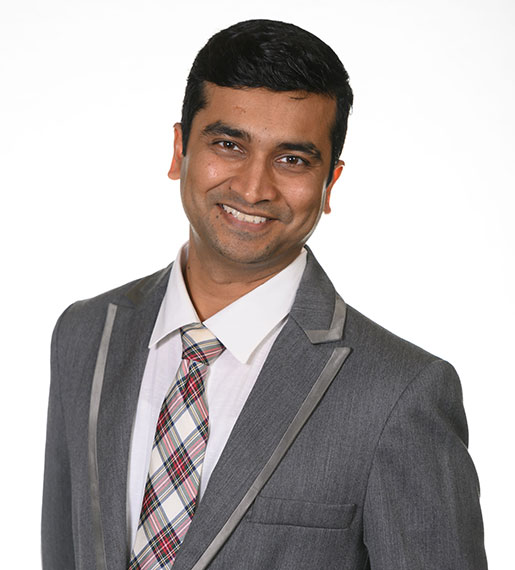
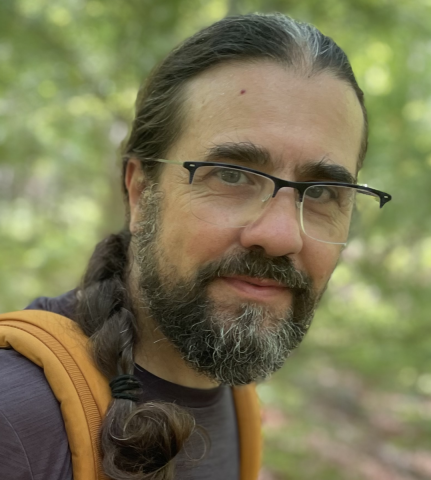
Raj Sunderraman is a Professor of Computer Science at Georgia State University, specializing in databases, data mining, and logic programming. His research focuses on deductive databases, semantic web technologies, bioinformatics, and graph data modeling. He holds a B.E. (Honors) in Electronics Engineering from Birla Institute of Technology and Science, an M.Tech. in Computer Technology from Indian Institute of Technology Delhi, and a Ph.D. in Computer Science from Iowa State University. His research projects include NeuronBank—a tool for cataloging neuronal circuitry—and work on scalable graph storage systems for big data. He has developed a programming environment for protein structure data and contributed to the paraconsistent relational data model. His teaching and research emphasize practical applications in bioinformatics, geoinformatics, and software systems. Key areas of exploration include reasoning with incomplete/inconsistent data, deductive database semantics, and graph query languages. Recent work involves lambda calculus visualization tools and 3D perception benchmarks for UAVs. He has authored over 150 publications and a textbook on Oracle 10g programming.
Kenny Joseph is an Associate Professor in the CSE Department at the University at Buffalo, leading the Computation and Equity Lab (cubelab) . His work bridges computational methods with social inequality research, focusing on predictive modeling for social good and analyzing systemic disparities through digital traces. Current affiliation: University at Buffalo Previous positions: Postdoc at LazerLab (Northeastern), Fellow at Harvard's Institute for Quantitative Social Science Research Interests: Combining machine learning with social theory to address structural inequalities in areas like foster care systems, neighborhood change, and gender disparities in academia. Key methodologies include agent-based modeling, network analysis, and large-scale data mining. Publication Trends: Recent work focuses on Social media dynamics and misinformation Equity-focused predictive modeling Political communication analysis Identity expression in digital spaces Urban planning applications Additional Contributions: Developer of computational tools for location extraction (GALLOC) and self-presentation analysis, with applications in disaster response and social inequality research.
Regina Stodden is a Research Fellow at the Department of Computational Linguistics, Heinrich Heine University Düsseldorf, since January 2019. She is affiliated with the NRW Research College for Online Participation (second funding phase) and works under the supervision of Prof. Dr. Marc Ziegele. Education: B.A. in Educational Science, Text Technology, and Computational Linguistics from Bielefeld University M.A. in Information Science and Language Technology from HHU Düsseldorf Her research focuses on automatic text processing , particularly text simplification for online discussions. This includes: Enabling participation for people with limited German proficiency Reducing manual workload in text analysis Exploring accessibility in Open Data portals She has contributed to tools like TS-ANNO for corpus annotation and EASSE-DE for simplification evaluation, with recent work extending to CEFR-based language proficiency assessment . Her research intersects Natural Language Processing , Machine Learning , and Usability Studies , often addressing accessibility challenges in digital participation. Scientific awards: No explicit awards mentioned. Advising and grants: Participates in the NRW Research College for Online Participation funding program and collaborates under Prof. Dr. Laura Kallmeyer's supervision. Her work involves grants related to text simplification for online participation processes.
Matthieu Labeau is a Senior Lecturer at Télécom Paris, affiliated with the Department of Image, Data, Signal (IDS). He joined the institution in 2019 after completing his PhD at the University of Paris-Saclay and a postdoctoral position at the University of Edinburgh. His research primarily centers on Natural Language Processing (NLP), with specialized interests in representation learning, language modeling, and conversational AI. His work spans: Core NLP : Contextual word representations, semantic alignment, and polysemy analysis. Machine Learning : Hierarchical classification, graph prediction, and few-shot learning techniques. Applications : Emotion recognition in dialogues, persuasiveness decoding, and educational NLP tools. Labeau leads research in the Signal, Statistics and Learning (S2A) team at the Information Processing and Communication Laboratory (LTCI). His recent publications demonstrate a strong focus on improving language model interpretability and efficiency, with innovations in tokenization effects and multimodal fusion. Though no awards or grants are mentioned, his consistent output in top-tier venues (e.g., NeurIPS, ACL, AAAI) highlights significant scholarly contributions. He actively collaborates on tools like EZCAT for conversation annotation and mentors researchers in NLP projects. Current work explores LLM capabilities in persuasion assessment and optimal transport methods for graph-based learning.
Dr. Mario Angst is a Researcher at the University of Zurich's Digital Society Initiative , focusing on governance networks and digitalization's role in sustainability governance. He co-leads the DSI Community Sustainability and the project sustainability.discourses , which analyzes urban sustainability transformations via computational methods and media data. Research Areas: Governance networks, digitalization policy, computational social sciences, urban sustainability discourses, and policy in the Anthropocene. His work combines natural language processing, Bayesian models, and network analysis with interdisciplinary teams. Scientific Awards: Robert Bosch Postdoc Academy for Transformational Leadership fellowship SNSF-funded visiting scholar at Stockholm Resilience Centre Students: Supervises bachelor's, master's, and PhD students at the University of Bern and Zurich, with teaching experience in methodology and sustainability topics. Labs & Tools: Develops computational tools like the R packages motifr , diskurs , and rayab , and contributes to the stance-llm Python library for actor stance classification.
Parisa Jamadi Khiabani is a Researcher at Queen Mary University of London's School of Electronic Engineering and Computer Science. Her research focuses on Natural Language Processing (NLP), Social Media Analysis, and Machine Learning, with a particular emphasis on stance detection techniques. She contributes to advancing methodologies for cross-target stance detection and few-shot learning in social media contexts, leveraging multimodal data and graph-based models. Her work addresses challenges in analyzing sentiments and positions across diverse targets, employing innovative approaches like the ego network model and socially informed pattern exploitation. Parisa's research bridges theoretical advancements with practical applications in social media analytics, reflecting a commitment to interdisciplinary computational methods.
Marta Carretero Lapeyre is a Full Professor at the Complutense University of Madrid, specializing in the Department of English Studies, Linguistics and Literature. Her research focuses on modality, evidentiality, and evaluative language in English and contrastive studies, alongside syntactic, semantic, and pragmatic analysis of noun phrases. Supervised 3 PhD dissertations Co-supervised 2 PhD dissertations Currently supervising 1 PhD dissertation Her work spans corpus linguistics, pragmatics, and digital communication. Recent publications address topics like machine learning applications in modal analysis, cross-linguistic pragmatic markers, and epistemic stance in pandemic discourse. She welcomes proposals on pragmatics, corpus linguistics, and digital communication research. Email: mcarrete@filol.ucm.es
Yang Liu is a researcher at the Institute of Computing Technology (ICT), Tsinghua University , and affiliated with the Beijing Academy of Artificial Intelligence . His work spans computational linguistics, machine translation, and dialogue systems, with additional collaborations in medical NLP and cross-lingual knowledge representation. Doctorate from Purdue University Collaborations with Microsoft, Amazon, and Facebook researchers Research focuses on Neural Machine Translation (NMT) advancements through: Self-supervised alignment and regularization Document-level context integration Robust translation frameworks for low-resource scenarios Adapter-based pluggable models Recent works extend to conversational AI, including: Subjective knowledge integration in task-oriented dialogue Context representation analysis for open-domain dialogue Synthetic conversation dataset generation Key contributions include: THUMT: Open-source NMT toolkit Earth Mover's Distance for lexicon induction Context Gates for translation fluency Publications demonstrate continuous engagement with top-tier conferences including ACL, EMNLP, and COLING, collaborating with prominent figures like Maosong Sun and Qun Liu.
David Sanchez Jimenez is an Associate Professor in the Department of Humanities at City Tech CUNY, School of Arts & Sciences. He specializes in Spanish Applied Linguistics, focusing on academic discourse analysis, intercultural rhetoric, and Spanish language teaching. Ph.D., Universidad Antonio de Nebrija: Applied Linguistics (Teaching of Spanish as a Foreign Language) M.A., Universidad de Salamanca: Teaching of Spanish as a Foreign Language B.A., Universidad de Salamanca: Spanish Philology His research explores: Academic text composition by non-native Spanish postgraduate students Rhetorical functions of citations in academic writing Intercultural rhetoric and gender analysis Heritage language learners' written production Authorial voice construction and metadiscourse Politeness and persuasion in academic Spanish Recent publications analyze cross-linguistic citation patterns, metadiscourse in Spanish academic writing, and intercultural communication challenges. He teaches courses ranging from elementary Spanish to advanced academic communication for heritage speakers.
Bhattacharya Prasanta is an Adjunct Assistant Professor at the Department of Analytics and Operations (DAO) within the National University of Singapore (NUS) Business School. He has designed graduate and executive-level courses on AI, business analytics, and network science. Additionally, he serves as Innovation Lead & Senior Research Scientist at the Social and Cognitive Computing Department of A*STAR's Institute of High Performance Computing (IHPC), focusing on interdisciplinary research. His research bridges network science, behavioral analytics, and psychometric modeling with AI applications in emerging markets. Key areas include: Analysis of social networks and causal inference Development of AI-driven tools for qualitative data collection Stance detection using large language models Behavioral drivers of online misinformation Teaching includes the course DBA5104 - Introduction to Network Science & Analytics . His work integrates computational methods with real-world challenges in finance, public health, and education. At IHPC, he contributes to projects like Project Communicate, which empowers children with autism in India through technology. Recent research trends show focus on: Multi-modal data analysis for pandemic forecasting Policy impact modeling in social networks Ethical AI implementation in financial literacy No scientific awards are explicitly listed in the provided materials. His roles combine academic teaching with applied research in Singapore's tech ecosystem, emphasizing practical AI solutions for socio-economic challenges.
Dr. Vibhor Agrawal is an Associate Professor of Population Health and Research Director for Medical Education at the Charles E. Schmidt College of Medicine , Florida Atlantic University. With over two decades of research experience, his career spans leadership roles at the University of St. Augustine for Health Sciences and the University of Miami , where he directed the Functional Outcomes Research lab. Education Ph.D. in Biomechanics, University of Miami (2010) M.S. in Biomechanics, University of Toledo (2003) Assistive Technology and Rehabilitation, Georgia Institute of Technology (2005) B.E. in Biomedical Engineering, University of Mumbai (2000) Dr. Agrawal's research focuses on movement biomechanics , limb-loss rehabilitation , and fall prevention , with significant work on prosthetic foot categories , knee injury recovery , and wearable sensor applications for health monitoring. His publications highlight innovations in gait symmetry analysis, prosthetic device optimization, and inertial sensor integration. He actively contributes to academic governance as Chair of the Publications Committee for the International Society for Prosthetics and Orthotics. His expertise in biomechanics and rehabilitation engineering has led to roles as a grant reviewer and journal editorial board member .
Ashwin Rao is a Research Professor at the University of Southern California's Information Sciences Institute (ISI) within the Viterbi School of Engineering. With a research career spanning over two decades, his work bridges computer science, social sciences, and political science, focusing on understanding human behavior through digital footprints. His academic journey began with signal processing research in the 1990s before evolving into network protocols and mobile computing, and most recently into computational social science and AI ethics. Rao's research interests encompass Social Media Analysis, Online Political Polarization, Misinformation Detection, Network Protocols, Mobile Computing, Privacy in Mobile Applications, Natural Language Processing, and AI Ethics. His work demonstrates a consistent trajectory from technical networking research to the societal implications of technology. His most recent publications reveal a strong focus on understanding political discourse online, particularly examining polarization, emotional responses to events, and the impact of social media algorithms on information ecosystems. His interdisciplinary approach combines computational methods with social science theories to address pressing issues in digital society. Rao has published extensively across top venues including ICWSM, WWW, ACL, IEEE Transactions, and numerous conferences in networking and systems. His work often appears with Kristina Lerman, with whom he collaborates closely at USC ISI. His recent research portfolio shows a sophisticated integration of machine learning techniques with social science questions, particularly examining how language models reflect and potentially amplify societal biases. Rao has made significant contributions to understanding privacy issues in mobile applications, network protocols, and social media dynamics. His research has been influential in both technical communities studying network performance and social science communities examining online behavior. His work on BitTorrent performance, mobile privacy, and social media analysis has been widely cited across disciplines. His laboratory work appears to focus on computational social science methodologies, developing tools and frameworks for analyzing large-scale social media data while addressing ethical considerations in AI and data analysis. Recent projects suggest strong connections with public health research through social media analysis during the pandemic.
Mark Sicoli is an Associate Professor at the University of Virginia , where he serves as Director of the Interdepartmental Program in Linguistics and Associate Editor of Language Documentation and Description . His work spans Zapotec-speaking communities in Mexico (since 1997) and Virginia Tribal Nations like the Nottoway (since 2020). As a Fellow of the UVA Institute for Advanced Technologies in the Humanities (IATH), he leads the Data Back! project (2025-2027) , focusing on digital infrastructure for community-driven language documentation. Specialties: Multimodality, Embodied Interaction, Community-Engaged Research, Video Analysis, Ethnography, Semiotic Theory Research Themes: Language in Human Evolution, Human Social Organization, Anarchist Theory, Language Contact, Documentary Linguistics His scholarship critiques evolutionary progress narratives through anarchist theory and interactional analysis , arguing that language evolved via mutual aid rather than self-interest. He has conducted NSF-funded projects on Zapotec and Chatino language surveys and whistled speech documentation, co-directing initiatives that trained 23 native speakers. His teaching includes collaborative courses like Language Revival in the Eastern Tribes with Nottoway citizens. Key publications include Saying and Doing in Zapotec (2020), exploring how language emerges through joint action, and a 2025 chapter on Zapotec perception categories in the Oxford Handbook of the Languages of Perception . His work emphasizes decolonizing linguistics and empowering Indigenous communities in language preservation. Scientific Awards: Fellow, UVA Institute for Advanced Technologies in the Humanities (IATH)
Dr. Blessing Ogbuokiri is an Assistant Professor in the Department of Computer Science at Brock University, Canada. He holds a PhD in Computer Science from the University of the Witwatersrand (South Africa) and has held roles including Postdoctoral Researcher at York University and Instructor in AI/infectious diseases modeling. His expertise spans machine learning, NLP, responsible AI, multi-modality, and theoretical computing. Education: BSc (Hons) from University of Nigeria, Nsukka; MSc (Cloud Computing) from University of Nigeria; PhD (Theoretical Computing/Machine Learning) from Wits University. Research focuses on AI applications in healthcare, including disease prediction, NLP for public health surveillance, and ethical AI frameworks. He has secured 5+ research grants and 5+ academic awards. Recent activities include guest lecturing on machine translation at the University of Johannesburg.
Dr. Eric Hochstein is an Associate Professor in the Department of Philosophy at the University of Victoria (on leave until June 30, 2025). He holds a BA from Concordia University, an MA from the University of British Columbia, and a PhD from the University of Waterloo. His research focuses on the philosophy of science, neuroscience, psychology, mind, language, and metaphysics, with a particular interest in how contradictory scientific models contribute to explanations of complex phenomena like the mind. He also explores social and linguistic influences on scientific practice, traditional philosophy of mind questions, and the metaphysics of intentionality. Before joining UVic in 2017, Hochstein was a SSHRC Postdoctoral Fellow at Washington University in St. Louis and a Visiting Research Fellow at the University of Leeds. His work has been published in leading journals such as The British Journal for the Philosophy of Science and Synthese. He currently serves as the Graduate Coordinator for the Philosophy Department. Key research themes include model pluralism in scientific explanation, the role of social factors in shaping science, and the integration of psychological and neuroscientific theories. His scholarship challenges reductionist approaches, advocating instead for explanatory holism and interdisciplinary dialogue.