Professor Üner Çolak is affiliated with the Energy Institute at Istanbul Technical University, focusing on nuclear engineering, computational fluid dynamics, and renewable energy systems. His work spans reactor simulation, droplet dynamics, and energy optimization algorithms. Nuclear Reactor Engineering Computational Fluid Dynamics Renewable Energy Systems High-Temperature Reactors Droplet Dynamics Energy Optimization Algorithms Recent research includes validating AGREE HTR code with PROTEUS experiments (2025), developing pelican optimization algorithms for load dispatch (2024), and numerical studies on droplet interactions (2023). His projects address pebble-bed reactor dynamics, hydrogen technologies, and export-oriented localization strategies for nuclear plants. Scientific recognition includes the TÜBA TEÇEP Award (2015). Current projects involve pebble flow dynamics hydrogen production low-quality heat source utilization TRIGA reactor diffuser optimization
Andrew K. Godwin, Ph.D., is a Chancellor’s Distinguished Chair in Biomedical Sciences Endowed Professor, Division Director of Genomic Diagnostics, and Director of Molecular Oncology at the University of Kansas Medical Center (KUMC). He is Deputy Director of the NCI-Designated KU Comprehensive Cancer Center and Founding Director of the Kansas Institute for Precision Medicine, the Biospecimen Shared Resource, and the Center for Genomic Services and Health Equity. With over 550 peer-reviewed publications and an h-index of 144, his work bridges basic and clinical sciences to advance precision oncology. Chancellor’s Distinguished Chair in Biomedical Sciences Division Director, Genomic Diagnostics Deputy Director, KU Cancer Center Founding Director, Kansas Institute for Precision Medicine Director, Biospecimen Shared Resource Director, Center for Genomic Services and Health Equity Dr. Godwin's research focuses on early cancer detection , liquid biopsies , and molecular therapeutics . His laboratory investigates extracellular vesicle biology , biosample ascertainment , and companion diagnostics to improve patient outcomes in ovarian cancer , breast cancer , and Ewing sarcoma . Recent work emphasizes multi-omics approaches for biomarker validation and therapeutic development . His laboratory has produced groundbreaking studies on AKT2 activation in ovarian cancer , KRAS mutations in EGFR-targeted therapy , and circulating tumor cell diagnostics . Current research trends integrate spatial transcriptomics , mitochondrial DNA mutations , and immune microenvironment profiling across cancer types. Scientific honors include: Dolph C. Simons, Sr. Higuchi Award (2020) KU Mentoring Awards (2021, 2024) NIH/NIGMS COBRE Grant ($24M total) CELLSEARCH® Clinical Validation Leadership Dr. Godwin mentors over 150 trainees across career stages and leads KUMC's Clinical Molecular Oncology Laboratory (CMOL) and Biomarker Discovery Lab (BDL) , advancing team science and translational research infrastructure.
Oscar Kuipers is Professor of Molecular Genetics of Prokaryotes at the University of Groningen, affiliated with the Department of Molecular Genetics within the Groningen Biomolecular Sciences and Biotechnology Institute. His research focuses on prokaryotes—microorganisms without nuclei such as bacteria and cyanobacteria—and the molecular genetic mechanisms governing their functions and interactions. Kuipers studied Biology at Utrecht University, where he also earned his PhD in Biochemistry in 1990. Following his doctoral studies, he worked at NIZO Food Research in Ede and the Wageningen Centre for Food Sciences before joining the University of Groningen. His research interests center on antimicrobial peptides, particularly lanthipeptides like nisin, and their applications in combating antibiotic-resistant bacteria. Kuipers investigates gene regulation, peptide engineering, and the biosynthesis of ribosomally synthesized and post-translationally modified peptides (RiPPs). His work bridges fundamental molecular genetics with practical applications in biotechnology and medicine, with a strong emphasis on developing novel antimicrobial strategies against drug-resistant pathogens. Analysis of Kuipers' recent publications reveals a consistent focus on peptide engineering, particularly modifications to nisin and related antimicrobial compounds. His research spans structural modifications to enhance stability and specificity, exploration of novel lanthipeptides from diverse bacterial sources, and investigation of mechanisms by which these compounds interact with bacterial pathogens. A significant portion of his recent work addresses the growing crisis of antibiotic resistance through innovative approaches to peptide-based antimicrobials. Simon Stevin Master Award (2011) with €500,000 research grant Elected member of the Royal Netherlands Academy of Arts and Sciences (KNAW) (2011) €1 million EU grant for synthetic peptides development, particularly for new antibiotics (2013) NWO subsidy for developing microscopic techniques to study intracellular processes (2012) Kuipers actively supervises the University of Groningen student team in the international iGEM competition, which achieved world champion status in 2012 with a biological detection system for meat freshness. He is also co-founder and director of the Centre for Sustainable Antimicrobials (CeSAM), a collaborative initiative between the University of Groningen and University Medical Center Groningen focused on breaking down disciplinary boundaries to accelerate the development of new antibiotics. His laboratory work centers on the Groningen Biomolecular Sciences and Biotechnology Institute, where his team employs advanced techniques in genetic engineering, peptide synthesis, and microbiological analysis to develop and characterize novel antimicrobial compounds. The research environment fosters interdisciplinary collaboration between microbiologists, biochemists, and biotechnologists working toward the common goal of addressing antimicrobial resistance.
Assoc. Prof. Dr. Nuri Serteser is an Associate Professor in the Department of Architecture at Istanbul Technical University's Faculty of Architecture. His academic career spans over three decades, beginning as a Research Assistant in 1991 and progressing through various academic positions to his current role as Associate Professor since 2019. He holds a PhD in Building Science from Istanbul Technical University and has extensive experience in architectural engineering with a specialized focus on fire safety and environmental control systems. His educational background includes a Licence in Architecture (1985-1989), a Master's in Building Information with thesis (1990-1993), and a Doctorate in Building Information (2000-2004), all from Istanbul Technical University. His academic journey reflects a steady progression from Research Assistant (1991-2013) to Doctor Lecturer (2013-2019) and finally to Associate Professor (2019-present). Prof. Serteser's research interests center on fire safety in architecture, physical environmental control systems, building construction technologies, and wind control engineering. His work integrates computational fluid dynamics (CFD) with architectural design to address critical safety concerns in building envelopes, particularly focusing on fire propagation in facades, smoke movement in double-skin systems, and pedestrian wind comfort around tall structures. His research bridges theoretical engineering principles with practical architectural applications, making significant contributions to building safety standards and sustainable design practices. His publication record demonstrates consistent scholarly output with a clear thematic focus on fire safety engineering and wind dynamics in architectural contexts. Recent works (2024-2025) increasingly incorporate building information modeling (BIM) and computational optimization techniques, reflecting evolving methodologies in architectural engineering research. The publications reveal a progression from fundamental fire safety investigations to more complex integrated systems analysis, with growing emphasis on computational modeling and sustainable design solutions. The Japan Prize (2009) International Association for Urban Climate Award (2009) Prof. Serteser maintains active professional engagement through multiple organizational memberships including Türkiye IMSAD Structural Fire Safety Working Group (2016-present), TÜYAK Building Materials Technical Committee (2004-present), ITU Alumni Association (1991-present), and TMMOB Chamber of Architects (1989-present). His research portfolio includes multiple funded projects through ITU's Scientific Research Projects Unit (BAP) and Technology Development Foundation of Turkey (TTO), focusing on wind-building interactions, fire safety performance evaluation, and wind turbine integration in tall buildings. His laboratory work primarily involves computational fluid dynamics simulations and numerical modeling of fire and wind phenomena in architectural contexts. His research group collaborates with both national and international institutions on building physics and safety engineering projects, with particular emphasis on developing early-stage design tools for fire safety and wind comfort assessment.
Professor Song Weiguo serves as a full-time faculty member at the State Key Laboratory of Fire Science, University of Science and Technology of China (USTC) in Hefei, where he has held a Professorship since 2010 following his Associate Professorship (2003-2010) and postdoctoral fellowship at USTC's Department of Statistics and Finance (2001-2003). His international research experience includes a Guest Researcher position at the U.S. National Institute of Standards and Technology (NIST) during 2006-2007. His educational foundation comprises a PhD from USTC (2001) and specialized postdoctoral training in statistical finance. Research interests focus on pedestrian evacuation dynamics, fire system criticality, performance-based building fire protection, and remote sensing fire monitoring, with particular emphasis on complex systems modeling of crowd behaviors and fire spread phenomena. Analysis of his 2007-2011 publications reveals a dominant trend in microscopic pedestrian dynamics (60% of works), especially bottleneck flow, counter-flow, and exit selection behaviors, complemented by fire monitoring via remote sensing (22%) and weather-fire interaction modeling (18%). This portfolio demonstrates rigorous integration of experimental validation with computational modeling across fire safety disciplines. His scientific recognition includes: Huaxia Construction Award for Science and Technology (First-class, 2010) Lu Jia Xi Youth Excellence Prize (Chinese Academy of Sciences, 2009) National Liangxi Forestry Science and Technology Progress Award (Second-class, 2007) National Science and Technology Progress Award (Second-class, 2006) Chinese Academy of Sciences President Award Excellence (2001) Professor Song has secured significant research funding as principal investigator for three National Natural Science Foundation projects, three National Key Technologies R&D Program grants, and additional awards from the Ministry of Science and Technology and Ministry of Education. His role as Communication Expert for China's National Natural Science Foundation and reviewer for top journals like IEEE Transactions on Intelligent Transportation Systems reflects his leadership in fire safety science. Current projects likely involve mentoring graduate students through USTC's laboratory infrastructure. He remains actively engaged at USTC's State Key Laboratory of Fire Science, which serves as China's primary hub for interdisciplinary fire research, collaborating with international bodies like the International Association of Fire Safety Science while advancing evacuation modeling and fire monitoring technologies.
Dr. Conrad Sanderson is a Researcher and Team Leader at the Data61 division of CSIRO , focusing on artificial intelligence, machine learning, AI ethics, and high-performance numerical computing. He is also an Adjunct Professor at Griffith University . With over 150 publications and 11,000+ citations, he is renowned for developing influential open-source libraries like Armadillo and RcppArmadillo . Research Interests Artificial Intelligence & Deep Learning Responsible AI, Safe AI, and Ethical Trade-offs Numerical Linear Algebra and High-Performance Computing Recent Publications highlight advancements in: Dynamic graph anomaly detection via extreme value theory Fire propagation uncertainty estimation using neural emulators Resolving ethical tensions in AI implementation GPU-accelerated machine learning Scientific Awards Most cited paper award for thesis-based article Armadillo framework: 30+ million downloads Collaborations include researchers from Facebook, NASA, Boeing, and institutions like MIT and Stanford. His work bridges academia and industry through open-source contributions and interdisciplinary applications.
Heidi Salonen is an Associate Professor and Head of the Department of Civil Engineering at Aalto University. She holds a Doctoral degree in Natural Sciences from the University of Kuopio (now part of University of Eastern Finland). Her research focuses on indoor air quality, building material emissions, and their health impacts, contributing to UN Sustainable Development Goals related to health and sustainable cities. She leads projects such as SustainSchool (2024–2026) and TSR/LAIVA (2023–2025), addressing school air quality and ship cabin environments respectively. Her expertise spans microbiology measurement methods, material emissions analysis, and multi-professional collaboration in indoor environment assessments. Notable achievements include three major awards for research excellence and supervision. She actively participates in international conferences and collaborates across Europe on environmental health issues. Salonen's work integrates building physics, chemistry, and public health, emphasizing practical solutions for sustainable indoor environments. Recent studies explore cleaning product impacts, real-time aerosol monitoring, and fungal contamination risks in buildings. Education: Doctoral degree in Natural Sciences (University of Kuopio, 2009) Key Projects: SustainSchool: Sustainable school air quality frameworks TSR/LAIVA: Ship interior environmental design Awards: Best paper award at ICCBE 2017 Supervision award for DI Tuomas Alapietin thesis
Alberto Ravagnani is an Associate Professor in the Department of Mathematics and Computer Science at Eindhoven University of Technology (TU/e), the Netherlands. He specializes in the mathematical foundations of communication theory, with a focus on coding theory, network communication, and combinatorics. His research addresses challenges in error-correcting codes, network coding, quantum error correction, and applications in data storage and cryptography. He holds a PhD from the University of Neuchâtel, Switzerland, and has held academic positions at institutions including University College Dublin, Ireland, and the University of Zurich. His work has been recognized with awards such as the KNAW Early Career Award (2021), Ambizione Research Grant (2019), and the Nexans Prize (2017). Ravagnani’s research spans theoretical and applied domains, including rank-metric codes, network decoding, and combinatorial structures. His recent publications explore eigenvalue bounds for codes, densities in metric spaces, and evasive subspaces. He is actively involved in editorial roles for journals like IEEE Transactions on Information Theory and Designs, Codes and Cryptography. His teaching includes courses on coding theory and combinatorics, and he has mentored multiple PhD students in areas such as DNA storage and quantum error correction. Key grants include a NWO Gravitation Grant (EUR 10M) and an EuroTech PhD Program Grant (EUR 235K).
Dr. Ben Ma is an Assistant Professor in the Department of Civil & Environmental Engineering at the University of Nevada, Reno (UNR). His research focuses on advancing water treatment technologies, pathogen control in water systems, and resilient infrastructure solutions using UV-based technologies. He also investigates earthquake-induced geotechnical hazards, including liquefaction, fault displacement mechanics, and multi-hazard interactions in coastal environments. His work integrates field reconnaissance, laboratory experiments, and computational modeling to address real-world challenges in environmental and geotechnical engineering. Dr. Ma's research group explores innovative approaches to public health sanitation, water microbiome dynamics, and earthquake engineering. His recent work emphasizes improving seismic design codes through probabilistic hazard modeling and advancing understanding of anthropogenic impacts on ground failures. He has conducted field investigations in major earthquake events such as the 2023 Türkiye earthquakes and the 2018 Palu-Donggala disaster, contributing critical data to global geohazard research. His publications reflect expertise in soil-structure interaction, tsunami loading effects, and centrifuge testing methodologies. While no specific awards are listed, his prolific output and field contributions highlight his emerging influence in geotechnical and environmental engineering disciplines. Dr. Ma's advising and grant activities are not detailed here, but his active research group indicates ongoing mentorship of students. His lab focuses on bridging environmental microbiology with engineering solutions, particularly in water reuse systems and UV disinfection technologies.
Joan Lluís Pijoan is an active researcher in wireless communication systems, with a focus on high frequency (HF) radio transmission, antenna design, and IoT architectures. He has co-authored numerous publications in journals such as IEEE Access, Sensors, and Remote Sensing, primarily investigating technical challenges in long-haul HF links, NVIS communication, and heterogeneous wireless networks. His research spans applications in Antarctic geophysical observatories IoT for natural disaster monitoring Advanced modulation schemes Signal processing for remote sensing Recent work highlights his expertise in antenna booster design (2023), multicarrier modulation (2020), and ionospheric channel analysis (2015). While specific university affiliations or departmental roles remain unspecified, his 15 most recent articles demonstrate sustained contributions to wireless systems since 2004.
Professor Konuralp Girgin is a distinguished academic in the Department of Civil Engineering at Istanbul Technical University, where he has served as a Professor since 2014, following his promotion from Associate Professor (2007-2014) and Assistant Professor (1999-2007) positions. His academic journey at ITU began with his doctoral studies in Civil Engineering completed in 1989, followed by work as a Research Assistant from 1988-1999. His educational background includes: Doctorate (PhD) in Civil Engineering from Istanbul Technical University (1989-1996) Master's Degree in Structural Engineering from Istanbul Technical University (1987-1989) Licence in Civil Engineering from Istanbul Technical University (1982-1986) Professor Girgin's research focuses on structural mechanics, with particular expertise in reinforced concrete structures, earthquake engineering, and structural analysis methods. His work bridges theoretical developments with practical applications in civil engineering, especially in the areas of structural safety assessment and seismic design. He has made significant contributions to understanding slenderness effects in reinforced concrete frames, torsional behavior of structures, and buckling analysis of complex structural systems. His publication record demonstrates expertise across multiple sub-disciplines of structural engineering, with particular strength in finite element methods, structural stability, and seismic performance evaluation. Among his notable recognitions: Outstanding Reviewer Award from Elsevier Journals (2017) Prof. Dr. Dr. hc. Önder Öztunalı Science Award from Istanbul Culture University (2007) Professor Girgin has supervised numerous graduate students, with 30 theses in progress noted in his profile. His research has been supported by significant projects including TUBITAK-funded initiatives on collapse safety of structures, earthquake resistance design, and more recently, software development for fiber-reinforced concrete applications. He has contributed to important technical reports that have influenced Turkish building codes and standards. His scholarly activities extend to professional service, including membership in TMMOB-IMO since 1986, and active participation in multiple international research collaborations such as the LESSLOSS project on risk mitigation for earthquakes and landslides.
Prof. Vasileios Angelidakis is a Professor at Friedrich-Alexander-Universität Erlangen-Nürnberg (FAU), specializing in Discrete Element Method (DEM) modeling, granular materials, and particle dynamics. His research focuses on numerical simulations of particulate systems, including particle shape characterization, DEM framework comparisons, and applications in additive manufacturing, railway ballast, and material science. He has collaborated internationally, contributing to open-source DEM software like MercuryDPM and Yade, and has published extensively on topics such as clump dynamics, thermal-particle interactions, and global benchmark studies on granular behavior. He has also worked on seismic engineering, analyzing structural responses to earthquake-induced ground motion. Education: PhD in Engineering (Newcastle University, 2022), MSc in Structural Engineering (National Technical University of Athens, 2016), Diploma in Civil Engineering (National Technical University of Athens, 2014). Research Interests: DEM modeling, particle shape effects, granular flow, computational mechanics, additive manufacturing processes, and seismic structural analysis. Publications highlight his work on open-source frameworks, particle morphology analysis, and validation studies across disciplines. His contributions include algorithms for rotational motion integration and tools like CLUMP and SHAPE for particle representation.
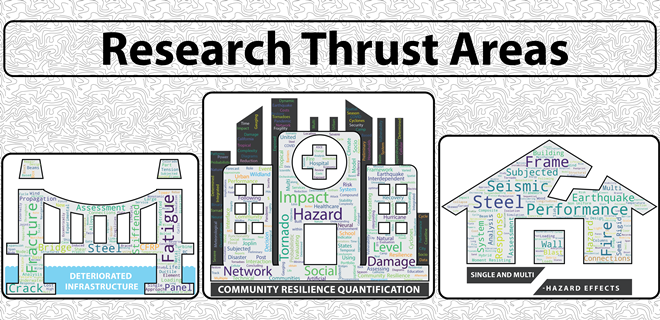
Hussam N. Mahmoud is the George T. Abell Professor in Infrastructure and Director of the Structural Laboratory at Colorado State University's Department of Civil and Environmental Engineering. He leads the SoPHIE Research Group , focusing on Sustainable and Resilient Infrastructure and Communities across three major research thrusts: community resilience quantification, multi-hazard structural performance, and deteriorated infrastructure lifecycle assessment. Key research areas include climate change adaptation , multi-hazard design , and life-cycle cost analysis for infrastructure subjected to earthquakes, wildfires, hurricanes, and climate-related deterioration. His work integrates machine learning (e.g., neural networks for wind damage prediction), hybrid simulation , and multi-resolution modeling of structural systems. Recent publications highlight interdependent recovery of healthcare/school networks , coastal community resilience to cyclones, and fatigue repair methodologies using fiber composites. Scientific Recognition Keynote speaker at international conferences (STESSA 2015, NEES Annual Meeting 2013) Invited to prestigious events: G7 One Health Summit , NASEM New Voices program Recipient of the George T. Abell Professorship, a distinguished academic honor Professional Leadership Chaired NASEM workshop on Natural Infrastructure Active in global collaborative frameworks through the InterAcademy Partnership Organizing committee member for triennial international academic conferences
Oğuz Yayla is a full-time faculty member at Middle East Technical University (METU), Türkiye, active in research and graduate supervision. His scholarly output comprises 57 Web-of-Science-indexed publications, 31 peer-reviewed conference papers and numerous invited talks, with a WoS h-index of 13 and Scopus h-index of 3 (as of the latest data dump). Research Interests Algebraic and applied cryptography, including post-quantum schemes Coding theory, particularly algebraic-geometry codes and codes over rings Sequences with good correlation properties for CDMA, stream ciphers and 5G/6G applications Blockchain security, distributed consensus, and IoT-medical data integrity Hardware-oriented security: TRNG design, side-channel countermeasures on FPGA/SoC Over the past decade, his publications reveal a clear evolution from foundational work on finite fields and pseudorandom sequences toward practical cryptographic engineering, including verifiable timed signatures, threshold multi-secret sharing for blockchain storage, and FPGA-based true random number generators compliant with AIS-20/31. Scientific Awards & Recognition Consistently high citation impact: >34 WoS citations and >20 Scopus citations PlumX reader and capture metrics place him in top percentiles for cryptography outputs in Türkiye Principal investigator / senior researcher on 7 funded national projects Graduate Advising & Collaborative Grants Yayla has formally supervised 15 graduate theses (MS and PhD) in mathematics and cryptography. He leads or co-leads multiple TÜBİTAK and BAP-funded projects on post-quantum cryptography, secure IoT medical devices, and code-based cryptography. Laboratory & Teams He heads the Cryptography & Information Security Research Group at METU, where a multidisciplinary team of graduate students and post-doctoral researchers work on lattice-based cryptography, side-channel analysis, and blockchain protocol design.
Qianru Guo serves as an Adjunct Professor in the Department of Civil and Urban Engineering at NYU's Tandon School of Engineering, while maintaining her primary role as Senior Consulting Engineer at Simpson Gumpertz & Heger Inc. (SGH) with over 10 years of specialized experience in performance-based fire protection design and structural fire engineering. Her academic credentials include: Ph.D. in Structural Engineering from University of Michigan, Ann Arbor M.S. in Civil Engineering and Mechanical Engineering from University of Michigan, Ann Arbor B.S. in Civil Engineering from Tongji University, Shanghai, China Dr. Guo's research pioneers the integration of probabilistic methodologies with structural fire engineering, focusing on reliability analysis of fire-exposed structures through advanced computational techniques. Her work develops inverse modeling for heat release rate determination, stochastic finite element methods for fire resistance evaluation, and performance-based design frameworks that redefine safety standards. She addresses critical gaps in predicting structural behavior under fire by quantifying uncertainties in material properties, fire scenarios, and structural responses. Analysis of her publication trajectory reveals consistent methodological evolution from fundamental reliability theory (2011-2013) toward practical performance-based design applications (2014-2018). Her research consistently bridges computational mechanics with fire safety engineering, emphasizing probabilistic safety assessment and code-compliant reliability calibration across residential and commercial structures. Based at 6 MetroTech Center, 4th Floor, Brooklyn, NY 11201, her professional activities integrate academic research with real-world engineering practice to advance fire-resilient infrastructure design.