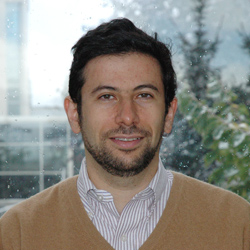
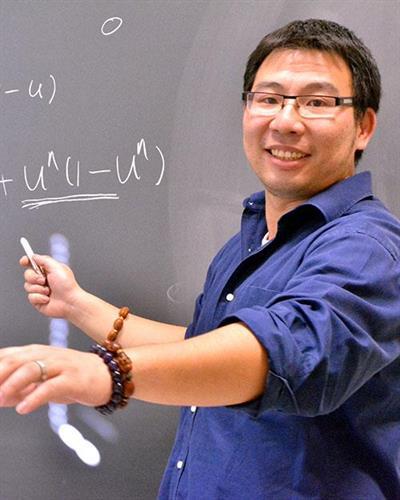
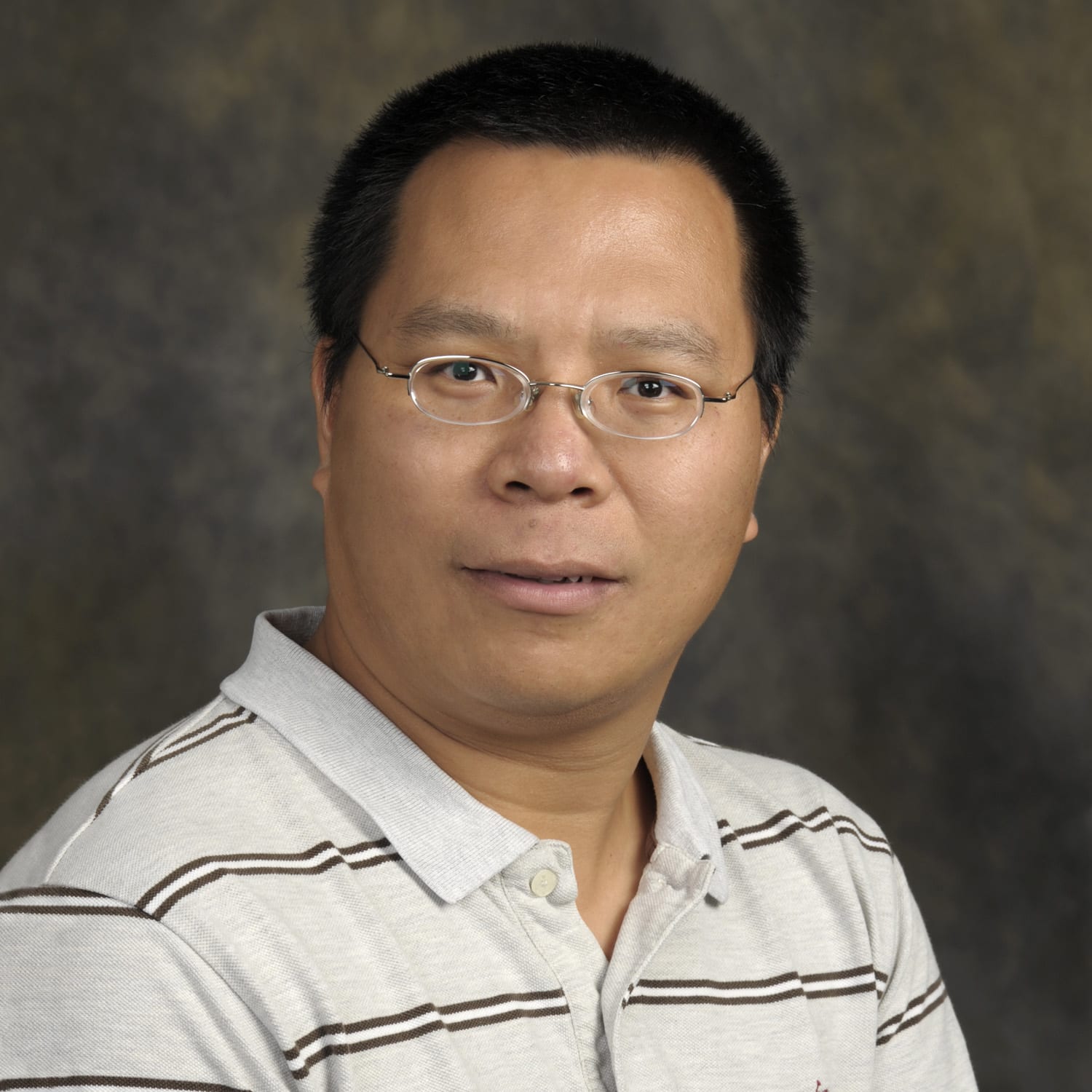
Horng-Tzer Yau is the Merton Professor of Mathematics at Harvard University's Department of Mathematics. His research focuses on probability theory, quantum dynamics, random matrices, differential equations, and nonequilibrium physics. He serves as Editor in Chief of Communications of Mathematical Physics and organizes the Random Matrix Seminar. His work explores fundamental questions in mathematical physics, particularly in understanding universality phenomena in random systems. Key research areas include spectral properties of random matrices, quantum chaos, and statistical mechanics models like spin glasses. His recent studies address delocalization in random band matrices, edge universality in regular graphs, and high-dimensional spectral statistics. Yau's contributions span theoretical frameworks for quantum dynamics, rigorous analysis of eigenvalue distributions, and interdisciplinary applications bridging probability, combinatorics, and physics. Despite the extensive publication record, no specific student advisement or grants are explicitly mentioned in the provided materials.
Vadim Linetsky is a Professor of Industrial Engineering and Management Sciences at Northwestern University. His research focuses on financial engineering, mathematical finance, and stochastic modeling. He holds a Ph.D. in Theoretical and Mathematical Physics from the P.N. Lebedev Physical Institute of the Russian Academy of Sciences (FIRAN), an M.S. in Electrical Engineering from the Moscow State Institute of Radio Engineering, and a B.S. in Electronics and Automation from the University of Technology. His work emphasizes applications in financial markets, including interest rate modeling, credit risk, derivatives pricing, and algorithmic trading. Notable contributions include advancements in spectral methods for pricing financial instruments and the development of models addressing the zero lower bound in interest rate dynamics. Linetsky has also explored long-term risk frameworks and stochastic spectral theory, bridging econometrics and financial mathematics. His publications span journals such as Finance and Stochastics , Econometrica , and Mathematics and Financial Economics , with a focus on practical computational methods and theoretical rigor. Collaborative research projects include high-performance algorithms for Markov processes and interdisciplinary applications of stochastic modeling. Linetsky’s research has been supported by grants, including work on customer default risk management and computational methods in financial engineering. His contributions have influenced both academic theory and industry practices in quantitative finance.
Kwok-Kun Kwong is a UOW CERL Fellow at the University of Wollongong, specializing in differential geometry, Riemannian and Lorentzian geometries, and mathematical relativity. His research focuses on integral formulas, curvature flows, isoperimetric inequalities, and quasi-local mass problems. He holds a PhD (2011) and M.Phil. (2008) from The Chinese University of Hong Kong, supervised by Prof. Luen-Fai Tam, along with a B.Sc. (2006). Research interests include geometric inequalities involving scalar curvature, eigenvalue estimates on manifolds, and rigidity theorems in warped product manifolds. Recent work explores Alexandrov-Fenchel inequalities, optimal transport applications, and geometric flows in spacetime contexts. He secured grants such as the Innovative Applications of Optimal Transport (2024) and Early Mid-Career Researcher Enabling Grant (2024). Current supervisions involve PhD topics like derivative pricing for geological risks and nonlinear PDE applications. Active in publishing high-impact geometric analysis papers, he contributes to foundational theories in geometric analysis and mathematical physics.
Prof. Dr. Nicole Mücke is a Professor in the Institute for Mathematical Stochastics at the Carl-Friedrich-Gauss Faculty of Technische Universität Braunschweig. Her research focuses on mathematical statistics, machine learning, kernel methods, and statistical inference. She explores topics such as neural network theory, inverse problems, optimization, and regularization techniques. Her work bridges theoretical foundations with practical applications in areas like distributed computing and uncertainty quantification. Prof. Mücke’s research portfolio includes contributions to empirical risk minimization, neural operator learning, and gradient-based optimization. She investigates the interplay between overparameterization and generalization in machine learning models, as well as the design of efficient algorithms for large-scale problems. Her publications span topics ranging from distributed stochastic gradient descent to localized kernel regression techniques. Her recent work emphasizes theoretical guarantees for learning algorithms, including convergence rates, statistical performance in high-dimensional settings, and the role of regularization in inverse problems. She also explores methodological advancements in spectral methods, algorithm unfolding, and data-splitting strategies to enhance statistical efficiency. Prof. Mücke’s research is characterized by a strong emphasis on rigorously analyzing machine learning algorithms through the lens of statistical theory and functional analysis. Her contributions address challenges in both classical and modern machine learning paradigms, with a focus on bridging the gap between abstract mathematical frameworks and practical implementation.
Professor Long Lee is a faculty member in the Department of Mathematics and Statistics at the University of Wyoming, where he has held the rank of Professor of Mathematics since 2005. His research spans numerical analysis, computational fluid dynamics, and nonlinear partial differential equations, with recent extensions into image registration and pattern classification. Ph.D. in Applied Mathematics, University of Washington, 2002 M.S. in Applied Mathematics, University of Maryland at College Park, 1998 M.S. in Geophysics, National Central University, Taiwan, 1990 B.S. in Bio-Machinery Engineering, National Taiwan University, 1988 Lee’s research focuses on developing advanced numerical algorithms for Euler-Poincaré equations, shallow-water waves, and computational methods for medical imaging and epidemiology. His work bridges mathematical rigor with real-world applications in fluid dynamics, nonlinear optics, and ecological modeling. Recent publications highlight his contributions to self-similar asymptotics, geodesic shooting algorithms for template matching, and numerical solutions for ill-conditioned systems. These articles demonstrate expertise in numerical linear algebra, geometric pattern recognition, and nonlinear dynamics.
Man-Chung Yeung is an Associate Professor of Mathematics at the University of Wyoming specializing in numerical analysis. His research develops iterative methods and preconditioning techniques for high-performance computing applications. Publications include novel algorithms for eigenvalue computation and linear system solutions. MATLAB implementations of his methods are available for research use.
Zeljko Cuckovic is a Professor in the Department of Mathematics and Statistics at the University of Toledo, part of the College of Natural Sciences and Mathematics. His research focuses on operator theory, functional analysis, and complex analysis, with a particular emphasis on Toeplitz operators, Hankel operators, Bergman spaces, and pseudoconvex domains. His work explores spectral properties, invariant subspaces, and the interplay between algebraic and geometric structures in complex analysis. Recent publications highlight investigations into Hankel operators on polydiscs, Toeplitz operators on Reinhardt domains, and the Berezin transform's role in essential norms. His 2025 study on Hankel operator spectra and 2022 work on Toeplitz zero products exemplify his contributions to operator theory's foundational questions. Key themes across his research include compactness criteria for operator products, Axler-Zheng type theorems in weighted spaces, and determinantal hypersurfaces linked to Coxeter groups. His articles frequently address norm estimates, spectral analysis, and invariant subspace lattices in Hardy and Bergman spaces. Zeljko Cuckovic's scholarship bridges pure mathematics domains, with implications for functional analysis and complex geometry. He has published extensively in journals like the Pacific Journal of Mathematics, Transactions of the AMS, and the Journal of Functional Analysis.
Dr. Elnaz Naghibi is a Senior Lecturer in Mechanical Engineering at the University of East London, affiliated with the Research Institute of Architecture, Computing & Engineering. Her work bridges fluid dynamics, computational mechanics, and interdisciplinary engineering applications. Research Interests: Her primary research spans turbulent flows, ocean-atmosphere interactions, and geophysical fluid dynamics, with applied focus on reduced-order modeling, machine learning for jet flow analysis, and continuum robotics. Key themes include: Advanced numerical methods for ocean/climate systems (e.g., Southern Ocean jet dynamics) Data-driven approaches in aeroacoustics and high-Reynolds flows Nonlinear dynamics in materials and mechanical systems Publication Trends: Recent works emphasize machine learning integration in fluid dynamics (2022–2024), building on earlier foundations in spectral methods (2018–2019) and continuum robotics (2017–2020). Dominant fields include computational fluid dynamics (7/11 papers), geophysics (4/11), and robotics (3/11), reflecting strong cross-disciplinary collaboration.
Xiaozhe Hu is a full-time Professor in the Department of Mathematics at Tufts University since July 2024. Previously held positions include Associate Professor (2019-2024) and Assistant Professor (2014-2019) at Tufts, and Adjunct Associate Professor (2020-2022) at the University of Bergen, Norway. Education : PhD in Computational Mathematics (Zhejiang University, 2009); BS in Information and Computer Science (Zhejiang University, 2004) His research focuses on scientific computing and numerical analysis , particularly: Development of adaptive and parallel numerical methods for PDEs and graph problems Multigrid/multilevel solvers for large-scale coupled systems Quantum algorithms and spectral graph theory Applications in poromechanics , reservoir simulation , and bioinformatics Recent publications demonstrate expertise in preconditioning techniques for Biot’s model, meshless methods for fluid-structure interaction, and data-driven discretization approaches . Awards include the Reimann-Louville Award (2016) and outstanding PhD graduate recognition (Zhejiang Province, 2009). PhD Students : Junyuan Lin (Loyola Marymount), Peter Ohm (RIKEN), Casey Cavanaugh (LSU), Kaiyi Wu, Eoghan O'Keefe Master Students : Charles Colley (Purdue PhD), Yue Shen (Florida State PhD), Samuel Rabinowitz, Phong Huang, Samuel Hocking Co-organizer of the Computational and Applied Mathematics Seminar and contributor to open-source HAZmath finite element library.
Zhisheng Shuai is a Professor of Mathematics at the University of Central Florida (UCF), Department of Mathematics, College of Sciences. He joined UCF in 2012 after serving as an NSERC Postdoctoral Fellow at the University of Victoria, following completion of his PhD from the University of Alberta. His office is located in MSB 321, and he teaches mathematical modeling courses including Mathematical Modeling of Data and Mathematical Biology. Dr. Shuai's research focuses on mathematical biology, differential equations, and dynamical systems, with particular emphasis on infectious disease modeling, epidemiology, and population dynamics. His work applies graph-theoretic approaches to construct Lyapunov functions for large-scale differential equation systems and develops target reproduction numbers with applications to ecology and epidemiology. He has made significant contributions to cholera modeling, waterborne disease transmission, and community network analysis for disease invasion. His recent publications (2019-2022) show a continued focus on epidemic modeling on networks, population dynamics, and mathematical approaches to disease control. The research spans from theoretical developments in stability analysis to practical applications in infectious disease modeling, with strong connections between graph theory, differential equations, and biological applications. His work frequently addresses spatial aspects of disease transmission through patch models and network structures. Dr. Shuai serves on the editorial board of the Journal of Biological Systems and is part of the Population Dynamics, Ecology and Evolution (PDEE) Subgroup of the Society for Mathematical Biology. His research has been supported by the National Science Foundation, Simons Foundation, and UCF Office of Research. He actively mentors students, including PhD candidates in mathematics and modeling & simulation, as well as undergraduate researchers. He participates in organizing mathematical contests including the Mathematical Contest in Modeling (MCM) and Interdisciplinary Contest in Modeling (ICM), and has organized workshops on mathematical modeling. His Erdős number is 2, connecting him to the legendary mathematician through coauthor John Moon.
Christopher Bergevin is an Associate Professor in the Department of Physics and Astronomy at York University, specializing in auditory biophysics. His research focuses on otoacoustic emissions (OAEs), Tuvan throat singing, nonlinear oscillators, and signal processing in sensory physiology. He combines experimental and theoretical approaches across comparative frameworks to study hearing mechanisms. He is affiliated with the Faculty of Science and eligible to supervise graduate students in both Biology and Physics programs. His research areas include biological physics, with emphasis on auditory systems. Key projects involve analyzing OAEs in diverse vertebrates to uncover cochlear tuning mechanisms and their translational applications. He explores how sound is transduced in the ear and how OAEs reflect inner ear dynamics. Recent work includes studies on avian vocal communication specialists and the role of interaural coupling in binaural systems. Bergevin's lab employs computational, experimental, and theoretical methods. He collaborates across disciplines, integrating biology, physics, and mathematics. While no specific grants or awards are listed, his work contributes to understanding human hearing uniqueness and comparative auditory physiology across species. He maintains a research website and can be contacted through his office at the Petrie Science Building. His work bridges fundamental auditory science with applications in clinical audiology and ethnomusicology.
Georgi S. Medvedev is a Professor in the Department of Mathematics at Drexel University. He earned his PhD from Boston University (1999) and was a Veblen Research Instructor at Princeton University and the Institute for Advanced Study before joining Drexel in 2002. His research investigates dynamical systems, stochastic analysis, and mathematical neuroscience. Research develops mathematical frameworks for understanding complex network dynamics. Primary areas include synchronization in coupled oscillator systems, metastability in stochastic networks, and continuum limits of large-scale dynamical systems. Applications span neuroscience, statistical physics, and engineering. Recent publications focus on the Kuramoto model, exploring bifurcations in networked oscillators, stability of twisted states, and continuum approximations for sparse graphs. The work bridges discrete network models with continuum descriptions using graph limit theory. He has developed interdisciplinary courses including Mathematical Neuroscience and Dynamical Networks. His research is supported by multiple NSF grants focusing on network metastability, mean-field analysis, and synchronization phenomena. Service includes editorial roles for Discrete and Continuous Dynamical Systems and Networks and Heterogeneous Media. He mentors undergraduate researchers in projects investigating metastability in oscillator networks.
Christino Tamon is a Professor of Computer Science at Clarkson University's Coulter School of Engineering & Applied Sciences. He holds a Ph.D. from the University of Calgary (1993-1996), an M.S. from the University of Toronto (1990-1992), and a B.Sc. in Computer Science and Applied Mathematics from the University of Calgary (1986-1990). His research focuses on theoretical computer science, quantum computing, graph theory, and machine learning, with notable contributions to quantum state transfer and quantum walks on graphs. Recipient of the Clarkson University Distinguished Teaching Award (2009) and New Teacher Award (2000). Principal Investigator on multiple NSF grants, including quantum computing and REU mathematics programs. Visiting appointments at institutions like the Institut Henri Poincaré and the University of Waterloo. Research interests include quantum algorithms, graph spectral theory, and the application of algebraic methods to discrete systems. His work on quantum walks explores perfect state transfer, fractional revival, and spatial search optimization. Recent grants support quantum advantage in algorithm design and interdisciplinary research in quantum dynamics. Advised numerous graduate students and mentors undergraduate research through REU programs. Active in professional service, including organizing workshops on quantum mathematics and algebraic graph theory.
Dr. A. Alexandre Trindade is a Professor in the Department of Mathematics & Statistics at Texas Tech University. His research focuses on developing novel statistical methodologies for complex data structures, with applications spanning finance, physics, and environmental science. He teaches graduate courses in Time Series Analysis and Nonparametric Statistics, and serves as advisor for the undergraduate Actuarial Science Minor program. His primary research areas include: Saddlepoint-Based Bootstrap (SPBB) : Methods for approximate inference in complex models with intractable distributions Time Series & Volatility Modeling : Multivariate autoregressive models, GARCH variants, and asymmetric distributions Spatial & Longitudinal Analysis : State-space models for missing data and spatial regression techniques Tail Risk Quantification : Nonparametric estimation of systemic risk measures like CoVaR Nonparametric Inference : Density estimation and signal detection for high-energy physics His publications demonstrate consistent innovation in statistical theory, particularly in developing resampling-based inference and extending time series methodologies. Collaborative projects include interdisciplinary work with petroleum engineering, nuclear science, and finance. Dr. Trindade maintains active research partnerships with national laboratories and industry, including reliability studies for Boeing and medical device research. He has developed specialized software for multivariate time series analysis and maintains public repositories for statistical computing resources.
Dmitry Kleinbock is a Professor in the Department of Mathematics at Brandeis University. His research focuses on Lie groups, discrete subgroups, homogeneous spaces, ergodic theory, dynamical systems, and metric Diophantine approximation. He has supervised several graduate students including Jiajie Zheng, Mishel Skenderi, Anurag Rao, and Shahriar Mirzadeh. His recent publications explore homogeneous dynamics, Diophantine approximation, and ergodic theory, with particular focus on metrical properties, dimension theories, and inhomogeneous approximations. These works demonstrate consistent innovation in connecting geometric methods with number-theoretic problems. Dr. Kleinbock has received significant recognition including the Simons Foundation Research Fellowship and Alfred P. Sloan Research Fellowship. He serves on editorial boards for several mathematics journals and has organized multiple conferences in dynamics and number theory.