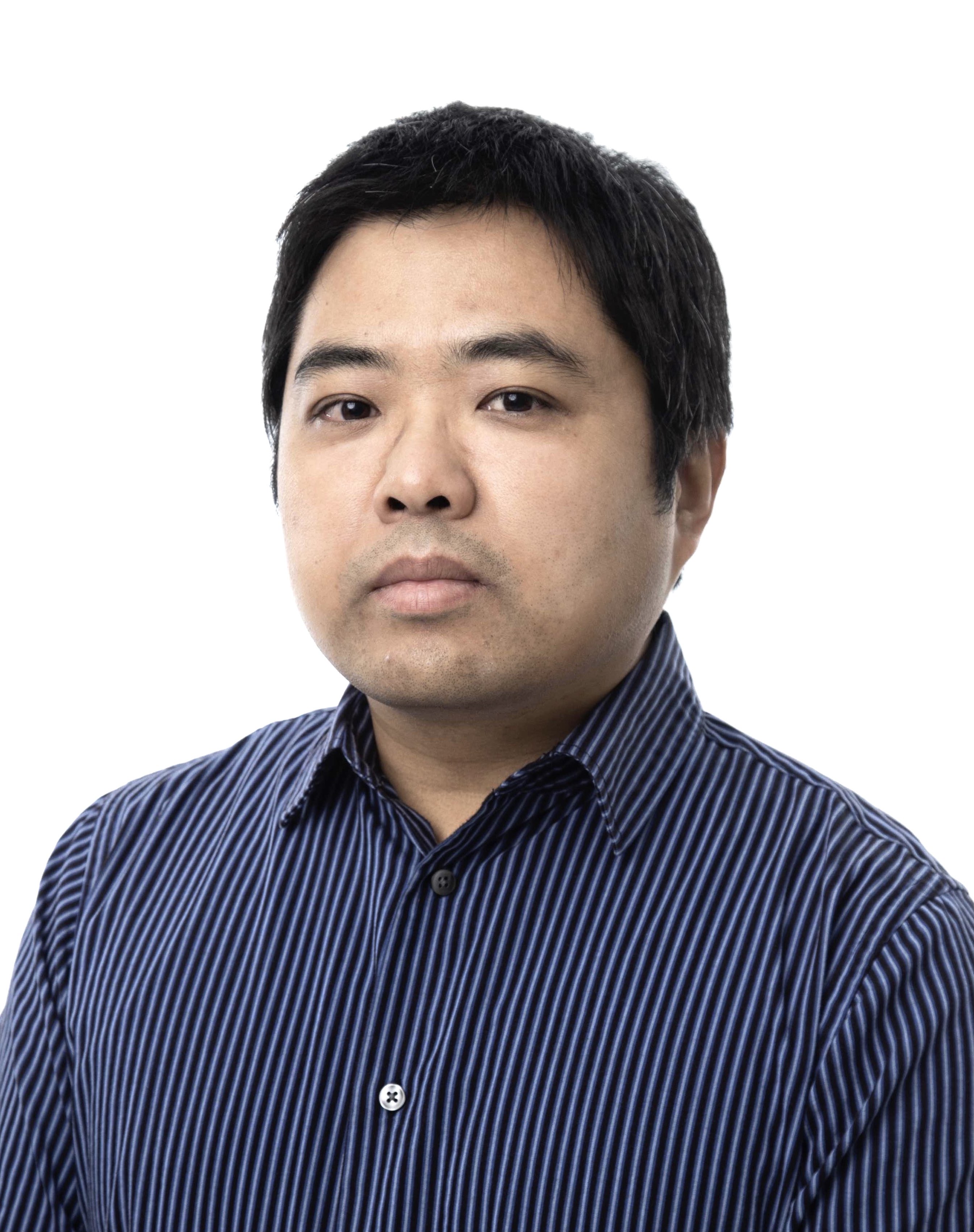
Michele Ciavotta is an Associate Professor at the University of Milano-Bicocca's Department of Computer Science, Systems, and Communication, specializing in AI-driven optimization for complex systems. His research integrates reinforcement learning, graph neural networks, and metaheuristics applied to distributed computing and physical systems like smart mobility and production lines. Research spans cloud/edge computing optimization, industrial production systems, smart city applications, and graph-based learning methods. Recent publications demonstrate focus on decentralized AI systems, geospatial data processing, and hypergraph neural networks for chemical and urban applications. Extensive involvement in European R&D projects addresses challenges in cloud computing infrastructure, Industry 4.0 implementations, and distributed AI solutions.
Dmitri Pavlov is an Associate Professor in the Department of Mathematics and Statistics at Texas Tech University, where he has been since 2017 (promoted to tenured Associate Professor in 2024). His research focuses on homotopy theory, algebraic topology, and their applications to quantum field theory. He earned his Ph.D. from UC Berkeley (2011) and held postdoctoral positions at the University of Regensburg, Max Planck Institute, and University of Münster. Pavlov has supervised multiple Ph.D. students and actively engages in teaching advanced courses like Lie Groups, Homological Algebra, and Functorial Field Theory. His awards include the Herb Alexander Prize (2011) and a Simons Fellowship (2007–2008). Pavlov’s work bridges pure mathematics with theoretical physics, particularly through geometric cobordism hypothesis and extended field theories. He collaborates widely, co-authoring papers on topics like classifying spaces of infinity-sheaves and symmetric operads in spectra. His recent research emphasizes locality principles in quantum field theories and their classification via homotopy-theoretic methods. Education: B.S./M.S. (2006/2007) from ITMO University, Ph.D. (2011) from UC Berkeley. Academic lineages trace back to prominent mathematicians like Peter Teichner and Friedrich Hirzebruch. Current research includes geometric field theory, differential cohomology, and higher categorical structures. Pavlov organizes the Quantum Homotopy Seminar and Topology & Geometry Seminar at Texas Tech, and has delivered invited talks globally at institutions like the Erwin Schrödinger Institute and University of Nottingham.
Juan Alberto Rodríguez Velázquez is an Associate Professor at the Department of Computer Engineering and Mathematics (DEIM) at Rovira i Virgili University (URV), Spain. He serves as the coordinator of the GEMiF program and leads the Research Group on Discrete Mathematics. His research focuses on graph theory, including metric, chemical, and spectral graph theory, as well as geometry and topology. He has authored over 130 journal articles and supervised 7 PhD students. Notably, he was awarded Full Professor Accreditation by ANECA (2021) and ranks among the top 2% most influential researchers globally since 2020 (Stanford University study). Education: PhD in Mathematical Sciences (1997) from Polytechnic University of Catalonia (UPC). Previous academic roles include lecturer positions at UPC, UNED, UOC, and UC3M. Research interests span graph theory applications, metric dimensions, and topological indices. His work emphasizes lexicographic product graphs, domination theory, and algorithmic graph problems. Recent publications explore equidistant dimensions, mutual visibility, and protection in product graphs. Awards: ANECA Full Professor Accreditation (2021) Top 2% Global Influential Researcher (Stanford, 2020–present) Grants & Advising: Supervised 7 PhD students in graph theory and related fields. Research Group: Founder of the Research Group on Discrete Mathematics, focusing on alliances, metric dimensions, and spectral properties in graphs.
Jan Nagel is Professor of Stochastics at TU Dortmund University's Department of Mathematics. His research explores probability theory with focus areas including random walks in random environments, random matrix theory, and stochastic processes. Recent publications investigate the dynamic behavior of viscoelastic structures with random material properties, sum rules in mathematical physics, and functional central limit theorems for random matrices. Dr. Nagel completed his doctorate in Mathematics at Ruhr University Bochum (2010) following a Diplom degree (2008). His academic trajectory includes positions as Assistant Professor at TU Dortmund (2019-2023), research fellowship at TU Eindhoven, and visiting professorships at LMU Munich. His work bridges theoretical mathematics with applications in statistical mechanics and disordered systems.
Nikolaos M. Missirlis is a Professor at the Department of Informatics and Telecommunications at the National and Kapodistrian University of Athens (NKUA) since 1995. He earned his BSc in Applied Mathematics from the University of Ioannina, Greece in 1974 and his PhD in Numerical Analysis from Loughborough University of Technology, UK in 1978. He has held visiting positions at Rutgers University (1986-1987), Cyprus University (2006-2008), and SUNY Stony Brook (2013). His research focuses on Scientific Computing , particularly parallel solution of Partial Differential Equations and load balancing algorithms. His work bridges theoretical mathematics with high-performance computing applications in meteorology and fluid dynamics. His publications demonstrate consistent output in parallel algorithms and numerical methods, with recent work emphasizing GPU acceleration and diffusion-based load balancing techniques. Research trends show evolution from foundational iterative methods to applications in heterogeneous computing environments. Teaching activities include undergraduate courses: Numerical Analysis Numerical Linear Algebra Algorithms and Complexity Introduction to Programming Data Structures Graduate courses: Scientific Computing (Numerical Solution of PDEs) Parallel Algorithms He has advised five PhD students and led major projects including: PYTHAGORAS (Distributed iterative methods for weather prediction) SKIRON (Parallelization of Eta model for Hellenic Meteorology Service) Princeton Ocean Model parallelization Contact: nmis@di.uoa.gr | +30 210 7275103 | Department of Informatics and Telecommunications, NKUA, Panepistimiopolis 157 84, Athens, Greece.
Guangliang Chen is an Associate Professor in the Department of Mathematics and Statistics at San José State University (SJSU), part of the College of Science. His research focuses on subspace/manifold clustering, dictionary learning, and classification with applications in image and document analysis. He earned a Ph.D. in Applied Mathematics from the University of Minnesota (2009) and a B.S. in Mathematics from the University of Science and Technology of China (2003). Key research contributions include scalable spectral clustering algorithms, geometric multi-resolution analysis, and advancements in compressive sensing. His work has been recognized with a Best Paper Award at the 2009 ICCV workshop for Kernel Spectral Curvature Clustering (KSCC). He teaches courses in applied statistics, machine learning, and data visualization at both undergraduate and graduate levels. Dr. Chen's recent projects involve developing efficient SVM classification techniques, large-scale spectral clustering frameworks, and MATLAB implementations for scalable algorithms. His research also extends to anomaly detection in hyperspectral imaging and functional genomics analysis through multiscale methods.
Dr. Dongsheng Luo is an Assistant Professor at the Knight Foundation School of Computing and Information Sciences at Florida International University (FIU). He holds a Ph.D. in Information Science and Technology from Pennsylvania State University (2022) and a B.Eng. in Computer Science and Technology from Beihang University (2017). His research focuses on developing interpretable AI tools for complex data analysis, particularly in graph mining, deep learning, and natural language processing, with applications in neuroscience, healthcare, and environmental systems. Education: 2022: Ph.D., Penn State University 2017: B.Eng., Beihang University His research interests emphasize explainable AI, robust graph neural networks, and multimodal integration. Recent work includes frameworks for medical plan generation, causal discovery, and flood forecasting. He investigates methods to enhance model reliability and transparency, such as confidence-aware explanations and fidelity evaluation. Collaborations span biomedical informatics, climate science, and IoT systems. Publications highlight contributions to graph explainability, time series analysis, and molecular modeling. His work bridges theoretical advances with practical applications in healthcare, environmental monitoring, and communication systems.
Inci Güneralp is Professor in the Department of Geography at Texas A&M University. Her research investigates human-environment interactions in floodplain systems, with emphasis on climate resilience, geomorphic processes, and sustainable landscape management. Key research areas include nature-based flood mitigation strategies, river morphodynamics, and infrastructure vulnerability to climate change. Her work employs geospatial analysis, field monitoring, and modeling approaches across diverse river systems. Recent publications demonstrate methodological innovation in meander migration quantification, surface-water connectivity assessment, and land cover classification using UAV and machine learning techniques. Her research informs adaptive floodplain management strategies. Professor Güneralp contributes to international climate adaptation initiatives and maintains extensive field research programs in US coastal regions and river corridors.
Rikkert Hindriks is an Assistant Professor at the Faculty of Science in the Department of Mathematics at Vrije Universiteit Amsterdam. He also holds an affiliation with Amsterdam Neuroscience - Mood, Anxiety, Psychosis, Stress & Sleep . His research focuses on advanced neuroimaging techniques, particularly magnetoencephalography (MEG) and electroencephalography (EEG), with emphasis on functional connectivity, neural signal processing, and brain network dynamics. Key research areas include phase-lag analysis, non-reversible brain state characterization, and spatiotemporal modeling of neural activity. He teaches courses such as Probability and Statistics and oversees Bachelor Project: Business Case . Hindriks has published extensively in journals like NeuroImage and PLoS Computational Biology , with recent work addressing MEG data reconstruction and neural field theory applications. No ancillary activities or scientific awards are listed in the provided profile. His research collaborations span institutions globally, reflecting his interdisciplinary approach to neuroscience and computational modeling.
Bruno Carpentieri is an Associate Professor in Applied Mathematics at the Faculty of Computer Science , Free University of Bozen-Bolzano , Italy. His work focuses on Numerical Linear Algebra , High-Performance Computing , and Preconditioning Techniques for large-scale scientific problems. Education : Laurea in Applied Mathematics (1997, University of Bari Aldo Moro); PhD in Computer Science (National Polytechnic Institute Toulouse). Research Interests : Sparse linear systems, Krylov subspace methods, computational electromagnetics, PageRank problems, and fractional calculus applications in nonlinear engineering. His publications (1998–2025) emphasize efficient solvers for multi-shifted systems, parallel computing, and preconditioning strategies. Recent works (2025) explore fractional-order methods and multilayer network centrality . He has collaborated on ITER tokamak simulations (F4E/MIUR grants) and biomedical finite element models . Grants : F4E-2008-OPE-06-06-11 (ITER analysis); MIUR PRIN 2010SPS9B3. Key Contributions : VBARMS preconditioner (2014), hybrid block GMRES variants (2018), and chaos-enhanced fractional solvers (2025).
Karl Rohe is a Professor of Statistics at the University of Wisconsin–Madison, with courtesy appointments in the School of Journalism and Mass Communication, Electrical & Computer Engineering, and Educational Psychology. His research focuses on modern data analysis challenges, including embeddings, PCA, and machine learning. He leads the Rohe Lab, which develops methods for network analysis and graph dimensionality estimation. Key contributions include the gdim package for estimating graph dimensions and work on spectral clustering. His work is supported by grants from the National Science Foundation (DMS-1309998, DMS-1612456, DMS-1916378) and the Army Research Office (W911NF-15-1-0423, W911NF-20-1-0051). Research interests span post-modern data science, leveraging linear algebra for statistical methods, and applications in social networks. His lab’s GitHub repositories include implementations of algorithms like fastadi and invertiforms , reflecting his commitment to open-source software.
Dr. Xiaofeng Gu is a Professor of Mathematics at the University of West Georgia's Dr. Perry College of Mathematics, Computing, and Sciences. He earned his PhD in Mathematics from West Virginia University in 2013. His research specializes in combinatorics and graph theory, with particular focus on spectral properties of graphs and combinatorial optimization. Dr. Gu's research explores fundamental properties of graphs through combinatorial and spectral methods, investigating connectivity parameters, cyclic orderings, and extremal graph properties. His recent work demonstrates advanced applications of spectral graph theory to solve complex problems in discrete mathematics. Analysis of Dr. Gu's publications reveals consistent focus on spectral graph theory, combinatorial structures, and connectivity properties. His work applies mathematical rigor to problems in graph characterization, random graphs, and discrete optimization, with recent emphasis on spectral radius applications and graph connectivity measures.
Anastasis Kratsios is an Assistant Professor in the Department of Mathematics and Statistics at McMaster University. His research focuses on the analytic and statistical foundations of deep learning, particularly in encoding structures from natural and social sciences like stochastic processes, games, and PDEs. He teaches courses including Computational Finance, Mathematical Reasoning, and Calculus for Science. Research interests span machine learning theory, approximation methods, and their applications in finance and geometry. Notable work includes neural operator design for PDEs, causal deep learning models, and federated learning frameworks. He frequently publishes in top venues like NeurIPS, ICLR, and Journal of Machine Learning Research. Teaching responsibilities include MFM 713 (Computational Finance II), MATH 1C03 (Introduction to Mathematical Reasoning), and MATH 1A03 (Calculus for Science I). He has developed innovative curricula blending theoretical rigor with practical computational finance tools. Publications emphasize theoretical guarantees for neural networks, kernel methods, and geometric deep learning. Recent work explores universal approximation under constraints, adversarial learning in market models, and scalable graph representation techniques. His research bridges mathematical foundations with real-world applications in finance, physics, and engineering.
Charles Walkden is a Lecturer in Pure Mathematics at the School of Mathematics, University of Manchester, where he has been employed since 1997 after completing his PhD at the University of Warwick under Bill Parry. His academic career spans over two decades with continuous contributions to mathematical research and education. Education: PhD in Mathematics, University of Warwick (1997) Dr. Walkden's research specializes in Ergodic Theory and Dynamical Systems, with significant work on iterated function systems, skew products, and hyperbolic systems. His investigations frequently integrate probability theory to analyze limit laws, invariant measures, and spectral properties within dynamical frameworks, advancing theoretical understanding of complex systems. His publication record reveals a sustained focus on contractive dynamical systems, particularly examining limit theorems for iterated maps, structural properties of skew products, and topological dynamics. This body of work demonstrates methodological consistency in applying operator theory and stochastic analysis to solve problems in pure mathematics. Scientific Awards: No awards documented in available sources. Dr. Walkden has supervised three PhD students (Sara Santos 2005, Ian Morris 2006, and current student Andrew Moss) and serves as Programme Director for the MSc in Pure Mathematics. He actively seeks new PhD candidates interested in ergodic theory, reflecting his commitment to academic mentorship and program development. He contributes to the Analysis and Dynamical Systems research group within the University of Manchester's Data Science Institute, collaborating on interdisciplinary projects that connect pure mathematics with computational applications.
Geoffrey Grimmett is Professor of Mathematical Statistics at the University of Cambridge, affiliated with the Faculty of Mathematics and the Statistical Laboratory. His research focuses on probability theory, combinatorial theory, stochastic models in statistical physics, and probabilistic number theory. He has contributed extensively to percolation theory, self-avoiding walks, and lattice models, with notable collaborations on hyperbolic site percolation and critical probabilities of lattice-pairs. His work bridges theoretical mathematics with applications in statistical physics and combinatorics. Education and Background: No explicit educational details provided in the text, but his role as a professor implies advanced degrees in mathematical statistics or related fields. Research Interests: His primary areas include probability theory, with a focus on percolation, stochastic processes, and applications in statistical physics. Recent work involves hyperbolic percolation models, connective constants of graphs, and alignment percolation. He also explores intersections with combinatorics and quantum systems, such as entanglement entropy in the quantum Ising model. Publications Trends: Over 20 articles listed, emphasizing percolation theory (e.g., hyperbolic site percolation, critical probabilities), combinatorial problems (self-avoiding walks, cubic graphs), and applications in physics (quantum spin systems, epidemic models). His work often combines rigorous mathematical analysis with interdisciplinary applications. Awards: None explicitly listed in the provided text, though his contributions to probability theory are widely recognized in academic circles. Grants and Labs: No specific grants or lab affiliations mentioned, but his position suggests involvement in Cambridge’s research initiatives. Collaborators include Z Li (frequent co-author) and researchers in statistical mechanics.