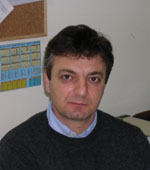
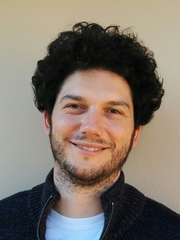
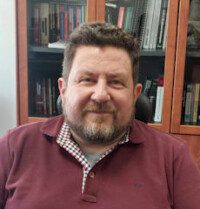
Dionysios Christopoulos is a Professor at the School of Electrical and Computer Engineering, Technical University of Crete. He holds a PhD in Physics from Princeton University (1991) and an Electrical Engineering degree from NTUA (1985). His career spans postdoctoral work at UNC Chapel Hill, research at FPInnovations, and academic roles at TUC since 2002. Teaching: Probability Theory, Statistics, Geostatistics, Time Series, Random Fields Collaborations: Interdisciplinary work with engineers, statisticians, mathematicians, physicists, and geologists Editorial Roles: Stochastic Environmental Research and Risk Assessment (Springer), Computers & Geosciences (Elsevier) His research focuses on spatial/spatiotemporal data modeling, with applications in statistical physics and stochastic methods. He has coordinated national and EU research programs and authored 202 publications, including two foundational books. Awards: 2003 Johannes A. Van den Akker Prize
Dionissios T. Hristopulos is a Professor and Head of the Geostatistics Laboratory at the School of Mineral Resources Engineering, Technical University of Crete, Greece. His research spans geostatistics, spatial random fields, environmental modeling, stochastic hydrology, and porous media mechanics. He has developed innovative Spartan Spatial Random Field (SSRF) models rooted in statistical physics, enabling efficient spatial interpolation and simulation. PhD in Physics, Princeton University (1991) MA in Physics, Princeton University (1988) Diploma in Electrical Engineering, National Technical University of Athens (1985) Hristopulos' research interests focus on the development and application of geostatistical methods in mineral resources, environmental monitoring, petroleum reservoirs, and GIS. He investigates spatial anisotropy, groundwater dynamics, earthquake return times, and the mechanical properties of heterogeneous materials. His work bridges statistical physics and geostatistics, particularly through SSRF models and renormalization group methods for upscaling transport properties in porous media. The most recent publications highlight his focus on geometric anisotropy detection in environmental data, non-parametric estimation methods, and applications of Spartan random fields in environmental time series and spatial data interpolation. His work increasingly integrates machine learning concepts with geostatistical modeling, especially for automatic mapping and ecological monitoring using remote sensing. Marie Curie success story (European Commission, 2010) for SPATSTAT project Hristopulos has secured research funding from national and EU programs, including the Marie Curie Transfer of Knowledge (SPATSTAT) and the INTAMAP STREP project. He has mentored several Master’s and PhD students, including Manos Varouchakis (PhD candidate on groundwater monitoring) and Manolis Petrakis (Master’s on anisotropy characterization). He collaborates with researchers in the US, France, Slovakia, and the UK. He serves on the editorial board of Stochastic Environmental Research and Risk Assessment and has contributed software tools for anisotropy detection in MATLAB and R. His research group, the Geostatistics Laboratory at TUC, focuses on machine learning and geostatistics, developing computational tools for environmental data analysis, spatial interpolation, and simulation. The lab emphasizes practical applications in hydrology, ecology, and mineral resources, supported by strong theoretical foundations in statistical physics and stochastic modeling.
Dr. Petros Gaganis is an Assistant Professor in the Environmental Engineering and Science Sector at the University of the Aegean's Department of Environmental Studies. He holds a PhD in Stochastic-Contaminant Hydrogeology from the University of British Columbia (2000), an M.Sc. in Contaminant Hydrogeology (1997), and a B.S. in Geology from Aristotle University (1986). His research focuses on numerical modeling of groundwater flow and contaminant transport in heterogeneous soils, stochastic methods for risk assessment, and decision models for water resource management. Education: Ph.D., 2000: University of British Columbia, Earth and Ocean Sciences M.Sc., 1997: University of British Columbia, Earth and Ocean Sciences B.S., 1986: Aristotle University of Thessaloniki, Geology Research Interests: Dr. Gaganis specializes in groundwater flow modeling, contaminant transport simulation, stochastic hydrogeology, and climate change impacts on water resources. He develops decision models to integrate multidisciplinary data for risk-cost-benefit analyses and optimal management strategies. His work emphasizes reliability quantification in hydrogeological models and participatory approaches for environmental policy. Key Article Trends: Recent work includes climate change impacts on Mediterranean river hydrology, arsenic contamination in volcanic Lesvos aquifers, and participatory flood risk management in coastal regions. His research bridges hydrology, geostatistics, and policy to address water scarcity and pollution challenges. Teaching: Responsible for courses like Environmental Geology and Water Resources Management. Instructs Environmental Hydrogeology and Special Topics in Environmental Science under the Socrates Program. Lab/Tech Focus: Active in hydrological modeling using advanced geostatistical techniques and numerical simulations, with field studies in Greece and internationally.
Markos Koutras is a Professor in the Department of Statistics and Actuarial Science at the University of Piraeus, where he has been serving since September 2000. He previously held academic positions at the University of Athens, including Scientific Associate (1981-1983, 1985-1986), Lecturer (1986-1989), Assistant Professor (1989-1993), and Associate Professor (1993-2000). He has also served as Visiting Researcher at several international institutions including the University of Manitoba (Canada), Queen Mary and Westfield College (London), and McMaster University (Canada). His educational background includes: 1979: Degree from the University of Athens, Department of Mathematics (Grade: 9 and 6/20) 1981: MSc from the University of Athens, Department of Mathematics, in Computer Science and Operations Research (Grade: 9 and 7/16) 1983: PhD from the University of Athens, Department of Mathematics, with thesis 'Contribution to the theory of Spherical Distributions and related Taxonomic Problems' (Grade: Excellent) Professor Koutras specializes in several key areas of statistics and probability theory. His primary research interests focus on Reliability Theory, where he has made significant contributions to the understanding of system reliability, failure models, and maintenance policies. He has extensively researched Scan Statistics and Run Theory, developing methodologies for pattern recognition in sequences of trials and applications in quality control. His work in Multivariate Analysis has advanced techniques for analyzing complex data structures, while his contributions to Statistical Quality Control have provided new methodologies for process monitoring and improvement. He has also made notable contributions to Combinatorial Distributions, exploring the theoretical properties and applications of specialized probability distributions. With over 70 publications in international peer-reviewed journals (h-index: 16 as of January 2014) and 13 publications in international peer-reviewed volumes totaling more than 700 citations, Professor Koutras has established himself as a leading researcher in his fields. His work shows a clear progression from theoretical foundations in probability and reliability to practical applications in quality control, medical statistics, and risk management. A significant portion of his recent work focuses on scan statistics, run theory, and their applications in statistical process monitoring, demonstrating his continued contribution to advancing methodological frameworks in these areas. Professor Koutras has received significant recognition for his scholarly work: Associate Editor for 8 international journals including Methodology and Computing in Applied Probability and Journal of Statistical Planning and Inference Referee for papers submitted to more than 30 different journals President of the local organizing committee for 3 major international conferences Co-Chair of the International Organizing Committee for 7 International Workshops in Applied Probability Member of the Scientific Committee for 10 international conferences Elected member of the European Regional Committee of the Bernoulli Society (2013-present) Scientific responsible for more than 10 Research and Educational projects, including MarieCurie (2013-2016) and Aristeia (2014-2015) Professor Koutras has supervised 6 doctoral theses (5 completed, 1 in progress) and has been actively involved in research grant management. His leadership extends to administrative roles, having served as Director of Studies for the Postgraduate Program in Applied Statistics (2001-2004, 2007-2011), Chairman of the Department of Statistics and Actuarial Science (2003-2007, 2011-2013), and Dean of the School of Finance and Statistics (2013-2017). He has also been President of the Interdepartmental Committee for the Interuniversity Postgraduate Program in Biostatistics at the University of Athens. Professor Koutras leads a research group focused on reliability theory, scan statistics, and their applications. His team collaborates internationally, particularly through the International Workshops in Applied Probability that he has helped organize since 2002. His research has practical applications in quality control, medical statistics, and risk assessment, contributing to both theoretical advances and real-world problem solving.
Andreas Göbel is a Professor and Chair of Algorithm Engineering at the Hasso Plattner Institute (HPI). His research focuses on computational counting, randomness in computation, computational complexity, graph theory, and stochastic processes. He has contributed extensively to understanding diffusion processes, clique structures in networks, and algorithmic approaches to statistical physics problems. His work bridges theoretical computer science with practical algorithm design. Recent contributions include analyzing SIRS process survival times, clique dynamics in geometric random graphs, and non-linear information diffusion models. He has published widely in top-tier conferences such as IJCAI, AAAI, and SODA. Göbel teaches courses including Probability and Computing, Algorithmix, and Theoretical Foundations of Cryptography. His research group explores both foundational aspects of algorithms and real-world applications, particularly in network science and combinatorial optimization.
Mitianoudis Nikolaos serves as a Professor in the Department of Electronics and Information Systems Technology at Democritus University of Thrace, where he leads research in audio and video processing within the Electrical Circuits, Signal and Image Processing Laboratory. His work bridges statistical signal processing with modern machine learning techniques for real-world applications. Education: Diploma in Electrical and Computer Engineering, Aristotle University of Thessaloniki (1998) MSc in Communications and Signal Processing, Imperial College London (2000) PhD in Audio Source Separation, Queen Mary University of London (2004) His research spans Machine Learning , Statistical Signal Processing , and Deep Learning with specialized focus on audio source separation, image fusion, and machine hearing/vision systems. Current projects include environmental sensing with backscatter radio networks (BLASE), 3D structure estimation (F3SME), and cultural heritage digitization (TEXTaiLES), demonstrating interdisciplinary applications from healthcare to cultural preservation. Analysis of his recent publications (2019-2024) reveals a decisive shift toward neural network architectures, particularly transformer models and multi-resolution U-Nets, applied to audio separation and image processing challenges. His work consistently addresses noise robustness in real-world scenarios while advancing theoretical frameworks for underdetermined systems. As Principal Investigator for the F3SME project and Scientific Associate on multiple EU-funded initiatives, he has secured significant research funding. His teaching portfolio includes core undergraduate courses in Electrical Circuits II and Digital Signal Processing, plus graduate-level Signal and Image Coding. The Electrical Circuits, Signal and Image Processing Laboratory serves as his primary research base, focusing on practical implementations of theoretical signal processing concepts through collaborations with Imperial College London and industry partners like General Dynamics UK.
Dimitrios Karapiperis serves as an Academic Scholar at the School of Science and Technology, International Hellenic University (IHU), specializing in Entity Resolution and Privacy-Preserving Record Linkage. Previously, he held a post-doctoral position at the Hellenic Open University. He earned his PhD from the Hellenic Open University and his MSc from the University of York (UK). His doctoral thesis was featured in the IEEE Intelligent Informatics Bulletin of August 2017, highlighting its significance in the field. Dr. Karapiperis' research centers on developing advanced algorithms for entity resolution, including similarity measures, data structures, and scalable distributed solutions using randomization techniques. His work extends to privacy-preserving methods for record linkage with applications in electronic health records, cryptocurrency analysis, and social media sentiment. He has made significant contributions to efficient record linkage in data streams and spatio-temporal data through innovative blocking techniques and approximation schemes. His recent publications (2020-2022) reveal a consistent focus on scalable and privacy-aware record linkage, with increasing applications in financial technology and affective computing. Collaborations with prominent researchers like V.S. Verykios have resulted in numerous publications in top venues including IEEE Big Data and IEEE TIFS, demonstrating expertise in both theoretical foundations and practical implementations. Scientific Recognition Doctoral thesis featured in IEEE Intelligent Informatics Bulletin (2017) Research Projects University of York: Development of Java servlets for converting VisioXML into GSML within the High Integrity Systems Engineering research group University of Macedonia: Standardization of distance learning systems University of Macedonia: Establishment of a data bank for the fur sector in Kastoria University of Macedonia: System for organizing business processes of the Ministry of Macedonia and Thrace Dr. Karapiperis has collaborated with research teams across multiple institutions, contributing to diverse projects from healthcare data integration to government business process optimization, while maintaining active research in scalable entity resolution methodologies.