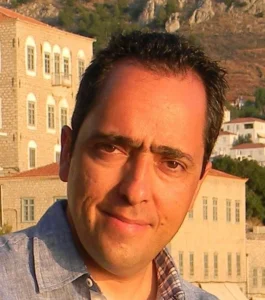
Angelos Alexopoulos is an Assistant Professor at the Department of Economics , Athens University of Economics and Business . He has held Research Associate positions at the University of Cambridge, University College London, and University of Exeter in the UK. PhD: Athens University of Economics and Business Research Focus: Computational Statistics, Econometrics, Bayesian Analysis, Network Modelling Publications span Bayesian inference, epidemic forecasting, machine learning for fraud detection, and econometric methodology. Key journals include Journal of the Royal Statistical Society , Journal of Computational and Graphical Statistics , and Statistics and Computing . 2024: Gaussian invariance in MCMC 2024: Epidemic nowcasting models 2023: VAT fraud detection with ML Awards include certifications in Deep Learning (Coursera), Blockchain (edX), and Object-Oriented R Programming (DataCamp).
Dr. Fousteris Andreas is an Assistant Professor at the Department of Business Administration, University of Piraeus. He holds a PhD in Business Administration and multiple advanced degrees in Management and Economics. With nearly 20 years of private-sector experience in finance, consulting, and infrastructure sectors, his expertise spans strategic planning, sustainability, and innovation management. Education: Bachelor of Economics, University of Piraeus MSc in Management of Industrial Systems (Energy & Environmental Management specialization), National Technical University of Athens & University of Piraeus Executive MBA, University of Piraeus PhD in Business Administration, University of Piraeus Research Interests: Economic Analysis and Public Policy Environmental & Energy Management Technology & Innovation Management Sustainable Development and Corporate Governance Entrepreneurship and Feasibility Studies Recent Research Focus: His work emphasizes sustainability in maritime sectors, digital twins for building efficiency, and environmental performance assessment using machine learning. He also explores urban health integration in city planning and the impact of cultural values on corporate sustainability practices. Professional Engagement: Active in international conferences (e.g., ICBAP 2024, Southern Economic Association), with a focus on bridging academic research with industry challenges. His contributions span over 20 peer-reviewed articles and conference papers addressing environmental, economic, and technological sustainability themes.
Spyros Vosinakis is an Associate Professor in the Department of Product and Systems Design Engineering at the University of the Aegean , Greece. He leads the Interactive Systems Design Laboratory and specializes in Virtual Reality (VR), Augmented Reality (AR), and their applications in education, cultural heritage, and serious games. Education: BSc in Informatics, University of Piraeus, Greece MSc in Computer Graphics & Virtual Environments, University of Hull, UK PhD in Informatics, University of Piraeus, Greece (2003) Research Interests: Focuses on immersive technologies for cultural heritage dissemination, natural user interfaces, and adaptive virtual environments. His work bridges digital humanities with interaction design, emphasizing embodied interaction and accessibility. Recent projects include VR applications for archaeological sites like Delphi, and AR installations for intangible heritage preservation. Publications: Over 70 peer-reviewed papers in journals like Virtual Reality , British Journal of Educational Technology , and International Journal of Computational Methods in Heritage Science . Themes include interaction design in VR, serious games for STEM education, and ethical representation of cultural heritage. Grants & Projects: Principal investigator in 11 R&D projects (3 as coordinator). Collaborates with UNESCO, EU initiatives, and museums on digital heritage preservation. Current work includes XR applications for industrial heritage and accessibility in virtual museums. Labs & Teams: Directs the Interactive Systems Design Laboratory , fostering interdisciplinary projects in HCI, game design, and heritage technology. Advises on industrial partnerships for AR/VR solutions in education and tourism.
Prodromos Vlamis serves as an Associate Professor of Financial Analysis at the Department of Economics within the School of Economics, Business and International Studies at the University of Piraeus, where he has held academic positions since 2018 after progressing from Assistant Professor (tenured) roles. His academic journey includes significant international experience with appointments at Harvard University, the London School of Economics, and the University of Cambridge, where he also taught as a Lecturer in Finance at age 28. Education: B.Sc. from Athens University of Economics (1991-1995) M.Sc. in Economics from University of York (1995-96) M.Phil. and Ph.D. in Financial Analysis from University of Cambridge (1999-2004) Vlamis specializes in the intersection of real estate markets and financial systems, with particular emphasis on how ESG criteria, sovereign debt crises, and monetary policy affect property markets. His research demonstrates how Greek fiscal challenges have uniquely impacted real estate dynamics, revealing asymmetric price adjustments in energy markets and spatial effects of property investments on regional growth. His methodological approach combines advanced econometric modeling with practical financial analysis, particularly evident in his work on credit risk assessment of real estate companies and interest rate pass-through mechanisms. His scholarly impact is reflected in 44 publications including 18 papers in reputable international journals such as Journal of Real Estate Finance and Economics, International Journal of Finance and Economics, and Economic Modelling. His work has been cited 737 times according to Google Scholar (h-index 13), with notable inclusion in teaching materials at Geneva University, Carleton University, and Ohio State University. Harold A. Pollman Fellowship in Real Estate and Urban Development (Harvard) British Chevening/De La Rue Scholarship Isaac Newton Studentship (Cambridge) Harold Samuel Scholarship (Cambridge) Leventis Foundation Scholarship Vlamis has advised numerous government bodies including Greece's Ministry of Finance and Ministry of Economy, serving as external evaluator for Greek higher education institutions. His teaching portfolio spans undergraduate courses in Financial Analysis and Real Estate Markets to graduate courses in Real Estate Financing and International Financing, reflecting his dual expertise in theoretical finance and practical real estate economics. He maintains active research collaborations with institutions worldwide and serves on editorial boards of Eurasian Journal of Economics and Finance, Panoeconomicus, and Economics and Finance Notes, demonstrating ongoing scholarly engagement in his specialized fields.
Panos Parthenios is a Professor at the Technical University of Crete with a Doctor of Design from the Harvard Graduate School of Design . He also leads PARTHENIOS architects+associates , an architecture firm active in residential, tourism, and commercial projects. Education : Doctor of Design (Harvard GSD) His research focuses on urban design, digital architecture, and smart cities. Key areas include: Urban biodiversity and vertical plane design Digital twins of cultural spaces using photogrammetry and laser scanning Integration of ICT and immersive technologies (AR/VR/MR) for enhanced user experience Interdisciplinary approaches combining music and architecture Sustainable urban planning and wellness-oriented public spaces His publications from 2011-2024 demonstrate consistent innovation in architectural technology, with a focus on 3D reconstruction, environmental analysis, and interactive design tools. Current work explores geometric volatility in buildings and big data applications for cultural spaces.
Professor Alexandra Tragaki is a faculty member at Harokopio University of Athens, serving in the Department of Geography, where she holds the rank of Professor of Economic Demography. Her office is located in the Geography Building (Office 2.2) at 70 El. Venizelou, Kallithea, Athens, Greece. Education: PhD in Economics (Specialisation in Economic Demography), Institut d’Études Politiques de Paris, 1997 DEA in Economic Demography, Institut d’Études Politiques de Paris, 1993 Degree in Mathematics, National and Kapodistrian University of Athens, 1992 Research Interests: Professor Tragaki’s research centres on the complex interactions between demographic dynamics, economic performance, environmental sustainability and social policy. She investigates how population ageing, migration and fertility shifts influence labour markets, social security systems and environmental vulnerability. Her work integrates advanced statistical and spatial analysis to inform evidence-based policy making, particularly within the European context. Across her extensive publication record, three dominant themes emerge: (1) mortality modelling and health transitions , often using sophisticated parametric distributions to forecast longevity and evaluate pandemic impacts; (2) fertility dynamics under economic stress , exploring how recessions, labour-market conditions and policy interventions shape reproductive behaviour; and (3) spatial demography and risk assessment , mapping population structures, coastal hazards and migration patterns across Greece and Europe. Scientific Awards: No specific awards are mentioned in the provided materials. Teaching & Program Development: Undergraduate courses: Statistical Analysis for Geographers, Population Geography and Demography, Population Economics and Policy Postgraduate courses: Applied Spatial Analysis, The Demographic Factor in Europe’s Economic and Social Policy, Migration Policy and Migration Flows She is involved in the interdepartmental MSc in Applied Geoinformatics and the MSc in Climate Crisis, Risks and Disasters. Laboratories & Research Teams: While no dedicated laboratory is explicitly named, her teaching and research activities within the Department of Geography suggest close collaboration with spatial analysis and geoinformatics teams at Harokopio University.
Professor Theodoridis Ioannis is a distinguished faculty member in the Department of Informatics at the University of Piraeus, where he serves as Director of the Data Science Laboratory within the School of Information and Communication Technologies. With a career spanning over two decades, he has established himself as a leading expert in data management and analysis. His research interests focus on Data Science, particularly in databases, big data management, data mining, and geoinformatics. Professor Theodoridis has made significant contributions to spatial database systems, time series analysis, and distributed data processing. His work bridges theoretical foundations with practical applications in areas such as smart cities, mobility analytics, and scientific data management. His publication record demonstrates consistent research productivity with over 100 peer-reviewed articles in top-tier venues, accumulating more than 10,000 citations. His research output shows a clear evolution from foundational database techniques toward contemporary challenges in big data analytics, machine learning integration, and privacy-preserving methods. Member of editorial board of ACM Computing Surveys (since 2016) Reviewer for numerous international journals and conferences Active participant in data management conference committees Professor Theodoridis has secured significant research funding through Horizon 2020 projects, serving as project coordinator and research team leader since 2001. His work demonstrates strong industry and academic collaboration, with applications spanning multiple domains. He has also co-authored three influential monographs in his field. He leads the Data Science Laboratory, which serves as a hub for interdisciplinary research at the intersection of database systems, machine learning, and domain-specific applications. The laboratory fosters collaboration between computer scientists, domain experts, and industry partners to address real-world data challenges.
Panayiotis D. Tsanakas is a Professor of Computer Engineering at the National Technical University of Athens (NTUA), serving in the School of Electrical and Computer Engineering within the Department of Information Technology and Computers. Since 2023, he has held the position of Dean of the School of Electrical and Computer Engineering at NTUA. His academic career spans several decades with significant contributions to computer engineering and informatics. His educational background includes a Dipl. in Electrical Engineering from Aristotle University of Thessaloniki (1982), an MSc in Computer Engineering from Ohio University (1985), and a PhD in Computer Engineering from National Technical University of Athens (1988). Tsanakas specializes in high-performance computer architectures, cloud-computing systems, Internet-of-Things (IoT), and AI-based applications in medicine and biology. His research spans parallel and distributed processing, computer architecture, supercomputing applications, and biomedical engineering. He has published over 100 research papers in established scientific journals and conferences, with recent work focusing on AI applications in healthcare, cloud computing security, and advanced medical monitoring systems. His recent publications demonstrate a strong trend toward applying artificial intelligence to healthcare challenges, particularly in mental health monitoring, medical imaging, and biomedical diagnostics. His work frequently combines computer architecture expertise with medical applications, creating innovative solutions for healthcare challenges. 2023-now: Dean of the School of Electrical and Computer Engineering at NTUA 2018-2020: Board member of the EuroHPC Joint Undertaking 2004-2019: Chairman of GRNET, the national research and education network 2005-2009: Member of EETT (The Hellenic Electronic Communications and Posts Regulator) Tsanakas has supervised eight doctoral dissertations and more than 50 diploma theses. He has co-authored seven textbooks on computer systems that have been adopted by several higher-education institutions. His professional experience includes significant roles in national infrastructure development, including leading the design and deployment of advanced networking and cloud services for Greek academic institutions and healthcare facilities.
Efstratiadis Andreas serves as an Assistant Professor in the Department of Water Resources and Environmental Engineering at the School of Civil Engineering, National Technical University of Athens (NTUA), based at the Laboratory of Hydrology and Water Resources Development. His research spans water resources systems, hydropower infrastructure, and the water-energy nexus, with emphasis on stochastic modeling and uncertainty quantification. His primary research interests include stochastic hydrology, flood risk assessment, multipurpose reservoir optimization, and renewable energy integration. He investigates cascading infrastructure failures, spatial reliability in solar PV systems, and climate-energy market uncertainties, often employing advanced simulation-optimization frameworks to address complex water-energy challenges under environmental variability. Recent publications (2023–2025) reveal a strong focus on hydropower dam safety, flood control infrastructure design, and the operational trade-offs in multipurpose reservoirs. His work increasingly integrates Earth Observation data for hydrologic modeling and examines socio-technical dimensions of the water-energy nexus, reflecting a shift toward interdisciplinary systems analysis. Dr. Efstratiadis contributes to NTUA's Laboratory of Hydrology and Water Resources Development, which develops decision support systems like Hydronomeas 2020 and national monitoring infrastructure (OpenHi.net) for Greek surface waters. His lab emphasizes computational tools for water resources management under climate uncertainty.
Adrian Sampson is an Associate Professor in the Department of Computer Science at Cornell University, where he is part of the Computer Systems Laboratory and the programming languages group. He joined Cornell in 2016 as an Assistant Professor and was promoted to Associate Professor in 2022. Prior to Cornell, he was a Visiting Researcher at Microsoft Research (2015-2016). He received his Ph.D. from the University of Washington in 2015 under advisors Luis Ceze and Dan Grossman, with a dissertation on Hardware and Software for Approximate Computing. His research focuses on breaking down abstraction barriers and rethinking the hardware-software interface. He is particularly known for his work on approximate computing, which explores how computers can be more efficient by allowing them to make controlled mistakes. He leads the Capra research group at Cornell, which investigates programming languages and computer architecture. Sampson's recent publications demonstrate a strong focus on hardware acceleration, FPGA programming, compiler design, and programming language theory. His work often bridges the gap between high-level programming abstractions and low-level hardware implementation, with particular attention to predictability, verification, and energy efficiency. He has made significant contributions to geometry types for graphics programming, timeline types for modular hardware design, and virtual machines for FPGA programming. Among his notable recognitions are the IEEE TCCA Young Computer Architect Award (2021), NSF CAREER award (2019), and multiple Distinguished Artifact Awards at major conferences. He has advised numerous Ph.D. students who have gone on to positions at institutions like Wellesley College, Northwestern University, and Amazon. Sampson is actively involved in academic service, serving on program committees for major conferences including PLDI, ASPLOS, and ISCA. He has also held leadership roles such as ACM SIGARCH Board of Directors (2023-2025) and SIGPLAN Information Director. His teaching at Cornell includes courses on computer systems, programming languages, and advanced compilers.
Adam Vrechopoulos is a Professor at the Department of Management Science and Technology (DMT) within the School of Business Administration at Athens University of Economics and Business (AUEB). Since 2003, he has served as a faculty member and Scientific Director of the DIMER Research Group (formerly IMES) at AUEB's ELTRUN Research Center. He also holds a part-time affiliation with the Hellenic Open University (HOU) since 2008. Education : PhD in E-Retail and Digital Marketing from Brunel University, UK; MBA (Marketing) from ALBA; BSc from AUEB's Department of Applied Informatics. His research focuses on Digital Marketing , Omnichannel Retailing , and Consumer Behavior in Virtual Environments . Recent work explores AI's impact on sales, green strategies in retail, and atmospheric cues in digital stores. Publications span journals like Journal of Retailing , Information Systems Journal , and International Journal of Electronic Commerce . Scientific roles include Senior Editor, Associate Editor, and Editorial Board member positions. He has supervised 6 doctoral theses and ~190 postgraduate projects, while co-developing 3D retail store typologies and virtual reality atmospheres. Key Research Themes : Omnichannel and diachronic retail strategies Virtual reality consumer behavior Mobile commerce and location-based services Store atmosphere in digital environments Technology-driven marketing innovation AI and digital transformation in retail He has received unspecified international research distinctions and maintains active industry engagement through consulting, conference organization, and public speaking. Administrative experience includes university governance and conference coordination.
Michael Boutsikas is an Associate Professor in the Department of Statistics and Insurance Science at the University of Piraeus. His academic career includes roles such as teaching Statistics II: Hypothesis Testing, Reliability Theory, and Stochastic Finance. He holds a PhD in Applied Probability from the University of Athens (2000), an MSc in Statistics and Operations Research (1998), and a Mathematics Diploma (1995). His research focuses on stochastic orders, probability metrics, reliability theory, and extreme value theory. Key contributions include work on scan statistics, compound Poisson approximation, and risk models. Recent studies address surplus processes in jump diffusion models and exit time analysis under barrier conditions. Teaching spans courses like Multivariate Statistical Analysis and Statistical Software Packages. His work often intersects actuarial science and financial modeling, with applications in insurance mathematics and risk management. Office hours are arranged via email.
Kioutsioukis Ioannis is a Professor in the Department of Physics at the University of Patras, affiliated with the School of Sciences. He holds the title of Professor in the Applied Physics Division. His research focuses on numerical weather and climate prediction, atmospheric pollution, climate change impacts, and epidemiological modeling of vector-borne diseases like West Nile virus. Education: BSc in Physics, Aristotle University of Thessaloniki (1993) MSc in Environmental Physics, Aristotle University of Thessaloniki (1996) PhD in Environmental Physics, Aristotle University of Thessaloniki & Joint Research Centre (2001) Research Interests: His work spans creation and verification of prognostic mathematical models for natural systems linked to weather and climate, reduction of forecast uncertainty in nonlinear dynamical systems, and extension of forecast horizons. Key thematic areas include numerical weather/climate prediction, boundary layer meteorology, atmospheric pollution, climate change impacts, and epidemiological modeling of respiratory and vector-borne diseases. Recent focus includes developing early warning systems for mosquito-borne diseases and integrating satellite Earth observation data into epidemiological frameworks. Research Projects: International: EYWA (EIC Horizon Prize), EPICO, e-shape, S3 (ERANET), AQMEII National: CLIMPACTII, EMPROS, Smart–AQM Awards: EIC Horizon Prize 'Early Warning for Epidemics' (2022) Marie Curie Fellowship (1998–2001) Advising & Grants: He has led numerous EU-funded projects and collaborates internationally on air quality and climate models. His work includes forecasting systems like SmartAQ and analog ensemble techniques for renewable energy applications. He advises on integrating environmental data with public health strategies, particularly for emerging infectious diseases. Labs/Teams: Active in the Applied Physics Division, collaborating with interdisciplinary teams on atmospheric modeling, climate change impacts, and epidemiological forecasting. Key partnerships include the Joint Research Centre, EuroGEO initiatives, and health institutions like the National School of Public Health.
Michalis Vazirgiannis is a Professor in the Department of Informatics at the Athens University of Economics and Business (AUEB), specializing in data mining and machine learning with applications in web and social network analysis. His work bridges theoretical algorithms and real-world scalability challenges. Education: Bachelor Degree in Informatics, National and Kapodistrian University of Athens, 1986 Master (M.Sc.) in Robotics, National and Kapodistrian University of Athens, 1988 Master (M.Sc.) in Knowledge Based Systems, Heriot Watt University, Edinburgh, 1989 Ph.D. in Informatics, National and Kapodistrian University of Athens, 1994 Research Focus: Professor Vazirgiannis pioneers clustering algorithms with subjective/objective validation, distributed feature selection for evolving graphs, and temporal link analysis for dynamic page ranking. His research addresses critical gaps in semi-supervised learning for large-scale web and social networks, emphasizing dimensionality reduction and ranking predictability in temporal contexts. Publication Trends: His 2007-dominated publications reveal a strategic shift toward graph-based web mining, with recurring themes of distributed processing (P2P similarity search), clustering validity frameworks, and semantic web personalization. The work consistently targets scalability bottlenecks in real-world network data. Scientific Recognition: ERCIM Post-doctoral Scholarship (2001) Marie Curie European Scholarship (2006) Leadership & Collaboration: As ERASMUS coordinator for AUEB's Informatics Department and editorial board member of Intelligent Data Analysis journal, he bridges academia and industry. His EU project leadership (FP6 SQO-OSS, Marie Curie NGWeMiS) and program committee roles (IEEE/ICDM 2008, ECML/PKDD 2008) highlight his influence in data mining standardization. International collaborations span INRIA, Fraunhofer, Max Planck, and IBM Research. Technical Innovation: His patent contributions and invited lectures at ECML/PKDD 2006/SIAM/SDM 2006 demonstrate applied impact, particularly in web personalization engines (SEWeP) and evolving graph analytics.
Konstantinos D. Blekas is a Professor at the Department of Computer Science & Engineering , Polytechnic School, University of Ioannina. His career spans over 25 years with research focusing on Machine Learning , Autonomous Agents , Computer Vision , and Bioengineering . Education: Diploma in Electrical Engineering (1993) and PhD in Electrical & Computer Engineering (1997) from NTUA. Teaching: Offers courses like Probabilities & Statistics (MY304), Machine Learning (MYE002), Data Mining, and Bioinformatics. Research Interests include advanced machine learning techniques, reinforcement learning applications in traffic and robotics, image segmentation, and bioinformatics for medical data analysis. His work bridges theoretical innovation with practical implementations in autonomous systems and biomedical research. Recent Publications highlight trends in multiagent reinforcement learning , neural network optimization , and fMRI data modeling , with applications in robotics, air traffic management, and biomedical imaging. Collaborative projects often integrate spatial constraints and generative models. Scientific Awards Best Paper Award, DASC 2018 Best Student Paper Award, SETN 2018 2nd Winner, AIBIRDS 2014 Competition Professional Impact includes mentoring students, developing educational curricula, and cross-disciplinary research in medical AI. His work is widely cited (>1000 citations) with contributions to journals like Neural Networks , Medical Imaging , and AI Magazine .