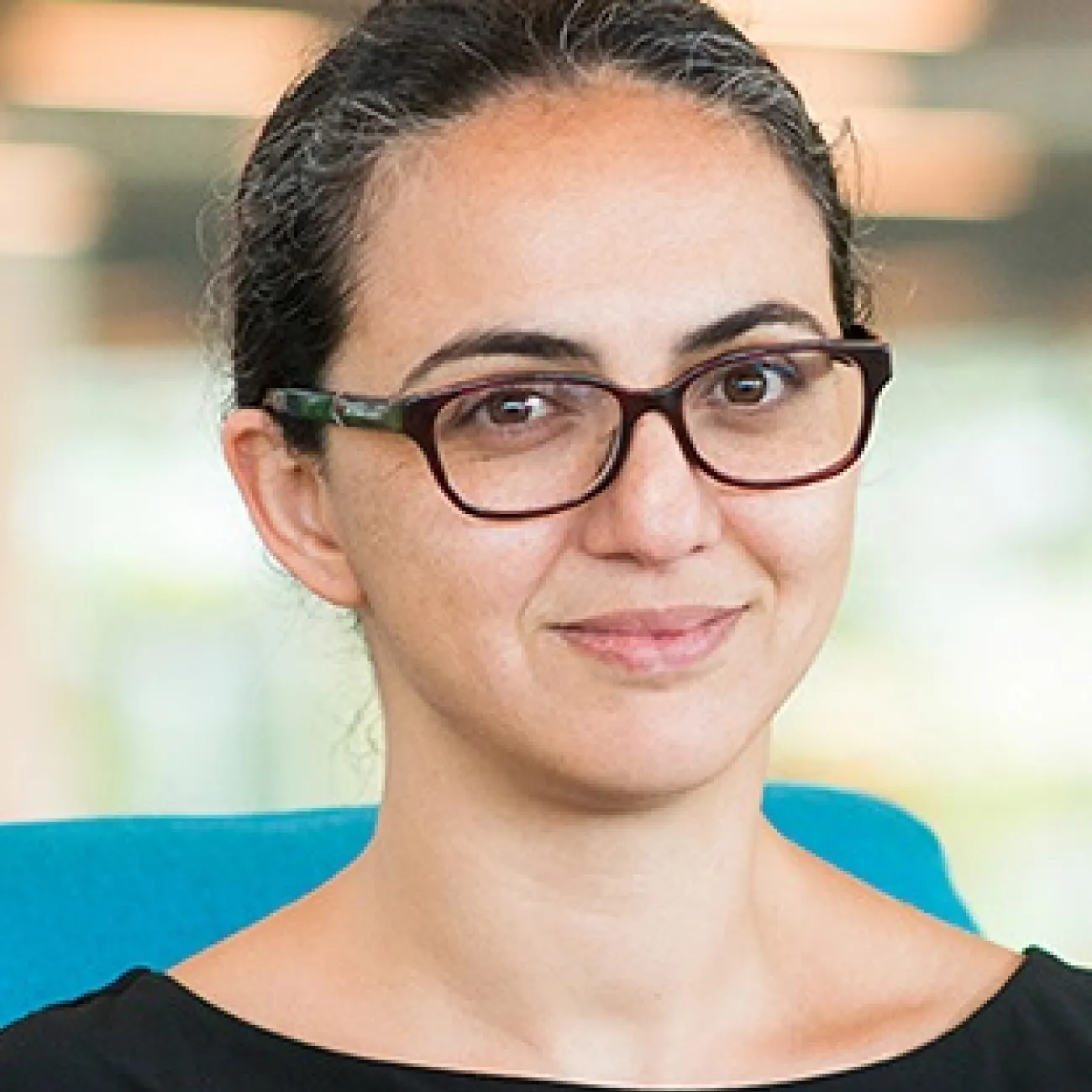
Buse Sen is a Doctoral Assistant at the Risk Analytics and Optimization Chair (RAO) within the College of Management of Technology at École Polytechnique Fédérale de Lausanne (EPFL). She is also a student in the Doctoral Program in Technology Management (EDMT). Institution: EPFL Primary Affiliation: College of Management of Technology (CDM) Department: Management of Technology, Innovation and Entrepreneurship (MTEI) Role: Doctoral Assistant (Staff) and PhD Student Research Focus: Her work centers on sparsity penalization in mean-variance portfolio optimization, bridging mathematical programming with financial risk analysis. This aligns with broader interests in technology management and quantitative finance. Publication Trends: Recent research applies sparse regularization techniques to portfolio selection, focusing on computational efficiency and risk modeling. Lab Affiliation: Risk Analytics and Optimization Chair (RAO), an EPFL research group specializing in quantitative finance and stochastic optimization.
Christoph Breunig is a Professor in the Department of Economics at the University of Bonn. His work bridges theoretical econometrics with empirical applications, focusing on nonparametric methods, instrumental variable modeling, and causal inference. His research addresses challenges in high-dimensional data, missingness mechanisms, and treatment effect estimation. University: University of Bonn Department: Economics Academic Rank: Professor Email: cbreunig@uni-bonn.de Research Trends: Nonparametric and semiparametric estimation techniques Applications of instrumental variables in causal inference Handling missing data and measurement error High-dimensional statistical models with economic applications Specification testing in complex regression frameworks Connections between microeconomic theory and empirical methods
Liming Chen is a Full Professor and Director of the Department Mathématiques - Informatique at École Centrale de Lyon, Université de Lyon. As a member of the Laboratoire d'Informatique en Image et Systèmes d'Information (LIRIS, UMR 5205), his research spans computer vision, pattern recognition, and multimedia computing. His extensive research portfolio includes 3D face analysis, image/video categorization, affect analysis, and biometric systems. He has led significant projects such as ANR 3D Face Analyzer, ANR Videosense, ANR Omnia, and ANR FAR3D, focusing on advanced recognition systems and multimodal analysis. Professor Chen supervises multiple PhD students and has developed open-source tools for 3D model processing. His work has received recognition through best performance awards at international competitions including SHREC 2011 (3D face recognition) and ImageCLEF 2011 (photo annotation).
Artem Barger is a researcher specializing in blockchain technology, distributed systems, and database optimization. With affiliations primarily in blockchain development and academic research, he has contributed extensively to Hyperledger Fabric enhancements and decentralized information systems. Research Interests Optimizing state databases for blockchain platforms Byzantine Fault Tolerance in distributed networks Permissioned blockchain architectures Tokenization of real-world assets AI applications in soft skills evaluation Recent Publications Barger's work focuses on improving blockchain scalability and security through techniques like certification blocks, Patricia Merkle tries, and verifiable randomness. He has also explored tokenization applications in charity and energy sectors.
Prof. Selin Damla Ahipasaoglu is a Professor in Operational Research at the University of Southampton's School of Mathematical Sciences . She serves on the management team of the UKRI CDT SustAI (Artificial Intelligence for Sustainability) as Senior Tutor and Co-Lead for the Transportation and Logistics Theme . Her work bridges mathematical optimization with practical applications in sustainability, finance, and transportation systems. Research Interests : Convex Optimization Robust Optimization Discrete Choice Theory Experimental Design Machine Learning Current Research : Focused on robust optimization and its applications in discrete choice modeling, portfolio optimization, and transportation systems. She explores theoretical frameworks alongside real-world implementations, particularly through interdisciplinary projects like the UKRI CDT SustAI. Teaching : In the 2025/2026 academic year, she teaches MATH3017: Mathematical Programming and MATH2013: Operational Research II . She supervises PhD students in Mathematical Sciences, including Kexin Lai, Samuel Jericho Ward, and others.
Dr. David Belton is a Senior Lecturer in the School of Earth and Planetary Sciences at Curtin University, within the Faculty of Science and Engineering. He also holds a portfolio role in the Office of the Provost. His expertise lies in laser scanning (both terrestrial and mobile) and photogrammetry, with a focus on automated processing, feature extraction, and applications in mining, heritage conservation, and structural monitoring. Dr. Belton holds a BCSc, BSc (First Class Honours), and a PhD from Curtin University. His teaching responsibilities include coordinating and lecturing in Cartographical Statistics and Integrated Surveying, alongside previous roles in Mine Surveying and Mine Survey Project courses. He actively supervises PhD, MPhil, and Honours students, fostering research excellence in spatial sciences. His research emphasizes practical applications of geospatial technologies, including underwater photogrammetry, pipeline monitoring, and coral reef analysis. Key areas include robust statistical methods for point cloud processing, sensor calibration, and open-source device development for marine surveys. His work bridges theoretical advancements with real-world challenges in environmental monitoring, infrastructure assessment, and cultural heritage preservation. Publications span high-impact journals like Corall Reefs , ISPRS Journal of Photogrammetry , and IEEE Transactions , reflecting contributions to geomatics, remote sensing, and computer vision. His research often addresses interdisciplinary challenges, such as UAV-based ecological monitoring and automated 3D model reconstruction from laser scanning data. Dr. Belton collaborates widely, contributing to projects like the Sydney-Kormoran wreck analysis and heritage documentation of Pilbara rock art. His work underscores innovative solutions for spatial data challenges across environmental, engineering, and archaeological domains.
Dr. V. Menkovski serves as an Associate Professor in Data Mining at Eindhoven University of Technology's Department of Mathematics and Computer Science. He also holds associate professor positions with EAISI Health and EAISI High Tech Systems, and is an ICMS Affiliated member. His work spans multiple domains of artificial intelligence and computational physics, with significant contributions to fusion energy research. Mathematics and Computer Science, Data Mining (Primary Appointment) EAISI Health (Associate Professor) EAISI High Tech Systems (Associate Professor) ICMS (Affiliated Member) Menkovski's research focuses on Graph Neural Networks, Machine Learning, Deep Learning, and their applications in diverse fields from plasma physics to metamaterials. His work demonstrates strong interdisciplinary connections, particularly between computer science and fusion energy research. He has developed novel approaches for crowd simulation, tokamak plasma monitoring, and metamaterials homogenization using advanced neural architectures. His fingerprint reveals expertise in Quality-of-Experience, Autoencoders, Neural Networks, Annotation, Graph Neural Networks, Video Streaming, Adversarial Machine Learning, and Anomaly Detection. Analysis of his recent publications (2023-2025) shows a clear trend toward applying Graph Neural Networks to complex physical systems, particularly in fusion energy research and materials science. His work increasingly integrates symmetry principles with neural architectures, as seen in his research on equivariant networks for metamaterials and symmetry-informed networks for zeolite analysis. There's also significant focus on practical applications in fake news detection, anomaly detection, and plasma state monitoring. Best Paper Award ICPM 2021 (with Sommers and Fahland) Best Paper Award of LoG 2022 (with multiple co-authors including Huang, Chen, Fang, Zhao, Yin, Pei, Mocanu, Wang, Pechenizkiy, and Liu) Menkovski teaches several advanced courses including Deep Learning, Advanced Topics in Artificial Intelligence, and Sociophysics 2, which runs through August 2025. His supervised work portfolio includes 79 projects, indicating substantial mentorship activity. He has received significant media attention for his research, including coverage by 11 news outlets, blog posts, and mentions on social media platforms. His work on 'Supervised Learning of Process Discovery Techniques Using Graph Neural Networks' was particularly noted in media coverage. His research involves collaboration with multiple institutions and teams, particularly in fusion energy research (Eurofusion Tokamak Exploitation Team, ASDEX-Upgrade team, EUROfusion MST1 Team). He works closely with researchers across disciplines, including physicists working on tokamak plasma and materials scientists studying metamaterials and zeolites.
Bikramjit Das is an Associate Professor and Associate Head of Pillar (Graduate Programme) at Singapore University of Technology and Design (SUTD). He holds a PhD in Operations Research from Cornell University and prior to SUTD, was a postdoctoral researcher at ETH Zurich’s RiskLab. His research focuses on extreme events analysis using applied probability, optimization, and statistical learning, with applications in finance, telecommunications, federated learning, and climate modeling. He teaches courses in Probability, Stochastic Modeling, and Analytics, and directs the Master of Science in Technology and Design (Data Science) program. Education: PhD in Operations Research (Cornell University), B.Stat & M.Stat (Indian Statistical Institute). Research emphasizes heavy-tailed distributions, risk contagion, and network modeling. Key areas include risk analysis in financial networks, robust optimization under uncertainty, and extreme value theory. His work bridges theoretical probability and real-world applications in data science and public policy. Notable contributions include studies on asymptotic independence in high dimensions, robust newsvendor models, and inference techniques for heavy-tailed data. His articles explore topics ranging from federated learning under noise to climate modeling and congestion phenomena in sparse networks. Collaborations include visiting positions at MIT and the Karlsruhe Institute of Technology. Active in academic leadership, he has contributed to technical reports on healthcare provider choice analysis and probabilistic flood risk assessments for nuclear power plants.
Prof. Dr. Nicole Mücke is a Professor in the Institute for Mathematical Stochastics at the Carl-Friedrich-Gauss Faculty of Technische Universität Braunschweig. Her research focuses on mathematical statistics, machine learning, kernel methods, and statistical inference. She explores topics such as neural network theory, inverse problems, optimization, and regularization techniques. Her work bridges theoretical foundations with practical applications in areas like distributed computing and uncertainty quantification. Prof. Mücke’s research portfolio includes contributions to empirical risk minimization, neural operator learning, and gradient-based optimization. She investigates the interplay between overparameterization and generalization in machine learning models, as well as the design of efficient algorithms for large-scale problems. Her publications span topics ranging from distributed stochastic gradient descent to localized kernel regression techniques. Her recent work emphasizes theoretical guarantees for learning algorithms, including convergence rates, statistical performance in high-dimensional settings, and the role of regularization in inverse problems. She also explores methodological advancements in spectral methods, algorithm unfolding, and data-splitting strategies to enhance statistical efficiency. Prof. Mücke’s research is characterized by a strong emphasis on rigorously analyzing machine learning algorithms through the lens of statistical theory and functional analysis. Her contributions address challenges in both classical and modern machine learning paradigms, with a focus on bridging the gap between abstract mathematical frameworks and practical implementation.
David A. Bader is a Distinguished Professor and founder of the Department of Data Science at NJIT's Ying Wu College of Computing, and Director of the Institute for Data Science. He holds a Ph.D. in Electrical Engineering from the University of Maryland (1996), an M.S. in Electrical Engineering from Lehigh University (1991), and a B.S. in Computer Engineering from Lehigh University (1990). His research focuses on large-scale graph analytics, parallel computing, and high-performance computing frameworks like Arachne and Arkouda. Dr. Bader has received prestigious awards including the IEEE Sidney Fernbach Award, ACM Fellowship, SIAM Fellowship, and AAAS Fellowship. His work emphasizes scalable algorithms for big data, quantum computing applications, and real-time graph processing systems. He leads research on dynamic graph algorithms, GPU optimization, and interdisciplinary data science projects. Education: Ph.D., Electrical Engineering, University of Maryland, 1996 M.S., Electrical Engineering, Lehigh University, 1991 B.S., Computer Engineering, Lehigh University, 1990 His research interests span parallel computing paradigms, graph theory applications, and high-performance computational systems. Recent work includes quantum interior point methods, scalable graph analytics frameworks, and efficient string processing algorithms. He actively contributes to open-source projects like GraphBLAS and LAGraph. Key Awards: 2022 Innovation Hall of Fame, University of Maryland 2021 ACM Fellow 2021 IEEE Sidney Fernbach Award 2010 IEEE Fellow Bader’s lab focuses on advancing big data infrastructure and has developed tools for large-scale graph analysis, including Arachne and Arkouda. His collaborations bridge academia and industry, addressing challenges in cybersecurity, climate modeling, and bioinformatics.
Professor Tony Jebara is a faculty member in the Department of Computer Science at Columbia University, where he chairs the Center on Foundations of Data Science and directs the Columbia Machine Learning Laboratory. His research focuses on machine learning with applications in vision, graphs, and spatio-temporal data. He holds a PhD from MIT (2002) and has advised startups including Sense Networks, Evidation Health, and Agolo. Notable awards include the NSF Career Award (2004), Best Paper at ICML 2009, and recognition as one of Esquire's Best and Brightest (2008). His work has been featured in major media outlets. Jebara's academic contributions span over 100 peer-reviewed papers and a textbook on machine learning. He served as General Chair for ICML 2017 and Program Chair for ICML 2014. His research explores generative and discriminative models, Bayesian inference, and optimization techniques. Current projects include neural ensemble analysis in neuroscience and robust learning algorithms for environmental modeling. Recent publications emphasize scalable methods for collaborative filtering, survival analysis in online experiments, and graphical model applications in neuroscience. His work bridges theoretical advancements with practical systems, including contributions to privacy-preserving algorithms and recommendation systems.
Ryan Cory-Wright is an Assistant Professor in the Analytics and Operations Group at Imperial College Business School . He previously held a Goldstine Postdoctoral Fellowship at IBM Research and earned his PhD in Operations Research from MIT in 2022 under Dimitris Bertsimas , after obtaining a BE (1st class Hons) in Engineering Science from the University of Auckland. Education : MIT (PhD), University of Auckland (BE) Affiliations : Imperial College Business School, IBM Research, MIT His research bridges optimization, machine learning, and sustainability, focusing on extending optimization methods to solve practical problems like rank-constrained product recommendations and low-carbon economy transitions . Collaborations include projects with OCP to guide two billion USD solar-battery investments . Recent work includes AI-Hilbert (2024 Nature Communications , Outstanding Technical Achievement Award ), Stability Regularized Cross-Validation , and Matrix Goemans-Williamson Rounding . He has developed scalable algorithms for sparse portfolio selection and certifiably optimal matrix completion . Honors : Goldstine Fellowship (2022-23) Nicholson Prize (2020) Pierskalla Award (2020) INFORMS DMDA Best Paper (2024) ICS Student Paper Award (2019) Advising : Co-advises Lingjun Meng as a doctoral student. He teaches Decision Making Under Uncertainty (PhD), Optimization and Decision Models (Online MSc), and Data Structures/Algorithms (UG Econ/Finance), with a focus on Python-based computational methods.
Yunzhi Chen is a Postdoctoral Researcher in Electrical Engineering at the National Renewable Energy Laboratory (NREL), working within the Grid Planning and Analysis Center. His research focuses on energy systems engineering with specialization in geothermal district energy systems and energy storage integration for grid applications. Chen's research interests encompass: Geothermal Energy: Advanced modeling of district-scale geothermal systems using ambient-temperature loops and borehole thermal energy storage District Energy Systems: Analysis of thermal load dynamics and infrastructure optimization for heating and cooling networks Energy Storage: Development of computational strategies for seasonal storage integration in electricity capacity planning Electricity Sector Modeling: National-scale scenario analysis for U.S. power system evolution Thermal Load Analysis: Regional assessment of heating/cooling demands and storage potential Grid Planning: Integration frameworks for renewable energy and storage solutions His 2024-2025 publications reveal a concentrated research trajectory on national geothermal district energy modeling and energy storage integration. Key contributions include computational methods for reducing complexity in capacity expansion models, regional assessments of geothermal potential, and comprehensive U.S. electricity sector outlooks. These works consistently address grid integration challenges through advanced modeling techniques and national-scale analysis. Scientific Awards: No scientific awards mentioned in available information Advising and Grants: No student advising information available No grant funding details provided Labs and Teams: Grid Planning and Analysis Center: Primary research unit at NREL focusing on grid integration challenges Interdisciplinary Research Teams: Collaborative projects with engineers, modelers, and analysts across NREL's energy systems portfolio
Emanuele Taufer is a Full Professor of Statistics at the Department of Economics and Management of the University of Trento. His academic career includes roles as Vice Director of the Department of Computer Science and Business Studies and Faculty Delegate for International Relations. He holds a Ph.D. in Statistics from Cardiff University, an M.Sc. in Mathematical Statistics from George Washington University, and a Laurea in Economics from the University of Trento. His research focuses on statistical inference, stochastic processes, goodness-of-fit tests, and applications in ESG analysis. Notable contributions include work on exponentiality testing, graphical models, and financial dependence modeling. He has been recognized for his 2002 paper on mean residual life characterization at the SIS2002 conference. Recent research trends emphasize methodological advancements in ESG performance measurement, sparse network estimation for heavy-tailed data, and generalized precision matrices for financial risk modeling. His work spans theoretical statistics, applied econometrics, and interdisciplinary topics like environmental governance. Education: Ph.D. in Statistics, Cardiff University (UK) M.Sc. in Mathematical Statistics, George Washington University (USA) Laurea in Economics, University of Trento (Italy) Professional Roles: Full Professor of Statistics at University of Trento (2003–present) Associate Professor (2003–2003), Assistant Professor (1996–2002) Awards: 2002 SIS2002 Recognition for innovative statistical testing methodology Key Research Themes: Stochastic processes and estimation ESG methodology and financial reporting High-dimensional data analysis Goodness-of-fit tests and tail index estimation
Ilya Safro is an Associate Professor and Associate Chair for Graduate Studies and Research in the Department of Computer and Information Sciences at the University of Delaware. He holds a joint appointment in the Department of Physics and Astronomy. Previously, he served as a Faculty Scholar at Clemson University's School of Health Research and as a postdoctoral researcher at Argonne National Laboratory. Ph.D. in Applied Mathematics and Computer Science (Weizmann Institute, 2008) MSc in Applied Mathematics and Computer Science (Weizmann Institute, 2004) BSc in Mathematics and Computer Science (Ben-Gurion University, 1998) His research focuses on quantum algorithms, machine learning, and combinatorial scientific computing. He develops hybrid quantum-classical algorithms for graph optimization problems and leads projects in biomedical hypothesis generation systems like AGATHA-C. His work spans quantum computing scalability, tensor network simulations, and multiscale approaches for large-scale optimization. Recent publications highlight advancements in QAOA parameter transferability, fermion-qubit mapping optimization, and quantum-inspired network interdiction algorithms. His lab has received multiple student paper awards at IEEE HPEC and QCE conferences. NSF, DARPA, NIH, DOE, BMW funding recipient Co-Chair of IEEE Quantum Computing and Engineering 2025 and 2024 Quantum Algorithms tracks Editorial board member for IEEE Transactions on Quantum Engineering and SIAM Journal on Scientific Computing Current lab members include Ph.D. students Bao Bach, Cameron Ibrahim, Ilya Tyagin, and alumni working at Fujitsu Research USA and Argonne National Laboratory. His Erdős number is 3 via multiple academic lineages.