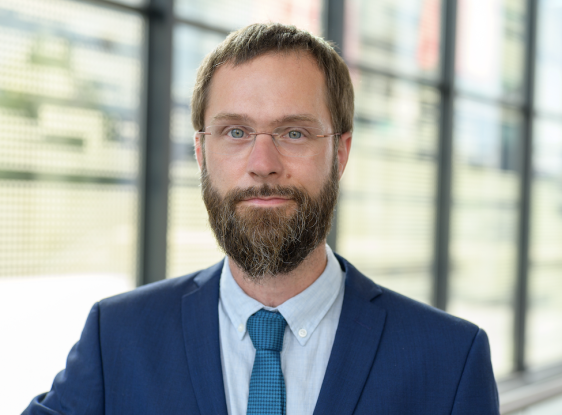
Martin Dalgaard Ulriksen is an Associate Professor at Aarhus University's Department of Mechanical and Production Engineering, specializing in system dynamics and affiliated with the Mechatronics and Dynamics section. His work focuses on vibration theory, system identification, and control theory with applications in offshore structures and wind turbines. His research encompasses fault detection, parameter estimation, and digital twin technologies. Key projects include True Digital Twin (2024-2025) for wind turbine design and CP-SENS (2023-2026) for cyber-physical sensing in structural monitoring. Publications highlight methodologies like modal expansion, basis pursuit, and eigenstructure assignment for damage localization and system identification. Martin teaches vibration theory and system identification courses at both bachelor's and master's levels while supervising thesis projects. Current collaborations with researchers like D. Bernal demonstrate his emphasis on interdisciplinary approaches. Contact: mdu@mpe.au.dk | +45 93 50 88 66.
Michael Muma is a Professor in the Department of Electrical Engineering and Information Technology at Technische Universität Darmstadt. His research focuses on robust data science theory and methods applied to signal processing and machine learning in biomedicine and engineering. He leads the ERC Starting Grant ScReeningData project, developing methods for reproducible information discovery in biomedical databases, and is a Principal Investigator in the LOEWE center emergenCITY and BMBF cluster curATime. Prior roles include Independent Junior Research Group Leader (Athene Young Investigator) and Lecturer at TU Darmstadt from 2017 to 2022, and Research Associate (Post-Doc since 2014) from 2009 to 2017. His research interests span robust statistical methods, high-dimensional data analysis, emergency response systems, and biomedical signal processing. Notable projects include FDR-controlled portfolio optimization, ECG delineation algorithms, and radar-based vital sign estimation. Muma has contributed to distributed sensor networks, robust clustering, and sparse regression techniques. His work addresses challenges in multi-source detection, financial data analysis, and genomics through interdisciplinary approaches combining signal processing, machine learning, and robust statistics. Recent publications emphasize scalable solutions for high-dimensional problems, including applications in robotics, cardiology, and financial index tracking.
Pravesh Kothari serves as an Adjunct Professor in the Computer Science Department at Carnegie Mellon University, focusing on theoretical computer science and algorithmic foundations of average-case computational problems. His research centers on designing efficient algorithms and establishing rigorous evidence for algorithmic thresholds in problems spanning theoretical computer science, statistics, and allied fields. Key contributions include the development of the sum-of-squares method which bridges proof complexity and semidefinite programming relaxations for optimization challenges, detailed in his monograph Semialgebraic Proofs and Efficient Algorithm Design with Pitassi and Fleming. Recent publications reveal consistent focus on constraint satisfaction problems, small-set expansion, and sparse statistical estimation, demonstrating strong integration of theoretical computer science with statistical learning theory through semidefinite programming frameworks. Major recognitions include: NSF CAREER Award (2021-2026) for The Nature of Average-Case Computation Sloan Fellowship (2022) Current research is primarily supported by the NSF CAREER Award, enabling investigation into computational thresholds and efficient algorithm design for average-case problems through theoretical frameworks. His Fall 2021 CMU lecture notes document practical applications of these methodologies.
Luca Barbierato is a Fixed-term Assistant Professor at the Department of Control and Computer Engineering (DAUIN), Politecnico di Torino, specializing in applied artificial intelligence, cybersecurity, and co-simulation infrastructures for integrated energy systems. He actively contributes to research in edge computing, IoT, and sustainable energy technologies. Research Focus: AI applications in energy systems, secure IoT infrastructures, and co-simulation frameworks Teaching Roles: Invited PhD teaching component (2025/26), teaching assistant across multiple programs His recent publications address critical areas including OpenTitan-based security controllers, urban building energy modeling, and distributed power system co-simulation. Barbierato's work aligns with SDG Goals 7 (Affordable Energy), 9 (Innovation Infrastructure), and 11 (Sustainable Cities). Notable scientific recognition includes the Learning to Teach (L2T) badge from Politecnico di Torino.
Jean-François Giovannelli is a Professor at IMS Bordeaux , affiliated with the Université de Bordeaux . His work focuses on Signal and Image Processing within the SPECTRAL team. Collaborations span institutions like CEA , CNRS , and industry partners ( STMicroelectronics , Stellantis ), emphasizing Bayesian methods and MCMC algorithms for diverse applications. Current Affiliation : Professor, IMS Bordeaux, Université de Bordeaux Research Group : Signal and Image Processing Team : SPECTRAL Collaborations : CEA, CNRS, CESTA, Thales, NXP Research Interests include: Bayesian inference for inverse problems MCMC sampling techniques Signal/image reconstruction Mass spectrometry data analysis Adaptive optics in astronomy Medical imaging algorithms Article Trends show a focus on Bayesian modeling across disciplines: biomedical data, astronomical imaging, and microwave mapping. Key methods include MCMC samplers , regularized inversion , and statistical validation . Professional Contributions involve developing tools like NiftyRec for tomography and advancing Adaptive Optics restoration algorithms. His work bridges theoretical statistics and practical applications in healthcare, space, and defense.
Stefano Marchesiello is a Full Professor of Applied Mechanics at the Polytechnic University of Turin, Department of Mechanical and Aerospace Engineering (DIMEAS), a position he has held since 2019. His academic work spans theoretical studies, numerical applications, and experimental tests within the field of Applied Mechanics. He maintains active roles in doctoral education, serving on mechanical engineering doctoral colleges from 2013/2014 through 2024/2025, and teaches courses including Dynamics and Identification of Nonlinear Systems, Dynamics of Mechanical Systems, Vibration Mechanics, and Machine Mechanics for Aerospace Engineering. Marchesiello's research focuses on modal analysis and identification, damage diagnosis in structures and construction materials, damping systems, mechanical vibrations, and nonlinear dynamics. His primary research lines include vehicle-bridge dynamic interaction, dynamic identification techniques in linear and nonlinear fields, damage identification, vibrations of continuous systems with non-proportional damping, innovative vibration damping devices, diagnostics and monitoring of rotating systems, and pantograph-catenary dynamic interaction. His work bridges theoretical mechanics with practical engineering applications, particularly in transportation infrastructure and mechanical systems. His recent publications demonstrate a strong focus on nonlinear system identification, structural health monitoring, and vibration analysis across various mechanical and aerospace applications. Marchesiello's research shows increasing integration of machine learning techniques with traditional mechanical engineering approaches, particularly in system identification and damage detection. His work spans from fundamental nonlinear dynamics to practical applications in railway systems, rotating machinery, and structural components. Certificate of reviewing awarded by Journal of Sound and Vibration - Elsevier, Netherlands (2013) Certificate of Excellence in Reviewing - Mechanical Systems and Signal Processing 2013 awarded by Elsevier, Netherlands (2013) Marchesiello serves as Scientific Director for multiple commercial research contracts, particularly with Officina Fratelli Bertolotti SpA, focusing on vibration damping systems for railway catenaries and rotor dynamics modeling. He has led research projects from 2008 through 2023, demonstrating sustained research leadership and industry collaboration. His editorial work includes membership on the Editorial Board of SHOCK AND VIBRATION since 2018, and he has served on program committees for the International Conference on Damage Assessment of Structures (DAMAS) across multiple years. He is actively involved with the Dynamics of Mechanical Systems and Identification research group (DIMEAS), which focuses on developing advanced methods for analyzing and identifying mechanical systems with both linear and nonlinear behaviors. His research integrates computational modeling, experimental validation, and practical applications across multiple engineering domains.
Dr. Stavros Nousias is a researcher at the Chair of Computing in Civil and Building Engineering at the Technical University of Munich , focusing on applications of Artificial Intelligence in the Built Environment . His work bridges Knowledge Representation and Reasoning , Geometry Processing , and Machine Learning to advance construction informatics and digital twinning. Research Interests: AI for building evacuation prediction, technical drawing segmentation, BIM optimization, and respiratory disease modeling. Publications: 15+ peer-reviewed articles on topics including graph neural networks for construction simulations, pulmonary airflow analysis, and heritage site monitoring. Supervised Theses: Guided projects on AI-based BIM command prediction and robotized construction simulation . Labs: Active in the BIM-Lab and Robotic Fabrication Lab . Teaching: Co-instructor for courses like Artificial Intelligence in Engineering and Computation in Engineering 1 .
Domenico Bianculli is an Associate Professor and Chief Scientist 2 at the Interdisciplinary Centre for Security, Reliability and Trust (SnT) at the University of Luxembourg. He leads the Software Verification and Validation (SVV) research group and is affiliated with the Department of Computer Science in the Faculty of Science, Technology and Medicine (FSTM). Additionally, he serves as the deputy study program director for the Master in Space Technologies and Business. Dr. Bianculli earned his PhD from the University of Lugano (Switzerland) under Carlo Ghezzi, with a dissertation titled "Open-world software: Specification, Verification, and Beyond." He also holds a MSc in Computing Systems Engineering and a BSc in Computer Engineering from Politecnico di Milano (Italy). His research focuses on the specification, verification and validation of software systems, particularly evolvable software systems. His work spans trace checking and run-time verification of temporal properties, modeling access control policies, program analysis for security, incremental verification techniques, and verification of service-oriented systems. Dr. Bianculli bridges theoretical foundations with practical applications in cyber-physical systems, financial technology, and regulatory compliance. His recent publications reveal a strong trend toward applying machine learning to software engineering challenges, particularly in log analysis, anomaly detection, and automated compliance checking. He has made significant contributions to verifying cyber-physical systems through techniques for stress testing control loops and trace diagnostics for signal-based temporal properties. His work increasingly addresses financial technology challenges, with papers focusing on automated regulatory compliance related to GDPR and financial regulations. ACM SIGSOFT Distinguished Paper Award for "Efficient large-scale trace checking using MapReduce" (ICSE 2016) Nomination for the best paper award for "SMT-based checking of SOLOIST over sparse traces" (FASE 2014) Dr. Bianculli leads multiple significant research projects including KITS24/19067232 "SnT-R2S" funded by FNR Luxembourg, LOGODOR "Automated Log Smell Detection and Removal" funded by FNR's CORE scheme, and several financial regulation projects including AFRICA, ICCOFIDO, and RUMOFA. His research has been supported by national funding agencies and industry partnerships with CSSF Luxembourg, HITEC Luxembourg, BGL BNP Paribas, and LuxSpace. As head of the SVV research group at SnT, Dr. Bianculli oversees a team developing advanced techniques for software specification, verification, and validation. His group works on theoretical foundations and practical applications, with current projects addressing challenges in cyber-physical systems, financial technology, and regulatory compliance. The group maintains strong collaborations with industry partners in the financial sector and space technology domains.
Klaas Smilde serves as an Adjunct Professor in the Department of Food Science (Design and Consumer Behavior section) and holds a postdoctoral position in the Department of Plant and Environmental Sciences (Section for Environmental Chemistry and Physics) at the University of Copenhagen. His dual appointments bridge food science and environmental research, with institutional email addresses at both University of Copenhagen (smilde@plen.ku.dk) and University of Amsterdam (A.K.Smilde@uva.nl). His research centers on advanced chemometric methodologies applied to complex biological systems, particularly metabolomics and lipoprotein analysis. Key interests include multiway data modeling, sparse PCA interpretation, longitudinal study design, and integration of mechanistic models with high-dimensional datasets. This work spans food science applications, environmental chemistry, and human health investigations. Recent publications (2020-2025) reveal consistent methodological innovation in data analysis for metabolomics and environmental screening. Dominant themes include development of robust protocols for lipoprotein profiling using NMR and ultracentrifugation, application of multiway models to postprandial dynamics, and novel approaches to non-target screening in environmental samples. His work demonstrates strong interdisciplinary collaboration across food science, plant sciences, and medical research domains.
Konstantinos Giannoutakis serves as an Assistant Professor in the Department of Applied Informatics at the University of Macedonia, where he actively contributes to teaching and research in computational methods and applied informatics. His role encompasses both academic instruction and scholarly publication within the university's technical faculties. His educational foundation includes: B.Sc. in Mathematics from the University of the Aegean M.Sc. in Computational Science from the University of Athens Ph.D. in Electrical and Computer Engineering from Democritus University of Thrace Dr. Giannoutakis' research centers on advanced computational techniques, with significant focus on Scientific Computing and Parallel Computing architectures. His work in Numerical linear algebra develops optimized approaches for sparse linear systems, while his expertise in Finite difference and finite element methods supports complex scientific simulations. The Algorithms evaluation component of his research ensures computational efficiency across diverse mathematical applications. He instructs key undergraduate courses including Algorithm Analysis (CSC401), Discrete Mathematics (AIC203), and Mathematical Analysis (AIC104), demonstrating commitment to foundational computer science education. His substantial publication portfolio comprises 27 books, 37 scientific journal articles, and 34 conference papers, though specific recent works were not detailed in the source material. No scientific awards, research grants, advised students, or laboratory affiliations were documented in the available information.
Ami Wiesel is a Professor at The Rachel and Selim Benin School of Computer Science and Engineering at The Hebrew University of Jerusalem. His research focuses on statistical signal processing, machine learning, and covariance estimation. Previously, he completed his postdoctoral studies at the University of Michigan with Professor Alfred Hero, earned his PhD in Electrical Engineering from Technion under Professors Yonina Eldar and Shlomo Shamai, and obtained his MSc and BSc in Electrical Engineering from Tel Aviv University. His research interests include robust covariance estimation , statistical learning , signal detection , and MIMO communications . Wiesel has made significant contributions to the field of structured covariance estimation, particularly in elliptical distributions and Tyler's estimator. His work bridges theoretical statistics with practical applications in radar systems, wireless communications, and hyperspectral imaging. Wiesel's publications show a clear trend toward integrating deep learning with traditional statistical signal processing methods. His recent work explores unbiased estimation using neural networks, fair principal component analysis, and deep learning applications for target detection with constant false alarm rate. His research spans theoretical foundations in covariance estimation to practical implementations in radar and communications systems. Among his notable scientific achievements are: Young Author Best Paper Award (2019) for 'Learning to Detect' Young Author Best Paper Award (2006) for 'Linear precoding via conic optimization for fixed MIMO receivers' Student Paper Award (2017) for 'Deep MIMO detection' Wiesel has advised numerous graduate students who have gone on to publish significant work in the field. His research has been supported by various grants focusing on statistical signal processing, machine learning applications, and radar systems. His monograph 'Structured Robust Covariance Estimation' (2015) has become a reference in the field. He maintains an active research group focusing on the intersection of statistical learning and signal processing, with applications in communications, radar, and medical imaging.