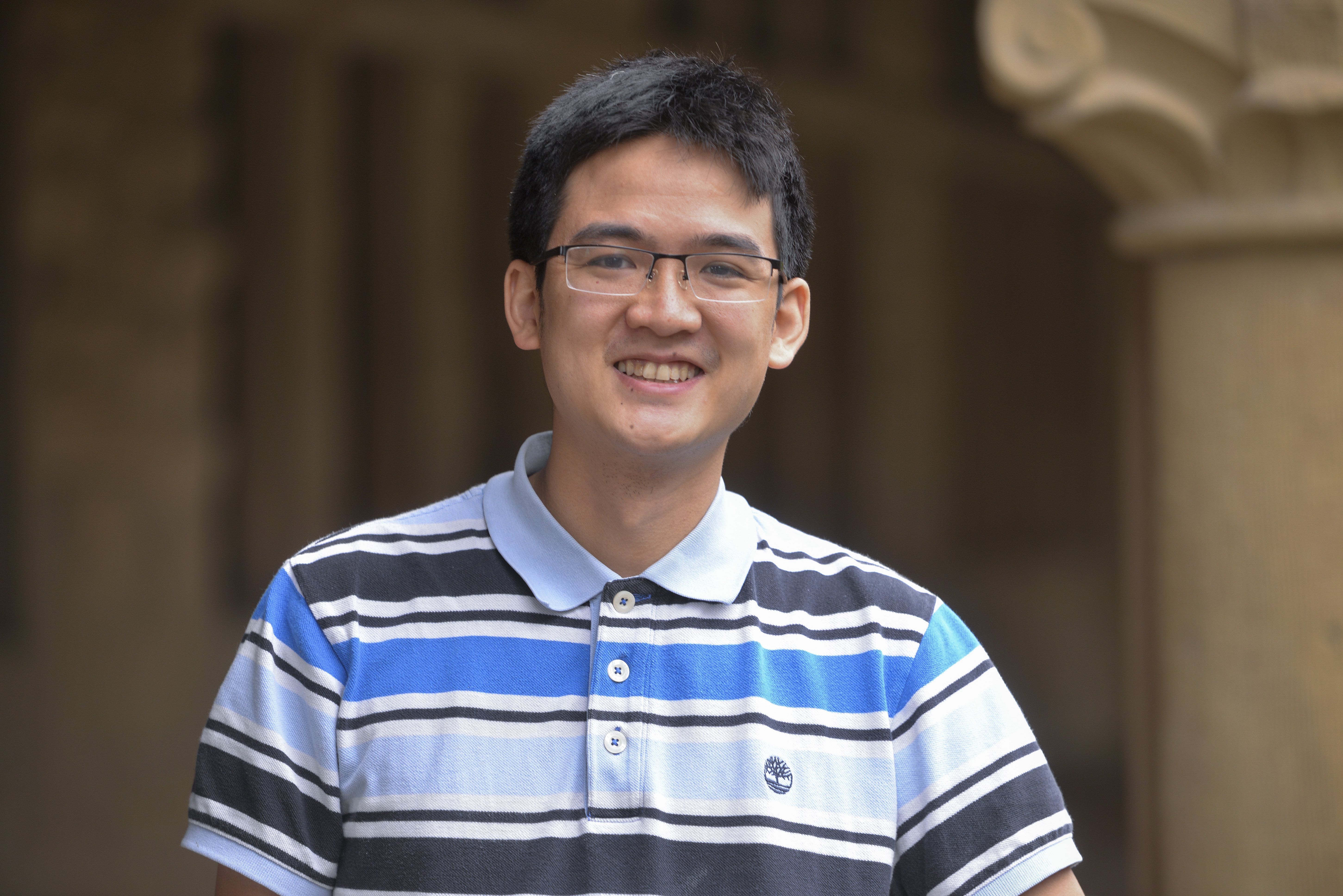
Jonathan Winghong Luk is a Professor in the Department of Mathematics at Stanford University. His research focuses on nonlinear partial differential equations, general relativity, and mathematical physics, with a particular emphasis on gravitational wave dynamics, shock formation, and high-frequency spacetime solutions. Contact: Email: jluk@stanford.edu Office: 382-Z, Building 380, Stanford, CA 94305 Research Trends: His recent publications examine nonlinear wave equations on dynamic spacetimes, gravitational phase mixing, impulsive gravitational wave interactions, and stability of black hole interiors. He frequently collaborates with experts like C. Huneau, S.-J. Oh, and J. Speck. Academic Activities: Luk organizes the Analysis and PDE seminar at Stanford with Eugenia Malinnikova and Ryan Unger. He has developed lecture notes on nonlinear wave equations and Fourier analysis, complemented by example sheets.
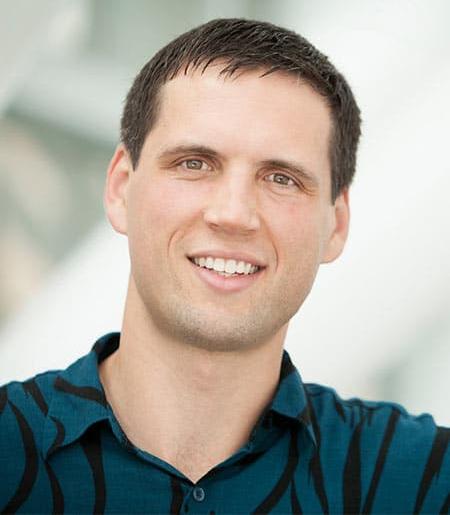
Harvey Reall is a Professor of Theoretical Physics at the University of Cambridge , affiliated with the Department of Applied Mathematics and Theoretical Physics (DAMTP) and a Fellow of Trinity College . His research focuses on General Relativity and Effective Field Theory , particularly in the context of black hole mechanics , higher-dimensional gravity , and cosmic censorship . He has held prestigious positions including a Royal Society University Research Fellowship from 2005 to 2013. Education: PhD from DAMTP, University of Cambridge. Previous Appointments: Lecturer at the University of Nottingham (2005-2007); Postdoctoral positions at the Kavli Institute (2003-2005), Queen Mary University of London (2000-2003), and University of California, Santa Barbara (2003-2005). Reall's work explores the uniqueness and stability of black holes , causality in gravitational theories , and effective field theory approaches to gravity . His recent publications address nonperturbative second law formulations , event horizon dynamics , and axisymmetry theorems in extended theories of gravity. He has supervised numerous researchers including Aidan McSharry (2025-) , Maxime Gadioux (2022-) , and Iain Davies (2020-24) , contributing to the training of the next generation of physicists. Scientific Awards: Royal Society University Research Fellow (2005-2013)
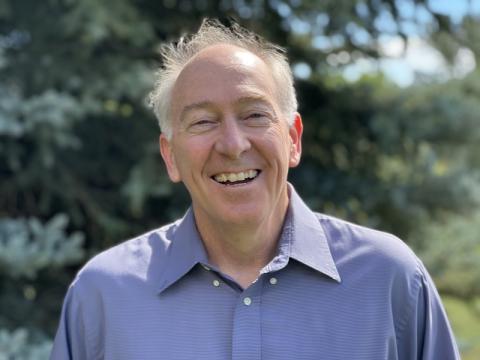
Thomas Hartman is a Professor of Physics in the College of Arts and Sciences at Cornell University. He received his A.B. in Physics from Princeton University in 2004 and his Ph.D. in Physics from Harvard University in 2010. His professional journey includes being a Member of the School of Natural Sciences at the Institute for Advanced Study (2010-2013), Research Associate at the Kavli Institute for Theoretical Physics, UCSB (2013-2014), Assistant Professor at Cornell University (2014-2020), Associate Professor at Cornell University (2020-2022), and Professor at Cornell University (2022-present). Hartman's research focuses on theoretical aspects of quantum gravity and quantum field theory, with particular emphasis on black hole information and strongly interacting quantum fields. His work explores four major interconnected areas: gauge/gravity duality (examining how quantum field theory degrees of freedom organize into fluctuating spacetime), black hole information paradox (investigating the relationship between classical black hole solutions and quantum statistical systems), new approaches to quantum field theory using dualities and entanglement dynamics, and the physics of de Sitter space with implications for early universe cosmology. His research employs techniques from string theory, holographic duality, general relativity, and quantum information theory. Analysis of Hartman's publication record reveals a strong focus on resolving fundamental questions in quantum gravity, particularly through the development of replica wormhole techniques that address the black hole information paradox. His work spans both highly mathematical approaches to quantum gravity and connections to potentially observable phenomena, with increasing emphasis on connections between quantum information science and gravitational physics in recent years. Member, School of Natural Sciences, Institute for Advanced Study, 2010-2013 Hartman has advised graduate students including Jeevan Chandra Namburi and Wan Zhen Chua, contributing to the next generation of theoretical physicists. His research group actively investigates the emergence of spacetime from quantum information principles and develops new mathematical frameworks for understanding quantum gravity. The group maintains strong connections with other leading institutions through collaborative projects and participates in major theoretical physics initiatives including Snowmass planning for future research directions in high energy physics. Hartman's research program represents a vital bridge between abstract theoretical concepts in quantum gravity and potential experimental tests, working to develop frameworks that could ultimately connect quantum gravity to observable phenomena in both high-energy physics and cosmological observations.
Kenneth McLaughlin is the Evelyn and John G. Phillips Distinguished Chair in Mathematics at Tulane University's School of Science & Engineering. He holds a Ph.D. and B.A. in Mathematics from New York University (1994 and 1989). Prior to Tulane, he served as faculty at the University of North Carolina, Chapel Hill, the University of Arizona, Universidade Federal de Brasília, and Colorado State University, where he also held leadership roles as Department Head and Chair. His research focuses on integrability, applying techniques across mathematics to study complex systems and phenomena. He has held visiting positions at institutions worldwide, including France, Italy, Brazil, Belgium, and the UK. McLaughlin’s research spans integrable systems, nonlinear dynamics, and asymptotic analysis. His work often involves the Riemann-Hilbert problem approach, orthogonal polynomials, and random matrix theory. Notable contributions include studies on soliton gases, the KdV equation, and universality in quantum operator dynamics. His recent articles explore topics such as asymptotic behavior of polynomials, soliton gas condensation, and hydrodynamic limits in integrable systems. McLaughlin’s academic career is marked by interdisciplinary collaboration and international research engagement.
Laur Järv is an Associate Professor in Theoretical Physics at the University of Tartu, Faculty of Science and Technology, Institute of Physics. He has been serving as Associate Professor since 2021 and is currently the Head of the Laboratory of Theoretical Physics (since 2019). His academic career at the University of Tartu spans over 20 years, with progressive roles from Post-Doc to his current position. Dr. Järv received his education at the University of Tartu (B.Sc. in Fundamental Physics, 1996; M.Sc. in Theoretical Physics, 1998) and completed his Ph.D. in Mathematical Sciences at the University of Durham in 2002. His doctoral research focused on "The enhancon mechanism in string theory" under the supervision of Clifford V Johnson. Dr. Järv's primary research interests lie in gravitational physics and cosmology, with particular focus on modified theories of gravity including teleparallel gravity, scalar-tensor theories, and nonmetricity-based approaches. His work explores the cosmological implications of these theories, including inflationary models, black hole solutions, and gravitational wave propagation. His research bridges theoretical physics with observational cosmology, addressing fundamental questions about the nature of gravity and the evolution of the universe. His publication record demonstrates a strong focus on geometric foundations of gravity, with numerous high-impact papers in leading journals like Physical Review D and Classical and Quantum Gravity. Recent work shows increasing emphasis on alternative formulations of gravity (teleparallel, symmetric teleparallel) and their cosmological applications, often collaborating with international researchers in the field. Estonian National Research Award in exact sciences (2020) for the cycle of works "Extended geometric theories of gravity" with Manuel Hohmann and Margus Saal University of Tartu Badge of Distinction (2021) Best teaching staff in the UT Institute of Physics, recognized by students (2024) Letter of recognition for supervision of Joosep Lember's award-winning student work (2022) Dr. Järv has been actively involved in academic mentoring, serving as a supervisor for student research projects and as an opponent for PhD defenses internationally. He has organized multiple international conferences on gravitational physics in Tartu, establishing the university as a hub for research in modified gravity theories. As Head of the Laboratory of Theoretical Physics, he leads a research group focused on geometric foundations of gravity and cosmological applications. Dr. Järv's laboratory has become a recognized center for research on alternative gravity theories, particularly through the organization of the biennial "Geometric Foundations of Gravity" conference series since 2017, which has attracted leading researchers from around the world to Tartu.
Ali Feizmohammadi is an Assistant Professor, Teaching Stream (LTA) in the Department of Mathematics at the University of Toronto Mississauga, affiliated with the Mathematical and Computational Sciences division. His research focuses on inverse problems, partial differential equations, and geometric analysis. He holds a position emphasizing teaching excellence within the university's framework. His work addresses advanced mathematical challenges such as coefficient identification in subdiffusion equations, fractional Laplacian problems on Riemannian manifolds, and nonlinear elliptic equations on manifolds. Recent articles highlight contributions to the Calderón problem in various contexts, wave equation control, and spacetime finite element methods. No scientific awards or grants are explicitly listed in the provided information. He has not yet listed advisees in the available data. His research trends emphasize rigorous mathematical analysis of inverse problems in both classical and fractional PDE frameworks, with applications to geometric and control-theoretic questions. Dr. Feizmohammadi's work spans theoretical advancements in inverse problems, numerical methods for control systems, and the interplay between differential geometry and PDEs. His contributions address both fundamental theory and applied methodologies in mathematical physics and engineering.
University of Illinois Urbana-ChampaignUnited States
Thomas Faulkner is an Associate Professor in the Department of Physics at the University of Illinois at Urbana-Champaign, where he has been a faculty member since 2014. His research bridges condensed matter physics, high energy physics, and quantum information science through the framework of holographic duality (AdS/CFT correspondence), exploring connections between quantum field theories and gravitational theories. Dr. Faulkner received his BSc in Physics from the University of Melbourne in 2003 and his PhD from MIT in 2009 under Hong Liu and Krishna Rajagopal. He held postdoctoral positions at the Kavli Institute for Theoretical Physics (2009-2012) and the Institute for Advanced Study in Princeton (2012-2013) before joining the Illinois faculty. His primary research focuses on three interconnected areas: entanglement entropy as a tool to study quantum phases and gravity; string-inspired models of strongly correlated phenomena including non-Fermi liquids and quantum criticality; and holographic approaches to QCD under extreme conditions. His work leverages theoretical tools from both condensed matter and string theory communities to address fundamental questions in quantum gravity and many-body physics. Dr. Faulkner's publication record shows an evolving research trajectory from early work on strange metal transport and QCD applications toward increasingly sophisticated investigations of entanglement structure, quantum information aspects of holography, and fundamental constraints on quantum field theories. His recent work demonstrates deep connections between quantum information theory, gravitational physics, and condensed matter phenomena. DOE Early Career Award (2018) DARPA Young Faculty Award (2015) Dr. Faulkner has taught a comprehensive range of physics courses from undergraduate College Physics to advanced graduate-level field theory courses. His research program receives significant external funding, supporting his investigations into the quantum structure of spacetime and its connections to condensed matter phenomena. He participates in a vibrant research ecosystem exploring the quantum information foundations of spacetime geometry, contributing to collaborative efforts that are reshaping our understanding of the relationship between quantum mechanics and gravity.
Professor Fay Dowker is a leading theoretical physicist at Imperial College London's Department of Physics, affiliated with the Faculty of Natural Sciences. Her research focuses on quantum gravity, causal set theory, and the nature of spacetime. She explores the granular structure of spacetime at Planck scales, emphasizing causal relationships and the interplay between relativity and quantum mechanics. Dowker's work addresses foundational questions such as the cosmological constant problem, the passage of time, and the relationship between spacetime discreteness and consciousness. Her contributions include seminal lectures like A Meditation on General Relativity and Spacetime Atoms and the Unity of Physics , as well as public debates on parallel universes and the hard problem of consciousness. She has held roles such as organizing events for Einstein's general relativity centenary and contributes to outreach via BBC Radio 4 and the Royal Institution. Her Orcid identifier is 0000-0002-6652-1058, and she is part of interdisciplinary teams like Physics of Universe and Quantum Engineering, Science, and Technology. Dowker’s research bridges physics and philosophy, tackling dichotomies such as continuity vs. atomicity, locality vs. non-locality, and objectivity vs. subjectivity. Her work on causal set theory challenges traditional views of spacetime and offers novel insights into quantum gravity and cosmology.
Virginia Polytechnic Institute and State UniversityUnited States
Dr. Arpit Dua is an Assistant Professor in the Department of Physics at Virginia Tech. Previously, he held positions including a joint Simons-IQIM postdoc at Caltech under Xie Chen and a PhD at Yale University under Meng Cheng and Liang Jiang. His research focuses on theoretical quantum information systems, with emphasis on quantum error correction, topological order, and integrating machine learning principles into physics frameworks. Education: PhD in Physics from Yale University, Postdoctoral research at Caltech. Research Interests: Quantum error correction (developing novel codes using conventional and machine learning methods), thermalization in topological systems, self-correcting models, and applying physics-based insights to AI architecture design. His current projects explore fault-tolerant protocols, fracton orders, and Floquet codes. Publications reflect contributions to topological codes, subsystem symmetries, and fracton physics. His work bridges quantum information theory with condensed matter physics.
California Institute of Technology (Caltech)United States
Dr. Konstantin (Kostia) M. Zuev serves as Teaching Professor in the Computing + Mathematical Sciences Department at California Institute of Technology , where he has made significant contributions to network science and computational statistics since 2016. His dual PhDs in Mathematics (Moscow State University, 2008) and Civil Engineering (HKUST, 2009) underpin his interdisciplinary research spanning differential geometry, stochastic simulation, and network dynamics. Education PhD in Mathematics, Lomonosov Moscow State University (2008) PhD in Civil Engineering, Hong Kong University of Science & Technology (2009) His research focuses on network science , particularly course-prerequisite networks and complex financial systems , with recent work extending to network navigability in cosmological models and rare event simulation. Over his career, he has developed innovative Bayesian inference methods and geometric preferential attachment theories while maintaining active collaborations across mathematics, physics, and biomedical domains. Recent publications highlight network analysis in education ( 2023 ), hyperbolic graph theory ( 2024 ), and pandemic-informed cancer mortality studies ( 2023 ). His 15 most recent articles demonstrate methodological innovations across disciplines including statistics, physics, finance, and cosmology. Scientific recognition includes Humboldt Research Fellowship (2021) Carver Mead Seed Fund Grant (2023) ASCIT Teaching Award (2018, 2023) Northrop Grumman Teaching Excellence Prize (2019) As Graduate Option Representative for Information and Data Sciences at Caltech and faculty advisor for multiple student organizations including the Caltech Karate Club and Caltech Chess Club , he actively bridges academic rigor with community engagement through outreach initiatives like the virtual math education channel and university math circles for K-12 students.
Prof. Dr. Harald Lesch is a distinguished Professor of Theoretical Astrophysics at Ludwig Maximilian University of Munich and Lecturer in Natural Philosophy at the Munich School of Philosophy. Born on July 28, 1960 in Giessen, he completed his physics studies at Justus Liebig University of Giessen and Rheinische Friedrich-Wilhelms University of Bonn, earning his doctorate in 1987. After research positions at the Heidelberg-Königsstuhl State Observatory and University of Toronto, he received his habilitation at the University of Bonn in 1994. Lesch is renowned for making complex scientific concepts accessible to the public. His research interests span theoretical astrophysics, cosmology, gravitational waves, and the philosophical implications of scientific discoveries. He has authored numerous books exploring the relationship between science, philosophy, and everyday life, focusing particularly on how cosmic phenomena connect to human existence. His television career began in 1998 with 'Alpha Centauri' and 'The Physics of Albert Einstein' on BR-alpha. Since September 2008, he has presented ZDF's science magazine, which evolved from 'Abenteuer Forschung' to 'Leschs Kosmos' in 2014, and most recently to 'Terra X Harald Lesch' in 2024. In February 2016, he launched the YouTube channel 'Terra X Lesch & Co,' further expanding his science communication efforts. Patron of the Children's University Weimar since 2018 Presenter of 'The Big Questions' since 2023 Host of numerous documentary series including 'Fascination Universe' (2009-2023), 'Supercodes - The Secret Formulas of Nature' (2021/2022), and 'Das Rätsel Zeit' (2024) Lesch has received over 20 major awards recognizing his exceptional contributions to science communication, including the Communicator Prize (2005), multiple Deutscher Fernsehpreis awards (2018, 2020), and Germany's highest honor, the Verdienstorden der Bundesrepublik Deutschland (2023). His work bridges the gap between academic research and public understanding, making him one of Germany's most influential science communicators.
Carlo Rovelli is a Professeur de classe exceptionnelle in the Department of Physics at Aix-Marseille University, holding adjunct roles at Western University's Department of Philosophy and a Distinguished Visiting Research Chair at the Perimeter Institute. He founded the quantum gravity group at the Centre de Physique Théorique (CPT) and is an associate member of the Rotman Institute of Philosophy. His research focuses on loop quantum gravity, relational quantum mechanics, and the history/philosophy of science. He authored influential popular science books including Seven Brief Lessons on Physics (41 languages, 1M+ copies sold) and Helgoland: Making Sense of the Quantum Revolution . Rovelli's work bridges theoretical physics with philosophical inquiry, exploring foundational questions in quantum mechanics, spacetime structure, and the interpretation of physical theories. His recent publications address topics like quantum information theory, gauge symmetries, black hole evaporation, and cosmological implications of quantum gravity.
Prof. Dr. Ekrem Aydıner is a distinguished physicist at Istanbul University, Faculty of Science, Department of Physics, specializing in High Energy and Plasma Physics. He also serves as a visiting researcher at Koç University and has been invited by Princeton University. With 78 WoS publications and an H-index of 726, his work spans particle physics, cosmology, and complex systems.
Valter Moretti is a Full Professor in the Department of Mathematics at the University of Trento. His academic career spans roles from Research Fellow to Full Professor, focusing on Mathematical Physics and Quantum Field Theory (QFT) in curved spacetime. He earned an MSc in Physics from Genova University and a PhD in Theoretical Physics from Trento University. Research Interests : Algebraic QFT, General Relativity, Quantum Mechanics, Operator Algebras, and Spectral Theory. His work bridges mathematical rigor with physical applications, particularly in quantum localization, entanglement, and curved spacetime phenomena. Publications : Authored 15+ recent papers on topics like quantum particle localization, entanglement certification, and QFT on curved backgrounds. Collaborated on a 2022 patent for generating entangled photon states. Awards : Holds a patent for a quantum-certified random number generator (2022). Supervision : Advised 8 PhD students, including N. Pinamonti, L. Franceschini, and C. van de Ven. Coordinated national and international research projects (e.g., H2020-MSCA-COFUND-2015). Labs & Collaborations : Affiliated with INFN, TIFPA-INFN, and Q@TN (Quantum@Trento). Organized conferences like Quantum Physics and Geometry (2014) and Quantum Machine Learning (2023). Teaching : Lectures on Analytical Mechanics, Quantum Relativistic Theories, and Special Relativity. Authored textbooks on Spectral Theory and Quantum Mechanics.
Professor Gary Gibbons is a distinguished academic at the University of Cambridge, holding the position of Professor of Theoretical Physics within the Department of Applied Mathematics and Theoretical Physics (DAMTP), part of the Faculty of Mathematics. His research focuses on general relativity, quantum gravity, cosmology, and black hole physics. He is a core member of the Relativity and Gravitation Group, known for contributions to gravitational wave theory, black hole thermodynamics, and geometric methods in physics. His work intersects with areas such as the memory effect of gravitational waves, Carroll symmetry, and the mathematical structure of spacetime. Prof. Gibbons collaborates internationally, publishing extensively in top journals like Physical Review D and Classical and Quantum Gravity . His research also extends to applied mathematics, including studies on abrasion processes and shape evolution in geosciences. He maintains an active role in theoretical physics, advising graduate students and contributing to the academic community through lectures and seminars.