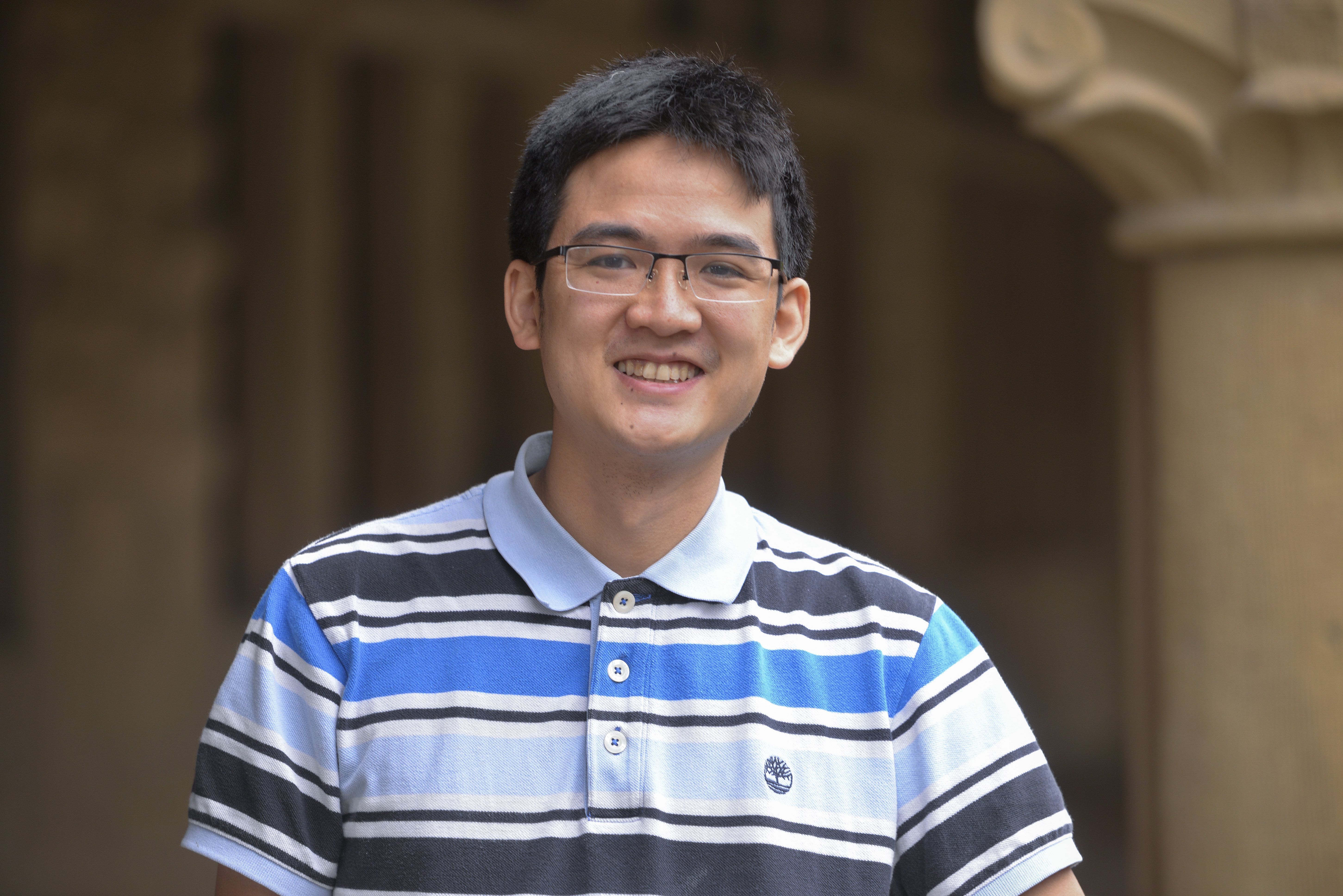
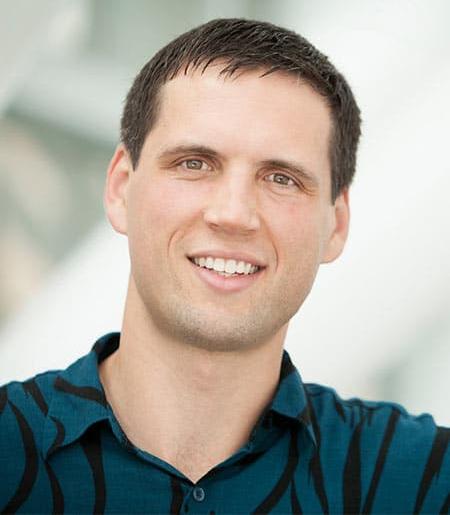
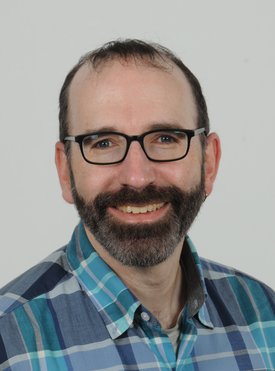
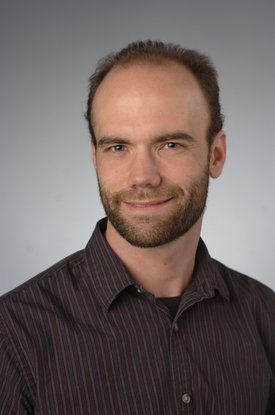
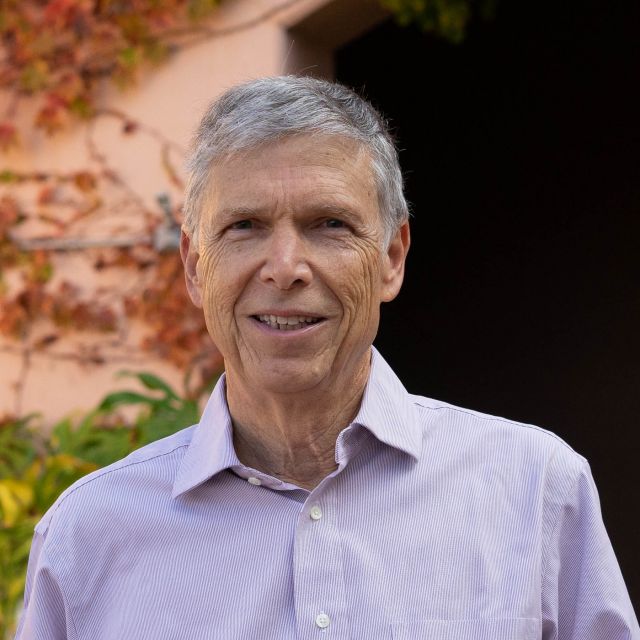
Jonathan Winghong Luk is a Professor in the Department of Mathematics at Stanford University. His research focuses on nonlinear partial differential equations, general relativity, and mathematical physics, with a particular emphasis on gravitational wave dynamics, shock formation, and high-frequency spacetime solutions. Contact: Email: jluk@stanford.edu Office: 382-Z, Building 380, Stanford, CA 94305 Research Trends: His recent publications examine nonlinear wave equations on dynamic spacetimes, gravitational phase mixing, impulsive gravitational wave interactions, and stability of black hole interiors. He frequently collaborates with experts like C. Huneau, S.-J. Oh, and J. Speck. Academic Activities: Luk organizes the Analysis and PDE seminar at Stanford with Eugenia Malinnikova and Ryan Unger. He has developed lecture notes on nonlinear wave equations and Fourier analysis, complemented by example sheets.
Thomas Hartman is a Professor of Physics in the College of Arts and Sciences at Cornell University. He received his A.B. in Physics from Princeton University in 2004 and his Ph.D. in Physics from Harvard University in 2010. His professional journey includes being a Member of the School of Natural Sciences at the Institute for Advanced Study (2010-2013), Research Associate at the Kavli Institute for Theoretical Physics, UCSB (2013-2014), Assistant Professor at Cornell University (2014-2020), Associate Professor at Cornell University (2020-2022), and Professor at Cornell University (2022-present). Hartman's research focuses on theoretical aspects of quantum gravity and quantum field theory, with particular emphasis on black hole information and strongly interacting quantum fields. His work explores four major interconnected areas: gauge/gravity duality (examining how quantum field theory degrees of freedom organize into fluctuating spacetime), black hole information paradox (investigating the relationship between classical black hole solutions and quantum statistical systems), new approaches to quantum field theory using dualities and entanglement dynamics, and the physics of de Sitter space with implications for early universe cosmology. His research employs techniques from string theory, holographic duality, general relativity, and quantum information theory. Analysis of Hartman's publication record reveals a strong focus on resolving fundamental questions in quantum gravity, particularly through the development of replica wormhole techniques that address the black hole information paradox. His work spans both highly mathematical approaches to quantum gravity and connections to potentially observable phenomena, with increasing emphasis on connections between quantum information science and gravitational physics in recent years. Member, School of Natural Sciences, Institute for Advanced Study, 2010-2013 Hartman has advised graduate students including Jeevan Chandra Namburi and Wan Zhen Chua, contributing to the next generation of theoretical physicists. His research group actively investigates the emergence of spacetime from quantum information principles and develops new mathematical frameworks for understanding quantum gravity. The group maintains strong connections with other leading institutions through collaborative projects and participates in major theoretical physics initiatives including Snowmass planning for future research directions in high energy physics. Hartman's research program represents a vital bridge between abstract theoretical concepts in quantum gravity and potential experimental tests, working to develop frameworks that could ultimately connect quantum gravity to observable phenomena in both high-energy physics and cosmological observations.
Mark Trodden is the Dean of the School of Arts & Sciences and Thomas S. Gates Jr. Professor of Physics and Astronomy at the University of Pennsylvania. He previously served as the Fay R. and Eugene L. Langberg Professor of Physics, Department Chair, and Co-Director of the Center for Particle Cosmology. His career includes faculty roles at Syracuse University (2000–2009) and visiting positions at Case Western Reserve University and Cornell University. Ph.D. and M.Sc. in Physics, Brown University (1992–1995) Advanced Study in Mathematics, University of Cambridge (1990–1991) M.A. in Mathematics, University of Cambridge (1987–1990) Trodden’s research focuses on the intersection of cosmology and particle physics, addressing fundamental questions such as the nature of dark energy, dark matter, the baryon asymmetry of the universe, inflation, and modified gravity theories. His work explores how cosmological data can constrain physics beyond the Standard Model and general relativity. His publications span topics like dark energy models , inflationary spacetimes , topological defects , and BPS states in supersymmetric theories , reflecting his expertise in connecting high-energy physics to cosmological observations. At Penn, Trodden has held editorial roles for journals like Physics Letters B and Journal of Cosmology and Astroparticle Physics , and has contributed to collaborative workshops advancing cosmology and particle physics.
Elie During is an Associate Professor of Philosophy at the University of Paris Ouest – Nanterre and a seminar lecturer at the École Nationale Supérieure des Beaux-Arts de Paris. He is a junior member of the Institut Universitaire de France and affiliated with the Institut de Recherches Philosophiques (IREPH) in Nanterre. His research focuses on the intersection of metaphysics, science, and aesthetics, particularly exploring spacetime theory, Bergson’s philosophy, and the philosophy of contemporary art. During holds a PhD from the University of Paris Nanterre (2007) for his work on the philosophical reception of relativity theory. His academic career includes roles at Princeton University and the French Cultural Service in New York. He co-directs the “MétaphysiqueS” series at Presses Universitaires de France and contributes to Critique journal. His publications span philosophy, cinema, and science, including Bergson et Einstein: La Querelle du Temps (2012), Temps Flottants (2015), and collaborative works with thinkers like Alain Badiou and Bernard Stiegler. His work bridges philosophy with contemporary art, film, and scientific thought, emphasizing temporal ontology and interdisciplinary dialogue. Awards include membership in the Institut Universitaire de France. He is a project manager at the CIEPFC (École Normale Supérieure) and actively engages in curating academic and artistic projects.
Professor Jean Alexandre is a Professor of Physics at King's College London, affiliated with the Department of Physics within the Faculty of Natural, Mathematical & Engineering Sciences. His research focuses on non-perturbative quantum field theory, tunnelling phenomena, exact renormalization methods, and Lorentz symmetry violation. He has held positions including a Leverhulme Trust postdoc and temporary lectureship before his current role. Education: Doctor of Science in Theoretical Physics from University Louis Pasteur, Strasbourg (1998) Master of Physics in Theoretical Physics from École Normale Supérieure de Lyon (1994) Research Interests: Non-perturbative effects in QFT (dynamical mass generation, exact functional methods) Lorentz symmetry violation in particle physics and modified gravity Tunnelling mechanisms, cosmic bounce models, and null energy condition studies Non-Hermitian extensions of the Standard Model and PT-symmetric field theories Key contributions include work on magnetic monopole searches with the MoEDAL experiment at the LHC, finite volume effects in quantum field theory, and dynamical mass generation mechanisms. His recent articles explore topics like scalar high-electric-charge objects, vacuum decay rates, and cosmic bounce scenarios. He has supervised PhD theses on topics such as Lifshitz-type theories and gravitino condensation. Grants and Collaborations: Principal Investigator on Leverhulme Trust project 'Saving the Universe with finite volume effects in Quantum Field Theory' Co-Investigator on EPSRC and STFC-funded projects in particle physics and cosmology Labs/Teams: Active collaborator in the MoEDAL experiment and the Theoretical Particle Physics & Cosmology group at King's College London.
Prof. Dr. Jens Eisert is a Professor at the Free University of Berlin, where he leads the Quantum Many-Body Theory, Quantum Information Theory, and Quantum Optics research group (Eisert AG) within the Institute of Theoretical Physics at the Dahlem Center for Complex Quantum Systems. His office is located at Arnimallee 14, Room 1.3.06 in Berlin-Dahlem. His research focuses on the intersection of quantum information theory and condensed matter physics, specifically exploring what information processing tasks are possible using individual quantum systems as information carriers. His group develops mathematical-theoretical foundations of quantum information, particularly in entanglement theory and tomography, while also investigating quantum optical implementations using light modes or cold atoms in optical lattices. A major emphasis of their work is on quantum many-body systems, including static properties, efficient numerical simulation methods like tensor networks, and non-equilibrium quantum dynamics. Recent publications highlight significant contributions in thermalization of quantum systems (Communications Physics 2025), quantum thermodynamics (Nature Physics 2025), and quantum error correction (PRX Quantum 2025). The group's work is characterized by combining the rigor of mathematical physics with physically motivated applicability, frequently leading to direct collaborations with experimental groups. Quantum Information Theory Quantum Many-Body Theory Quantum Optics Entanglement Theory Tensor Networks Quantum Error Correction Prof. Eisert maintains active supervision of numerous PhD students and postdoctoral researchers, with research positions regularly available in areas including quantum error correction, quantum information theory, tensor networks, and quantum simulation. His group has published extensively in top journals including Nature Physics, PRX Quantum, and Physical Review series.
Wayne Myrvold is a Professor in the Department of Philosophy at Western University, Faculty of Arts and Humanities. His research lies at the intersection of philosophy of physics and philosophy of science, with a focus on quantum mechanics, statistical mechanics, and the foundations of probability. His primary research interests include: Philosophy of Physics, especially quantum mechanics and relativity Foundations of probability and its role in science Statistical mechanics and thermodynamics Quantum state realism and ontology Unification and scientific explanation Epistemology of scientific inference Myrvold's recent publications, including his 2021 book Beyond Chance and Credence , explore hybrid conceptions of probability that bridge epistemic and physical interpretations. His articles span topics such as quantum collapse theories, Bell’s Theorem, and the nature of the wavefunction, reflecting a deep engagement with both technical and philosophical dimensions of modern physics. His work frequently appears in leading journals like Studies in History and Philosophy of Modern Physics , Physical Review A , and Synthese . He is the Subject Editor for Quantum Mechanics in the Stanford Encyclopedia of Philosophy and has co-authored key entries, including the comprehensive overview of Bell’s Theorem. His scholarly contributions emphasize rigorous analysis of foundational concepts in physics and their philosophical implications. Myrvold holds a BSc from McGill University and a PhD from Boston University. He maintains an active research profile with a continually updated list of publications available via Google Scholar. He advises graduate students in philosophy of science and supervises research in foundational physics. While specific grant details are not listed, his sustained publication output suggests active research support. He is affiliated with the Rotman Institute of Philosophy, which supports interdisciplinary research in philosophy of science.
Alexander D Maloney serves as the Kathy and Stan Walters Endowed Professor of Quantum Science and Director of the Institute for Quantum and Information Science at Syracuse University's College of Arts and Sciences, Department of Physics. His leadership bridges theoretical physics and quantum information science through institutional and research initiatives. His academic foundation includes a Ph.D. in Physics from Harvard University (2003) with dissertation "Time-Dependent Backgrounds of String Theory," complemented by dual B.Sc. and M.Sc. degrees in Physics and Mathematics from Stanford University (1998). Maloney's research centers on quantum gravity and information theory, exploring black hole physics through string theory frameworks. His work connects quantum field theory, cosmology, and information paradox resolution, with particular focus on wormhole geometries, resurgence phenomena, and holographic dualities. This interdisciplinary approach examines how quantum information principles shape spacetime structure. Recent publications reveal evolving emphasis on Narain ensemble statistics, modular invariance applications, and quantum cosmology in reduced dimensions. His 2020-2025 output demonstrates methodological progression from semiclassical gravity to non-perturbative quantum gravity techniques, increasingly integrating machine learning concepts with theoretical frameworks. His scientific recognition includes: James McGill Professor at McGill University (2023) Sir William Macdonald Chair in Physics at McGill University (2020) Maloney secures major research funding including NSERC Discovery Grants (2015-2020, 2020-2025) and Simons Foundation's "It from Qubit" collaboration (2015-2022). He actively shapes academic discourse through search committee leadership, journal reviewing (Journal of High Energy Physics since 2007), and international conference organization at Aspen Center for Physics and Institute for Advanced Study. As Director of Syracuse's Institute for Quantum and Information Science, he cultivates collaborative research environments exploring quantum gravity applications to quantum computing and cosmological modeling.
Dr. K.F.J. Salimkhani (Kian) is an Assistant Professor at the Institute for Science in Society, Radboud University. His research focuses on metaphysical and foundational questions in physics, including spacetime philosophy, quantum gravity, and fundamentality. He also explores ethical dimensions of collective harm, such as climate crisis implications. Previously, he held a postdoc at the University of Cologne and was a visiting scholar at the University of Oslo. Salimkhani earned his PhD in Philosophy from the University of Bonn in 2020. Education: PhD in Philosophy, University of Bonn (2020) Studies in Physics and Philosophy, University of Bonn Research Interests: Salimkhani investigates fundamentality in physics and metaphysics, spacetime emergence, and the interplay between physics and metaphysics. His current DFG-funded project examines concepts of fundamentality across disciplines. Key areas include: Philosophy of quantum gravity Emergence and dependency relations Climate crisis ethics Unification in physics Grants & Projects: DFG Project: ‘Fundamentality in Physics and Metaphysics’ (2023–2026, PI) Co-organizer of ‘Quarterly Lectures on Philosophy of Science’ and ‘Weekend Seminars on the Philosophy of Physics’ Teaching: Courses include Philosophy of Mathematics, Physics and Philosophy, and supervision of bachelor/master theses in Mathematics and Physics. Labs/Teams: Active in the Radboud Centre for Natural Philosophy (RCNP) and the DFG-funded ‘Inductive Metaphysics’ research unit.
Jay Hubisz is a Professor of Physics at Syracuse University's College of Arts and Sciences. He holds a Ph.D. in Theoretical Particle Physics from Cornell University (2006) and a B.S. in Physics from the California Institute of Technology (2001). His research focuses on Physics Beyond the Standard Model, Quantum Field Theory, Cosmology/Astrophysics, and Quantum Information Science. Recent work explores cosmological quasiparticles, holographic phase transitions, and quantum algorithms for lattice field theory. Hubisz has led major grants including a decade-long Department of Energy grant on Theoretical Particle Physics and Cosmology (2013-2025). He teaches advanced courses like Quantum Computing Demystified and serves as Director of Undergraduate Studies in Physics. Awards include the 2024 Undergraduate Majors Teaching Award. He chairs the Joint CAS|MAX Faculty Council and contributes to curriculum development, faculty mentoring, and physics outreach initiatives.
Léo Bigorgne is a CNRS Research Fellow (Chargé de recherche CNRS) at the University of Rennes 1, affiliated with the Rennes Institute of Mathematical Research (IRMAR). He works within the Partial Differential Equations team of the IRMAR laboratory, focusing on mathematical problems arising from plasma physics and general relativity. Dr. Bigorgne's research primarily centers on the asymptotic analysis of equations from plasma physics and general relativity. His work extensively investigates the Vlasov-Maxwell and Vlasov-Poisson systems, with particular focus on: Asymptotic behavior and decay estimates of solutions Scattering theory for kinetic equations Global existence results for small data solutions Mathematical analysis of Vlasov equations in curved spacetimes Applications to plasma physics and gravitational physics His publication record demonstrates consistent contributions to top mathematical physics journals including Communications in Mathematical Physics, Annales Henri Poincaré, and SIAM Journal on Mathematical Analysis. Dr. Bigorgne frequently collaborates with international researchers, particularly with members of the Velozo Ruiz family on various aspects of Vlasov equations. Dr. Bigorgne maintains an active research program with publications spanning from 2017 to projected 2025, indicating ongoing significant contributions to mathematical physics. His work bridges pure mathematics with applications in theoretical physics, particularly in understanding the mathematical foundations of plasma dynamics and gravitational physics.
Pedro Vieira is a Portuguese theoretical physicist affiliated with the Perimeter Institute and ICTP-SAIFR . He specializes in mathematical physics , quantum field theory , and quantum gravity , with a focus on AdS/CFT correspondence and integrability . His groundbreaking work includes the exact solution for the spectrum of planar N=4 Super Yang-Mills theory and advancements in finite coupling proposals for polygonal Wilson loops and three-point functions. His research has established critical connections between quantum field theory and string theory, particularly in analyzing non-perturbative effects in supersymmetric systems. Key contributions involve Bethe ansatz techniques, flux tube S-matrices, and mathematical structures underlying integrability. Pedro Vieira has received numerous prestigious awards, including: Sloan Fellowship (2015) Gribov Medal (2015) Raymond and Beverly Sackler International Prize in Physics (2018) New Horizons in Physics Prize (2020) The articles in his bibliography highlight trends in quantum field theory, particularly in supersymmetric Yang-Mills theories , non-perturbative methods , and finite coupling phenomena , reflecting his expertise in mathematical structures of theoretical physics.
Gary Horowitz is a distinguished Professor of Physics at the University of California Santa Barbara, with a research career spanning over four decades. He holds appointments in the Department of Physics at UCSB and maintains an active research program in theoretical gravitational physics. Horowitz's research interests focus on both classical and quantum aspects of gravitational physics, particularly gravity under extreme conditions including the big bang in cosmology and spacetime inside black holes. His work centers on understanding spacetime singularities through string theory, examining black holes in higher dimensions, quantum properties of black holes, and quantum descriptions of singularities. He has made significant contributions to the application of gauge/gravity duality to understand quantum gravity and aspects of particle physics. His scholarly work shows consistent focus on theoretical foundations of gravity, with publications spanning from foundational work in the 1990s through recent contributions to the field. His research trajectory demonstrates deep engagement with the most challenging problems in gravitational physics. Scientific Recognition: Elected Member of the National Academy of Sciences (2010) Elected Member of the American Academy of Arts and Sciences (2013) Horowitz has held significant leadership positions including President of the International Society on General Relativity and Gravitation (2013-2016), head of the Astrophysics, Gravity, and Cosmology panel at the National Academy of Sciences (2014-2017), and chair of the Division of Gravitational Physics at the American Physical Society (2019-2020). His work continues to influence both theoretical physics and cosmology through innovative applications of string theory to gravitational phenomena.
Daniel Monclair is a Senior Lecturer at Université Paris-Saclay , affiliated with the Orsay Mathematics Laboratory and the Topology and Dynamics Team . His work bridges Differential Geometry and Dynamical Systems , focusing on group actions, pseudo-Riemannian geometry, and Anosov representations. Education: PhD in Mathematics (2014, ENS de Lyon), HDR (2025, Paris-Saclay University). Research interests include Lorentzian geometry , convergence groups , isometric actions , and Anosov representations . His recent articles analyze pseudo-Riemannian hyperbolic geometry, anti-de Sitter manifolds, and geometric structures for Anosov groups. Key themes: spectral analysis of Lorentzian manifolds, regularity of limit sets, and dynamics of spacetime attractors. Email: daniel.monclair@universite-paris-saclay.fr Orsay Institute of Mathematics, Building 307, Office 2M22 F-91405 Orsay Cedex, France
Arkady Plotnitsky is a Distinguished Professor in the Department of English at Purdue University, affiliated with the School of Interdisciplinary Studies (SIS), where he also serves as Director of Theory and Cultural Studies. His work bridges literature, philosophy, and science, positioning him as a leading figure in interdisciplinary humanities. Research Interests: His scholarship spans critical and cultural theory, continental philosophy, Romanticism, modernism and postmodernism, and the philosophical foundations of science and mathematics. He explores how literary and philosophical modes of thought interact with scientific paradigms, especially in quantum theory and non-classical logics. The analysis of his recent publications reveals a sustained engagement with the intersections of philosophy and theoretical physics, particularly quantum mechanics and relativity, as well as deep inquiries into the works of thinkers like Deleuze, Derrida, Riemann, and Kant. His work often examines non-classical epistemologies, the limits of representation, and the role of imagination in scientific discovery. Scientific Awards: No awards explicitly listed in the provided text. Advising and Grants: While no formal list of advisees or grants is mentioned, Plotnitsky has supervised numerous scholarly projects through his editorial work and leadership in theory and cultural studies. His extensive publication record and editorial roles suggest significant mentorship and research leadership. Labs and Research Teams: He leads the Theory and Cultural Studies initiative within SIS, fostering interdisciplinary dialogue among humanities and science scholars. His work cultivates collaborative intellectual spaces focused on the philosophical dimensions of scientific and literary thought.