Dmitri Strukov is a Professor at the University of California, Santa Barbara in the Department of Electrical and Computer Engineering. His work spans material science, electrical engineering, and computer science, focusing on novel computing paradigms using emerging memory devices. Education: PhD in Electrical and Computer Engineering from SUNY Stony Brook, MS in Applied Physics and Mathematics from Moscow Institute of Physics and Technology. Research Interests include neuromorphic computing , non-volatile memory applications , and mixed-signal circuits for machine learning and hardware security. His group develops memristive crossbar arrays and 3D NAND flash for energy-efficient systems. Scientific Leadership features Fellow of IEEE and Distinguished Lecturer roles. His work has been recognized with best paper awards at ASPLOS’19 and Computing Frontiers’13. Students: Mentored PhD graduates in neurocomputing, security, and memristor design including Z. Fahimi, S. Larimian, M.R. Mahmoodi, and X. Guo. Grants: Funded by AFOSR, ARO, DARPA, NSF, and industry leaders like Google and Samsung. Labs: Utilizes UCSB’s nanofabrication center and advanced tools for memristor characterization.
Martin Z. Bazant is the E. G. Roos (1944) Professor of Chemical Engineering and Professor of Mathematics at the Massachusetts Institute of Technology (MIT), holding the Digital Learning Officer role in the Department of Chemical Engineering. His research focuses on mathematical modeling of electrochemical systems, transport phenomena, and applied mathematics, with significant contributions to battery technology and electrochemical energy storage. He is affiliated with MIT’s Department of Mathematics and the MIT Energy Initiative (MITEI), leading initiatives like the Center for Battery Sustainability and D3BATT. Education: Ph.D. from Harvard University (1997), M.S. and B.S. from the University of Arizona (1993, 1992). His work bridges theory and application, addressing challenges in lithium-ion batteries, solid-state systems, and electrolyte dynamics. Notable achievements include pioneering studies on coupled ion-electron transfer mechanisms and phase separation in battery materials. He is an elected member of the National Academy of Engineering (2025) and a Fellow of the Electrochemical Society (2023). As an educator, he develops MOOCs on transport phenomena and contributes to digital learning initiatives. His research group explores advanced battery diagnostics, machine learning for materials science, and environmental applications of electrochemical processes. Key collaborations include startups like Lithios, Inc., and leadership roles in professional societies such as the International Electrokinetics Society.
Beatriz Noheda is a Full Professor of Functional Nanomaterials at the University of Groningen's Faculty of Science and Engineering, where she chairs the Solid State Materials for Electronics group at the Zernike Institute for Advanced Materials. She also serves as the founding Director of the Groningen Cognitive Systems and Materials center (CogniGron). Her academic journey began with a PhD in Physics from the Autonomous University of Madrid in 1996, followed by research positions at Brookhaven National Laboratory and various European institutions before joining Groningen through the prestigious Rosalind Franklin Fellowship program in 2004. Her research interests span the physics of functional materials with particular emphasis on ferroelectric, piezoelectric, and multiferroic thin films . She investigates the relationship between structure and functionality, focusing on nano-domain control through strain engineering and the unique properties of domain walls. Her work bridges fundamental physics with two promising application areas: piezoelectric energy harvesting for low-power electronics and the development of novel materials for neuromorphic computing . This dual focus reflects her vision of enabling the next technological revolution through materials science. Noheda's publication record shows a clear evolution from fundamental structural studies of ferroelectric materials toward cutting-edge research in hafnia-based ferroelectrics and neuromorphic computing materials. Her most recent work focuses on oxygen migration in hafnium-zirconium oxide systems, metal-insulator transitions in nickelates, and the development of novel ferroelectric phases suitable for next-generation electronic devices. These publications demonstrate her leadership in advancing the field from basic understanding toward practical applications in memory devices and cognitive computing systems. Fellow of the American Physical Society (2011) - awarded for fundamental structural studies of new phases in perovskite-type ferroelectric materials and domain nanostructures IEEE Robert E. Newnham Ferroelectrics Award (2020) - for outstanding contributions to understanding giant piezoelectricity in lead zirconate titanate Member of the Netherlands Academy of Technology and Innovation (AcTI) (2022) Elected Senior member IEEE (2021) Rosalind Franklin Fellowship (2004) - enabling her successful academic career in Groningen Noheda has secured substantial research funding throughout her career, including a Rosalind Franklin Fellowship (2004-2009), VIDI-NWO Fellowship (2004-2008), TOP-NWO project on Functional Nanowalls (2007-2012), multiple Zernike Institute Dieptestrategie grants, and a significant TOP-PUNT grant (2016-2021). She has supervised numerous students and early-career researchers, contributing to the development of the next generation of materials scientists. Her leadership extends to editorial roles on prestigious journals including Science, Physical Review Applied, and npj Quantum Materials. As Director of CogniGron, Noheda leads an interdisciplinary center focused on developing materials and systems for cognitive computing. Her team combines expertise in functional oxides, nanoelectronics, and neuromorphic engineering to create novel computing paradigms inspired by the human brain. The center represents a strategic initiative at the University of Groningen to position itself at the forefront of cognitive systems research.
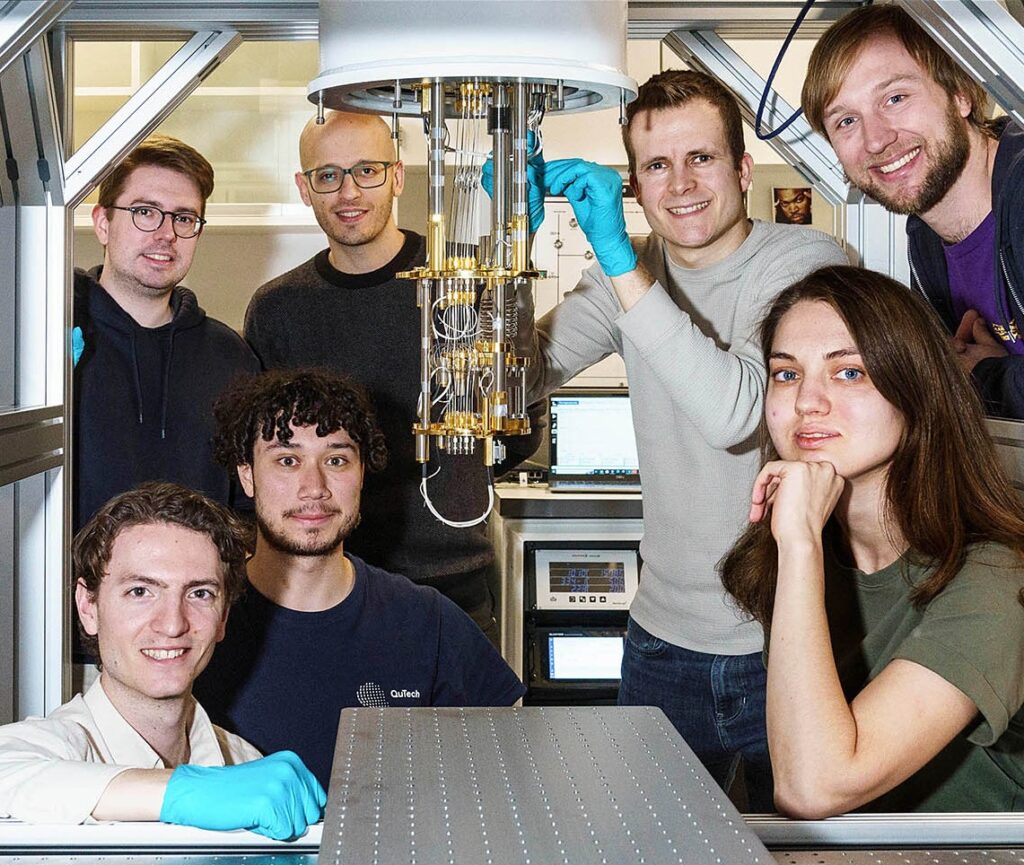
Carlos Errando Herranz serves as an Assistant Professor in the Quantum and Computer Engineering Division at Delft University of Technology's Faculty of Electrical Engineering, Mathematics and Computer Science (EEMCS) and as a Principal Investigator at QuTech. His research focuses on developing scalable quantum photonic integrated circuits using semiconductor fabrication processes compatible with existing infrastructure for quantum internet applications. He received Bachelor's and Master's degrees from Universitat Politècnica de València (2013) and a PhD in Micro and Nanosystems from KTH Royal Institute of Technology (2018), followed by postdoctoral positions at KTH and MIT as a Marie Curie fellow. His lab investigates quantum photonics, integrated photonics, and color centers with emphasis on diamond tin-vacancy systems and silicon-based quantum emitters. Recent publications demonstrate strong expertise in tuning quantum emitters via strain engineering, heterogeneous integration of spin-photon interfaces, and MEMS-enabled reconfigurable photonics. Key advancements include cavity-enhanced quantum memories, superconducting detector integration, and spectral control of solid-state emitters for quantum networks. Dr. Herranz advises seven graduate students including PhD candidates Vicky Dominguez Tubio, Arjan Mejas, Matteo Pirro, Christian Primavera, Jan Riegelmeyer, and Elena Volkova, along with Master student Bram Zijlstra. His team comprises postdocs Lin Jin and Pat Laferriere, and interns Elsa Herranz Valiente and Ernest Staffetti Cruañas. The Errando Herranz Lab operates within QuTech's Quantum Internet Division at Delft University, maintaining specialized facilities for nanofabrication and optical characterization of quantum photonic devices. Current research directions include developing CMOS-compatible quantum memories operating at telecom wavelengths and scalable architectures for quantum repeaters.
John Davis is a Professor in the Department of Physics at the University of Alberta, Faculty of Science. He holds a PhD and MSc from Northwestern University and a Bachelor’s from Washington University. His research focuses on nanomechanics, superfluidity, and superconductivity, particularly in confined geometries and quantum properties of nanomechanical systems. His lab develops superfluid-based technologies for dark matter detection and precision measurement. He has held academic positions since 2010, including roles at the Canadian Institute for Advanced Research and postdoctoral training at the University of Alberta with Prof. Mark R. Freeman. Education: PhD in Physics (2008), Northwestern University MSc in Physics (2003), Northwestern University Bachelor’s in Physics with Honors (2001), Washington University Research Interests: Superfluid nanomechanical resonators Ultralow-temperature superfluid 3He Nanofluidic cavity quantum electrodynamics Quantum-limited torque magnetometry Applications in dark matter detection and gravitational wave sensing His recent work emphasizes magnomechanics and optomechanical transduction , integrating superfluid systems with quantum sensors. Articles highlight advancements in cryogenic devices, nonlinear dynamics, and hybrid quantum systems. Ongoing projects include the HElium-based Light Operated Superfluid (HELIOS) dark matter detector. Grants & Labs: His lab operates a cryogen-efficient low-temperature facility, focusing on microfluidic quantum fluid experiments. Collaborations involve advanced photonic crystal cavities and diamond-based optomechanical platforms.
Prof. Dr. Taner Akbay is a faculty member at Yeditepe University, Faculty of Engineering , Department of Materials Science and Nanotechnology Engineering. He has held academic positions at institutions including Kyushu University, Oita University, and Imperial College London. Education: PhD in Materials Engineering (1993, Imperial College London); Master’s (1989) and Bachelor’s (1986) degrees from Middle East Technical University. His research spans Materials Engineering , Metallurgy , and Solid Oxide Fuel Cells (SOFCs) , with a focus on oxide ion conductivity, laser surface treatment, and phase transformations. Recent work explores photocatalysis , anion intercalation , and CO2 reduction using computational and experimental approaches. Key article trends include SOFC optimization (2004–2009), strain effects on catalysts (2015–2020), and dual-carbon battery technology (2016–2020). His work bridges fundamental metallurgy and advanced energy materials . Scientific Awards: Postdoctoral Research Sponsorship Award (EPSRC, UK) JSPS Fellowship (Japan) Daiwa Adrian Prize (2016, UK) PhD Studentship at Imperial College (European Commission) He has supervised multiple PhD and Master’s theses, including projects on dual-carbon batteries , microwave absorption nanocomposites , and rare earth recovery . Administrative roles include Head of Department (2020–2021). Non-University Experience: Worked with Mitsubishi Materials Corporation (2001), Çolakoğlu Metalurji (2010), and National Research Council Canada (2009).
Julia R. Greer serves as the Ruben F. and Donna Mettler Professor of Materials Science, Mechanics and Medical Engineering at the California Institute of Technology (Caltech), where she also holds the position of Executive Officer for Applied Physics and Materials Science since 2025. She earned her B.S. from MIT (1997) and M.S./Ph.D. from Stanford University (2000/2005), joining Caltech as Assistant Professor in 2007, promoted to Professor in 2013, and appointed to her current named professorship in 2019. Her research spans mechanics of hierarchical architectures , nanomaterials , and additive manufacturing , with significant contributions to energy storage systems and biomedical materials . Key focus areas include nano-scale mechanical properties, in-situ deformation analysis, and development of novel fabrication techniques for micro-architected materials. Her group pioneered hydrogel infusion additive manufacturing for metals and multiphoton 3D lithography standards. Analysis of recent publications reveals strong emphasis on solid-state battery interfaces (2025), bioresorbable microrobots (2024), and AI-enabled material design (2024), demonstrating cross-disciplinary impact across energy, healthcare, and quantum technologies. Her work consistently bridges fundamental nanomechanics with practical applications in energy storage and medical devices. 2024 ASME Nadai Medal 2024 SES A.C. Eringen Medal Elected to National Academy of Sciences (2025) Fletcher Jones Foundation Director (2019-2025) Professor Greer has advised over 40 PhD students including Seola Lee (2025) and Wenxin Zhang (2025), with research funded by collaborations spanning MIT, UCSF, Purdue, and ETH Zurich. Her group maintains active projects in lightweight nanoarchitected materials for impact absorption, electroactive polymers for braille devices, and 3D interdigitated solid-state batteries. Current leadership includes Editor-in-Chief of the Journal of Applied Physics (2024-) and direction of Caltech's Materials Science department.
Richard D. Noble is a Research Professor in the Department of Chemistry at the University of Colorado Boulder. His research focuses on advanced membrane technologies for gas and liquid separations, with particular expertise in ionic liquids, liquid crystals, and the application of external fields for selective separations. He maintains an active laboratory in Cristol Chemistry (room 357) and collaborates extensively with Professor Doug Gin on many research projects. Noble received his BE and ME from Stevens Institute of Technology in 1968 and 1969 respectively, followed by a Ph.D. from the University of California, Davis in 1976. His educational background in engineering has provided a strong foundation for his research in chemical engineering and materials science. Professor Noble's research program centers on three interconnected areas. His primary focus is on ionic liquids for gas separations , where he evaluates various ionic liquids and complexation chemistry to tailor material properties to specific feed mixtures. He explores composite polymer/IL structures and incorporation of complexation chemistry and zeolites, and has developed specialized apparatus to measure gas solubility and diffusivity in ionic liquids. This work is conducted in collaboration with Professor Doug Gin. His second research thrust involves the use of external fields for selective separations . Noble studies how electric or light energy can enhance separation processes by changing binding affinity of complexing agents. His notable achievement is an electrochemical pump with no moving parts that produces pressures exceeding 20 atm, with applications in lab-on-a-chip and micro-scale devices. He also develops charged polymer structures for membrane separators with wide temperature and chemical stability. His third major area focuses on liquid crystals organized to form nanostructured polymer network films. These cross-linked stable films are evaluated for nanofiltration applications, particularly in water filtration including treatment of water from fracking operations. This work often intersects with his ionic liquids research, creating composite structures with potential applications in electrochemical pumps. Noble's publication record from 2017-2019 shows consistent focus on membrane technologies for separation processes, with increasing sophistication in membrane design incorporating ionic liquids, liquid crystals, and novel materials like pillar[5]arenes. His work demonstrates a clear trend toward addressing practical industrial challenges, particularly in natural gas purification (CO 2 /CH 4 separation) and environmental applications (treatment of fracking wastewater). His collaborations have produced high-impact work published in top journals including Nature Materials , Journal of Membrane Science , and Angewandte Chemie . Professor Noble has received numerous prestigious awards recognizing his contributions: AIChE Institute Service to Society Award (2005) Alfred T. and Betty E. Look Professor of Chemical Engineering (2005-present) Multiple Outstanding Graduate Teaching Awards from the Chemical Engineering Department (2006-2008) ACS Industrial & Engineering Chemistry Division Fellow (2007) CU Boulder Inventor of the Year (2008) Barrer Lecture at Penn State University (2008) Fellow at the Renewable and Sustainable Energy Institute (2009-2012) Robert L. Stearns Award from CU Alumni Association (2010) Chair d'Excellence Pierre de Fermat at Paul Sabatier University, Toulouse (2010) AIChE Institute Excellence in Industrial Gas Technology Award (2010) And numerous others through 2015 While specific grant details aren't provided, Noble's extensive publication record with multiple co-authors suggests active research mentoring and well-funded projects. His work on sophisticated apparatus and high-quality publications indicates substantial research support. His collaborations, especially with Doug Gin, suggest a strong research group environment focused on membrane science and separation technologies. Professor Noble's research operates at the intersection of chemistry, chemical engineering, and materials science. His laboratory includes facilities for membrane fabrication, gas separation testing, and characterization of novel materials. The development of specialized apparatus for measuring gas properties in ionic liquids suggests dedicated equipment for fundamental property measurements. His work on electrochemical pumps indicates capabilities in microfluidics and device fabrication, with the collaborative nature of his research suggesting a team approach to tackling complex separation challenges.
Umut Aydemir is an Associate Professor at the Department of Chemistry, Koç University , where he also serves as Director of KUBAM (Koç University Boron Application and Research Center) . His research focuses on Boron-Based High-Tech Materials, 2D Materials, Electrocatalysis, Thermoelectric Energy Harvesting , and Hydrogen Storage . PhD in Chemistry (2012), Dresden University of Technology MSc in Materials Science and Engineering (2006), Koç University BSc in Chemistry and Physics (2004), Koç University Umut’s work addresses structure-property relationships in advanced materials, with a particular emphasis on boron-containing compounds , MXenes , and thermoelectric systems . His recent publications highlight innovations in electrocatalytic water splitting , hydrogen storage materials , and sustainable coating technologies . His research trends include: Development of metal diborides for water splitting Engineering MXene/polymer composites for corrosion resistance Novel approaches to thermoelectric materials like MgAgSb and Zintl phases Designing hydrogenated borophene for environmental applications Awarded the 2024 Koç University College of Science Outstanding Faculty Award and 2019 TÜBA Young Scientist Award , Umut leads high-impact projects in materials science. He advises graduate students in Nanocatalysis and Advanced Material Synthesis and contributes to interdisciplinary initiatives at KUBAM.
Prof. Baker Mohammad serves as Professor and Director of the System on Chip Lab in the Department of Computer and Information Engineering at Khalifa University. With over 15 years of industrial experience at Intel and Qualcomm designing microprocessors and DSP chips, he bridges academic research with real-world engineering challenges in high-performance computing and low-power systems. His educational background includes: Ph.D. in Electrical and Computer Engineering, University of Texas at Austin (2008) M.S. in Electrical and Computer Engineering, Arizona State University B.S. in Electrical Engineering, University of New Mexico Dr. Mohammad's research spans cutting-edge domains where VLSI design converges with AI acceleration and emerging memory technologies . His work pioneers Memristor applications in environmental sensing (radiation, vacuum, glucose) and neuromorphic computing, while advancing energy harvesting systems for wearable electronics. The integration of in-memory computing with security primitives represents a paradigm shift in hardware design, moving beyond traditional CMOS limitations. His publication trajectory reveals accelerating focus on self-powered neuromorphic systems and RRAM-based architectures, with recent work (2021-2023) emphasizing hardware-software co-design for edge AI. Over 75% of his recent publications involve cross-disciplinary collaborations spanning materials science, chemistry, and biomedical engineering. Notable scientific recognition includes: IEEE TVLSI Best Paper Award 2016 IEEE MWSCAS Myrill B. Reed Best Paper Award Qualcomm Qstar Award for Performance Leadership KUSTAR IP Excellence Award Multiple SRC Techon Best Session Papers As a dedicated mentor, he has supervised over 15 graduate students while securing competitive funding from Khalifa University, ADEK, Qualcomm, Tii, and UAE space agencies. His grant portfolio demonstrates exceptional translational impact, converting fundamental research in memristive devices into drone flight computers and medical sensors. Current projects integrate academic rigor with industrial deployment timelines. The System on Chip Lab operates as a multidisciplinary hub where semiconductor physicists collaborate with AI researchers to develop RISC-V-based secure processors and piezoelectric nanogenerator systems. Recent expansions include partnerships with Tii for aerospace applications and medical device startups for glucose monitoring technology.
Assoc Prof Ng Teng Yong is an Associate Professor at the School of Mechanical & Aerospace Engineering (NTU), specializing in numerical modeling and simulation. With a background as Research Manager at A*STAR Institute of High Performance Computing, his work spans materials science, nanotechnology, and aerospace engineering. Current focus on graphene-based desalination membranes Expertise in molecular dynamics simulations Investigates nanoscale fluid mechanics and structural dynamics Recent publications highlight advancements in energy-efficient electrodialysis, smart robotics, and nonlinear vibration analysis. His interdisciplinary approach integrates computational methods with experimental validation in additive manufacturing and soft material mechanics.
H.-S. Philip Wong is the Willard R. and Inez Kerr Bell Professor in the School of Engineering at Stanford University, where he has been since 2004. He holds the rank of Professor in the Department of Electrical Engineering and serves as the Director of the Stanford Nanofabrication Facility. Prior to Stanford, he spent 16 years at IBM’s T.J. Watson Research Center and served as Vice President of Corporate Research at TSMC (2018–2020), remaining as Chief Scientist in an advisory role thereafter. Leadership roles include founding the Stanford SystemX Alliance and leading the Microelectronics Commons AI Hardware Hub funded by the CHIPS Act. Research focuses on nanotechnology, semiconductor devices, and next-generation computing architectures, including carbon nanotube electronics, 3D integration (N3XT/MOSAIC), and neuromorphic computing. Awarded IEEE Fellow (2001), the IEEE Andrew S. Grove Award, and the J.J. Ebers Award for contributions to electron devices. His work spans device physics, fabrication, and system integration, with over 600 publications. Key contributions include advancements in phase-change memory, carbon nanotube transistors, and compute-in-memory systems. He advises numerous students and collaborates with industry through initiatives like the Stanford Non-Volatile Memory Technology Research Initiative. Recent efforts emphasize AI hardware acceleration, cryo-CMOS for quantum computing, and scalable memory architectures. His lab innovations include CellChips for synthetic biology and hyperdimensional computing using 3D RRAM.
Prof. Dr. Markus Zimmermann leads the Chair of Product Development and Lightweight Design at the Technical University of Munich (TUM). With a background in mechanical engineering from TU Berlin and the University of Michigan, and a doctorate from MIT on solid-state singularities, he bridges academic rigor with industrial application. His career spans 12 years at BMW focusing on vehicle development before transitioning to academia. Specializes in solution space engineering for robust design Expert in additive manufacturing and systems engineering Develops methodologies for managing design complexity and uncertainty His research focuses on multidisciplinary design optimization and lightweight structures , particularly in robotics and automotive systems . His team applies digital twin frameworks and attribute dependency graphs to enhance design processes. Recent publications emphasize topology optimization in robotic systems and thermal management for medical X-ray sources. Key trends in his 2024-2025 publications include: Topological optimization for additive manufacturing and robotics Application of solution spaces to manage design uncertainty Development of compact X-ray systems for medical therapy Integration of digital twin technologies in industrial contexts
R. Edwin García is a Professor at the School of Materials Engineering at Purdue University, where he has been faculty since 2005. He holds appointments in the Materials Engineering department within Purdue's College of Engineering, specifically in the School of Materials Engineering located in the Neil Armstrong Hall of Engineering at Purdue's West Lafayette campus. His educational background includes: B.S. in Physics from the National University of Mexico (1996) M.S. in Materials Science and Engineering from Massachusetts Institute of Technology (2000) Ph.D. in Materials Science and Engineering with a minor in Applied Mathematics from Massachusetts Institute of Technology (2003) Professor García's research focuses on the design of materials and devices through the development of a fundamental understanding of the solid state physics of individual phases, their short and long range interactions, and associated microstructural properties and time evolution. His current research emphasizes establishing relationships between material properties and resultant performance and degradation in electrochemical systems. He integrates computational approaches ranging from kinetic Monte Carlo, phase field and level set methods, to finite elements, finite volumes, and symbolic computing. His work particularly addresses microstructure design, crystallographic texture, and grain boundary science and engineering to control the topology of underlying phases and establish practical relations between processing, microstructure, and material properties. His recent publications demonstrate a strong focus on lithium-ion battery technology, ferroelectric materials, and computational modeling of material behaviors. The research trends show increasing integration of machine learning with traditional computational methods, exploration of novel sintering techniques like flash sintering, and deeper investigation into the fundamental mechanisms of material degradation in energy storage systems. His work spans multiple length scales from atomistic to continuum modeling, reflecting a comprehensive approach to materials design and analysis. Professor García teaches several courses including MSE 230 (Structure and Properties of Materials), MSE 350 (Thermodynamics of Materials), MSE 597G (Modeling and Simulation of Materials), MSE 597I (Introduction to Computational Materials), and MSE 597N (Physical Properties of Crystals). He mentors graduate students in areas related to computational materials science, battery technology, and microstructural evolution. His research group, the Laboratory of Computational Microstructures, focuses on developing home-grown analytical theories and algorithms to resolve relevant time and length scales in materials systems. The group's work has significant implications for portable power sources, including rechargeable batteries and fuel cells, as well as for ferroelectric ceramic applications.
Professor Shubhra Pasayat is affiliated with the Department of Electrical and Computer Engineering and Materials Science & Engineering at the University of Wisconsin-Madison. She holds a PhD (2021) and MS (2017) from University of California, Santa Barbara, and a B.Tech (2013) from Indian Institute of Technology Kharagpur. Research focus: MOCVD growth of III-nitrides/oxides for optoelectronics, power electronics, quantum materials, and bio-photonics Key applications: LEDs, LASERs, HEMTs, bio-photonics, and sanitization technologies Her research interests center on wide bandgap semiconductor materials, particularly group-III nitrides and oxides. She works on strain relaxation techniques using porous GaN substrates, quantum dot engineering for visible light emission, and high-voltage GaN HEMT development. Current projects include lattice engineering for improved crystal quality and thermal management in RF devices. Publications highlight advancements in ultraviolet lasers, high-electron-mobility transistors, and micro-LEDs. Her work spans fundamental material studies and device optimization for industrial applications like electric vehicles, 5G/6G communications, and horticultural lighting. 2024 Awards : NSF CAREER, ONR DEPSCoR, WARF Early Career Innovator 2022 Awards : UCSB ECE Outstanding Dissertation, JAP Best Paper She teaches ECE 235 Introduction to Solid State Electronics and mentors research at both graduate and undergraduate levels.