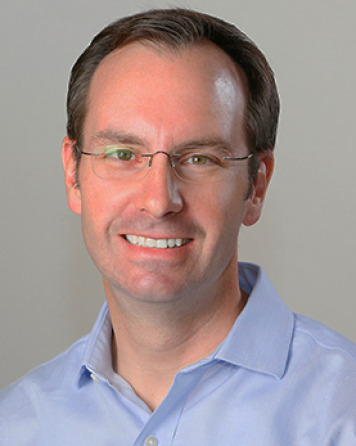
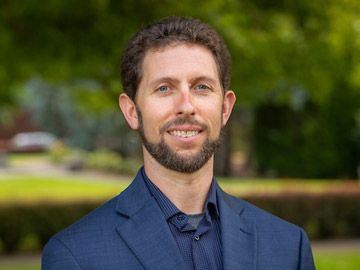
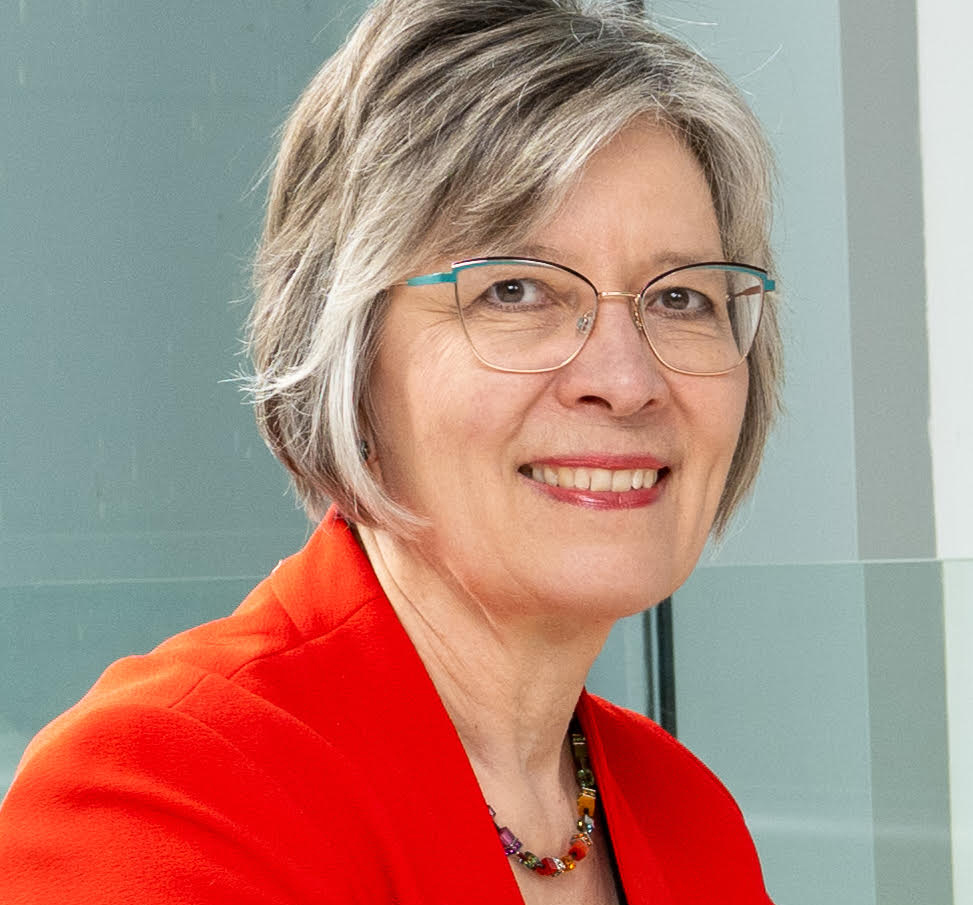
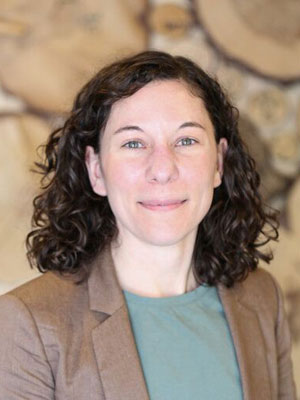
Christian Hoover is an Assistant Professor in the School of Sustainable Engineering and the Built Environment at Arizona State University, where he has been a faculty member since 2016. He specializes in structural and solid mechanics, fracture mechanics, and multi-scale material characterization. Ph.D. in Theoretical and Applied Mechanics (Northwestern University) M.S. and B.S. in Civil Engineering (New Jersey Institute of Technology) Postdoctoral research at Massachusetts Institute of Technology (2012-2016) His research focuses on understanding mechanical behavior of materials ranging from concrete structures to extraterrestrial regolith, with a particular emphasis on nanoindentation, fracture toughness, and impact dynamics. Recent work includes characterization of asteroid Bennu samples and mechanical effects in meteorites. Notable achievements include the NSF CAREER Award (2022) for his work on metallic organic frameworks. He teaches courses in advanced mechanics of materials and concrete structures, alongside graduate research and dissertation guidance. Collaborative projects span planetary defense and sustainable construction materials.
Laura de la Torre Ramos is a full-time researcher at the University of Vigo , affiliated with the School of Aeronautical and Space Engineering and the Marine Research Center in Ourense Campus. Her work bridges Applied Physics and Earth Physics , focusing on stratospheric dynamics, troposphere-stratosphere coupling, and climate change impacts on atmospheric systems. Research Interests : Laura’s research centers on stratospheric contraction , atmospheric wave propagation , and climate change monitoring in the middle and upper atmosphere. She investigates phenomena like sudden stratospheric warmings, ozone trends, and solar cycle modulations, integrating climate intervention techniques and citizen co-creation in projects like the ODEÓN workshop. Publications highlight trends in stratospheric dynamics under climate change, renewable energy impacts in extreme climates (e.g., Atacama Desert), and validation of reanalysis data against satellite observations. Her work extends to photovoltaic resource modeling, convective cloud forecasting, and magnetosphere-atmosphere interactions. Labs & Collaborations : Laura contributes to the EphysLab research group and the Marine Research Center, fostering international collaborations (e.g., Brazil-Spain climate science projects). Her email is ltr@uvigo.es .
FuQing Huang is a researcher at the Chinese Academy of Sciences Key Laboratory of Geospace Environment and affiliated with the School of Earth and Space Sciences, University of Science and Technology of China . His work focuses on ionospheric dynamics during geomagnetic storms, particularly equatorial plasma bubbles (EPBs) and their responses to electric field variations, using satellite and ground-based observations. Affiliations Chinese Academy of Sciences Key Laboratory of Geospace Environment Mengcheng National Geophysical Observatory Chinese Academy of Sciences Center for Excellence in Comparative Planetology Research Interests Storm-time ionospheric irregularities Equatorial Spread F and Rayleigh-Taylor instability Role of prompt penetration and disturbance dynamo electric fields Daytime and nighttime plasma bubble generation mechanisms Magnetic latitude dependencies of EPB occurrences Key Contributions Analysis of EPB enhancement/suppression during the October 2016 geomagnetic storm Multi-instrument study combining Beidou GEO, Swarm satellite, and ionosonde data Investigation of sunrise EPBs triggered during storm main phase (unusual compared to recovery phase events) Observational evidence linking h’F variations to storm-induced electric field changes Grants National Natural Science Foundation of China (42004136) China Postdoctoral Science Foundation (2020T130628, 2019M662170) Fundamental Research Funds for the Central Universities (WK2080000130) Collaborations ESA Swarm satellite data analysis Chinese Meridian Project infrastructure International data networks (OMNIWeb, NASA CDDIS)
Professor Tom Zega is a faculty member at the University of Arizona’s Lunar and Planetary Laboratory, where he has served since 2011. He directs the Planetary Materials Research Group and holds a primary appointment as Professor, leading federally funded investigations into the origin and evolution of the Solar System’s earliest solids. Education: Ph.D. in Geological Sciences, 2003, Arizona State University Research Focus: Dr. Zega couples ultrahigh-resolution ion- and electron-microscopy with computational thermodynamics to decode the chemical and physical histories of planetary materials. His current work concentrates on: Refractory inclusions—the first solids to condense from the solar nebula Sulfides that record nebular and parent-body processes Samples returned by JAXA’s Hayabusa missions to asteroids Itokawa and Ryugu NASA’s OSIRIS-REx samples from asteroid Bennu Astrobiology, examining organic–mineral associations at the nanometer scale Research Trends: Across his 2019-2025 publications, a clear trajectory emerges from fundamental microanalytical method development (e.g., single-standard quantitative EDS) to high-impact studies of pristine astromaterials. The body of work integrates (1) laboratory shock and irradiation experiments, (2) coordinated isotope-microstructure analyses of presolar grains, and (3) comprehensive petrographic surveys of CI- and CM-like Ryugu samples. Collectively, these studies illuminate nebular fractionation, parent-body hydrothermal alteration, and space-weathering pathways. Scientific Awards & Honors: No named awards are listed in the supplied text. Grants & Leadership PI, NASA Laboratory Analysis of Returned Samples (LARS) – Atomic-scale Analysis of Hayabusa Samples PI, NASA PSEF – The Kuiper-Arizona Laboratory for Astromaterials Analysis PI (with Co-Is K. Muralidharan & V. R. Manga), NASA – Characterizing the Role of Solutes and Defects in Refractory Planetary Materials Co-I, NASA New Frontiers – OSIRIS-REx Mission Co-I, Moore Foundation – Next-generation NanoSIMS for Planetary Materials Laboratory & Team The Planetary Materials Research Group operates the Kuiper-Arizona Laboratory for Astromaterials Analysis, housing FIB-SEM, TEM, and NanoSIMS instrumentation. Current staff scientists include Dr. Jerry Chang and Dr. Ken Domanik; former postdocs Jacob Bernal, Shaofan Che, Pierre Haenecour, Prajkta Mane, and Pierre-Marie Zanetta continue to collaborate on joint publications.
Professor Krzysztof Murawski is affiliated with the Department of Theoretical Physics at the Faculty of Mathematics, Physics and Computer Science, University of Maria Curie-Skłodowska. His research focuses on solar physics, space weather, and numerical simulations of fluid media and hyperbolic differential equations. Research Interests: Solar chromosphere heating, plasma outflows, two-fluid plasma dynamics, Alfvén waves, magnetohydrodynamic instabilities, sunspot oscillations, and numerical methods for solving wave equations. Publications: Active contributor to journals like Astronomy & Astrophysics , Solar Physics , and Nature Astronomy , with recent work on impulsively generated waves, chromospheric heating, and transverse oscillations in sunspots. Collaborations: Works with international researchers such as Stefaan Poedts, Emilia Kilpua, and Tom Van Doorsselaere.
Assoc. Prof. Dr. Barış Baykan serves as Associate Professor and Deputy Head of Department in the Department of Public Administration at Yeditepe University's Faculty of Economics and Administrative Sciences. He teaches courses including Global Environmental Politics, Urban Sociology, and Social Movements while leading the Sociology Undergraduate Program and Sustainable Interior Studies Master's Program. PhD in Sociology (2012), University of Kent: 'Multilayered framing process in environmental movement: the anti-GM mobilization in Turkey' Master's in Political Science (2002), University of Paris Nanterre: 'Entre la démocratie et la tutelle : L'intervention militaire de 1960 en Turquie' B.A. in Public Administration (2001), Marmara University His research centers on environmental sociology, urban governance, and social movements with particular focus on climate politics, municipal activism, and framing processes in environmental movements. His work bridges theoretical sociology with practical policy analysis, examining how local governments implement environmental policies and how social movements adapt to global policy shifts. His scholarship reveals the complex interplay between civil society, state institutions, and environmental challenges in Turkey's unique geopolitical context. Analysis of his recent publications shows consistent focus on urban environmental governance, climate movement strategies, and Turkey's integration of EU environmental policies. His work demonstrates strong methodological diversity combining discourse analysis, case studies, and policy evaluation across Turkish and international contexts. Baykan actively supervises graduate students and participates in research projects including the TÜBİTAK-funded 'Role of NGOs in Environmental Protection and Policies in Turkey' (2011-2012) and the EU BASICC project 'Building Alternative Skills to Implement Creativities and Commons' (2023-present). He maintains active memberships in the Climate for 350 Association, Green Thought Association (serving on Board of Directors 2021-2023), and Sociology Association, demonstrating commitment to both academic and practical environmental engagement.
Evan Shenkin serves as an Assistant Professor at Linfield University, joining the faculty in 2022 with research spanning Indigenous sovereignty, environmental justice, and sustainable development paradigms. His interdisciplinary work bridges sociology, anthropology, and political ecology to address global socio-ecological crises. His academic foundation includes: B.A. in Anthropology from the University of Oregon M.A. in International Studies from the University of Oregon Ph.D. in Sociology from the University of Oregon Shenkin's research critically examines environmental racism, prison abolition, renewable energy transitions, and gender equity within Latin American contexts. He investigates how Indigenous communities in Bolivia's eastern lowlands resist extractive industries while advancing land sovereignty, and analyzes systemic barriers to sustainable development through frameworks like telehealth access during pandemics and sail cargo as fossil fuel alternatives. His scholarship consistently centers human rights and social justice within ecological crisis narratives. Analysis of his 2021-2023 publications reveals dominant engagement with United Nations Sustainable Development Goals (SDGs), particularly through university-led climate action, carceral state alternatives, and post-development theory. His work demonstrates methodological diversity across ethnographic studies of Bolivian land struggles, policy analyses of renewable energy integration, and feminist critiques of global health systems, consistently advocating for radical reimagining of sustainability beyond capitalist paradigms. No scientific awards are documented in available sources. His academic contributions include collaborative grant-funded research on Indigenous governance and fossil fuel divestment movements, though specific funding details remain undisclosed. While no formal laboratory structure is described, Shenkin's co-authored publications with scholars like V.C. Sánchez and L. Greer indicate active participation in transnational research collectives focused on environmental justice and sustainable transport innovation.
Sandro Manica is a Contract Professor at the Faculty of Law, University of Trento, specializing in Energy Law, Environmental Law, and Regional Autonomy. He has taught "Diritto dell’energia" and directed seminars on constitutional jurisprudence and energy market dynamics since 1998. His academic career includes a PhD in Comparative Constitutional and Administrative Law (2003) and legal certifications in bilingualism (1992) and a law degree summa cum laude (1996). PhD in Comparative Constitutional and Administrative Law (2003) Law Degree, University of Trento (1996) Bilingualism Certification (1992) Maturity Diploma, Giosuè Carducci Liceo (1991) His research focuses on Energy Law , Environmental Law , and Public Contracts , with emphasis on hydroelectric concessions, renewable energy markets, and urban green space liability. Recent publications analyze EU solar energy incentives, hydroelectric jurisdiction reforms, and energy sector mergers, reflecting a blend of Environmental Compliance and Competition Law . As a certified lawyer before the Court of Cassation, he advises provincial governments and public entities on energy infrastructure, urban planning, and public procurement. Notable projects include the "Manifattura – Green Innovation Factory" and FESR 1018 KlimaKit. He has organized seminars on wind energy, hydroelectric concessions, and natural gas market competition since 2001.
Dr. Samy Missoum is a Professor in the Department of Aerospace and Mechanical Engineering at the University of Arizona's College of Engineering. His academic career spans over two decades with continuous research and teaching contributions in multidisciplinary design optimization, reliability-based design, and computational mechanics. He has maintained an active teaching schedule offering graduate-level courses including Finite Element Methods, Design Optimization, and Advanced Finite Element Analysis through Fall 2025. Dr. Missoum's research focuses on Multidisciplinary Design Optimization, Reliability-Based Design Optimization, Finite Element Analysis, Probabilistic Design, Structural Dynamics, and Aeroelasticity. His work bridges theoretical developments with practical engineering applications, particularly in handling uncertainty in complex systems. He has pioneered approaches using Support Vector Machines for engineering design problems, especially for discontinuous responses and multiple failure modes. His research has significant applications in aerospace structures, mechanical systems, and renewable energy technologies. His recent publications (2022-2024) demonstrate a strong focus on reliability assessment of uncertain systems subjected to random vibrations, stochastic optimization of nonlinear energy sinks, and thermal optimization for concentrated solar power systems. His work employs sophisticated computational approaches including surrogate modeling, multi-fidelity methods, and advanced optimization techniques to address complex engineering problems with uncertainty. Dr. Missoum's scholarly achievements have been recognized through several awards including being named an Associate Fellow of the American Institute of Aeronautics and Astronautics (2017) and receiving the 'Most Helpful to Their College Education' award from AME Seniors (2014). He was also invited as a Professor at Ecole Centrale in Marseille, France during 2021. His research has been consistently supported by grants that enable his work on structural reliability, optimization under uncertainty, and multidisciplinary design. He maintains active collaborations with researchers both nationally and internationally, as evidenced by his co-authored publications with scholars from various institutions. Dr. Missoum leads the CODES Laboratory at the University of Arizona, which focuses on Computational Optimization and Design under uncertainty. The laboratory conducts research on reliability assessment, multidisciplinary design optimization, and development of novel computational methods for engineering design problems with complex constraints and uncertainties.
Ross Pallister serves as a Research Fellow at Northumbria University's School of Engineering Physics and Mathematics, specializing in solar and space physics with emphasis on particle acceleration mechanisms in the solar corona. His work integrates computational modeling and theoretical analysis to investigate high-energy phenomena in solar plasmas. He earned his PhD in Mathematics in 2021, with research focusing on the mathematical foundations of plasma dynamics. His academic trajectory demonstrates sustained engagement with solar physics through rigorous computational approaches. Dr. Pallister's research centers on unraveling acceleration processes for solar energetic particles (SEPs), particularly electrons and protons in coronal structures. Key investigations include turbulent coronal acceleration, current sheet dynamics, and spatially separated particle beams in coronal jets. His methodology combines magnetohydrodynamic (MHD) simulations with observational constraints to model particle transport and energization in solar flares and coronal mass ejections. This work contributes significantly to space weather prediction and understanding of heliospheric particle populations. Analysis of his 2019-2025 publications reveals consistent focus on electron-proton separation mechanisms, coronal null-point physics, and turbulent acceleration environments. The research demonstrates increasing sophistication in modeling complex plasma interactions, with recent work (2025) extending to turbulent coronal acceleration scenarios while maintaining core investigation of particle energization pathways. Collaborating with international researchers including N. Jeffrey, P. F. Wyper, and D. I. Pontin, Dr. Pallister contributes to major solar physics initiatives. His work appears in leading journals such as The Astrophysical Journal and Astronomy & Astrophysics , with growing citation impact (15 total Scopus citations as of the profile data). Current research directions indicate expanding investigation of turbulent acceleration environments and multi-particle transport phenomena in solar eruptive events.
Tuija Pulkkinen is the George R. Carignan Collegiate Professor of Climate and Space Sciences and Engineering at the University of Michigan. She leads the Pulkkinen Research Group, focusing on Sun-Earth interactions, space weather modeling, and auroral physics using advanced simulations and observational data. Her work bridges solar phenomena, magnetospheric dynamics, and technological impacts of space weather. Research interests span: Space Weather Modeling : Developing predictive frameworks for geomagnetic storms and solar wind impacts on Earth's magnetosphere. Auroral Physics : Investigating mechanisms behind transpolar arcs (e.g., Theta Aurora) and omega bands. Magnetospheric Energetics : Quantifying energy transfer via global simulations (e.g., SWMF) for real-time forecasting with NOAA. Her publications (2022–2025) reveal trends in magnetospheric substorms, solar wind coupling, and space weather uncertainty quantification. Recent articles emphasize simulation-driven insights into storm-time dynamics, auroral sources, and model validation against satellite data. No scientific awards are explicitly mentioned in the source text. She mentors PhD students and postdocs (e.g., Austin Brenner, Shannon Hill, Tim Keebler) and collaborates on NASA/NSF grants, including projects with NOAA's Space Weather Prediction Center. Her group also contributes to missions like SWIFT for heliospheric structure analysis. The Pulkkinen Research Group operates within the University of Michigan's Climate and Space department, utilizing the Space Weather Modeling Framework (SWMF) for geospace simulations. Collaborations extend to Aalto University, NASA Goddard, and international consortia studying ICMEs and magnetospheric eruptions.
Audrey Maheu is a full professor in the Department of Natural Sciences at the University of Quebec in Outaouais (UQO) and serves as Director of the Institute of Temperate Forest Sciences (ISFORT). With a strong background in water sciences, she leads the Ecohydrology Laboratory where she conducts research on forest-water interactions in the context of climate change. Dr. Maheu's research focuses on ecohydrology and environmental hydrology, specifically examining how water and energy flow through ecosystems and influence forest function. Her work includes measuring and modeling forest water balance, predicting water stress episodes, and studying the impacts of climate change on forest water availability. Recent projects investigate how American beech proliferation affects sugar maple responses to drought, how forest structure influences water dynamics, and how small dams alter stream thermal regimes. Her extensive publication record shows consistent research productivity with numerous high-impact articles in leading journals such as Frontiers in Forests and Global Change, Ecohydrology, and Journal of Environmental Management. Her work spans from fundamental hydrological processes to applied forest management questions, demonstrating the practical relevance of her research. Dr. Maheu supervises a diverse team of graduate students and postdoctoral researchers, currently serving as primary supervisor for three doctoral students and three Master's students, with additional co-supervision roles. Her lab has produced numerous successful graduates who have completed theses on topics ranging from microclimate in agroforestry systems to forest road infrastructure assessment. Her research program bridges hydrology, forest ecology, and climate science, addressing critical questions about how forests will respond to changing water availability. This interdisciplinary approach positions her work at the forefront of climate change adaptation research for temperate forest ecosystems.
David Wood is a Professor at the University of Calgary's Schulich School of Engineering, Department of Mechanical and Manufacturing Engineering, where he holds the Schulich Chair in Renewable Energy. His affiliations include directorship at the Wind Energy Institute of Canada, editorial roles for renewable energy journals, and memberships in research centers: CEERE, LTRAC, and CaPES. Previously, he was an academic at the University of Newcastle and researcher at NASA Ames. His research spans wind turbine aerodynamics, renewable energy integration, photovoltaic performance, and wind resource assessment. Recent work examines urban wind patterns, hydroturbine design, and solar array monitoring. Awards include the APEGA Environment Award (2015) and University of Calgary Peak Scholar (2015). Education : PhD in Aeronautical Engineering (Imperial College London), MEng and BEng in Mechanical Engineering (University of Sydney) Awards : Environment and Sustainability Award, APEGA (2015) Peak Scholar, University of Calgary (2015) Research Centers : CEERE, LTRAC, CaPES
Rami Vainio is a Professor of Space Physics at the University of Turku's Department of Physics and Astronomy, where he serves as head of the Space Research Laboratory (SRL). SRL conducts experimental, theoretical, and computational research on high-energy space phenomena, with focus areas including solar energetic particles (SEPs) and collisionless shocks. The laboratory maintains active collaborations with international research groups. Professor Vainio's research examines: SEP physics : Acceleration mechanisms during solar eruptions and transport through interplanetary space Collisionless shocks : Energy dissipation and particle acceleration in space plasmas Space weather impacts : Radiation risks to technology and humans in space He leads curriculum development for Space Physics and teaches courses including: Mathematical Methods in Physics II (BSc) Space Physics (BSc) Hydrodynamics and Hydromagnetics (MSc) Plasma Astrophysics (MSc) Under his direction, SRL develops particle detection instrumentation and simulation codes. Recent publications focus on SEP forecasting, shock wave analysis using Solar Orbiter data, and radio burst observations with LOFAR.
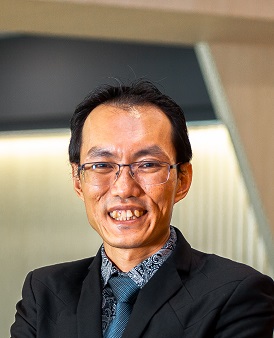
Dr. Chong Kok Hing serves as a Senior Lecturer in the Faculty of Engineering, Computing and Science at Swinburne University of Technology Sarawak campus. His academic credentials include a PhD in Mechanical Engineering from Universiti Malaysia Sarawak (UNIMAS), along with Bachelor of Engineering (Hons) and Master of Engineering degrees from the same institution. As a registered Professional Engineer with the Board of Engineers Malaysia and Chartered Engineer with the Institution of Mechanical Engineers (UK), he bridges academic theory with professional engineering practice. Dr. Chong's research program focuses on critical energy challenges, particularly in thermal fluids, renewable energy systems, biomass combustion technologies, and sustainable energy management. His work demonstrates strong regional relevance with emphasis on energy-efficient building solutions for Sarawak, as evidenced by his SRDC-funded project 'Towards Energy-Efficient Buildings in Sarawak.' His research integrates computational modeling with experimental validation across diverse applications from HVAC systems to biomass-to-energy conversion. The publication analysis reveals a consistent research trajectory with 11 publications between 2014-2021, primarily in mechanical engineering and energy journals. His work shows increasing focus on renewable energy applications, with 6 of his 11 publications appearing in 2021 alone. The research spans fundamental materials science (composites, fracture mechanics) to applied building services engineering (smoke control, ventilation systems), demonstrating both breadth and depth in mechanical engineering applications. Winner, Innovate Malaysia Design Competition (Shell Design Challenge) 2019 Success in Phase 3 Shell Eco-marathon Asia 2020, Malaysia Adobe Innovation Grant recipient 2021 Swinburne Sarawak Learning and Teaching Grant recipient 2020 Dr. Chong maintains active supervision of research students, with opportunities available in thermal fluids, renewable energy, and sustainable energy management. His research program is supported by multiple grants including the SRDC Catalyst Grant 2020, Adobe Innovation Grant 2021, and IEEE Humanitarian Activities Committee grant 2021, indicating strong funding support for his research directions. His professional memberships with IMechE, BEM, and ASHRAE provide valuable industry connections for student projects and research collaborations.