Andrew Hutchinson is a Researcher at the School of Electrical and Electronic Engineering, University of Sheffield, specializing in energy storage systems and grid resilience. His work focuses on optimizing power systems to reduce carbon emissions, enhance renewable energy integration, and improve grid stability through advanced storage technologies like flywheels and batteries. He holds a Research Associate position and has contributed to over 20 peer-reviewed articles since 2020. Research Interests: Energy Storage System Design & Control Grid Decarbonization Strategies Renewable Energy Integration Challenges Frequency Response Services Techno-Economic Analysis Grid Resilience Assessment Recent Work Trends: His articles emphasize hybrid storage systems, flywheel applications for ancillary services, and economic feasibility studies for energy storage deployment. He explores how storage technologies can mitigate export limitations in wind and solar sites while enhancing grid resilience against climate change impacts. Advising & Grants: No formal advisee records or grant details provided in the text. Labs/Teams: Affiliated with the School's energy storage research groups, collaborating on projects funded by UK energy networks and academic partnerships.
Dawn Dechand is an Associate Professor in the Department of Biosystems and Agricultural Engineering (BAE) at Michigan State University's College of Engineering. Her research focuses on leveraging plant-based ecological systems to address water quality challenges, particularly agricultural and urban runoff, wastewater treatment, and hazardous waste remediation. She specializes in wetlands, phytoremediation, and plant-microbe interactions to understand pollutant fate and mitigation strategies. Education: Ph.D. in Environmental Engineering, Georgia Institute of Technology (2007) B.S. in Biological and Agricultural Engineering and Natural Resources and Environmental Sciences, Kansas State University (2002) Research Interests: Phytoremediation of emerging pollutants and hazardous wastes Constructed wetlands and vegetated technologies for water quality protection Plant tissue culture and genetic engineering for enhanced phytoremediation capabilities Her work emphasizes sustainable solutions, including duckweed-based systems for nutrient recovery and anaerobic digestion optimization in agricultural waste management. Teaching: BE 332: Engineering Properties of Biological Materials BE 482: Non-point Source Pollution Control Research Trends: Recent publications highlight advancements in plant-driven pollutant mitigation, including antibiotic metabolism in plants, antimicrobial accumulation in food crops, and solar-bio-powered waste systems. Her studies bridge laboratory experiments (e.g., hydroponic and callus culture models) with field-scale applications, addressing both environmental and human health impacts. Labs and Teams: Her research group operates within the College of Engineering's Biosystems Engineering program, collaborating on interdisciplinary projects to advance ecological engineering solutions for water quality challenges.
Dr. Jose Anguita is a Cleanroom Manager at the Advanced Technology Institute (University of Surrey), specializing in nanomaterials and advanced composite research. His work focuses on graphene, carbon nanotubes, electrochromic devices, and space-grade materials. He leads projects in thermal management systems, radiation-resistant composites, and low-temperature nanomaterial synthesis. Research Interests: Dr. Anguita’s research integrates nanotechnology with aerospace and energy applications. Key areas include: Development of ultra-stable polymer composites for space environments Graphene-based materials for broadband light trapping and optoelectronics Electrochromic infrared devices for energy-efficient thermal control Low-temperature growth techniques for carbon nanomaterials Functionalization of carbon fibers for aerospace applications Articles Trends: His recent work emphasizes multifunctional nanomaterials for extreme environments, including atomic oxygen protection, radiation resistance, and scalable production methods. Key contributions include graphene growth mechanisms and CNT-enabled solar cell efficiency improvements. Grants & Labs: Collaborates with ESA and NASA on projects like the Sentinel-5 mission. Active in the Nanoelectronics Centre and Advanced Technology Institute labs.
Dr. Ying Chen is an Assistant Professor in Atmospheric Science at the University of Birmingham's School of Geography, Earth and Environmental Sciences. An expert in climate change and air quality, Dr. Chen focuses on aerosol-cloud-climate interactions, sustainable energy, and climate extremes. Holding a PhD from Leipzig University (2017) and MSc/BSc from Peking and Nanjing Universities, Dr. Chen teaches in Birmingham's MSc Air Pollution Management and Control program. Research interests include: Aerosol-cloud-climate interactions Air quality analysis Machine learning applications in climate science Climate tipping points and carbon budgets Recent publications (2023-2025) demonstrate expertise in pollution transport modeling, monsoon system interactions, and renewable energy climate impacts. Dr. Chen holds editorial roles at Frontiers in Environmental Science and Atmosphere, and has contributed to patents in wind/solar power forecasting methods. Scientific involvement includes: Member of AGU, EGU, and Royal Society of Chemistry Reviewer for prestigious journals (Nature, Geophysical Research Letters) Conference chair at International Aerosol Conference 2022
Brian Corbett is a Research Professor and Group Leader in the Tyndall Photonics group at the Tyndall National Institute, University College Cork (UCC). His research focuses on semiconductor materials, photonics, and optoelectronics, with emphasis on III-V semiconductors, laser technology, and photonic integration. He leads major projects such as ALIGHT (collaborating on semi-polar GaN) and COMPASS (a Marie Curie industry-academia partnership). His work spans applications in optical communications, bio-sensors, and solar cell technologies. Corbett holds a B.A.Mod in Experimental Physics and Mathematics from Trinity College Dublin, an M.Sc. from Trinity College, and an M.Eng.Sc. from UCC. He has over 150 publications and 4 granted patents, including innovations in single-frequency semiconductor lasers and LED directionality enhancement. He received the 'Researcher of the year award' for his Intel collaboration. His research achievements include low-cost single-frequency laser fabrication and a method to enhance LED directionality, both commercially licensed. Students and postdocs under his mentorship have secured roles at companies like Trumpf, Huawei, and Infineon. Key projects include contributions to the Irish Photonic Integrated Centre (IPIC) and CTVR. His work addresses challenges in high-speed photonic components, semiconductor materials, and integrated optoelectronic systems.
Bruno Ehrler is a Professor at the University of Groningen (honorary) and Group Leader of the Hybrid Solar Cells Group at AMOLF in Amsterdam since 2014. His research focuses on perovskite materials science, including fundamental studies and device applications like solar cells. He holds significant grants (ERC Starting, NWO Vidi) and is a WIN Rising Star award recipient. He previously worked at the University of Cambridge, where he earned his PhD in Physics under Prof. Neil Greenham. His expertise spans optoelectronics, quantum dots, and singlet fission photovoltaics. Ehrler contributes to national energy initiatives and serves on advisory boards for the Dutch Chemistry Council and nanoGe conferences. Education: PhD in Physics, University of Cambridge (2009–2012) MSci in Physics, University of London (Queen Mary College, 2005–2009) Studies at RWTH Aachen and University of London Research Interests: Perovskite materials, solar cell efficiency, ion migration dynamics, photonic materials, and sustainable energy technologies. His work bridges fundamental material science with applied device engineering, addressing challenges in scalability, stability, and energy conversion efficiency. Grants & Awards: ERC Starting Grant (2020): Artificial synapses from halide perovskites NWO Vidi Grant (2017): Metal halide perovskites WIN Rising Star Award (2018) Advising & Labs: Leads the Hybrid Solar Cells Group at AMOLF, focusing on perovskite innovation. Collaborates on national energy projects like the Netherlands Energy Research Alliance (NERA). Active in mentoring early-career researchers through advisory roles and grant programs.
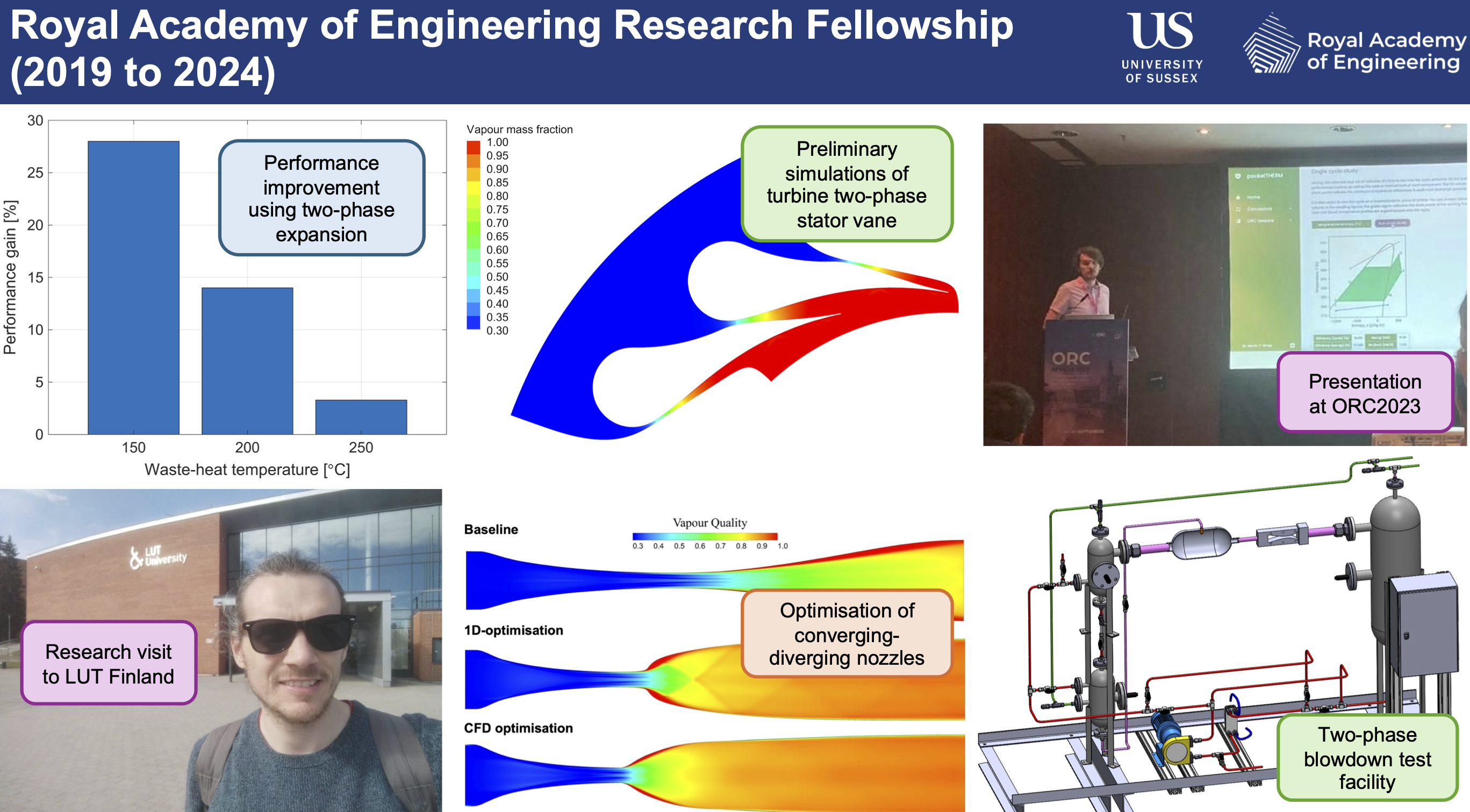
Dr. Martin T. White is an Associate Professor in Mechanical Engineering at the University of Sussex, part of the School of Engineering and Informatics and the Energy and Materials Engineering Research Centre (EMERC). He holds a PhD from City, University of London (2015) and an MEng in Mechanical Engineering from the University of Southampton (2011). Prior to his current role, he served as Senior Lecturer (2022–2024) and Lecturer in Thermal Power (2019–2022) at City, University of London, and held postdoctoral roles at Imperial College London and City. He is a Fellow of the Higher Education Academy and a member of the Institution of Mechanical Engineers. His research focuses on novel thermal power systems, particularly organic Rankine cycles (ORC), supercritical carbon dioxide (sCO₂) turbines, and waste-heat recovery. He leads the development of experimental test rigs and computational tools like pocketTHERM and pocketORC , which enhance education and design in thermodynamics. Key projects include the EU-funded SCARABEUS initiative, designing axial turbines for concentrated solar power, and optimizing turbine blades for CO₂ blends. Recent work includes advancing wet-to-dry expansion in ORC systems using non-equilibrium CFD simulations and experimental rigs. He has supervised PhD students (e.g., Charlie Westpfel, Pawel Ogrodniczak) and co-supervised Salma Salah, who successfully completed her viva in 2023. His research spans turbine aerodynamics, fluid dynamics, and educational technology, addressing global energy challenges through innovative thermal systems. Key achievements include the Royal Academy of Engineering Research Fellowship (2019–2024), which supported studies on two-phase expansion in ORC turbines. His work integrates academic and industrial collaboration, exemplified by the SCARABEUS turbine design with industrial partners. Future directions include experimental validation of two-phase expansion and exploring CO₂-blend applications in heat pumps and refrigeration systems. Awards and recognition include the IMechE awards for student projects supervised and the University of Sussex’s Brian Roberts Prize for academic excellence. His interdisciplinary approach bridges fundamental research, engineering design, and educational innovation in sustainable energy systems.
Matthew White is an Associate Professor in the Department of Physics at the University of Vermont, affiliated with the College of Engineering and Mathematical Sciences. He earned his Ph.D. from the University of Colorado, Boulder in 2009. His research focuses on nonlinear processes in optoelectronic devices and materials physics for low-cost, high-performance photovoltaics, particularly hybrid and organic photovoltaic device physics. Key research areas include perovskite solar cells, organic light-emitting diodes (OLEDs), photonic crystals, and nanomaterials synthesis. His work integrates experimental techniques with theoretical modeling to optimize device performance and stability. Recent studies explore ligand design for perovskite nanocrystals, defect engineering in photonic crystals, and microcavity effects in OLEDs. Publications highlight advancements in optoelectronic materials, including nonlinear impedance spectroscopy for ion migration analysis and band structure control in photonic systems. His research emphasizes practical applications in renewable energy and high-efficiency light-emitting technologies. No scientific awards or grants are explicitly mentioned in the provided information. He advises no listed students and has not disclosed lab affiliations beyond the UVM Device Physics group.
Seppo Sierla is a University Lecturer at Aalto University's Department of Electrical Engineering and Automation within the School of Electrical Engineering. His expertise spans software engineering, automation systems, and human-computer interaction. He has been repeatedly recognized for his teaching excellence, notably receiving multiple Recognition Awards for bachelor-level courses such as Automation Systems 1 (2019-2020), Automation Software Projects (2018-2019), and Automation 1 (2017-2018). These awards highlight his impactful contributions to curriculum development and student engagement in automation education. His research focuses on industrial automation technologies, including digital twins, reinforcement learning applications in energy systems, and process optimization. Notable projects include physics-informed modeling in steel manufacturing and energy-efficient district heating systems. He also explores cloud-based MLOps frameworks and renewable energy time-shifting strategies for photovoltaic systems. Key Research Themes : Industrial process automation, digital twin integration, reinforcement learning for energy systems, and sustainable manufacturing. Recent Contributions : Over a dozen peer-reviewed publications since 2021, addressing topics ranging from steel production modeling to HVAC frequency control. Dr. Sierla's work bridges academic research and industrial applications, emphasizing practical implementations in sectors like manufacturing and energy. His teaching and research synergize to advance automation education and technological innovation.
Jia Wang is an Associate Professor in the Department of Physics at Umeå University, Sweden. Their research focuses on low-dimensional semiconductor materials, including organic, inorganic, and hybrid systems, with applications in energy conversion, optoelectronics, and biomedicine. They specialize in luminescent nanomaterials such as quantum dots and carbon nanodots, particularly exploring sustainable synthesis methods using biomass-derived precursors. Key research themes include developing carbon dots for biomedical applications (e.g., neurite outgrowth promotion), optoelectronic devices (e.g., LEDs with high color purity), and energy-efficient materials. Their work emphasizes environmental sustainability, leveraging green chemistry principles and renewable resources. Publications highlight innovations in nanomaterials engineering, including ligand engineering for perovskite quantum dots and the development of metal-free TADF emitters for light-emitting electrochemical cells. Collaborations span materials science, chemistry, and biomedical engineering. Teaching includes master-level courses on solar cells, reflecting expertise in energy conversion technologies. Research is conducted via the OPEG (Organic and Perovskite Electronics Group) section at Umeå, with ongoing projects on novel materials for next-generation optoelectronic devices.
Dr. Mingyang Wei is an Assistant Professor in the Department of Materials Science and Engineering at the National University of Singapore (NUS). He holds a B.Sc. in Physics from Peking University (2016) and a Ph.D. in Electrical Engineering from the University of Toronto (2020). Prior to joining NUS, he was a scientist at École Polytechnique Fédérale de Lausanne (EPFL), Switzerland (2021-2024). His research focuses on hybrid organic-inorganic semiconductors for energy-conversion technologies, including perovskite solar cells, optoelectronic devices, and advanced interface engineering. Awards: Canadian Governor General’s Gold Medal (2020), Marie Skłodowska-Curie Fellowship (2021), Clarivate Highly Cited Researcher (2022–2023), NUS Presidential Young Professor (2024) Research interests: Hybrid heterostructure design for energy-efficient optoelectronics Advanced spectroscopic analysis of interfacial properties Stable perovskite-based photovoltaic and light-emitting devices Key contributions include developing crystal capping layers for black-phase perovskites and self-assembled bilayers for thermal stability. His work spans 20+ high-impact publications in journals like Nature , Science , and Advanced Materials . Current openings exist for postdoctoral researchers and graduate students in materials chemistry, semiconductor physics, and optoelectronics.
Jörg Libuda is a Professor at the Chair of Interface Research and Catalysis , Friedrich-Alexander-University Erlangen-Nürnberg . His work bridges materials chemistry , electrocatalysis , and molecular solar thermal systems , focusing on solid catalysts with ionic liquid layers (SCILLs) , atomic layer deposition , and model catalyst systems . Research Areas: Catalysis, Ionic Liquids, Surface Science, Energy Storage, Nanoparticle Stability His 2025–2024 publications analyze trimetallic PtNiMo/C catalysts , molecular solar thermal systems with electroswitchable catalysis , and supraparticle catalysts for ultralow noble metal loadings . Key trends include ionic liquid modifiers to enhance electrocatalytic selectivity , atomic layer deposition on oxide surfaces , and metal-support interactions in Pd-Rh catalysts . No explicit scientific awards are listed in the provided text. His group investigates model electrocatalysts under ambient-pressure conditions , redox-mediated bond cleavage , and CO permeability in ionic liquid films. The summary underscores his contributions to energy conversion , catalyst stabilization , and surface molecular engineering .
Dr Neil Buchanan is a Reader in the School of Electronics, Electrical Engineering, and Computer Science at Queen's University Belfast. He is affiliated with the Wireless Communication Systems Institute and ECIT (Institute of Electronics, Communications & Information Technology). His research focuses on advanced antenna systems, wireless power transfer, space communication technologies, healthcare sensors, and high-efficiency RF circuits. Buchanan leads major projects such as R-NGIN (Next Generation Information Networks) and has pioneered innovations in retrodirective arrays, self-steered antennas, and satellite communication systems. He has secured £multi-million grants and holds 8 awards including the Belfast Business Top 50 Award (2012) and ESA Young Antenna Engineer Prize (2010). His research group collaborates globally, with recent work on microwave energy beaming for space-based solar farms, anti-plagiarism remote labs, and AI-resistant educational tools. Buchanan advises two PhD students and actively engages in public outreach via BBC and RTE media appearances on topics like space energy and wireless power. Key Projects: R-NGIN (2023-present), Wireless Power Transfer (2018-2023), FlisH Satellite Dish (2011-2014) Notable Awards: ESA Young Antenna Engineer Prize, Mobile World Scholar Gold Award Media Expertise: Featured in BBC Radio Ulster, RTE Futureville, and BelfastLive on solar farms and space energy Buchanan's work bridges academia and industry through innovations like hybrid delay-locked loops for satellite systems and novel RFID transceivers for healthcare applications. His lab hosts cutting-edge research in 5G/6G antenna design, beamforming techniques, and phased array systems.
Dr. Manish Kumar is a Scientist in the Department of Microbial Biotechnology at the Helmholtz Centre for Environmental Research - UFZ in Leipzig, Germany. His research focuses on the Biohybrid Solar Power Plant (BISON) project, working on electrochemical system integration and characterization for sustainable energy solutions that bridge biological and electrochemical components. Dr. Kumar received his Dr. rer. nat. (PhD) from Leibniz Universität Hannover, Hannover School for Nanotechnology, with a dissertation rated 'Very Good.' Prior to his doctoral studies, he earned a Master of Technology with Distinction in Nanotechnology from Pondicherry University and a Bachelor of Engineering in Electronics Engineering from RGPV. His primary research interests center on developing sustainable energy solutions through the intersection of electrochemistry, nanotechnology, and biotechnology. Dr. Kumar specializes in creating advanced materials for energy storage applications, particularly focusing on carbon nanofibers derived from renewable sources like lignin. His work on the Biohybrid Solar Power Plant (BISON) project aims to establish electrochemical configurations with low cost and high energy efficiency for solar energy conversion. His research bridges the gap between material science and biological systems to create innovative solutions for renewable energy challenges, with particular emphasis on microbial electrochemical technologies. Analysis of Dr. Kumar's publication record reveals a strong progression from fundamental materials synthesis to applied research on biohybrid systems. His work consistently explores the use of renewable precursors like lignin to create carbon-based nanomaterials for energy storage. Over time, his research has evolved toward more integrated approaches that combine microbial systems with electrochemical devices, reflecting the growing importance of sustainable bioprocesses in energy technology development. Dr. Kumar has received the Society for Biomaterials Award from Charlotte, NC, USA, recognizing his contributions to biomaterials research, particularly his work on protein immobilization using electrospun fibers which has important applications in biosensors and biomedical devices. As a Scientist at UFZ, Dr. Kumar contributes significantly to the Systems Biotechnology research group's mission of sustainable production of chemicals and green energy carriers. His expertise in electrochemical systems and materials science supports the group's work on manipulating redox balances and developing microbial electrochemical technologies. His current involvement in the BISON project demonstrates his role in substantial research initiatives focused on renewable energy solutions and biohybrid technology development. Dr. Kumar works within the Systems Biotechnology group at UFZ, which employs an interdisciplinary approach combining quantitative physiology, systems metabolic engineering, and microbial electrochemical technologies. The group works with photoautotrophic cyanobacteria as 'farmers' to provide redox power and organic carbon, and metabolically engineered microbes as 'laborers' for production. His research on electrochemical integration directly supports the group's four-pillar approach that includes modeling of metabolism, advanced analytics, in-depth physiology studies, and microbial electrochemical technologies.
Rakesh Agrawal is the Winthrop E. Stone Distinguished Professor of Chemical Engineering at Purdue University's College of Engineering. His research focuses on sustainable chemical processes, energy systems, and advanced materials. Key affiliations include the Sustainability Engineering and Environmental Engineering programs. He actively contributes to committees such as the Dean's Awards Committee and institutional awards and honors initiatives. His research interests span chalcogenide perovskite synthesis, energy-efficient distillation systems, photovoltaic technologies (especially agrivoltaics), and electrification of chemical plants. Notable work includes developing low-temperature perovskite fabrication methods, optimizing distillation configurations via MINLP formulations, and advancing agrivoltaic systems for dual energy and crop productivity. Recent publications emphasize breakthroughs in BaZrS3 synthesis, electrified ethylene cracking towers, and energy storage strategies for renewable integration. His work bridges chemical engineering fundamentals with real-world applications in sustainability and materials innovation. Dr. Agrawal collaborates extensively on projects involving solution-processed semiconductors, electron microscopy adaptations for material analysis, and process intensification. His lab focuses on translating laboratory discoveries into scalable industrial and environmental solutions.