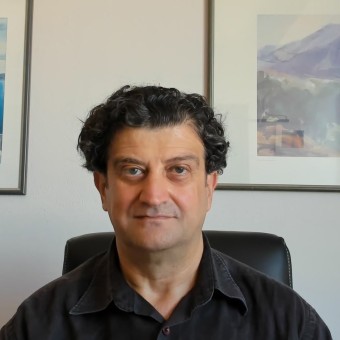
Nikolaos Efkolidis is an Assistant Professor at the University of Western Macedonia in the Department of Product and Systems Design Engineering . He is a member of the Computational Design and Digital Fabrication Research Lab ( codeplus.uowm.gr ) and co-founder of the design studio heptahedron.studio . Research Focus : Computational design, digital fabrication, AI-driven optimization, and sustainable product development. Key Techniques : Response Surface Methodology (RSM), Genetic Algorithms, Finite Element Analysis (FEA), and Additive Manufacturing. His recent publications highlight trends in multi-material 3D printing , machine learning for machining processes , and user-driven customization . Applications span footwear, marine robotics, and industrial design.
John Paparrizos is an Assistant Professor of Computer Science and Engineering at The Ohio State University's College of Engineering, where he directs The DATUM Lab (Data Analytics, Understanding, Mining, and Management Lab). He maintains an adjunct affiliation with the School of Informatics at Aristotle University of Thessaloniki. His research spans databases, data science, machine learning, and artificial intelligence , with focus areas including: Time-series analysis (clustering, anomaly detection) Scalable data mining for structured/unstructured data Adaptive algorithms for resource-constrained environments Foundational technologies for data-intensive applications His work addresses real-world challenges across relational, time-series, multimedia, text, graph, web, and IoT data domains. Notable recognition includes: 2025 ACM SIGMOD Test-of-Time Award for k-Shape time-series clustering 2023 IEEE TCDE Rising Star Award ACM SIGMOD Research Highlight Award NetApp Faculty Award His research has been featured in New York Times (front page), Washington Post , Forbes , and adopted by Fortune 500 companies (Exelon, Nokia) and the European Space Agency. He actively serves on program committees for premier conferences including ACM SIGMOD, VLDB, IEEE ICDE, ACM SIGKDD, and NeurIPS. His open-source tools have exceeded 100,000 downloads and are integrated into academic curricula at Brown, Columbia, Purdue, and University of Chicago.
Ioannis Stamelos is a Professor of Software Engineering at the School of Informatics, Aristotle University of Thessaloniki (since 2015, research/teaching staff since 1997). He serves as Director of the Postgraduate Master Course in Interactive Hardware & Software Technologies. Major Research Areas: Open Source Software, Software Effort/Quality Estimation, Agile Methods, Enterprise Information Systems Key Projects: Deep Blue/AUTH Research Hub (2018-2022), BlockAdemic (blockchain-based micro-credentials), European Commission Open Source Policy Studies Research Trends from recent publications include: Process mining in library information systems Reusability metrics for software assets Bayesian networks in software project management Impact of design patterns on gaming software defects Technical debt assessment via structural metrics Blockchain applications in supply chain management Scientific Awards: Best Paper Award at IEEE DEST’09 Best Student Paper Award at ICSR 2012 Best Paper Award at QUATIC2012 Education & Leadership: PhD in Computer Science (1988), Diploma in Electrical Engineering (1983). Led numerous EU-funded projects (IST, ERASMUS, FP7) and national initiatives (ΓΓΕΤ, ΕΠΕΑΕΚ). Supervised PhD/MSc students in software reuse, OSS quality, and agile practices.
Dr. Dimitrios Bakalis is an Assistant Professor at the Department of Physics, University of Patras, specializing in Digital Electronic Circuits and Systems. He joined the faculty in 2004 and focuses on the design and control of digital circuits, emphasizing low-power testing and built-in self-test (BIST) methodologies. His academic roles include teaching courses such as Computer Programming I, Digital Electronics, and Microcomputer Architecture at both undergraduate and postgraduate levels. Education: Diploma in Computer Engineering and Informatics (University of Patras) Master’s Degree in Computer Science and Technology (University of Patras) PhD in Computer Engineering and Informatics (University of Patras) Research Interests: His work revolves around VLSI design, arithmetic circuits, and low-power techniques. Key areas include modulo arithmetic circuits, fault-tolerant systems, and reconfigurable computing architectures. He has published over 50 papers in top-tier journals and conferences, contributing to advancements in digital circuit efficiency and reliability. Teaching: He instructs core courses in digital electronics and computer architecture, integrating cutting-edge research into his pedagogy. His MSc courses focus on FPGA-based digital system design, emphasizing practical applications. Labs/Teams: His research aligns with the Electronics & Computers sector within the Department of Physics, collaborating on projects involving arithmetic core optimization and low-power testing strategies.
Christos Diou is an Associate Professor of Artificial Intelligence and Machine Learning at the Department of Informatics and Telematics, Harokopio University of Athens, Greece. His academic career spans over 15 years of participation in national and international research projects, with a focus on machine learning algorithms, domain generalization, causal inference, and bias mitigation. He earned a BSc and Ph.D. in Electrical and Computer Engineering from Aristotle University of Thessaloniki. His research emphasizes the application of machine learning to healthcare, addressing challenges such as visual bias mitigation, causal effect estimation from observational data, and fairness-aware representation learning. Notable projects include REBECCA and RELEVIUM , both EU-funded, and MELIORA , targeting lifestyle interventions for breast cancer risk reduction. He has published extensively in top-tier venues like IEEE TPAMI, CVPR, and ICCV. Christos is a leading voice in AI ethics and healthcare innovation, with over 150 publications and best paper awards at IEEE Big Data Service 2023 and AIAI 2022. His work includes developing platforms like Effector for feature effects and Beam for behavior studies. He collaborates with institutions such as Karolinska Institutet and CERTH/ITI, and his students include PhD candidates Ioannis Sarridis and Aristotelis Ballas.
Mara Nikolaidou is a Professor in the Department of Informatics and Telematics at Harokopio University of Athens since 2007 and has served as the university's Rector since 2016. She represents Greek universities in the European University Association (EUA) for 2023-2024. Her research focuses on distributed systems, system modeling, and responsible computing, with a strong emphasis on IoT, cloud/edge computing, and cyber-physical systems. She leads projects funded by national, EU, and international agencies, exploring topics like autonomous systems, ethical requirements in design, and human-in-the-loop systems. Her educational background includes roles as a computer engineer and IT consultant before academia. She is a member of IEEE (SMC Society and Systems Council) and participates in the Object Management Group (OMG) working groups for SysML and responsible computing. She organizes international conferences in software and systems engineering. Research interests span distributed systems, IoT, and ethical computing. Recent work investigates cost analysis in cloud markets, human-AI collaboration, and smart city technologies. Over 200 publications highlight her contributions to model-based systems engineering, including SysML extensions for cost/QoS analysis and frameworks for autonomous fog nodes. Grants and projects include EU-funded initiatives on smart farming, cloud brokerage, and organizational interoperability. Her lab focuses on autonomous systems and context-aware middleware. She advises on e-Government compliance frameworks and collaborates with industry partners on IoT management platforms.
Prof. Vana Kalogeraki is a Faculty Member at the Department of Informatics , Athens University of Economics and Business (AUEB) , and serves as the Dean of the School of Information Sciences and Technology and Director of the Computer Systems and Communications Laboratory . She has held academic positions at the University of California, Riverside and was a Research Scientist at Hewlett-Packard Labs . PhD: University of California, Santa Barbara M.S. & B.S.: University of Crete, Greece Her research focuses on Distributed and Real-Time Systems , Big Data Systems , Cloud Computing , Human-Centered Systems , and Crowdsourcing . She has published over 200 papers at top journals (IEEE TPDS, ACM TOS, etc.) and conferences (RTSS, DSN, ICDCS, VLDB, MDM), including co-authoring the OMG CORBA Dynamic Scheduling Standard . Her 2023-2025 publications address AI pipelines in serverless environments, edge computing for trauma detection via eye-tracking, and fairness in resource scheduling. She has received prestigious awards including an ERC Starting Grant , Best Paper Awards (DEBS 2017, IPDPS 2009), a Best Poster Award (EuroSys 2024), and multiple UC Research Awards . Her research is funded by the European Union (ARISTEIA, THALIS), NSF, and industry partners like SUN and Nokia. Advising Legacy : Supervised 10 PhD graduates (now at Google, Amazon, IBM, Apple) and over 60 MS/PhD committees Labs & Teams : Leads the Computer Systems and Communications Laboratory at AUEB, focusing on mobile human-centered systems and urban data analytics
Dimitrios Apostolopoulos serves as Assistant Professor at the School of Electrical and Computer Engineering, National Technical University of Athens (NTUA), within the Division of Information Transmission Systems and Material Technology. His academic foundation was built at NTUA where he earned both Diploma (2004) and Ph.D. (2009) degrees, followed by an MBA from Hellenic Open University. His educational qualifications include: Diploma in Electrical and Computer Engineering, NTUA (2004) Ph.D. in Electrical and Computer Engineering, NTUA (2009) MBA, Hellenic Open University Prof. Apostolopoulos specializes in optical communication systems, optical wireless technologies, and converged optical-wireless networks, with particular expertise in photonic integrated circuits for telecom/datacom/sensing applications and optical computing for AI. His research directly addresses next-generation network challenges through photonic innovation, bridging theoretical frameworks with practical engineering solutions for 5G/B5G/6G systems. Analysis of his 2024-2025 publications reveals dominant themes in 6G hybrid transport architectures (fiber/FSO/mmWave), silicon photonics for aerospace environmental sensing, and integrated optical components for Lidar/gas detection systems. This work demonstrates consistent progression from fundamental photonic research to real-world deployment scenarios. His scientific recognition includes: Dimitris N. Chorafas Foundation Award (2009) for doctoral contributions to all-optical broadband communications Prof. Apostolopoulos actively leads over 15 European/national research projects while serving on technical committees for ECOC, IEEE GLOBECOM, and N&N conferences. As co-chair of EuCNC/6G Summit's Wireless/Optical/Satellite Networks track, he shapes next-gen network standards. His teaching portfolio spans undergraduate telecommunications courses from circuit analysis to optical network design. He maintains active collaboration within photonic research teams through projects like Int5Gent and Int5gent, focusing on integrated solutions for communications infrastructure and sensing applications across aerospace and environmental monitoring domains.
Professor Dimitra Kaklamani is a distinguished faculty member at the School of Electrical and Computer Engineering at the National Technical University of Athens (NTUA), where she serves as a Professor in the Division of Information Transmission Systems and Material Technology. With over 300 publications to her name, she has established herself as a leading researcher in microwave engineering, wireless communications, and computational electromagnetics, having progressed through academic ranks from Lecturer (1995) to Professor (2009). Her research spans numerous critical areas in electrical engineering: Microwave Theory and Techniques Wireless Communications and MIMO Systems Computational Electromagnetics Object-Oriented and Distributed Computing Security & Privacy in Networked Systems Machine Learning Applications in Telecommunications Professor Kaklamani's research trajectory demonstrates a natural evolution from traditional microwave engineering toward cutting-edge areas like AI-enabled wireless communications and privacy-preserving network architectures. Her recent work (2023-2025) shows particular focus on intelligent metasurfaces for wireless communications, federated learning applications in next-generation networks, and security aspects of 5G/6G systems. This reflects both continuity with her foundational work in computational electromagnetics and adaptation to emerging technological frontiers. She serves as Editor of an international book by Springer-Verlag (2000) in applied Computational Electromagnetics and regularly reviews for IEEE journals, demonstrating her standing in the scholarly community. Her teaching portfolio is equally comprehensive, ranging from foundational courses like Linear Circuits Analysis to advanced topics such as Computational Electromagnetics and Machine Learning in Mobile Computing, reflecting her broad expertise across electrical engineering disciplines.
Ruzica Piskac is a Professor of Computer Science at Yale University, where she leads the Rigorous Software Engineering (ROSE) group. She has made significant contributions to the fields of software verification, security, automated reasoning, and code synthesis, focusing on improving software reliability and trustworthiness through formal techniques. Dr. Piskac received her PhD from the Swiss Federal Institute of Technology (EPFL) in 2011, where her dissertation won the Patrick Denantes Prize. Prior to joining Yale, she led an independent research group at the Max Planck Institute for Software Systems in Germany (2012-2013). Her research spans several key areas: symbolic execution for Haskell (G2), privacy-preserving formal methods (PPFM), functional reactive synthesis, verification of configuration files, and analysis of software updates. Her work consistently bridges theoretical formal methods with practical applications in real-world systems. Dr. Piskac's recent publications demonstrate a strong trend toward applying formal verification techniques to emerging challenges including large language models, quantum computing security, legal accountability of automated systems, and cyber-physical systems. Her research increasingly intersects with AI, cryptography, and legal domains while maintaining strong foundations in formal methods. Her scientific achievements have been recognized with numerous prestigious awards: Multiple Amazon Research Awards Yale University's Ackerman Award for Teaching and Mentoring Facebook Communications and Networking Award Microsoft Research Award for the Software Engineering Innovation Foundation (SEIF) Patrick Denantes Prize for her PhD dissertation Dr. Piskac has graduated five PhD students, four of whom have gone on to become assistant professors of computer science. She has served as Program Chair of the 37th International Conference on Computer Aided Verification and is on the Steering Committee of the Formal Methods in Computer-Aided Design conference. She leads the Rigorous Software Engineering (ROSE) group at Yale, which focuses on several key projects including: Symbolic Execution Engine for Haskell (G2) Privacy Preserving Formal Methods (PPFM) Functional Reactive Synthesis Verifications for Configuration Files Analysis of Software Updates and Configuration Files
Alastair F. Donaldson is a Professor in the Department of Computing at Imperial College London's Faculty of Engineering, where he leads the Multicore Programming Group. He also works as a Software Engineer at Google in the Android Graphics Team. Previously, he served as Director of GraphicsFuzz, an Imperial College spinout company acquired by Google in 2018. His research spans programming languages, compilers, verification, and testing, with a particular focus on randomized and fuzz testing techniques for compilers and program analyzers. Donaldson has developed several influential testing frameworks including GraphicsFuzz, RustSmith, and GrayC, which have significantly advanced compiler testing methodologies. Analysis of his recent publications reveals a strong trend toward practical applications of compiler testing techniques across diverse domains including GPU programming, verification-aware languages, and memory models. His work increasingly incorporates continuous integration practices and focuses on addressing real-world challenges in compiler development and verification. Donaldson maintains active involvement in the programming languages research community, serving on program committees for major conferences including PLDI, POPL, ASPLOS, and SPLASH. He has contributed significantly to advancing compiler testing methodologies and has mentored numerous researchers through PLMW (Programming Languages Mentoring Workshop). He leads the Multicore Programming Group at Imperial College London, which focuses on challenges in parallel and concurrent programming. His work bridges theoretical computer science with practical software engineering challenges, particularly in the areas of compiler correctness and verification.
Andy D. Pimentel is a Full Professor at the University of Amsterdam, where he chairs the Parallel Computing Systems (PCS) group within the Systems and Networking Lab at the Informatics Institute. His work focuses on the design, programming, and run-time management of multi-core and multi-processor computer systems, with particular attention to performance, power/energy consumption, system dependability, and design productivity. His academic background includes: PhD in Computer Science, 1998, University of Amsterdam MSc in Computer Science, 1993, University of Amsterdam Professor Pimentel's research spans multiple critical areas in modern computing systems. His primary interests include multi-core embedded systems, system-level design and simulation, design space exploration, performance and power analysis, system dependability, hardware/software co-design, run-time resource management, and Edge AI. His work addresses the growing challenges of making computer systems faster, more sustainable, energy efficient, reliable, and secure in an era of increasing computational demands and climate concerns. The PCS group he leads performs research on the modeling, analysis and optimization of extra-functional aspects of computing systems, which play a pivotal role in their work. An analysis of Professor Pimentel's recent publications reveals a strong focus on edge computing, distributed AI, and energy-efficient system design. His work bridges theoretical computer architecture with practical implementation challenges, particularly in the context of resource-constrained environments. Key trends include the adaptation of AI models for edge devices, thermal management in advanced architectures, and optimization of multi-core systems for both performance and energy efficiency. His research increasingly addresses sustainability concerns in computing, reflecting broader industry and academic priorities. His notable scientific achievements include: IEEE CEDA Outstanding Service Recognition Award DATE Fellow Award Professor Pimentel has served in numerous leadership roles in the academic community, including as General Chair of Design Automation and Test in Europe (DATE) 2024, Vice General Chair of IEEE/ACM Embedded Systems Week 2025, and General Chair of IEEE/ACM Embedded Systems Week 2026. He has secured significant research funding for projects related to sustainable computing, edge AI, and multi-core system design. His professional service includes board membership with the ICT Research Platform Nederland (IPN) since 2020 and leadership roles in major conferences such as DATE, Embedded Systems Week, and SAMOS. The Parallel Computing Systems group he chairs is a vibrant research team within the Systems and Networking Lab at the Informatics Institute. The PCS group focuses on the challenges of modern computing systems, particularly addressing the extra-functional aspects like performance, power consumption, and system dependability. Their work is highly relevant to current technological challenges in edge computing, sustainable systems design, and the integration of AI into resource-constrained environments.
Nikolaos Samaras is a Full Professor at the Department of Applied Informatics, School of Information Sciences, University of Macedonia in Thessaloniki, Greece. He has been serving as director of the Computational Methodologies & Operations Research (CMOR) Laboratory since April 2016. His academic career includes positions as Assistant Professor (2007-2012) and Lecturer (2003-2007) at the same institution, and earlier as an adjacent Lecturer at the Technological Institute of Western Macedonia (1998-2000). Dr. Samaras earned his Diploma in Applied Informatics from the University of Macedonia in 1996 and his Ph.D. in Applied Informatics from the same university in 2001. His educational background forms the foundation for his extensive research in computational optimization and operations research. Professor Samaras's research focuses on the interface between computer science and operations research, with particular expertise in linear and nonlinear optimization, network optimization, integer optimization, and scientific computing including HPC and GPU programming. His work has resulted in the development of new algorithmic families for optimization problems, efficient GPU implementations of the revised simplex algorithm, and novel algorithms and software for operations research. His research spans theoretical algorithm development, practical implementation, and real-world applications across various engineering and scientific domains. His extensive publication record includes over 35 journal papers in prestigious venues such as Computers and Operations Research, European Journal of Operational Research, and Journal of Artificial Intelligence Research, more than 85 conference papers, and four textbooks (two in English and two in Greek). His work has been recognized through citations and the Thomson ISI/ASIS&T Citation Analysis Research Grant in 2005. ACM Senior Member (2016) Thomson ISI/ASIS&T Citation Analysis Research Grant (2005) Editorial board member of Operations Research: An International Journal Reviewer for numerous top journals including Mathematical Programming Computation and European Journal of Operational Research Professor Samaras has supervised four current Ph.D. students working on hybrid simplex algorithms, large-scale optimization using Apache Hadoop, algorithmic procedures in matrix theory, and smoothed complexity analysis. He has successfully guided five Ph.D. students to completion, including Nikolaos Ploskas who won the 2014 HELORS Doctoral Dissertation Award. Additionally, he has supervised 45 master's theses and 84 bachelor's theses. His research group has secured funding from diverse sources including the European Union, Greek Secretariat of Research and Technology, and industry partners like Veltio Greece LTD. The Computational Methodologies & Operations Research (CMOR) Laboratory, which he directs, focuses on developing and implementing optimization algorithms with applications in transportation, energy systems, and business process design. The lab has produced notable software tools including Euclides and Visual LinProg, which have educational applications in linear programming.
Dr. Eleftherios Doitsidis is an Associate Professor at the School of Production Engineering & Management of the Technical University of Crete (TUC) and a member of the Intelligent Systems & Robotics Laboratory. Previously, he served as faculty at the Department of Electronic Engineering at Hellenic Mediterranean University. His expertise spans multirobot systems, autonomous vehicle control, and computational intelligence. He holds a robust record of EU and national research project involvement. Research Interests: Specializes in multirobot team coordination, autonomous navigation systems for UAVs/AUVs, control systems design, and computational intelligence applications. Recent work focuses on energy-efficient path-planning for swarms, educational robotics frameworks like HYDRA, and digital twin integration in autonomous systems. Publications Trends: His 150+ publications address cutting-edge topics including: Autonomous vehicle control architectures Modular robotics for STEM education Optimization algorithms for multirobot systems Energy efficiency in manufacturing systems Advising & Projects: Lead researcher on numerous funded projects involving UAV/AUV missions, swarm robotics, and educational technology. Active in collaborative research with institutions like the University of South Florida. Labs & Groups: Leads the Intelligent Systems & Robotics Lab at TUC, developing advanced robotic platforms and educational tools. Maintains an open-access research portal at doitsidis.tuc.gr .
Nikolaos S. Papaspyrou is a Professor at the School of Electrical and Computer Engineering of the National Technical University of Athens (NTUA), affiliated with the Software Engineering Laboratory and the Division of Computer Science. His research focuses on programming languages, compilers, formal verification, and concurrency. Since October 2021, he has been on leave from NTUA while working as a Software Engineer at Google's V8 JavaScript and WebAssembly engine team. Previously, he served as Director of the Division of Computer Science (2017–2019) and held a sabbatical at Google's Munich compiler group (2015–2016). His academic contributions include pioneering work on Erlang/OTP scalability, concolic testing for functional languages, and static analysis techniques. He has authored numerous publications in top venues like ACM Transactions on Programming Languages and Systems and IEEE conferences. Papaspyrou has supervised over 50 diploma students and multiple PhD candidates, contributing to the education of future researchers and engineers. He actively participates in programming competitions, coaching Greek Olympiad teams, and volunteers in the Hellenic Informatics Society. He teaches advanced courses on programming languages, compilers, and software engineering at NTUA, emphasizing practical applications of theoretical concepts. His educational philosophy integrates problem-solving through programming, as highlighted in his FedCSIS 2013 paper on teaching methodologies.