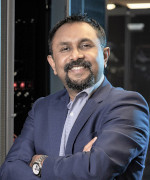
Beng Chin Ooi is a Lee Kong Chian Centennial Professor at the National University of Singapore (NUS), School of Computing (SoC). He holds a B.Sc. (1st Class Honors) and Ph.D. in Computer Science from Monash University. His research focuses on database systems, large-scale analytics, and distributed computing. He has held leadership roles including Dean of School of Computing (2007–2013) and Director of Smart Systems Institute (2011–2021). Key achievements include the Singapore President’s Science Award (2011), ACM Fellow (2011), IEEE Fellow (2009), and multiple best paper awards. His work emphasizes scalable data management, blockchain systems, and healthcare data analytics. Education: Monash University (B.Sc., Ph.D.) Leadership: Dean (SoC), Director (Smart Systems Institute) Awards: Over 15 major honors including ACM SIGMOD E.F. Codd Innovations Award (2020) His research spans distributed databases, big data systems, and innovative applications of blockchain technology. Recent work includes NASI (neural architecture search) and Rafiki (ML-as-a-service).
Ajmal Mian is a Professor of Computer Science at the University of Western Australia (UWA), affiliated with the School of Physics, Maths and Computing. He holds an Australian Research Council Future Fellowship (2022) and leads research in Artificial Intelligence, Computer Vision, and Machine Learning. His work focuses on 3D computer vision, adversarial AI defense, and explainable AI. His research interests include 3D point cloud analysis, face recognition, human action recognition, and remote sensing. He has published over 300 papers and secured major grants from ARC, NHMRC, and DARPA, totaling millions in funding. He has supervised 29 PhD students and mentored 12 postdoctoral researchers. Key projects include 3D diffusion models for scene generation, robust 3D vision systems, and defense against AI deception attacks. He serves as a fellow of IAPR, an ACM Distinguished Speaker, and has editorial roles at IEEE Transactions on Neural Networks and Pattern Recognition. Research Awards: HBF Mid-Career Scientist of the Year, West Australian Early Career Scientist of the Year, IAPR Best Scientific Paper Award. Grants: ARC Discovery Projects, National Intelligence & Security Discovery grants, DARPA grants for AI security. His teaching spans computer vision, machine learning, and programming courses. Collaborations include defense, medical, and agricultural applications.
Jenna Wise DiVincenzo is an Assistant Professor at the Elmore Family School of Electrical and Computer Engineering at Purdue University. She specializes in research areas such as software verification, formal methods, and programming languages, with a focus on gradual verification techniques that combine static and dynamic analysis. Her work emphasizes usability and scalability in verification tools, and she has contributed to projects like Gradual C0 and gradual null-pointer analysis. Dr. DiVincenzo earned her PhD in Software Engineering from Carnegie Mellon University (2023) and a BS in Mathematics and Computer Science from Youngstown State University (2017). She has interned at IBM Research, MIT Lincoln Laboratory, and the Software Engineering Research and Empirical Studies Lab at YSU. Her awards include the Google PhD Fellowship, NSF GRFP Fellowship, and 2022 Rising Star in EECS. Her research projects span theoretical advancements in gradual verification, empirical studies on usability, and practical tool development. She advises PhD students (e.g., Craig Liu, Conrad Zimmerman) and collaborates on initiatives like gradual verification for Rust and educational tools to teach verification concepts. Her work also explores leveraging large language models for specification generation and enhancing verification tool soundness through formal proofs.
Benjamin Carrison-Schafer is an Associate Professor and Assistant Dean for Graduate Student Success at the Department of Electrical and Computer Engineering, Erik Jonsson School of Engineering and Computer Science, University of Texas at Dallas. He leads the Design Automation and Reconfigurable Computing Laboratory (DARClab), focusing on systems, high-level design, and programming methodologies for VLSI computing systems and FPGAs. Education: MBA from McGill University, Canada (2012) PhD in Electrical and Electronic Engineering from University of Birmingham, UK (2003) Research Interests: His work spans modeling, analysis, synthesis, optimization, and implementation of VLSI systems. Current projects include: Approximate Computing, High-Level Synthesis Design Space Exploration, Hardware Security, Behavioral MPSoC Optimization, and Automatic Fault-Tolerant System Generation. His research blends theory and practice, using analytical and experimental techniques to solve real-world problems. Publication Trends: Recent publications demonstrate strong focus on hardware security, FPGA optimization, and automated design methodologies. Key themes include High-Level Synthesis innovations, hardware acceleration techniques, and cross-disciplinary applications of reconfigurable computing. His work frequently addresses challenges in hardware trustworthiness, energy efficiency, and design automation scalability. Professional Activities: Associate Editor: IEEE Transactions on Sustainable Computing (2022-present) Conference Chair: ICCD 2024, DCAS 2024 Program Committee: ASP-DAC, DATE, FCCM, GLSVLSI Advising & Labs: Supervises multiple PhD and Master's students at DARClab. Current research includes domain-specific architecture design, hardware security, sustainable computing, and ML for VLSI design. The lab collaborates with industry partners like Renesas Electronics and develops commercial tools through spin-off company highX Technologies.
Alexei A. Efros is the Howard Friesen Professor in the EECS Department at the University of California, Berkeley, and a core member of the Berkeley Artificial Intelligence Research (BAIR) Lab. Previously, he spent a decade at Carnegie Mellon University’s Robotics Institute. His research focuses on data-driven computer vision, self-supervised learning, computational photography, and generative models. He has pioneered advancements in visual representation learning, including seminal work on neural radiance fields and generative adversarial networks. Education Background: Efros holds a PhD in Computer Science from MIT, though specific details of his academic journey are not explicitly provided in the text. His career includes postdoctoral research at the University of Oxford with Andrew Zisserman and collaborative work with Team WILLOW at INRIA Paris. Research Interests: Efros explores how vast uncurated visual data can be leveraged for understanding and synthesizing the visual world. Key areas include self-supervised learning, generative models, and applications in robotics and art. His lab has contributed influential techniques such as Style Transfer, GAN-based image synthesis, and neural scene representation learning. Recent work emphasizes real-time adaptation (Test-Time Training), 3D perception models, and ethical AI implications of generative systems. Publications: Over 150+ publications span topics like Generative Adversarial Networks (GANs), unsupervised learning, and visual-linguistic models. Notable works include Unpaired Image-to-Image Translation (CUT/GAU), Style Transfer , and Swapping Autoencoder . His research has significant industry impact, with techniques adopted in Adobe’s software and generative AI applications. Grants & Collaborations: Efros has secured major funding from NSF, DARPA, and industry partnerships (e.g., Adobe, NVIDIA). He co-leads projects on scalable vision models, ethical AI, and real-world perception systems. Current collaborations include work with MIT, NYU, and INRIA Paris. Labs & Teams: Leads the BAIR Vision Group at Berkeley, fostering interdisciplinary research between computer vision, graphics, and robotics. The group emphasizes Slow Science principles, prioritizing deep exploration over rapid publication.
Larry Pileggi is the Coraluppi Head and Tanoto Professor of Electrical and Computer Engineering at Carnegie Mellon University (CMU). He is also the Department Head of CMU’s ECE Department and has held prior roles at Westinghouse Research and Development and the University of Texas at Austin. His work bridges academic research and industry innovation, with co-founding ventures like Fabbrix Inc., Extreme DA, and Pearl Street Technologies. Dr. Pileggi earned his Ph.D. in Electrical and Computer Engineering from CMU (1989), following an M.S. (1984) and B.S. (1983) in Electrical Engineering from the University of Pittsburgh. His research focuses on three core areas: secure integrated circuit hardware (mitigating supply-chain threats), integrated circuits design methodologies (supporting sub-20nm CMOS and heterogeneous technologies), and power systems simulation (developing robust grid analysis tools like SUGAR). He has been recognized with numerous awards, including the prestigious 2023 Phil Kaufman Award for contributions to electronic system design, and is an IEEE Fellow. His academic leadership includes fostering maker initiatives and interdisciplinary research programs to address future challenges in energy and computing systems. Pileggi’s advising record includes over 47 Ph.D. students, many of whom collaborate with him in industry ventures. Current and past grants support his work on resilient power grids and novel memory technologies, reflecting a commitment to both theoretical and applied research. His lab, the Pileggi Lab, develops cutting-edge solutions for energy and integrated systems, emphasizing scalable simulation, secure hardware design, and next-generation memory architectures. Collaborations span institutions like ETH Zurich and industry partners in EDA and semiconductor sectors.
Henrik Sandberg is a Professor at the Division of Decision and Control Systems , KTH Royal Institute of Technology , Stockholm, Sweden. He holds the title of Deputy Head of Division and is affiliated with the School of Electrical Engineering and Computer Science . Education: MSc in Engineering Physics (1999) PhD in Automatic Control (2004) from Lund University Postdoctoral position at Caltech (pre-2007) Research Interests: Focus on cyber-physical systems security , power systems , model reduction , and fundamental limitations of control systems . Key sub-areas include attack detection , networked control , privacy-preserving estimation , and resilient control architectures . Publications: Over 150 papers across IEEE Transactions and Automatica , covering topics like stealthy attacks , distributed control , LQG optimization , and thermodynamic costs in filtering . Recent work includes LWE-based encrypted control and Bayesian deception mechanisms . Scientific Awards: Best Student Paper Award Finalist at IEEE CASE 2014; Best Student-Paper Award at IEEE CDC 2004. Grants & Projects: Leads the DYNACON project (WASP Cybersec cluster) and collaborates on CERCES (critical infrastructure resilience). Serves as examiner for multiple advanced courses in cybersecurity and control systems. Contact: Email: hsan@kth.se Phone: +46 (0)8 790 7294 Room: A:607, Malvinas Väg 10, Stockholm
Sarita V Adve is the Richard T. Cheng Professor of Computer Science at the University of Illinois at Urbana-Champaign, where she conducts research spanning hardware, programming languages, operating systems, and applications with a focus on domain-specific systems. Her work bridges theoretical foundations and practical implementations, particularly in extended reality and heterogeneous computing. Her educational background includes a Ph.D. and M.S. in Computer Science from the University of Wisconsin-Madison (1993, 1989) and a B.Tech in Electrical Engineering from the Indian Institute of Technology Bombay (1987). Prior to joining Illinois, she served on the faculty at Rice University from 1993 to 1999. Adve's research centers on generalizable and scalable specialization for domain-specific systems, with current emphasis on extended reality (XR) systems including virtual, augmented, and mixed reality. She chairs the ILLIXR consortium to democratize XR research and developed the first fully open-source XR system (ILLIXR). Her foundational contributions include memory consistency models for C++ and Java programming languages, the Spandex coherence framework for heterogeneous systems, and software-driven approaches for hardware reliability. Her work spans hardware reliability (SWAT and RAMP projects), power management (GRACE system), and instruction-level parallelism. Recent publications reveal a strong focus on energy-efficient XR systems, hardware-software co-design for AI workloads, and resilience analysis. Her team explores rendering offload, visual-inertial odometry optimization, and compositional error injection frameworks, often targeting tradeoffs between energy, latency, and accuracy in mobile and edge environments. Fellow of the American Academy of Arts and Sciences Fellow of the ACM and IEEE ACM/IEEE-CS Ken Kennedy Award Anita Borg Institute Woman of Vision in Innovation Award ACM SIGARCH Maurice Wilkes Award Alfred P. Sloan Research Fellowship UIUC University Scholar University of Illinois Campus Award for Excellence in Graduate Student Mentoring Adve actively mentors students and has received multiple teaching awards. She co-founded the CARES movement to address discrimination in CS research events and chairs CS@Illinois CARES. Her service includes leadership roles in ACM SIGARCH (2015-2019), DARPA/ISAT study group, ACM Council, and Computing Research Association. She has secured significant funding including DARPA initiatives and Google Faculty Research Awards. She leads the ILLIXR consortium and has established collaborative research programs such as the $8.3M DARPA Joint University Microelectronics Program. Her lab focuses on open-source XR development, heterogeneous system architectures, and reliability-aware designs, with strong industry and government partnerships.
Mohammad Saifur Rahman is the Daniels School Chair in Management and a Professor of Management Information Systems at the Mitch Daniels School of Business, Purdue University. Previously, he was an Associate Professor at the Haskayne School of Business, University of Calgary. His academic journey includes significant leadership roles such as co-chairing the Conference on Information Systems and Technology (CIST) in 2013 and serving as president of the INFORMS eBusiness Society in 2014. Currently, he serves as an associate editor for both Management Science and Information Systems Research (ISR). Ph.D. in Management Information Systems, Krannert School of Management, Purdue University (2008) MBA in Management Information Systems, Southern Illinois University (2004) BS in Computer Science, Southern Illinois University (2002) Rahman's research primarily focuses on the economic implications of digital transformations. His work examines how digitization affects consumer behavior, market structures, and business strategies across various industries. He investigates the value of digital traces in driving consumer behavior and improving decision-making, particularly in omnichannel retail environments. His research on the sharing economy has revealed important insights about economic disparities, showing how platforms like Airbnb provide economic benefits to predominantly white neighborhoods while failing to generate similar spillover effects in predominantly Black or Hispanic neighborhoods. His recent publications reveal a consistent focus on the intersection of technology, economics, and social impact. Rahman's work frequently examines how local market structures interact with digital platforms to create or exacerbate economic inequalities. His research spans multiple disciplines including information systems, economics, marketing, and operations management, with a particular emphasis on empirical studies using real-world data from major companies like Walmart and Cisco. CICP Faculty Commercialization Award (2020) INFORMS Sandy Slaughter Early Career Award (2018) World's Top 40 Business School Professors Under 40 by Poets and Quants (2017) Jay N. Ross Young Faculty Scholar Award (2015) Dean's Award for Outstanding Research Achievement (University of Calgary, 2014) Rahman has secured substantial research funding from organizations including Social Sciences and Humanities Research Council (SSHRC), Adobe Systems ($50,000 grants in 2017 and 2020), Trask Innovation Fund ($21,218), and NSF I-Corps ($50,000). He has advised numerous PhD students and collaborated with industry partners to translate research into practical applications. Rahman co-founded RightFit Analytics, a precision health analytics solution that utilizes AI to learn success patterns in healthcare. He has organized significant academic events including the Krannert-Walmart Data Dive (believed to be the first data dive on a college campus) and the Dawn or Doom Data Dive in cooperation with Cisco. Rahman actively engages with industry through consulting and collaborative research projects. His work with Walmart, Cisco, and other major corporations demonstrates his ability to bridge academic research with practical business applications. He has been particularly active in studying how AI and big data analytics can be leveraged to improve business decision-making while addressing potential negative consequences like algorithmic bias and economic inequality.
Bahar Asgari is an Assistant Professor in the Department of Computer Science at the University of Maryland, College Park. She holds appointments in CS, UMIACS, and ECE, and directs the Computer Architecture and Systems Lab (CASL). Her research focuses on domain-specific architecture design, near memory processing, and reconfigurable computing. Before joining UMD, she worked at Google, contributing to system optimization and memory utilization strategies. Education: Ph.D., Georgia Institute of Technology, 2021. Research Interests: Developing energy-efficient architectures for sparse problems, scientific computing acceleration, FPGA optimizations, and reconfigurable hardware systems. Her work addresses challenges in memory efficiency, parallelization, and hardware-software co-design across domains like machine learning and IoT. Key Awards: 2024 UMD Excellence in Teaching Award 2023 DOE Early Career Award Advising & Grants: Supervises 9 graduate students and leads projects sponsored by NSF, DOE, and industry partnerships. Her lab explores systolic arrays, near-data processing, and fault-tolerant computing. Labs/Teams: Directs CASL, which builds next-generation computing systems through hardware innovation and algorithm-architecture co-design.
Florian Tramèr is an Assistant Professor in the Department of Computer Science at ETH Zurich, Switzerland, leading research at the intersection of machine learning security, privacy, and AI safety. His work focuses on identifying and mitigating security vulnerabilities in machine learning systems, particularly in large language models and other AI systems. Tramèr's primary research interests include adversarial machine learning, membership inference attacks, privacy-preserving AI, and the security implications of large language models. His work has significantly advanced our understanding of how machine learning models memorize training data, how this memorization creates privacy risks, and how to evaluate the robustness of machine learning systems against various attacks. His recent publications demonstrate a strong focus on practical security challenges in deployed AI systems, including data extraction from language models, adversarial attacks against generative AI, and developing more rigorous evaluation methodologies for machine learning security. Tramèr's research has been published in top venues including ICLR, NeurIPS, ICML, and IEEE Security & Privacy. Tramèr is actively collaborating with leading researchers in the field including Nicholas Carlini, Matthew Jagielski, and Javier Rando, contributing to important initiatives like the International AI Safety Report. His work bridges theoretical security concepts with practical implications for real-world AI deployment.
Xiangyu Zhang is the Samuel D. Conte Professor of Computer Science at Purdue University. He specializes in AI security, software analysis, and cyber forensics, with a focus on detecting vulnerabilities in traditional software and AI systems. His research includes dynamic slicing, program profiling, and securing AI models against backdoors. He has led projects funded by DARPA, IARPA, NSF, and industry, securing over $13 million in grants. He has mentored 30+ PhD students and postdocs, many of whom hold academic positions or industry roles. His work has been recognized with awards like the ACM SIGPLAN Distinguished Dissertation Award and NSF Career Award. Education: PhD, Computer Science, University of Arizona (2006) MS & BS, Computer Science, University of Science and Technology of China (2000 & 1998) Research Interests: AI Security: backdoor detection, adversarial attacks, model integrity Program Analysis: dynamic slicing, static/dynamic debugging Cyber Forensics: log analysis, attack investigation Software Reliability: fault localization, vulnerability detection Key Projects: DARPA V-SPELLS: domain-specific program analysis IARPA TrojAI: AI backdoor detection competitions NSF-funded research on model debugging and co-reasoning of software/NL artifacts Awards & Recognition: Top performer in IARPA TrojAI competitions (13/18 rounds) ACM SIGPLAN Distinguished Dissertation Award (2006) NSF Career Award (2009) Ranked 8th globally in systems research productivity (2024) Career Contributions: Secured over $13M in research funding Guided 25 PhDs and 8 postdocs Published 89+ top-tier papers (2014–2024)
Eytan Adar is a Professor of Information and Computer Science at the University of Michigan, holding dual appointments in the School of Information and the College of Engineering's Electrical Engineering and Computer Science department. His work sits at the intersection of human-computer interaction and artificial intelligence, focusing on large-scale systems analysis and novel interface design. Adar's research spans multiple domains including social media analysis (Twitter, Reddit), academic citation networks, meme propagation, information extraction, and political networks. His methodological expertise includes data mining, data visualization, and graph-based network analysis. His work often operates at internet scale, examining language, creativity, social network dynamics, and text production. His recent publications reveal a strong focus on AI-human collaboration, with particular attention to generative AI interfaces, visualization techniques for complex data, and ethical considerations in AI systems. His work shows a consistent pattern of bridging theoretical insights with practical system implementations. Best Paper Award at ProtoAI: Model-Informed Prototyping for AI-Powered Interfaces, IUI'21 Honorable Mention Award at CHI'24 for feminist interaction techniques research Best Paper Award at ICWSM'18 for Wikipedia language edition analysis Best Paper Award at ICML 2016 Workshop for neural language model visualization Best Student Paper at WSDM'09 for web dynamics research Best of CHI at CHI 2008 for web revisitation patterns analysis Adar has advised numerous PhD students who have gone on to prominent positions at organizations including Google, Apple, RAND, Northwestern University, and Stanford. His research is generously supported by the NSF, IARPA, NIH, the Education Department, and major technology companies including Adobe, Microsoft, Facebook, Google, and Yahoo. He is also a founder of the International Conference on Web and Social Media (ICWSM) and has served as Co-General Chair for WSDM and Co-Program Chair for UIST.
Fei Fang is an Associate Professor in the Software and Societal Systems Department at Carnegie Mellon University (CMU) , where she explores the intersection of artificial intelligence and multi-agent systems . Her work integrates machine learning with game theory to address challenges in security , sustainability , and mobility , aligning with the AI for Social Good mission. Ph.D. in Computer Science, University of Southern California (2016) B.Eng. in Electronic Engineering, Tsinghua University (2011) Recent research focuses on reinforcement learning , large language models (LLMs) , and human-AI collaboration . Her team’s work has been recognized with 15+ awards across prestigious venues like IAAI, AAAI, and IJCAI. Notable accolades include the 2023 Allen Newell Award , 2022 Sloan Fellowship , and NSF CAREER Award (2021) . She actively contributes to educational initiatives , including teaching "Demystifying AI for Everyone" at CMU, and has sought part-time teaching assistants for course development. Her research spans 15+ domains , including AI ethics , cyber defense , traffic optimization , and public health .
Dr. Anwar Haque is an Associate Professor in the Department of Computer Science at Western University, Canada, and a Faculty of Science Distinguished Research Professor. He holds a Ph.D. in Electrical and Computer Engineering and an M.Sc. in Computer Science from the University of Waterloo. Prior to academia, he was Associate Director at Bell Canada. His research focuses on 5G networks, IoT, cybersecurity, AI, and autonomous systems, with over 100 peer-reviewed publications and $15M in collaborative grants. Dr. Haque leads the Western Information & Networking Group (WING) Lab and is the founder/CEO of Bamboo Innovations Inc., a tech startup developing socially responsible smart technologies. Leadership roles include industry expert-in-residence in the Faculty of Science, Undergraduate Chair of the Computer Science Department, and member of Western’s Senate. He has delivered over 30 keynote talks and media features include BBC Earth and The Globe and Mail. Awards include the IEEE CCECE Leadership Award and multiple grants from NSERC, MITACS, and Bell Canada. His work spans network reliability, smart grids, and cybersecurity, with industry partnerships like the Bell-Western 5G Research Centre.