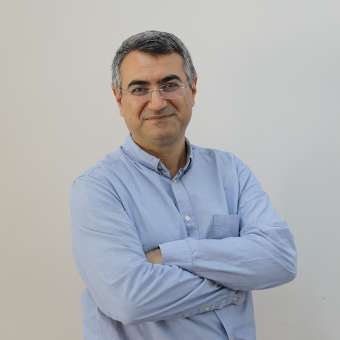
Dr. İsmail Arı is an Assistant Professor in the Computer Science department at Özyeğin University . He holds a PhD from the University of California, Santa Cruz (2004), MS from University of Maryland (2000), and BS in Electrical & Electronics Engineering from Boğaziçi University (1998).
Tuğçe Bilen is an Assistant Professor at Istanbul Technical University's Department of Artificial Intelligence and Data Engineering, within the School of Computer and Informatics. Her research focuses on Artificial Intelligence and Computer and Communication Networks, particularly Digital Twin technologies, 6G wireless systems, and smart IoT applications. PhD in Computer Engineering (2017-2022), Istanbul Technical University Master's in Computer Engineering (2016-2017), Istanbul Technical University Licence in Computer Engineering (2010-2015), Istanbul Technical University Her research explores Digital Twin middleware for smart farms, energy-aware task scheduling in 6G edge networks, aeronautical ad-hoc network optimization, and cloud-based protocol enhancements. Recent work addresses metaverse-driven supply chain optimization and secure routing for aircraft networks. Key publication trends show strong focus on: Digital Twin integration across domains 6G wireless network architectures Adaptive routing algorithms Energy-efficient IoT systems Security in airborne communication Machine Learning for network management Scientific recognition includes: Serhat Özyar Young Scientist of the Year Honorary Award (2023) Doctoral Thesis Award from Istanbul Technical University (2023) TÜBA Doctoral Science Awards-Teknofest (2023) She serves as Principal Investigator for the Unsupervised Learning-Based Management of Ad Hoc Airborne Network Topology project (2024-2026) and holds a patent for Parametric Parsing Based Routing System in Content Delivery Networks (2021). As IEEE member since 2015, she contributes to telecommunications standards.
Professor Okan Topçu is a faculty member in the Department of Computer Engineering at Middle East Technical University, Northern Cyprus Campus (METU NCC), where he serves as Head of the Academic Board of Engineering and Natural Sciences. He holds a Ph.D. and M.S. from Middle East Technical University (Ankara, Turkey, 2007 and 1999 respectively). Education: Ph.D. & M.S. in Computer Engineering from METU Ankara Research Focus: Modeling and simulation, agent-based systems, distributed simulation, cybersecurity, and model-driven engineering
Salih ERMİŞ serves as Assistant Professor and Department Head in the Department of Electrical and Electronics Engineering at Kırşehir Ahi Evran University's Faculty of Engineering and Architecture. With 25+ years of continuous service since 2000, he progressed from Instructor to Doctoral Lecturer in 2018 and assumed departmental leadership in 2022. His academic foundation includes a PhD (2019), MSc (2003), and BSc (2000) in Electrical Education from Gazi University, complemented by English proficiency certification (YDS 55, 2015). His educational journey demonstrates deep institutional commitment: PhD: Electrical Education, Gazi University Institute of Science (2004-2019) MSc: Electrical Education (Thesis), Gazi University Institute of Science (2001-2003) BSc: Electrical Education, Gazi University Faculty of Technical Education (1995-2000) ERMİŞ's research centers on electrical energy systems with emphasis on metaheuristic optimization applications. His work bridges theoretical algorithms and practical power grid challenges, particularly in voltage stability, renewable integration, and smart grid technologies. Recent publications reveal a strategic shift toward photovoltaic forecasting and educational technology, including augmented reality tools for circuit analysis. His methodology consistently applies nature-inspired algorithms (Ant Colony, Grey Wolf, Particle Swarm) to solve multi-objective power flow problems while addressing agricultural energy needs and distribution network efficiency. His publication portfolio shows consistent growth in high-impact domains, with 2023-2025 works focusing on distributed generation optimization, PMU placement, and environmental economic dispatch. The research demonstrates strong industry relevance through industrial control circuit analysis and solar radiation-based output estimation. Award recognition includes: Best Paper Award at 2017 IEEE ICRERA for FACTS devices research As an advisor, he has supervised two Master's theses on photovoltaic forecasting and metaheuristic load flow analysis. His grant leadership spans seven projects including mobile AR applications for engineering education (2025-2027), short-circuit fault analysis software (2023-2024), and solar panel efficiency testing (2021-2023). Collaborative work with researchers like Ramazan Bayındır and Mehmet Yeşilbudak over 2016-2023 demonstrates sustained interdisciplinary teamwork. Current initiatives focus on visual programming tools for power system education and hybrid PV/wind optimization.
Prof. Dr. Tolga Ovatman is a faculty member at the Department of Computer Engineering, Istanbul Technical University , where he has been serving as Head of Department since 2024. His academic career spans roles from Research Assistant (2004-2012) to Associate Professor (2019-2023) and full Professor (2023-present). He previously held administrative roles such as Vice Dean (2018-2022) and Deputy Head of Department (2016-2018). PhD in Computer Engineering (2005-2011) MS in Computer Engineering (2003-2005) BSc from Hacettepe University (1999-2003) His research focuses on model checking , replicated state machines , cloud computing , and object-oriented software . Recent work addresses computation offloading in 6G networks , collaborative text editing data structures , and energy-efficient environmental monitoring systems . Key projects led include Design of a Multiplexed State Machine Storage System for Edge Computing (2022-2024) and Microservice Compatible Symphony Infrastructure Research (2020). He has supervised numerous theses on topics ranging from collaborative text editing to AI applications in watershed management . Publications span IEEE Transactions , Springer , and conferences like CSCE and CLOSER .
Doç. Dr. Emre Sümer, currently serving as an Associate Professor at the Department of Computer Engineering within Baskent University , focuses on image processing, deep learning, and their applications in medical diagnostics and computer vision. His work bridges artificial intelligence with healthcare and geographic information systems. PhD (2011) : Geodesy and Geographic Information Technologies, Middle East Technical University MS (2004) : Geodesy and Geographic Information Technologies, Middle East Technical University BS (2001) : Computer Engineering, Baskent University His research spans medical imaging (e.g., Parkinson's and Alzheimer's detection), steganography for secure data transmission, and machine learning applications in healthcare and urban planning. Recent publications highlight CNN-based diagnostics, sign language recognition, and innovative advertising systems. Scientific awards include the First Oral Presentation Award at the International Congress on Artificial Intelligence in Health (2020). He has supervised multiple PhD/MSc theses on topics like zero-shot sign language recognition and steganography methods. Email: esumer@baskent.edu.tr
Prof. Dr. Yaşar Güneri ŞAHİN serves as the Dean of the Faculty of Engineering and Computer Sciences at Izmir University of Economics, where he also holds a professorship in the Department of Software Engineering. With over two decades of experience in both academia and industry, he has established himself as a prominent figure in software engineering, real-time systems, and educational technologies. His academic journey began with a Bachelor's degree in Computer Engineering from Middle East Technical University in 1994, followed by a Master's in Computer Education from Gazi University in 1999, and culminated with a Ph.D. in Industrial Technology from Gazi University in 2005. Prior to joining Izmir University of Economics in 2008, he served as a faculty member at Yaşar University starting in 2005, and before that, he gained nearly a decade of industry experience in high-level management roles overseeing numerous software projects for both public and private sectors. Prof. ŞAHİN's research spans several interconnected domains with a strong emphasis on practical applications. His work in software engineering focuses on project management methodologies, team building models for educational contexts, and database systems. In real-time systems, he has made significant contributions to forest fire detection technologies using innovative approaches like animal-based biological sensors and radio-acoustic sounding systems. His educational technology research addresses challenges in nursing education, special education for individuals with autism, and internet resource utilization by university students. Notably, his interdisciplinary approach bridges computer science with healthcare applications, particularly in medical informatics where he has developed public health information systems and tools for medical data entry. His scholarly output demonstrates a consistent trajectory of innovation across multiple domains, with particular concentration in the period from 2007-2013. While his early work focused on foundational software engineering concepts and database systems, his research evolved to address pressing societal challenges including forest fire detection, healthcare information systems, and educational technologies. This evolution reflects his ability to identify emerging technological needs and apply software engineering principles to diverse real-world problems. His contributions have been recognized through multiple prestigious awards: TÜBİTAK Scientific Publication Awards (2008-2012) İzmir University of Economics Scientific Publication Awards (2008-2011) As an academic advisor, Prof. ŞAHİN has supervised doctoral and master's theses on diverse topics including heart failure management, triage algorithms for multiple injuries, and software project selection metrics for small and medium enterprises. His administrative leadership extends beyond his deanship to include serving on juries for national art, design, and architecture competitions, as well as evaluating research projects for TEYDEB and TÜBİTAK. His grant activities include serving as a project reviewer and monitor for various technology development initiatives including "Bulut," "ARAGES," "SADE," and "SWH-ATLANTIS." Prof. ŞAHİN maintains an active research laboratory environment focused on real-time systems and software engineering applications. His work often involves interdisciplinary collaboration, particularly with medical professionals on health informatics projects and with education specialists on technology-enhanced learning initiatives. Current research directions appear to focus on the intersection of software engineering principles with healthcare applications and environmental monitoring systems.
Assoc. Prof. MÜJDAT SOYTÜRK is an Associate Professor at Marmara University's Faculty of Engineering, Department of Computer Software. He holds a Ph.D. and M.Sc. in Computer Engineering from Istanbul Technical University (2007 and 2002). His expertise lies in V2X Communications, Connected Cars, Wireless Networks, IoT, and Cyber-Physical Systems, with a focus on communication reliability and data analytics. He leads the VeNIT Lab (founded in 2013) and has secured EU and national grants (e.g., Horizon Europe projects like DECICE and LoLiPoP-IoT). Education: Ph.D. (2007) and M.Sc. (2002) in Computer Engineering from Istanbul Technical University. Research Interests: V2X Networks, IoT Security, UAV-Integrated Systems, Data Routing, and Intelligent Transportation. Notable contributions include vehicular platooning, jamming detection in IoT, and edge-cloud collaboration frameworks. Publications: Over 50 peer-reviewed articles in journals like IEEE Access and Sensors , focusing on network security, V2X protocols, and AI-driven communication systems. Recent work addresses 5G-V2X resource allocation and real-time jamming detection. Awards: Recognized by TÜBİTAK for contributions to RF sensing and automotive cybersecurity validation. Active in editorial roles for journals like Journal of Platform Technology and KSII Transactions . Grants & Labs: Directed 17 projects, including EU-funded initiatives like InSecTT and iRel4.0. VeNIT Lab advances ITS and V2X technologies. Advised 8 master's theses on topics like secure road preemption and UAV mobility patterns. Teaching: Courses on vehicular networks, performance evaluation, and discrete simulation. Engages in industry collaborations, such as the ABHS in-vehicle communication system for Turkey's Ministry of Transport.
Mustak E. Yalcin is a Professor in the Department of Electronics and Telecommunications Engineering at Istanbul Technical University (ITU). He holds a PhD from Katholieke Universiteit Leuven (2004), an MSc from ITU (1997), and a BSc from ITU (1993). His research focuses on nonlinear dynamics, chaos theory, FPGA-based systems, and secure communication. He has been elevated to IEEE Senior Member (2019) and serves as an Associate Editor for multiple journals, including the International Journal of Bifurcation and Chaos and SpringerBriefs in Nonlinear Circuits. His work spans applications in cryptographic systems, cellular neural networks, and hardware security. Notable contributions include FPGA implementations of hyperchaotic systems for medical image encryption, and designs for GPS spoofing detection. He leads projects on sensor-based navigation systems, smart weighing technologies, and energy-efficient embedded systems. Recent activities include chairing tracks at IEEE conferences and organizing events like FOSSistanbul. His lab actively explores wave computing, memristor-based networks, and bio-inspired algorithms for odor classification. Current projects include the design of fault-tolerant cryptographic hardware and real-time spectrum analyzers.
Ayşe Tosun Kühn is an Associate Professor in the Department of Computer Engineering at Istanbul Technical University (ITU), where she also serves in administrative roles such as Deputy Dean and Management Board Member of the ITU Artificial Intelligence and Data Science Application and Research Center. She earned her Ph.D. in Computer Engineering from Boğaziçi University and has held academic positions at Sabancı University and the University of Oulu. Her research lies at the intersection of software engineering, empirical methods, and data science, with a focus on software quality, defect prediction, technical debt, vulnerability analysis, and test-driven development. She leads numerous funded research projects, including those supported by TÜBİTAK and industry collaborations, applying machine learning and reinforcement learning to software engineering challenges. Her recent publications reflect a strong trend in applying advanced machine learning techniques—particularly deep learning and reinforcement learning—to problems in software analytics, developer behavior modeling, and delivery optimization. She has made significant contributions to empirical studies on test-driven development, defect prediction models, and vulnerability detection in code. Her work is frequently published in high-impact journals such as IEEE Transactions on Software Engineering, Empirical Software Engineering, and Journal of Systems and Software. She has served as a guest editor and editorial board member for the Turkish Journal of Electrical Engineering and Computer Sciences , and has contributed book chapters on data science in software engineering. Her research has been cited over 1,700 times, with an h-index of 23. Scientific Awards: None explicitly mentioned. She advises several graduate students and has collaborated extensively with researchers in Turkey and internationally. She has also contributed to industry applications through projects on software measurement, defect prediction, and AI-based analytics. She is actively involved in organizing and contributing to major software engineering conferences and workshops. She is a key member of ITU’s AI and Data Science initiatives, contributing to both academic research and practical implementations in software engineering.
Cihat Cetinkaya is a Professor in the Department of Software Engineering at Mugla Sitki Kocman University. He holds a PhD in Information Technologies from Ege University and has supervised research on deep learning applications in medical imaging and network optimization for video streaming. Bachelor's: Pamukkale University - Computer Engineering Master's: Ege University - Information Technologies Doctorate: Ege University - Information Technologies His research focuses on Software-Defined Networking (SDN) , Dynamic Adaptive Streaming over HTTP (DASH) , and Machine Learning applications in network management and medical imaging. He has pioneered SDN-based architectures for secure IoT systems and optimized DASH streaming via dynamic routing and MPTCP integration. Key trends in his publications include blockchain network optimization , SDN-driven quality of service (QoS) , and deep learning for radiograph analysis . He has developed tools like NetSim for network simulation and contributed to 5G UPF design via XDP programming. Scientific Awards: Distinguished Paper Award (2017) Student Travel Grant Award (2016) Best Paper Award (2014) As Head of the Department of Software Engineering since 2021, he has taught courses in Software Ethics , Software Testing , and Software-defined Networking . He serves on academic incentive committees and international project evaluation panels.
Muhammed Fatih ADAK is an Associate Professor at Sakarya University's Faculty of Computer and Information Sciences, Department of Computer Engineering. His work spans software engineering, artificial intelligence, and sensor systems with applications in energy, healthcare, and industrial automation. Doctorate: Sakarya University (2016) - Electronic Nose Data Classification with AI Master's: Kocaeli University (2012) - Elevator Simulator Design Bachelor's: Dokuz Eylul University (2009) - Computer Engineering Research focuses on machine learning , software testing , fuzzy logic , anomaly detection , and decision support systems . His articles (2013-2024) explore AI-driven solutions for natural gas monitoring, medical diagnostics, and industrial processes. Recent publications include systematic reviews of AI integration in software engineering phases and predictive models for gas consumption and voice pathology. He supervises graduate students and contributes to academic projects like Smart Gas Sensor Systems and Adaptive Online English Placement Exams . Teaches courses: Data Structures, Fuzzy Logic, Software Testing, Java Programming Co-authored books: Principles of Programming Languages , Visual Programming Managed EU-funded projects like HOPE (street rehabilitation) and AI-Enhanced Performance Evaluation Platforms Develops applications for visually impaired education and workplace safety systems
Dr. Farshad Miramirkhani serves as an Assistant Professor in the Department of Electrical and Electronics Engineering at Isik University's Faculty of Engineering and Natural Sciences. As a full-time lecturer and IEEE Senior Member, he directs the OPTWiCOM Research Group focusing on physical-layer design of optical wireless communication systems. Education: BSc in Electrical and Electronics Engineering, Isfahan University (2007-2011) MSc in Electrical and Electronics Engineering, Isfahan University (2011-2014) PhD in Electrical and Electronics Engineering, Ozyegin University (2015-2018) Research Focus: His expertise spans channel modeling and characterization for visible light communication (VLC) systems across medical, vehicular, and underwater environments. Current investigations include machine learning-enhanced adaptive modulation for medical body sensor networks, 5G/6G integration with VLC, and infrared communications. His work emphasizes practical applications in health monitoring and next-generation wireless infrastructure. Publication Trends: Recent publications (2021-2025) demonstrate a clear trajectory toward health-focused VLC applications and standardization contributions. Over 60% of his recent work addresses medical body sensor networks and channel modeling for healthcare, while significant efforts support IEEE 802.11bb standardization through reference channel models for diverse environments. Machine learning integration for adaptive systems represents a growing research thread. Awards and Recognition: IEEE 802.11bb-2023 Working Group Award (2023) Board of Trustees Outstanding Scientific Achievement Award (Isik University, 2019 & 2020) Best Paper Award at IEEE BlackSeaCom 2019 Ord. Prof. Bedri Karafakioglu Research Incentive Award (2019) IEEE Turkey Section Doctoral Thesis Award Academic Leadership: Dr. Miramirkhani advises Master's students on VLC-integrated health monitoring systems and vehicular communications. His OPTWiCOM group secures funding through projects like 'Innovative Optical Wireless Technologies for 5G and Beyond' and 'LiFi for In-Flight Entertainment Systems', providing graduate students with full tuition waivers, housing, health insurance, and research stipends. He teaches core courses including Wireless Communications and Introduction to Communication Systems. Research Infrastructure: The OPTWiCOM group maintains specialized facilities for VLC channel emulation and physical-layer testing, with active collaborations on medical body sensor networks and underwater communications. Current initiatives focus on machine learning-enhanced VLC systems for 6G networks and standardization of light communication protocols.
Murat IŞIK is a Lecturer in the Department of Computer Engineering at the Faculty of Engineering and Architecture, Kırşehir Ahi Evran University. He has been serving as a full-time faculty member since 2017 and currently holds additional administrative positions as Department Head (since 2025) and Research Application Center Deputy Director (since 2024). PhD in Computer and Information Engineering, Sakarya University (2011-2017) MSc in Computer Engineering, Sakarya University (2009-2011) Bachelor's Degree from Dicle University, Batman Technical Education Faculty (2002-2006) Dr. IŞIK's research spans multiple areas in computer science and engineering, with a focus on artificial intelligence applications. His primary research interests include Computer System Software, Image Processing, Programming Languages, Computer Software and Software Engineering, Machine Learning, and Artificial Intelligence. His work demonstrates a strong interdisciplinary approach, applying computer vision and deep learning techniques to diverse fields including medical diagnostics, education technology, and accessibility solutions. His recent publications show a trend toward practical applications of AI in education, healthcare, and everyday life challenges. He has developed innovative solutions such as real-time assessment systems for primary schools, assistive technology for visually impaired individuals, and classification systems using deep learning approaches. Research World Medal and Research World Excellent Paper Award (2016) Dr. IŞIK has successfully supervised multiple master's students and is actively involved in numerous research projects funded by higher education institutions. His projects range from BCI-supported deep learning models for motor/facial movement detection to AI-assisted insole production and intelligent test systems for primary school students. He has secured funding for projects extending through 2027, demonstrating sustained research productivity. He leads the Computer Engineering department's research efforts and has established collaborations with researchers both within Turkey and internationally, particularly in Iraq. His laboratory work focuses on implementing practical AI solutions with an emphasis on accessibility and educational applications.
Pelin Angin is an Assistant Professor in the Department of Computer Engineering at Middle East Technical University (METU), affiliated with the S2RL and WINS research laboratories. She holds a BS in Computer Engineering from Bilkent University and a PhD in Computer Science from Purdue University. Previously, she served as a Visiting Assistant Professor and Postdoctoral Research Associate at Purdue University. Her research focuses on High-Performance Mobile-Cloud Computing, Cloud Computing and IoT Security, Distributed Systems, Blockchain, and 5G Security. Her work addresses critical challenges in cybersecurity and efficient computing architectures for modern networked systems. Her publications exhibit strong emphasis on cybersecurity innovations, particularly intrusion detection systems, blockchain applications, and network security for IoT and 5G environments. Recent works demonstrate growing interest in AI-driven security solutions and energy-efficient computing frameworks.