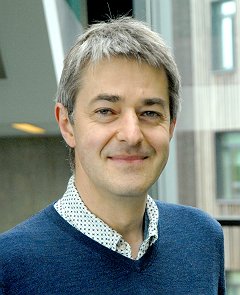
Rolf Drechsler is a Full Professor and Head of the Group of Computer Architecture at the University of Bremen's Institute of Computer Science since 2001, and Director of the Cyber-Physical Systems Group at DFKI Bremen since 2011. He holds an adjunct professorship at the Indian Statistical Institute and has been affiliated with Duke University. Education: Diploma (1992) and Dr. phil. nat. (1995) in Computer Science from Goethe University Frankfurt Academic Leadership: Dean of Mathematics and Computer Science Faculty (2018-2025), Vice Rector for Research (2008-2013) His research focuses on formal verification , RISC-V architectures , and quantum/in-memory computing . Recent work explores LLM integration in hardware testing and polynomial-based verification techniques. Publications from 2024-2025 span IEEE Transactions , DATE , and DAC , emphasizing automated verification , quantum circuit mapping , and LLM-driven testbench generation . Scientific Awards IEEE/ACM Best Paper Awards (2013, 2018) Berninghausen-Preis for Innovative Teaching (2018) IEEE Fellow (2015) Founder Award for Solvertec (2013) He has served on program committees for DAC, ICCAD, DATE, and founded graduate schools in Embedded Systems and System Design under Germany's Excellence Initiative.
Prof. Dr.-Ing. Sebastian Esser serves as Group Lead for Information Management at the Chair of Computing in Civil and Building Engineering at Technical University of Munich. His research focuses on advancing Building Information Modeling (BIM) methodologies, particularly in infrastructure and railway applications. He contributes significantly to international standardization efforts including IFC-Road and IFC-Rail projects, and leads research initiatives such as RIMcomb and BauPuls360. Dr. Esser's research spans several critical areas in digital construction: Graph-based version control systems for BIM collaboration Digital twin development for infrastructure management Semantic modeling of built environments BIM-based regulation checking for railway infrastructure Interdisciplinary model coordination techniques Knowledge representation in civil engineering His work bridges theoretical computer science with practical civil engineering applications, focusing on improving data interoperability and workflow efficiency in construction projects. Analysis of his recent publications reveals a strong emphasis on graph-based approaches to BIM challenges. His research has evolved from foundational work on BIM programming interfaces to sophisticated implementations involving knowledge graphs, semantic reasoning, and digital twin architectures. Key trends include increasing integration of semantic web technologies with BIM standards, development of specialized query interfaces like GraphQL for construction data, and application of formal methods to infrastructure modeling problems. Dr. Esser actively supervises numerous bachelor's and master's theses annually, with recent topics covering graph-based entity alignment, BIM-GIS integration for flood assessment, incremental model updates, and digital twin implementations. His teaching portfolio includes courses such as Bau- und Umweltinformatik, BIM.fundamentals, BIM.infra, and Semantic Modeling of the Built World, demonstrating his commitment to educating the next generation of digital construction professionals. He is involved in multiple research initiatives including DFG FOR 5672 (The information backbone of robotized construction), SPP 2187 (Adaptive modularized constructions), and AM2PM (Additive to Predictive Manufacturing). His laboratory work spans the BIM-Lab and related computational infrastructure supporting his research in digital construction technologies.
Jérôme Leroux is a Directeur de Recherche (DR CNRS) at the Laboratoire Bordelais de Recherche en Informatique (LaBRI) , affiliated with the University of Bordeaux , France. His research focuses on formal verification of infinite-state systems, vector addition systems, Presburger arithmetic, and acceleration techniques for symbolic computation. Key research themes include: Vector Addition Systems (VASS) and Petri Nets Automata-based representations for Presburger arithmetic Abstract interpretation and CEGAR frameworks Verification of asynchronous distributed systems His recent publications highlight work on acceleration techniques for convex binary relations, serialized digit automata, and regular acceleration methods for number decision diagrams. These contributions are implemented in tools like the Talence Presburger Arithmetic Suite (TAPAS) and the FAST tool for symbolic verification. Scientific awards include a Best Paper Award at TURING'100 . He has advised several Ph.D. students and postdoctoral researchers, including Alexander Heußner and Thibault Hilaire (current Ph.D. candidate). Leroux is actively involved in organizing conferences like MFCS'23 and serving on program committees for venues such as VMCAI'26 .
Alexandra Silva is a Professor of Computer Science at Cornell University with prior affiliations as a Royal Society Wolfson Fellow and Professor of Algebra, Semantics, and Computation at University College London . She leads a research group focusing on the modular development of specification languages and algorithms for models of computation, emphasizing coalgebra as a unifying mathematical framework. Research Interests Her work spans foundational and applied areas in theoretical computer science, including: Coalgebraic methods for formal verification Automata theory and learning algorithms Probabilistic programming and semantics Programming language design (e.g., NetKAT, Kleene Algebra with Tests) Concurrency theory and distributed systems Algebraic structures in computation Recent publications address network verification (StacKAT), symbolic automata learning, probabilistic regular expressions, and outcome logic for correctness/incorrectness reasoning. She is actively involved in organizing academic events like OPLSS 2025 and co-authoring foundational works in Formal Aspects of Computing and Theoretical Computer Science . Scientific Awards Distinguished Paper Award (ACM SIGPLAN POPL, 2020) Best Paper Award (RTA, 2015) She teaches courses on Kleene Algebra with Tests (KAT) and verification at summer schools like Marktoberdorf 2025 , and her research includes collaborations on probabilistic network verification (ProbNV) and stochastic system modeling.
Prof. Dr.-Ing. Steffen Helke serves as a full Professor in the Department of Electrical Engineering & Information Technology at University of Applied Sciences Südwestfalen. His academic roles include Senate membership, evaluation officer for the department, program coordinator for Media Informatics, and spokesperson for the GI Specialist Group Automotive Software Engineering. Current affiliations span committee work in electrical engineering bachelor programs and leadership in safety-critical software research. His research focuses on functional software security , safety-critical system verification , and model-based quality assurance . Key areas include information flow control languages, automotive software security, hierarchical statechart validation, and requirements delta analysis for efficient development estimation. Methodologies emphasize formal verification, static analysis, and tool-supported refactoring to ensure robustness in embedded systems. Teaching encompasses advanced courses in Software Engineering, IT Security, Ethical Hacking, and Competitive Programming. Thesis supervision occurs in research areas like NLP-based requirements analysis, refactorings for security languages (Jif), and model checking for Statecharts. Industrial collaborations facilitate project/bachelor theses with real-world security applications. Research trends from publications show consistent focus on bridging formal methods with industrial software development. Dominant disciplines include Software Engineering (72% of works) and Formal Verification (58%), with emerging subfields like NLP-assisted requirements engineering (2019) and automotive security frameworks. Keyword analysis reveals sustained emphasis on verification (100% of works), security (80%), and automotive applications (40%). Administrative contributions include leadership in the combined Electrical Engineering bachelor program and active participation in university governance through department councils. Tools developed in his research (e.g., Delta Analyzer, R2BC) are integrated into curricula using ReqView, Matlab/Simulink, and Enterprise Architect for systematic requirement engineering and UML modeling.
Myra Cohen is a Professor and the Lanh and Oanh Nguyen Chair in Software Engineering in the Department of Computer Science at Iowa State University. Previously, she held the position of Susan J. Rosowski Professor at the University of Nebraska-Lincoln where she was a member of the ESQuaReD software engineering research group. She serves on the ASE Steering Committee and has held leadership roles including general chair of ASE 2015 and program co-chair for ICST 2019 and ESEC/FSE 2020. Dr. Cohen earned her Ph.D. from the University of Auckland, New Zealand, her M.S. from the University of Vermont, and her B.S. from the School of Agriculture and Life Sciences at Cornell University. Her academic journey includes lecturing positions at both the University of Auckland and University of Vermont during her graduate studies. Her research spans several interconnected domains focused on software quality and assurance. A significant portion of her work addresses software testing challenges in highly-configurable systems, where she applies search-based techniques and combinatorial designs to create efficient test suites. More recently, her research has expanded into innovative areas including software testing for biological systems, quantum computing applications, and security testing through genetic improvement techniques. Her work demonstrates a consistent theme of addressing complex verification challenges through creative application of formal methods and automated techniques. Analysis of her recent publications reveals a growing focus on emerging domains including quantum software testing, molecular/biological computing systems, and assurance cases for safety-critical systems. She has increasingly incorporated AI techniques, particularly large language models, into traditional software engineering problems while maintaining her foundational work in configurable systems and metamorphic testing. NSF CAREER award recipient AFOSR Young Investigator Award recipient ACM Distinguished Scientist Recipient of 4 ACM Distinguished Paper awards Dr. Cohen has served as chair and committee member for numerous conferences including ASE, ICSE, ISSTA, ESEC/FSE, and ICST. She has mentored numerous students through the doctoral symposiums and student research competitions at major software engineering conferences. Her research has been supported by significant grants including those from NSF and AFOSR. She leads the LaVA-OPs (Laboratory for Variability-Aware Assurance and Testing of Organic Programs) research group at Iowa State University, which focuses on testing challenges in biological and organic computing systems.
Matteo Camilli is an Associate Professor in the Department of Electronics, Information and Bioengineering (DEIB) at Politecnico di Milano, Italy, where he leads research in software engineering and verification. His academic journey includes positions as Assistant Professor at Free University of Bozen-Bolzano and postdoctoral research at the University of Milan and University of Bergamo. His educational background includes a PhD in Computer Science (2015), MSc in Computer Science (2012), and BSc in Computer Science (2009), all from the University of Milan. His doctoral research focused on combining advanced abstraction techniques and big data approaches to address state explosion problems in formal verification. Camilli's research primarily centers on software verification, testing, and methods to improve dependability of autonomous, cyber-physical, service-based, and ML-enabled critical systems. His work spans formal methods, model-based testing, uncertainty quantification, and design-time/runtime verification with applications to complex distributed systems. His recent publications reflect a growing focus on explainable self-adaptation, quality assurance for LLM-based systems, and managing uncertainty in adaptive systems. His publication record includes papers in top journals (TOSEM, TAAS, JSS, EMSE) and conferences (ICSE, ISSRE, ICST, ICSA). He serves on program committees for prestigious conferences including ICSE, ICSA, ICST, and ECSA, and is on the steering committee for the International Workshop on Formal Approaches for Advanced Computing Systems (FAACS). Camilli actively contributes to the academic community through conference organization, including serving as Program Committee Member for numerous conferences and as Program Co-Chair for the Software Architecture track at ACM SAC. He also serves as guest editor for special issues on automated testing and dependable AI systems. His teaching portfolio at Politecnico di Milano includes Software Engineering 2, Software Engineering for Automation, and Distributed Software Development. Previously at Free University of Bozen-Bolzano, he taught Systems Engineering and Verification and Reliability for Dependable Systems.
Domenico Bianculli is an Associate Professor and Chief Scientist 2 at the Interdisciplinary Centre for Security, Reliability and Trust (SnT) at the University of Luxembourg. He leads the Software Verification and Validation (SVV) research group and is affiliated with the Department of Computer Science in the Faculty of Science, Technology and Medicine (FSTM). Additionally, he serves as the deputy study program director for the Master in Space Technologies and Business. Dr. Bianculli earned his PhD from the University of Lugano (Switzerland) under Carlo Ghezzi, with a dissertation titled "Open-world software: Specification, Verification, and Beyond." He also holds a MSc in Computing Systems Engineering and a BSc in Computer Engineering from Politecnico di Milano (Italy). His research focuses on the specification, verification and validation of software systems, particularly evolvable software systems. His work spans trace checking and run-time verification of temporal properties, modeling access control policies, program analysis for security, incremental verification techniques, and verification of service-oriented systems. Dr. Bianculli bridges theoretical foundations with practical applications in cyber-physical systems, financial technology, and regulatory compliance. His recent publications reveal a strong trend toward applying machine learning to software engineering challenges, particularly in log analysis, anomaly detection, and automated compliance checking. He has made significant contributions to verifying cyber-physical systems through techniques for stress testing control loops and trace diagnostics for signal-based temporal properties. His work increasingly addresses financial technology challenges, with papers focusing on automated regulatory compliance related to GDPR and financial regulations. ACM SIGSOFT Distinguished Paper Award for "Efficient large-scale trace checking using MapReduce" (ICSE 2016) Nomination for the best paper award for "SMT-based checking of SOLOIST over sparse traces" (FASE 2014) Dr. Bianculli leads multiple significant research projects including KITS24/19067232 "SnT-R2S" funded by FNR Luxembourg, LOGODOR "Automated Log Smell Detection and Removal" funded by FNR's CORE scheme, and several financial regulation projects including AFRICA, ICCOFIDO, and RUMOFA. His research has been supported by national funding agencies and industry partnerships with CSSF Luxembourg, HITEC Luxembourg, BGL BNP Paribas, and LuxSpace. As head of the SVV research group at SnT, Dr. Bianculli oversees a team developing advanced techniques for software specification, verification, and validation. His group works on theoretical foundations and practical applications, with current projects addressing challenges in cyber-physical systems, financial technology, and regulatory compliance. The group maintains strong collaborations with industry partners in the financial sector and space technology domains.
Tevfik Bultan is a Professor and Chair of the Department of Computer Science at the University of California, Santa Barbara. His research focuses on software verification, program analysis, software engineering, and computer security. He directs the Verification Laboratory (VLab) and has authored over 100 refereed publications. Education Ph.D. in Computer Science, University of Maryland, College Park (1998) M.S. in Computer Engineering, Bilkent University (1992) B.S. in Electrical Engineering, Middle East Technical University (1989) Research Focus Bultan's work spans automated verification techniques, security vulnerability detection, quantitative program analysis, and symbolic execution. His lab develops tools for analyzing software systems with applications in cloud security, network protocols, and embedded systems. Awards and Honors ACM Distinguished Scientist (2016) NSF CAREER Award (2000) UCSB Outstanding Graduate Mentor Award (2016) ACM SIGSOFT Distinguished Paper Awards (2005, 2014) NATO Science Fellowship (1993) Professional Activities He has chaired program committees for top conferences including ICSE, FSE, and ASE. Currently serves as associate editor for ACM TOSEM and on steering committees for ISSTA, ASE, and ICSE. Regularly advises PhD students and postdoctoral researchers in verification and security. Laboratory Leads the Verification Laboratory (VLab) focusing on automated reasoning techniques for software systems. Current projects include symbolic analysis for vulnerability detection, quantitative information flow, and security policy verification.
Radu Calinescu is Professor of Computer Science at the University of York, UK, where he serves as Principal Investigator for the UKRI Trustworthy Autonomous Systems Node in Resilience and leads the Trustworthy Adaptive and Autonomous Systems and Processes (TASP) Research Team. His academic career includes previous positions as Lecturer in Computer Science at Aston University (2009-2012), Senior Researcher at the University of Oxford (2008-2009), and part-time Lecturer at Oxford (2005-2009). Professor Calinescu's research focuses on formal modelling, analysis, verification and controller synthesis for autonomous and self-adaptive systems, with particular emphasis on parametric and probabilistic model checking, automated and model-driven software engineering. His work applies these approaches to robotic, cyber-physical, embedded and service-based systems, with a strong commitment to using formal methods at runtime to enhance the resilience and safety of critical autonomous systems. His extensive publication record spans top-tier journals including IEEE Transactions on Software Engineering, Journal of Systems and Software, and Automated Software Engineering. His research demonstrates consistent focus on verification techniques for adaptive systems, with increasing attention to safety-critical applications in recent years. His work bridges theoretical formal methods with practical applications in robotics and autonomous systems. British Computer Society Distinguished Dissertation Award for his DPhil thesis on Autonomic-Independent Loop Parallelisation Principal Investigator for multiple major projects including Continual Verification and Assurance of Robotic Systems under Uncertainty (ORCA Hub/EPSRC), Safety of AI Techniques (AAIP/Lloyd's Register Foundation), and CSI:Cobot Program Committee Co-Chair for major conferences including SEFM 2021, SEAMS 2020, and SERENE 2019 Professor Calinescu actively supervises numerous PhD students and postdoctoral researchers, with current team members including Faisal Alhwikem, Xinwei Fang, Mario Gleirscher, James Harbin, and Colin Paterson. His research group is based at the Ron Cooke Hub in York, a purpose-built facility housing world-class research groups and startups. His former students have gone on to academic positions at institutions worldwide and industry roles at major technology companies.
Wing-Kwong Chan is an Associate Professor in the Department of Computer Science at City University of Hong Kong. With a background that includes industry experience as a software engineer, Dr. Chan returned to academia and has established himself as a leading researcher in software engineering with a focus on emerging technologies. Dr. Chan received his BEng, MPhil, and PhD all from The University of Hong Kong. His academic journey began with a hardware-oriented Computer Engineering degree before shifting to software engineering for his graduate studies. His research interests center on software engineering, particularly the technical aspects interfacing with machine learning, blockchain, and GPU technologies. He addresses challenges in program analysis and concurrency, with recent work focusing on deep learning model verification and robustness. His publications span top venues including TOSEM, TSE, ICSE, ESEC/FSE, and ASE. Dr. Chan's recent publications demonstrate a strong trend toward integrating software engineering principles with deep learning systems, particularly in verification, testing, and robustness of AI models. His work bridges theoretical software engineering concepts with practical applications in emerging technologies. Best Paper Award from COMPSAC'04 Best Paper Award from COMPSAC'08 Best Paper Award from COMPSAC'10 Best Paper Award from QSIC'11 Best Paper Award from QRS'16 Best Paper Award from ISET'18 CityU President's Award 2017 Dr. Chan has successfully advised numerous PhD and MPhil students, with alumni dating back to 2006. He has secured substantial research funding through multiple Hong Kong Research Grants Council projects, ITF grants, and international collaborations. His current research focuses on patch robustness certification for deep learning models, reflecting his ongoing commitment to advancing software engineering practices for emerging technologies. As Program Leader for the MSc in E-Commerce program from the CS Department, Dr. Chan also contributes significantly to academic administration and curriculum development at City University of Hong Kong.
Antonio Filieri is a Senior Applied Scientist at Amazon Web Services (AWS) and holds a Visiting Associate Professor position at the Department of Computing, Imperial College London. Previously, he was a tenured Associate Professor at Imperial College London (2022-2024) and Assistant Professor (2016-2022), and served as Assistant Professor at the University of Stuttgart between 2013 and 2015. His academic career spans over a decade with significant contributions to software engineering research. Dr. Filieri's research focuses on formal mathematical methods for software design, verification, self-adaptation, and security. His primary research areas include static analysis, privacy, and automated test generation for security; exact and approximate methods for probabilistic program analysis; control theory for adaptive software; quantitative verification and model checking; and runtime-efficient and incremental verification. His work bridges theoretical foundations with practical applications in industry settings, particularly in cloud computing and security domains. His recent publications demonstrate a strong focus on probabilistic methods for software analysis, security testing, and performance modeling. The research trends show increasing integration of formal methods with machine learning techniques, particularly in test oracle generation and neural network analysis. There's also a clear emphasis on scalability and practical applicability of verification techniques to real-world systems like serverless computing and microservices architectures. Dr. Filieri has received numerous prestigious awards for his contributions: Best Student Paper Award (2025) for 'Robust Probabilistic Model Checking with Continuous Reward Domains' ACM Distinguished Paper Award (2023) for 'Sibyl: Improving Software Engineering Tools with SMT Selection' Best Paper Award (2022) for 'Enhancing Performance Modeling of Serverless Functions via Static Analysis' Best Artifact Award (2017) for 'Self-adaptive video encoder: comparison of multiple adaptation strategies made simple' Most Influential Paper Award (awarded at SEAMS 2025) for 'Software Engineering Meets Control Theory' ACM SigSoft Distinguished Paper Award (2011) for 'Run-time Efficient Probabilistic Model Checking' Dr. Filieri has advised several PhD students including Donato Clun (2024), Runan Wang (2024), and Xiaotong Ji (expected 2025). His advising focuses on probabilistic program analysis, automated testing, and security verification. His research has been supported by significant grants from both academic and industry sources, enabling collaborations across multiple institutions and contributing to advancements in software engineering practices. While specific lab information isn't prominently featured in the provided materials, Dr. Filieri's work suggests strong connections with research groups focused on formal methods, software verification, and adaptive systems at both Imperial College London and AWS. His research often involves interdisciplinary collaboration between theoretical computer science and practical software engineering challenges.
Bernd Fischer is a Professor and the current Head of Division in the Division of Computer Science at Stellenbosch University, South Africa. Previously, he held positions at TU Braunschweig, NASA Ames Research Center, and University of Southampton, establishing a strong international academic background in software engineering and formal methods. Professor Fischer's research focuses on automated software engineering, particularly logic-based techniques. His work spans specification-based component reuse, program synthesis, and program verification, with current emphasis on annotation inference, software model checking, and human-oriented presentation of verification results. His research bridges theoretical foundations with practical applications, particularly in concurrent program verification, grammar-based testing, and fault localization techniques. His work has significant implications for improving software reliability and developer productivity. Analysis of his recent publications reveals a strong focus on concurrent program verification through lazy sequentialization techniques, with substantial contributions to tools like CSeq and ESBMC. His research demonstrates consistent innovation in software verification, particularly in addressing the challenges of concurrency, bounded model checking, and fault localization. The interdisciplinary nature of his work connects theoretical computer science with practical software engineering challenges. ASE 2012 Most Influential Paper Award ACM Distinguished Paper Award Best Presentation Award Professor Fischer has successfully advised PhD students including Gillian Greene, who defended her thesis on "Concept-Based Exploration of Rich Semi-Structured Data Collections," and Geoff Birch, who completed work on "Fast, Fully-Automated, Model-Based Fault Localisation and Repair with Test Suites as Specification." His mentoring approach integrates theoretical rigor with practical tool development. His research has been supported through various academic grants enabling the development of multiple software verification tools. Professor Fischer leads development of several important software engineering tools including AutoBayes for statistical program synthesis, ConceptCloud for interactive visualization of software repositories, CSeq for concurrent program verification, and ESBMC for software model checking. These tools represent significant contributions to the software engineering research community and have been recognized in international verification competitions.
Yun Lin is an Associate Professor and Deputy Head of the Department of Computer Science and Technology at Shanghai Jiao Tong University's School of Computer Science. Prior to joining SJTU, Lin served as a Research Assistant Professor at the National University of Singapore working with Prof. Dong Jin Song. Lin leads the CoPhi ("Code Philia") research group, which focuses on the intersection of Software Engineering, AI, and Security. Lin's research spans three major areas: Automatic Programming (including code editing, software testing, and debugging), Explainable AI (focusing on representation interpretation and training data attribution), and Web Misinformation (particularly phishing and scam detection). The research has resulted in numerous tools including CoEdPilot for code editing recommendation, DeepDebugger for interactive debugging of deep classifiers, and Phishpedia for phishing webpage detection. Lin's recent publications demonstrate a strong trend toward integrating AI techniques, particularly large language models and vision language models, with traditional software engineering and security tasks. The work shows increasing sophistication in understanding project context, handling interactive nature of programming tasks, and addressing security challenges in the age of generative AI. Key themes include consistency-based approaches for anomaly detection, agent-based frameworks for complex tasks, and hybrid models that combine symbolic reasoning with neural approaches. ACM Distinguished Paper Award in ICSE'18 for "Towards Optimal Concolic Testing" Distinguished Reviewer Award in FSE'25 2nd prize Research Prototype Award in ChinaSoft'24 Lin advises a large team of PhD, Master's, and undergraduate students, with several publications co-authored with students appearing in top venues. Current research is supported by collaborations with National University of Singapore, particularly with Prof. Dong Jin Song, and includes projects on code editing, GUI testing, and phishing detection. The CoPhi group maintains active development of multiple research tools and datasets. The CoPhi research group under Lin's leadership focuses on building practical tools that bridge the gap between theoretical advances and real-world programming and security challenges. The group's work spans from fundamental program analysis techniques to applied security solutions, with an increasing emphasis on leveraging AI capabilities while maintaining explainability and reliability.
Michael Pradel is a full professor in the Computer Science Department at the University of Stuttgart and faculty member at CISPA Helmholtz Center for Information Security (effective September 2025), where he leads the Software Lab. He is also affiliated with the International Max Planck Research School for Intelligent Systems and the Stuttgart ELLIS Unit, reflecting his interdisciplinary research approach. His research interests focus on software engineering, particularly program analysis, bug detection, and the application of machine learning to developer tools. Pradel's recent work increasingly explores LLM-based approaches for program repair, code analysis, and automated software development, as evidenced by projects like RepairAgent and ExecutionAgent. Pradel's publication record shows a clear trend toward integrating AI techniques with traditional software engineering methods, with recent papers focusing on LLM applications for program repair, change validation, and quantum software analysis. His work bridges theoretical foundations with practical tool development, as seen in frameworks like DyLin for Python analysis and LintQ for quantum programs. Ernst-Denert Software Engineering Award Emmy Noether grant (1.3 million Euro) by the DFG ERC Starting Grant (1.5 million Euro) Multiple ACM SIGSOFT Distinguished Paper Awards ACM Distinguished Member recognition Pradel actively mentors PhD students, with recent graduates including Matteo (specializing in quantum software) and Luca (focusing on software evolution). His group has received significant funding and maintains strong industry connections, including past sabbaticals at Facebook. He serves in leadership roles for major conferences, including PC co-chair for FSE 2027, demonstrating his standing in the software engineering community. The Software Lab maintains active collaborations with institutions worldwide, including CMU, Google, KAIST, and several European universities.