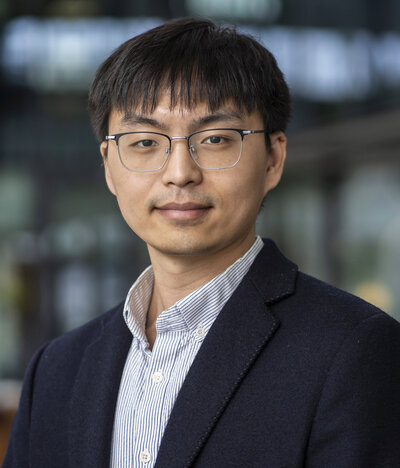
R. Hai is a researcher active in the fields of Machine Learning , Relational Databases , and Quantum Computing . Their work bridges the integration of large language models (LLMs) with database systems, focusing on optimizing query processing and data management through linear algebraic methods. Hai's research emphasizes seamless data-ML workflows and innovative applications of relational databases in emerging domains. Key Research Themes : LLM compilation to SQL, quantum circuit simulation via RDBMS, and convergence of data integration with ML. Collaborations : Active in international academic networks, with contributions to conferences like SIGMOD and IEEE journals. Scientific Awards: Veni grant AES2022 (2023) Publications demonstrate expertise in overcoming data barriers, enhancing database performance for ML tasks, and simulating quantum computations using relational database management systems.
Yaoxin Wu is an Assistant Professor at the Eindhoven University of Technology, affiliated with the Department of Industrial Engineering and Innovation Sciences. His research bridges deep learning and combinatorial optimization to solve complex problems in transportation, scheduling, and network design. Education : PhD in Computer Science from Nanyang Technological University (2023). Wu specializes in artificial intelligence and operations research , focusing on graph neural networks, stochastic programming, and multi-objective optimization. His work has significant applications in UAV routing and on-demand delivery systems. His 2025 publications highlight trends in neural combinatorial optimization for stochastic job shop scheduling, ride-hailing, and drone logistics. Key subfields include deep reinforcement learning, preference modeling, and topological graph learning. He has supervised 9 students, including PhD candidates Xia Jiang and Igor Smite, and Master’s students like Venkata Roshan Mannepu and Floor Halkes. Wu's research is funded by projects like LEO (Holland High Tech | TKI HSTM) and SURF Cooperative grants. His educational activities include teaching Fundamentals of Algorithmic Programming and AI-Driven Business Operations , emphasizing data-driven methods for manufacturing processes.
Marc Geilen is an Associate Professor at the Electronic Systems group of Eindhoven University of Technology (TU/e) . He leads the Model-Based Design Lab within the CompSOC Lab and High Tech Systems Center .
Jeroen Voeten is a Full Professor in the Electronic Systems group of the Department of Electrical Engineering at Eindhoven University of Technology (TU/e). He also holds a position as a Research Fellow at the Embedded Systems Institute in Eindhoven and is a Senior Scientist and Scientific Advisor to TNO-ESI since 2017. Academic Background: MSc in Mathematics and Computing Science (1991, TU/e) PhD in Electrical Engineering (1997, TU/e) Voeten's research focuses on formal methodologies for hardware/software system specification, design, and implementation. His work spans computer architectures, embedded systems, performance modeling, and cyber-physical systems. He is currently leading the Carm 2G project with ASML to enhance model-based engineering environments for wafer scanner control systems. His recent publications emphasize advancements in global scheduling, fault-tolerant real-time systems, and hybrid performance modeling. These studies address critical areas like latency reduction, schedulability improvements, and data age analysis in multi-rate task chains. Scientific Awards: Best Paper Award, Forum on Specification and Design Languages (FDL 2005) Best Paper Award, Property-Preserving Synthesis for Unified Control and Data-Oriented Models (2005) Voeten has contributed to 87 conference reports, 13 academic reports, 11 book chapters, and 11 journal articles, reflecting his extensive involvement in both academic and industrial research. Labs and Collaborations: He is affiliated with the Model-Based Design Lab and the High Tech Systems Center at TU/e, collaborating with institutions like TNO-ESI and industry leaders such ASML. His work aligns with the UN Sustainable Development Goals (SDGs) through applications in embedded systems and high-tech manufacturing.
Faiza Allah Bukhsh is an Associate Professor specializing in Artificial Intelligence, Data Mining, Process Mining, Health Informatics, Cybersecurity, and Ethical AI. Her work bridges technical innovation with societal impact, particularly in healthcare systems analysis, telecommunications resilience, and ethical data governance. Digital Society Institute TechMed Centre Datamanagement & Biometrics Her research focuses on Explainable AI , Process Mining , and Privacy Assurance in healthcare systems, with recent work on AI music perception, sepsis treatment analysis, and privacy-utility trade-offs. Key article trends include: AI in music and creative domains Process Mining for healthcare insights Explainable Machine Learning workflows Privacy-preserving analytics Telcom infrastructure resilience
Dr. Saber Darmoul is an Associate Professor specializing in Systems Engineering and Multidisciplinary Design. His research bridges artificial intelligence with industrial applications, focusing on cyber-physical production systems, operational resilience, and smart transportation. He actively explores knowledge representation, reinforcement learning, and agent-based modeling to address complex system challenges. Key Research Interests: Operational resilience, AI in manufacturing, multi-agent systems, smart mobility Technical Expertise: Ontology modeling, simulation platforms, immune-inspired control architectures His recent publications (2025-2019) demonstrate a consistent focus on integrating artificial immune systems into control architectures for transportation and manufacturing. Notable trends include: Development of knowledge-based systems for dynamic reconfiguration Application of multi-criteria decision frameworks in production environments Advancing predictive maintenance strategies through distributed systems Exploring 6G system-of-systems engineering While no explicit awards or student advisement information appears in available records, his 15 most recent publications reflect sustained academic productivity and evolving focus from foundational control systems (2017-2019) to advanced applications in Industry 4.0 (2020-2025).
Amirreza Yousefzadeh is an Assistant Professor specializing in computer architecture design for embedded systems. His research focuses on hardware acceleration for artificial intelligence, particularly in energy-efficient neuromorphic computing and edge AI applications. Research Interests Neuromorphic computing architectures Event-driven AI hardware Sparsity exploitation in neural networks Embedded vision systems Digital circuit design for AI Research Trends Recent work (2024-2025) demonstrates expertise in spiking neural networks (SNNs), activation sparsity, and hardware-software co-design for neuromorphic processors. Key areas include object detection, energy efficiency optimization, and digital implementations of synaptic delays. Technical Contributions Developed SENMap for multi-objective data-flow mapping Created SENSIM simulator for multi-core neuromorphic systems Investigated 3D stacking for memory-dominated architectures Explored temporal sparsity in event-based processing
M.M. de Krieger is a Teaching Professor at the Computer Science & Engineering department within the Electrical Engineering, Mathematics and Computer Science school at Delft University of Technology . His work focuses on leveraging domain-specific languages like WebDSL to enhance academic workflows, particularly in conference management systems through tools like Conf Researchr. His recent publications highlight the development of Conf Researchr, a scalable content management system designed to streamline conference organization, and case studies demonstrating its application in improving research workflows. Key themes include domain-specific languages, conference management, workflow automation, and web development. Collaborations with colleagues such as Danny M. Groenewegen, Elmer van Chastelet, and Craig Anslow underscore his engagement in academic software engineering projects. Conf Researchr has been adopted by SIGPLAN and SIGSOFT, hosting over 900 conference editions.
Peter Denning serves as Professor of Computer Science at the Naval Postgraduate School, where he maintains active research and teaching responsibilities. He previously held leadership roles as president of the Association for Computing Machinery (ACM) and editor-in-chief of Communications of the ACM, and currently serves as editor of ACM Ubiquity. His prolific scholarly output includes ten authored books, notably "Great Principles of Computing" (MIT Press, 2015), and over four hundred scientific publications spanning decades of contribution to computing disciplines. Denning's research encompasses an exceptionally wide spectrum of computer science domains, ranging from foundational areas like Computer Architecture, Programming Languages, and Operating Systems to applied fields including Data Mining & Machine Learning, Security & Privacy, and Human-Computer Interaction. His interdisciplinary work extends into Science Policy, Social Computing, and Emerging Technologies, reflecting both technical depth and societal engagement across computational theory, systems, and applications.
Dr. Gang Mei is an Associate Professor in Scientific Computing within the School of Engineering and Technology at China University of Geosciences (Beijing), where he has held academic positions since 2014. His career progression includes Postdoctoral Researcher (2014-2016), Lecturer (Oct-Dec 2016), and current Associate Professor (since Jan 2017). His research bridges computational science and engineering applications with significant editorial contributions to computer science literature. Education: Ph.D. in Computer Science, University of Freiburg, Germany (2014) Research Interests: Dr. Mei specializes in Numerical Simulation and Computational Modeling, GPU Computing, Machine Learning, and Data Mining, with strong applications in Network Science and Spatial Information Systems. His work integrates Distributed and Parallel Computing techniques for large-scale scientific simulations, particularly in geospatial modeling and network analysis. The research demonstrates consistent focus on computational efficiency through hardware acceleration and algorithmic optimization across diverse domains including satellite imagery processing, financial event detection, and medical image classification. Publication Trends: His editorial portfolio reveals strong interdisciplinary patterns connecting computer science fundamentals with domain-specific applications. Recent works emphasize GPU-accelerated methods for data-intensive problems (2020-2022), spatial-temporal modeling (2019-2020), and network science applications (2021). The publications consistently address computational scalability challenges while maintaining practical relevance across geospatial, financial, medical, and engineering contexts. Professional Recognition: As an IEEE Member, Dr. Mei serves on editorial boards for IEEE Access and PeerJ Computer Science, reflecting peer recognition in computational fields. His editorial contributions span 15+ publications demonstrating expertise in evaluating cutting-edge computer science research. Academic Service: Beyond editorial work, Dr. Mei's service includes advising on computational methodology across multiple disciplines. His role as Academic Editor demonstrates commitment to scholarly communication, particularly in bridging theoretical computer science with practical engineering applications. No grant funding details were specified in available materials.