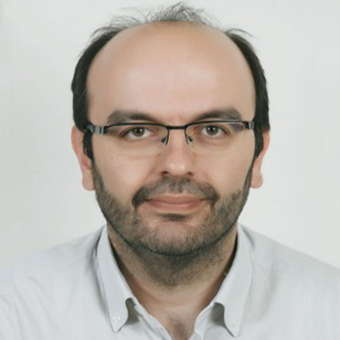
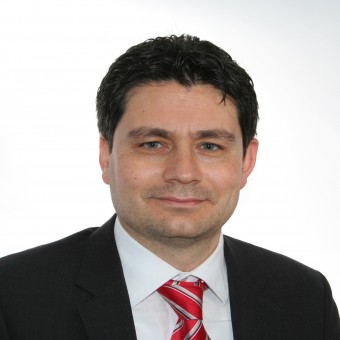
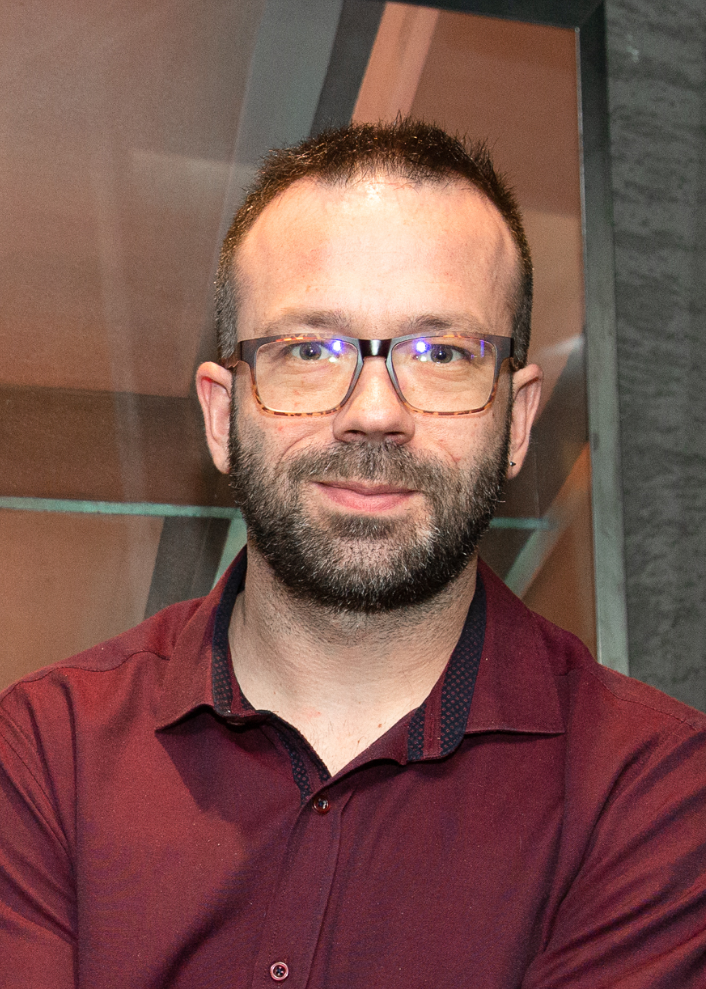
Mamatas Eleftherios serves as an Associate Professor in the Department of Applied Informatics at the University of Macedonia, specializing in next-generation wireless networking research and education. His academic credentials include a Diploma in Electrical and Computer Engineering (2003) and PhD in Computer Networks (2008), both from Democritus University of Thrace, Greece. Research focuses on critical networking challenges: Wireless/Mobile Networks infrastructure Quality of Service optimization Software-Defined Networking (SDN) architectures Energy-efficient communication protocols Stochastic modeling for network performance His publication portfolio comprises 8 books, 37 journal articles, and 59 conference papers reflecting deep technical engagement. Teaching responsibilities include BUSINESS DATA COMMUNICATIONS (ISC501), COMPUTER SYSTEMS (AIC105), and advanced topics in network performance analysis. No scientific awards or grant information appears in the provided documentation.
Panagiotis Papadimitriou serves as an Associate Professor at the Department of Applied Informatics, University of Macedonia in Thessaloniki, where he leads the NetCloud research group. Previously, he held positions as Assistant Professor at Leibniz University Hanover's Institute of Communications Technology and as a Post-Doctoral Researcher at Lancaster University (UK) and Telecom SudParis (France), with additional research experience at the University of Cambridge. His research spans Internet architectures and technologies with emphasis on Network Function Virtualization (NFV), Software-Defined Networking (SDN), Time-Sensitive Networking (TSN), Internet-of-Things (IoT), and Edge Computing. His work includes ML-assisted NFV orchestration (SFC-graph embedding, transformation, and multi-domain partitioning), network slicing orchestration, programmable dataplanes with P4, deterministic networks, datacenter network fabrics, and edge computing. Notable research outcomes include distributed network processing architectures (MIDAS, DistNSE), multi-provider service mapping mechanisms (Nestor), open-source NFV orchestration platforms (TeNOR), and orchestration platforms for cross-slice communication (MESON). His recent publications show a strong focus on In-Band Network Telemetry, Service Function Chain optimization, Time-Sensitive Networking implementations, and cross-slice communication systems, demonstrating his leadership in network virtualization and edge computing research areas. His work consistently addresses practical implementation challenges while advancing theoretical foundations in network management. Scientific Recognition: Senior Member of IEEE Associate Editor of IEEE Transactions on Network and Service Management Counselor of the IEEE Student Branch at University of Macedonia As Principal Investigator of the Horizon Europe NEPHELE project and previous EU-funded projects (NECOS, T-NOVA, CONFINE), he has secured over 1M euro in research funding. He actively contributes to the academic community through conference organization roles including IEEE ICC NGNI 2025, IEEE ICIN 2024, and IFIP/IEEE CNSM 2022 as General Co-Chair. The NetCloud research group he leads maintains a dedicated edge computing facility used for both research and teaching, and is known for its commitment to open-source software and community service through academic network resources. His educational background includes a Ph.D. in Electrical and Computer Engineering from Democritus University of Thrace (2008), an M.Sc. in Information Technology from University of Nottingham (2001), and a B.Sc. in Computer Science from University of Crete (2000).
Dr. Georgios Drakakis serves as Professor of Information Technology at the American College of Greece (Deree) since 2018, concurrently holding the position of Chief Executive Officer at Purposeful, an in silico drug repurposing company. He is a Research Area Leader within the Research, Technology & Innovation Network (RTIN) focusing on cheminformatics and bioinformatics. His educational background includes: PhD in Cheminformatics from University of Cambridge (2011-2015) MSc in Advanced Biological Sciences (Bioinformatics) from University of Liverpool (2009-2010) MSc in Computer Science from Trinity College Dublin (2008-2009) BSc in Computer Science from Aristotle University of Thessaloniki (2003-2007) Dr. Drakakis' research centers on applying machine learning and artificial intelligence to drug discovery, repurposing, and computational toxicology. His work bridges cheminformatics, bioinformatics, and data science to develop predictive models for compound mechanism of action, cytotoxicity, and polypharmacological effects. Recent efforts include computational approaches for identifying drug candidates against emerging pathogens like SARS-CoV-2. His publication record features 13 journal articles and 2 book chapters in high-impact venues including ACS Chemical Biology and Journal of Chemical Information and Modeling, with consistent focus on translational computational methods. Notable recognition includes: Engineering and Physical Sciences Research Council Doctoral Prize As an educator, he teaches Machine Vision and Semantic Web for the MSc in Data Science program, and Data Mining for the BSc in Information Technology program. His leadership in RTIN's Cheminformatics & Bioinformatics Research Area demonstrates commitment to advancing computational approaches in pharmaceutical sciences. His dual role as academic and CEO reflects strong industry-academia integration in his career trajectory.
Dr. Maira Kotsovoulou serves as Assistant Professor in the Department of Information Technology at Deree College and Graduate School, The American College of Greece, a position she has held since February 1, 1996. Her academic journey spans over 25 years of teaching and research in software systems and educational technology. Educational background includes: Doctorate in Technology Enhanced Learning, University of Lancaster (2011–2019) MSc in Human Computer Interaction, Heriot-Watt University (1994–1995) BSc in Computer Information Systems, The American College of Greece (1990–1994) Her research centers on the Software Systems and Databases Research Group, where she investigates visual programming applications for undergraduate education, automated assessment tools, and database optimization techniques. This work bridges theoretical computer science with practical pedagogy, focusing on how technology enhances student motivation and learning outcomes in programming courses. Her methodology combines empirical classroom studies with software development expertise gained through industry projects. Recent publications (2013–2018) reveal an evolving focus from collaborative resource tagging to sophisticated e-assessment systems, consistently addressing challenges in computer science education. The trajectory demonstrates increasing sophistication in analyzing instructor experiences and student perceptions while maintaining practical applicability in real classroom settings. Professional recognition includes: Oracle Certified Professional (OCP) in Database Administration Her industry engagement as a freelance solution architect complements academic work, with notable projects including Greece's national e-prescription system (IDIKA), COSMOTE retail software, and medical decision support systems. This dual expertise creates unique opportunities for students to engage with both academic research and enterprise-scale development challenges. As leader of the Software Systems and Databases Research Group, she fosters collaboration between academic theory and industry practice, emphasizing agile methodologies and practical implementation of educational technologies in real-world software development contexts.
Manolis Tzimtzimis is a PhD Candidate in Additive Manufacturing and Machine Learning at the School of Science and Technology, International Hellenic University (IHU). He serves as a Technical and Scientific Laboratory Associate at the Digital Manufacturing and Materials Characterization Lab and as an Academic Scholar (instructor) in the School of Design Sciences, Department of Creative Design and Clothing at IHU. His educational background includes: BSc in Automation Engineering from the Technological Educational Institute of Thessaloniki MSc in Data Science from the International Hellenic University Mr. Tzimtzimis's research focuses on additive manufacturing and machine learning integration, with expertise in rapid prototyping technologies, 3D printing, CNC machining, and laser-based manufacturing. His technical proficiency spans Solidworks CAD software certification, 3D scanning methodologies, and advanced material characterization techniques essential for digital manufacturing workflows. He has participated in 7 research funding programs (4 European and 3 National) as a Researcher representing the International Hellenic University, Center of Research and Technology Hellas (CERTH), and Aristotle University of Thessaloniki (AUTH). Mr. Tzimtzimis contributes to the Digital Manufacturing and Materials Characterization Lab, where he applies his dual expertise in automation engineering and data science to advance manufacturing process optimization and materials analysis.
Michael Kalogerakis serves as an Associate Professor in the Department of Electrical and Computer Engineering, School of Engineering, at the Hellenic Mediterranean University (HMU). He concurrently holds research positions at HMU's Laboratory of Artificial Intelligence and Systems Engineering and Institute of Energy, Environment and Climate Change, and collaborates with IACM/FORTH's Wave Propagation Group. His academic background includes: B.Sc. in Mathematics, University of Crete M.Sc. and Ph.D. in Mathematics and Computer Science, Clarkson University, USA (dissertation 'Linear Solvers on Multiprocessor Machines' archived by U.S. DOE) Research focuses on usability engineering , human-machine interaction , agile development , and wave propagation , with applied outcomes like the Hellenic Navy's underwater acoustic detection system for frigates/submarines. His work bridges theoretical computational methods and defense applications. Over 25 years, he participated in major programs (DAMOCLES-IP, ESPRIT, FP6, MAST, Archimedes), authored class notes for Patras/Crete/HMU courses, and supervised student projects in computational mathematics and software engineering. He actively contributes to HMU's Laboratory of Artificial Intelligence and Systems Engineering, the Institute of Energy/Environment/Climate Change, and IACM/FORTH's Wave Propagation Group, driving interdisciplinary research in energy systems and computational mathematics.
Konstantinos Barlas serves as a Senior Lecturer in the Department of Computer and Information Engineering within the School of Engineering at the University of West Attica. His academic career spans both Greek and international institutions, bringing specialized expertise in formal methods and mathematical logic to his teaching and research activities. Education: Diploma and Integrated Master from the School of Applied Mathematics and Physical Sciences, National Technical University of Athens (2006) PhD from the School of Electrical and Computer Engineering, National Technical University of Athens (2018) with research focus on algebraic pattern specification Dr. Barlas' research centers on formal methods in computer science, with particular emphasis on algebraic specifications, formal verification, and mathematical logic. His work bridges theoretical computer science with practical applications in systems design and open standards development. His scholarly approach integrates mathematical rigor with software engineering principles to address complex specification challenges in computing systems. He has published 10-12 papers in international scientific journals and conferences, including contributions to NASA's Innovations in Systems and Software Engineering. His publication record demonstrates consistent engagement with formal methods communities and interdisciplinary applications of mathematical logic in computing. As an educator, Dr. Barlas teaches core mathematics courses for computer science students including Discrete Mathematics, Probability and Statistics, Mathematical Analysis I, and Linear Algebra. He serves as a scientific editor for the Greek publication 'Μαθηματικές Δομές για την Επιστήμη Υπολογιστών (Διακριτά μαθηματικά και εφαρμογές)'. His teaching philosophy emphasizes the foundational mathematical principles that underpin computer science education. Dr. Barlas maintains strong connections with open source software communities, utilizing Arch and Void Linux distributions with i3wm as his preferred tiling window manager. His technical interests extend to Raspberry Pi projects, and he has creative pursuits including a music project called 'A group of crows'. His intellectual interests span literary works exploring absurdism and circular reasoning, including 'Catch-22', 'The Dice Man', 'The Hitchhiker's Guide to the Galaxy', and 'Gödel, Escher, Bach'.