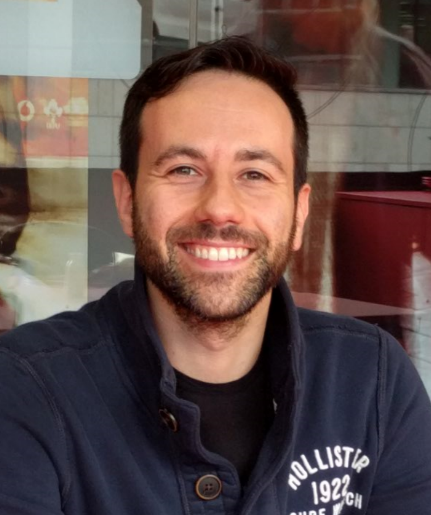
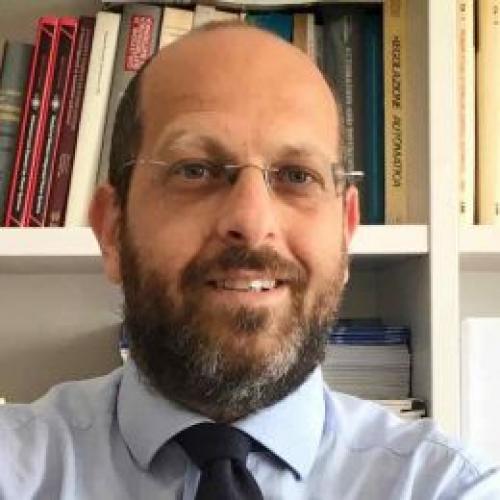
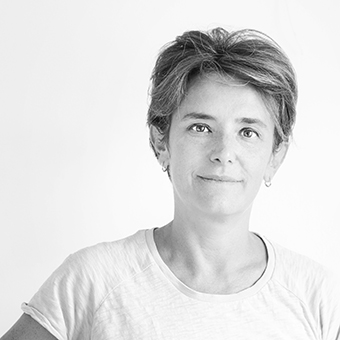
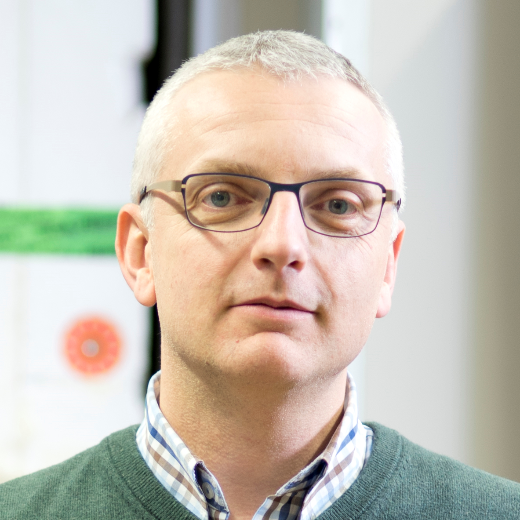
Andrea Bonfiglio is an Associate Professor at the Department of Naval, Electrical, Electronic and Telecommunication Engineering (DITEN) within the School of Engineering at the University of Genoa. His work focuses on power systems, smart grids, and renewable energy integration with a particular emphasis on innovative control strategies and energy storage solutions. Teaching areas: Electrical Systems, Industrial Measurements, Energy Security Key research themes: Smart distribution networks, synthetic inertia, microgrid control, vehicle-to-grid technologies, battery energy storage Recent work explores virtual energy partitioning, load flow optimization, and inertia allocation in transmission networks Contact: a.bonfiglio@unige.it His publications highlight advanced control methodologies using machine learning and sliding mode control for both transmission and distribution networks, with applications to renewable integration and grid stability challenges.
Gian Antonio Susto is an Associate Professor at the Department of Information Engineering , University of Padova . With a Ph.D. in Information Technology and post-doctoral experience at National University of Ireland, Maynooth, he leads research in Machine Learning , Semiconductor Manufacturing , and Industrial IoT . His work bridges Anomaly Detection , Continual Learning , and Algorithmic Fairness with applications in Hydroelectric Power Plants , Particle Accelerators , and Smart Mobility . B.Sc. and M.Sc. in Controls Engineering, University of Padova (cum laude) Ph.D. in Information Technology, University of Padova (2013) Post-Doc at National University of Ireland, Maynooth (2012-2013) Assistant Professor at University of Padova (2013-2021) His research focuses on Explainable AI , Virtual Metrology , and Deep Learning for manufacturing and infrastructure monitoring. Recent projects include the AIMS5.0 (AI for Manufacturing Sustainability) and MICS (Circular Economy in Italy) initiatives. His publications span Engineering Applications of Artificial Intelligence , IEEE Transactions , and Information Processing & Management , with 15+ recent papers on topics like Fault Diagnosis , Continual Learning , and Fair Ranking . Key scientific awards include: IEEE CCTA Best Student Paper Award (2021) IP&M 2020 Ph.D Paper Award Best Industry Paper Award, European Workshop on Advanced Control and Diagnosis (ACD 2019) He has supervised Ph.D. students on projects involving Particle Accelerators , Plant Behavior Modeling , and Explainable AI , with alumni now at institutions like Max Planck Institute , IBM , and Scripps Research . Current teaching includes Reinforcement Learning and Explainable Machine Learning at graduate and Ph.D. levels.
Andrea Lanzini is a Full Professor in the Department of Energy (DENERG) at the Polytechnic University of Turin, where he is also a member of the Interdepartmental Center Ec-L - Energy Center Lab. He serves as Scientific Advisor for the Partnership Agreement with Edison and Electricité de France (EDF). His academic and research leadership spans energy system integration, hydrogen technologies, fuel cells, renewable energy communities, and industrial decarbonization. His research interests focus on fuel cell and hydrogen technology , energy system integration and modeling , industrial decarbonization , and renewable energy communities . He leads the M3ES research group and is deeply involved in both fundamental and applied research, with a strong emphasis on sustainable urban energy systems and clean energy transitions. The analysis of his recent publications reveals a consistent focus on hydrogen production and storage, fuel cell durability and performance, biogas and biomethane technologies, and the optimization of hybrid renewable energy systems. His work often combines experimental investigation with techno-economic and environmental assessment, particularly in off-grid and community-scale energy applications. Scientific Awards: Fulbright Grant awarded by United States Department of State - Bureau of Educational and Cultural Affairs/The US-Italy Fulbright Commission, United States (2010) Prof. Lanzini actively supervises numerous PhD students and leads a wide array of research projects, including major EU-funded initiatives such as HYWAY, NoMaH, TIPS4PED, and EDUPED, as well as numerous commercial research contracts with industry and municipalities. He is a key contributor to national and international efforts in energy transition, particularly through his work on Positive Energy Districts and renewable energy communities. His research has significant implications for energy policy, urban planning, and industrial sustainability. He is involved in several research groups and collaborative agreements, including the M3ES Research Group (DENERG) and partnerships with RSE SpA, Edison, EDF, and various public administrations. His work is central to the activities of the Energy Center Lab at Politecnico di Torino.
Gianfranco Chicco is a Full Professor at the Politecnico di Torino , Italy, within the Department of Energy (DENERG). He serves as Scientific Director of the Electrical Power Systems research group and the Turin unit of the ENSIEL Consortium. A Fellow of IEEE (since 2018), he has held editorial leadership roles as Editor-in-Chief of Sustainable Energy, Grids and Networks and Subject Editor of Energy , while chairing major conferences like IEEE ISGT Europe 2017 and UPEC 2020. Education : Laurea (cum laude) in Electrical Engineering (1987), Ph.D. in Electrical Engineering (1992), Doctor Honoris Causa (2017, Polytechnic University of Bucharest; 2018, Technical University 'Gheorghe Asachi' of Iasi). Research Interests : Focus on power transmission and distribution systems , distributed energy resources , and multi-energy smart grids , with applications in artificial intelligence , load management , and power quality . His work addresses technical, economic, and environmental aspects of distributed generation and smart grid sustainability . Publications Trends : Recent articles emphasize photovoltaic power optimization , dynamic grid modeling , and multi-energy system coordination , reflecting expertise in renewable integration , clustering algorithms , and adaptive control . Key subfields include voltage stability , load forecasting , and blockchain for energy trading . Awards : IEEE Fellow (2018-) Best Paper Awards at SEST (2018, 2020) Doctor Honoris Causa (2017, 2018) 'Giancarlo Vallauri' Degree Prize (1988) Advising and Grants : Supervises PhD students in power converters , renewable integration , and high-voltage measurement methodologies . Leads European projects like H2020 MIGRATE and OSMOSE, focusing on grid resilience , clustering-based network planning , and multi-energy sustainability .
Matteo Nardello is a researcher affiliated with the Department of Industrial Engineering at the University of Trento. His work focuses on embedded systems, IoT, and energy harvesting technologies for sustainable applications. Current academic affiliation: Department of Industrial Engineering, University of Trento Research interests: IoT, embedded systems, energy harvesting, machine learning, cyber-physical systems Contact: matteo.nardello@unitn.it His research integrates hardware-software co-design for batteryless IoT systems, with applications in smart agriculture, industrial monitoring, and autonomous vehicles. Recent work explores deep learning at the edge, energy-efficient sensor networks, and microbial fuel cells for self-powered devices. Key article trends highlight a focus on sustainable power solutions, wireless sensor networks, and machine learning optimization for constrained environments. He contributes to courses on embedded systems, IoT, and AI-powered industrial applications at the University of Trento.
Gianluca Setti is a Full Professor at the Department of Electronics and Telecommunications (DET) at Polytechnic University of Turin, where he has been serving since 2017. He previously held positions at the University of Ferrara from 1997 to 2017. His institutional roles include being the Contact Person for the Research Quality Evaluation process, Member of the Interdepartmental Center SmartData@PoliTO - Big Data and Data Science Laboratory, and Member of the University Quality Assurance Committee. He serves as Editor-in-Chief of the Proceedings of the IEEE, the first non-US editor to hold this position. Dr. Setti's research spans multiple interdisciplinary fields including machine learning, artificial intelligence, big data analytics, Internet of Things, biomedical signal processing, power electronics, and electromagnetic compatibility. His work bridges theoretical foundations with practical applications, particularly focusing on compressed sensing, neural networks, and circuit design for specialized applications. His research has significant implications for healthcare, sustainable infrastructure, and next-generation electronics. His publication record reveals a consistent trajectory from foundational work in chaotic systems and neural networks to contemporary applications in AI, IoT, and edge computing. The most recent publications demonstrate his focus on anomaly detection at the edge, neural oracles for biosignal processing, and power electronics innovations. His work shows strong integration between theoretical signal processing and practical circuit implementation. 1998 Caianiello prize (best Italian Ph.D. thesis on Neural Networks) IEEE Fellow (2006) IEEE Circuits and Systems Society Distinguished Lecturer (2004, 2015) 2004 IEEE CAS Society Darlington Award 2013 IEEE CAS Society Meritorious Service Award 2013 IEEE CAS Society Guillemin-Cauer Award 2019 IEEE Transactions on Biomedical Circuits and Systems best paper award Multiple best paper awards at major conferences including ECCTD2005, EMCZurich2005, ISCAS2011, PRIME2019, and EMCCOMPO2019 Dr. Setti has supervised numerous PhD students across various research domains including electromagnetic compatibility, signal and power integrity, communication networks, mechatronics and robotics. His research is supported by significant funding including national PRIN projects, EU-funded JTI-ECSEL initiatives, and commercial contracts. He leads the VLSILAB Group at DET, focusing on circuit architectures, embedded systems, and AI applications. His current projects include DECORI (anomaly detection), StorAIge (embedded storage for AI), PROGRESSUS (energy infrastructure), CONNECT (smart grid), and CONVERGENCE (wearable healthcare applications).
Marco Badami is a Full Professor at the Department of Energy (DENERG) , Polytechnic of Turin. He serves as Scientific Director for national and EU-funded research projects in energy systems and has been a Course Lecturer for Energy Systems and Industrial Use of Energy since 2010. He supervises PhD students in Energetics and Electrical Engineering . Research Interests: His work spans energy systems optimization, machine learning applications for industrial energy efficiency, smart grids, cogeneration scheduling, blockchain-based energy data immutability, and predictive maintenance algorithms for photovoltaic plants. Current projects focus on AI-driven energy audits, optimized control systems for industrial microgrids, and digital twin architectures. Collaborations: He works with Trigenia Srl, Stogit SpA, and international institutions on commercial research contracts. His scientific contributions include 15+ publications on topics like LSTM forecasting for solar energy, deep reinforcement learning for multi-energy systems, and decentralized peer-to-peer energy trading platforms.
Federico Silvestro is a Full Professor at the University of Genoa , affiliated with the Naval, Electrical, Electronic and Telecommunications Engineering Department . His academic roles include being a Course Coordinator, Department Council Member, and Deputy Director of DITEN. His research focuses on Power systems stability and control Cybersecurity in energy networks Electric propulsion for marine applications Optimal energy storage and microgrid design Integration of renewable energy in maritime contexts Recent publications highlight trends in data-driven power system analysis , DC microgrid modeling , cybersecurity for virtual power plants , and advanced energy management strategies for maritime and port systems. Email: federico.silvestro@unige.it He leads the ENET-RT Lab , focusing on real-time power systems simulation and co-simulation platforms for marine and grid applications.
Cristiana Bolchini is a Professor at the Department of Electronics, Information and Bioengineering (DEIB) at Politecnico di Milano. She holds a PhD in Automation and Computer Science Engineering (1997) and a Laurea in Electronic Engineering (1993), both from Politecnico di Milano. Her research focuses on dependable systems, fault tolerance, and embedded systems design, with recent work on ICT solutions for smart buildings and energy efficiency. She coordinates projects such as the FP7 SAVE initiative and serves on technical committees for conferences like DATE and DAC. Education: PhD in Automation & Computer Science (1997), Laurea in Electronic Engineering (1993), both from Politecnico di Milano. Research interests span dependability (fault modeling, diagnosis), heterogeneous architectures, and sustainable smart environments. She collaborates with Prof. Giuliana Iannaccone on foresight for sustainable built environments and has led EU-funded projects like the SAVE initiative. Publications include over 150 refereed papers on dependability and context-awareness. She holds editorial roles for journals such as IEEE Transactions on Computer-Aided Design and ACM Transactions on Embedded Computing Systems. Awards include IEEE Senior Member status and two Cisco University Research Program Fund gifts (2012, 2014). Academic roles include Rector’s delegate for Southeast Asia relations and leadership of Technology Foresight workgroups. She teaches courses on computer science fundamentals and dependable systems, emphasizing problem-solving and programming in Python and C.
Marco Picone is an Associate Professor at the Department of Sciences and Methods for Engineering (DISMI) of the University of Modena and Reggio Emilia. He leads the Distributed and Pervasive Intelligence (DIPI) Group and holds a PhD in Information Technology from the University of Parma. His postdoctoral research at the University of Parma (2012-2015) and a visiting scholar position at the University of Cambridge (2011) further enriched his expertise. He is nationally qualified as an Associate Professor by MIUR (2020). Education: PhD in Information Technology, University of Parma (Italy) M.Sc. (cum Laude) in Computer Engineering, University of Parma Visiting Researcher, NetOS Group, University of Cambridge (UK) His research focuses on Distributed Systems , IoT , Edge Computing , and Digital Twins , emphasizing their applications in smart industries and cities. He has supervised postdocs (e.g., Matteo Martinelli) and PhD students (e.g., Enrico Rossini) on topics like Digital Twin Continuum and Edge-Cloud Systems. Teaching spans courses on Intelligent IoT , Distributed IoT Software Architectures , and Edge Computing , with a focus on lab-based learning and industry-relevant projects. He actively contributes to open-source frameworks like the White Label Digital Twin (WLDT) and collaborates on initiatives such as the Web of Digital Twins (WoDT). Research collaborations include projects on smart city data fusion, livestock waste management, and Industry 5.0 human-centric systems. His work bridges theoretical advancements with practical implementations in cyber-physical environments.
Andrea Appolloni is an Associate Professor at the Department of Management and Law, University of Rome Tor Vergata. His academic career focuses on Management with emphasis on Sustainable Supply Chain Management , Digital Transformation , and Circular Economy . His research explores the intersection of technological innovation and sustainability, particularly through topics like AI in Logistics , Green Procurement , and Policy Optimization . Publications span both theoretical frameworks and empirical studies in China, Italy, and Malaysia, with a strong focus on environmental impact and organizational performance. Recent work includes digital twin applications for human-AI collaboration, blockchain integration in sustainable supply chains, and analyzing barriers to circular economy adoption. His 15 most recent articles (2025-2022) demonstrate a trend toward combining Artificial Intelligence , Operations Management , and Environmental Governance .
Enrico Macii is a Full Professor at the Politecnico di Torino, affiliated with the Interuniversity Department of Regional and Urban Studies and Planning (DIST) and the Department of Control and Computer Engineering (DAUIN). He leads the Electronic Design Automation (EDA) research group and holds key roles as Scientific Advisor for the Politecnico-STMicroelectronics partnership and Scientific Contact for the European Chips Joint Undertaking. Research Interests: His work spans digital circuits and systems, energy efficiency, smart cities, Industry 4.0, and smart manufacturing. He focuses on embedded and cyber-physical systems, low-power design, neuromorphic computing, AIoT, and sustainable urban development. Recent Publications: His recent research demonstrates strong trends in edge AI, neuromorphic computing, and smart energy systems. Articles highlight innovations in low-power hardware acceleration, federated learning, physics-informed AI, and digital twin applications for urban and industrial systems. There is a clear emphasis on deploying AI efficiently on constrained devices and integrating physical models with machine learning. J. William Fullbright Fellowship (1993) Best paper award IEEE European Design Automation Conference (1996) Best paper award ACM/IEEE Great Lakes Symposium on VLSI (2008) DAC Service Award (2014) IEEE Fellow (2006) DATE Fellow (2014) Advising and Grants: He has supervised over 25 PhD students in computer engineering, AI, and urban systems. His research is funded by major EU programs (Horizon 2020, PNRR, KDT JU), national (PRIN, FAR), and regional grants, as well as industrial contracts with STMicroelectronics, Michelin, and Cefriel. He leads numerous high-impact projects in smart manufacturing, energy efficiency, and digital twins. Labs and Teams: He is a core member of the EDA Group, an interdepartmental research team at Politecnico di Torino focusing on VLSI-CAD, bioinformatics, smart cities, and Industry 4.0. He also contributes to IAM@PoliTo (Integrated Additive Manufacturing) and leads multiple EU and national research consortia.
David Macii is Associate Professor at the Department of Industrial Engineering, University of Trento, Italy, where he teaches "Digital Signal Processing for Mechatronics" and co-leads the "Laboratory of Internet of Things." His core expertise lies in digital signal processing, measurement science, smart-grid instrumentation, indoor positioning and industrial IoT applications. Research interests revolve around four pillars: (i) advanced estimation algorithms for frequency, ROCOF and synchrophasors to enhance power-quality monitoring in future smart-grids with high PV and EV penetration; (ii) design and metrological characterisation of low-cost PMU and smart-meter solutions; (iii) radar- and RFID-based indoor localisation and tracking for robotics and assisted-living scenarios; and (iv) embedded, IoT-enabled measurement systems bridging DSP, mechatronics and industrial electronics. Recent publications (2023-2025) reveal a clear methodological trend: development of fast, uncertainty-aware DSP algorithms (interpolated DFT, Kalman filtering, harmonic whitening) validated against real-world noise, interference and contingency conditions, followed by their embedding into resource-constrained hardware platforms for EV charging coordination, grid-support converters and robotic navigation. Although the supplied text does not list specific grants or doctoral students, the steady stream of joint publications with European colleagues and his leading teaching role in two inter-departmental master courses indicate an active, well-integrated research and educational profile within the University of Trento.
Andrea Gasparella is a Tenured Full Professor and Dean of the Faculty of Engineering at the Free University of Bozen-Bolzano, located at NOI Techpark in Bozen-Bolzano, Italy. His research focuses on building physics, energy systems, and inclusive design, with a particular emphasis on indoor environmental quality for neurodivergent individuals and sustainable urban development. He leads projects like the Flexibots initiative (biodegradable medical microrobots) and BeSENSHome (autonomy support for neurodivergent people). His work integrates advanced modeling (e.g., CFD, machine learning) with real-world applications in energy efficiency, climate adaptation, and human-centered design. Key research areas include thermal and acoustic comfort, renewable energy integration, and smart building technologies. He collaborates with industry partners like Galileo High School and regional institutions to advance automation and robotics. Notable contributions include studies on urban heat islands, energy retrofit strategies for historic buildings, and the impact of ventilation on contagion risks in educational settings. As Dean, he promotes innovation through interdisciplinary initiatives at NOI Techpark, including new engineering programs and infrastructure like the university canteen. His publications span over 50 peer-reviewed articles in journals and conferences like Building Simulation Applications (BSA), addressing topics ranging from solar irradiance prediction in mountain regions to the psychophysical needs of neurodivergent populations. He actively contributes to policy discussions on decarbonization and energy equity in Alpine contexts. Professional activities include organizing events such as the 'nextFSE' fire safety conference and engaging with local organizations like Rotary Clubs to foster community ties. His work bridges academic research with practical solutions for climate resilience, accessibility, and technological advancement.
Emanuele Crisostomi is Associate Professor of Electrical Systems at the University of Pisa's Department of Energy, Systems, Territory and Constructions Engineering. He holds PhD and graduate degrees in Automation Engineering from the University of Pisa, with research visits to University of Cambridge, University of Leicester, and Hamilton Institute. His research bridges control theory, energy systems, and smart mobility. His research integrates: Smart grid control and renewable energy integration Electric vehicle charging infrastructure and routing algorithms Urban traffic modeling and optimization Nonlinear system dynamics and Lyapunov stabilization Machine learning applications in energy systems Crisostomi's publications demonstrate consistent innovation in electric vehicle-grid integration, with recent focus on predictive charging control, highway EV circulation patterns, and hydropower monitoring. His work shows increasing application of deep reinforcement learning for multi-regional power systems and hybrid network models for infrastructure monitoring. He leads research on IoT-enabled energy efficiency in buildings and contributes to epidemic modeling through network science. Current projects examine battery sizing optimization, charging station scheduling under uncertainty, and synergetic building management systems integrating environmental monitoring with energy conservation.