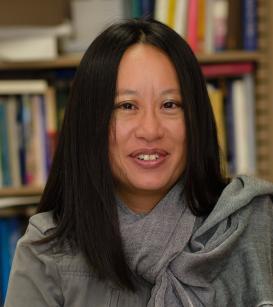
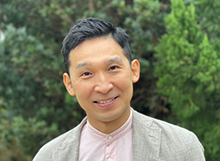
John Phan is an Associate Professor of Vietnamese Humanities at Columbia University, specializing in historical linguistics and East Asian writing systems. He holds a BA from Saint Olaf College (2002), MA from Columbia University (2005), and PhD from Cornell University (2012). BA: Saint Olaf College (2002) MA: Columbia University (2005) PhD: Cornell University (2012) His research examines Sino-Vietnamese linguistic contact, vernacular script evolution (particularly Chữ Nôm), and the cultural implications of language shifts in premodern Vietnam. He explores how writing systems reflect sociopolitical transformations and intellectual pluralism in East Asian societies. Recent publications analyze the 17th-century "reboot" of Vietnamese vernacular writing, the secularization of sinographic traditions in the 20th century, and phonological evidence challenging Muong subgroup classifications. His work bridges historical linguistics, cultural studies, and manuscript analysis.
Minoru Takano is a Postdoctoral Fellow at the National Institute for Advanced Humanistic Studies at Fudan University in Shanghai, guided by Prof. Ge Zhaoguang. He earned his PhD in 2023 from the Department of Asian Studies at the University of British Columbia under supervisor Dr. Bruce Rusk, following an MA (2014) and BA (2011) in Asian Studies. Specializes in cultural/intellectual history of late imperial China (1368–1911) Focuses on early modern Japanese intellectual history (1603–1868) Examines inter-regional cultural exchanges in premodern East Asia Expert in migration studies and geocultural identity analysis His research explores how migration shapes literary identity through case studies like Li Dongyang, a mid-Ming literatus with dual Beijing/Hunan affiliations. He challenges traditional scholarly narratives about Li's 'Chaling School' identity and demonstrates how migrant descendants negotiated belonging across administrative and cultural boundaries. Recent work extends this analysis to Japanese intellectual history, examining Ogyū Sorai's integration of Chinese literary models with Edo-period political reform. Current projects focus on: Transnational Sinographic networks Memory practices in premodern East Asia Bureaucratic identity formation
Jeffrey Niedermaier is the Mulberry Essence Assistant Professor of Comparative Literature and East Asian Studies at Brown University. He specializes in premodern Japanese literature and poetry, focusing on how texts in classical Japanese and literary Chinese contributed to trans-Asian literary networks. His research explores hybrid literary writings and their role in imagining broader global and cultural landscapes. Education: AB in East Asian Languages and Civilizations from the University of Chicago PhD in Japanese Literature from Yale University Research Interests: Niedermaier’s work bridges comparative methodologies and multilingual studies, analyzing how premodern texts situated Japan within a trans-Asian ecumene. He investigates themes like cosmopolitan literacies, world literature, and the Sinographic Sphere’s cultural exchanges. His current book project, The Poetics of Elsewhere , examines how 'resonant verse' transported readers beyond East Asia to regions like Persia and Portugal. Awards & Fellowships: Fulbright-Hays Fellowship (for research in Tokyo) Support from Yale, Brown, and the U.S. Department of Education Teaching & Grants: He teaches courses on premodern Japanese literature and comparative poetics. His research has been published in The Journal of World Literature and Asiatische Studien - Études asiatiques . He is also translating the Wakan rōeishū , a 11th-century anthology of Japanese and Chinese verse.
University of California, Los AngelesUnited States
Summary Sixiang Wang is an Associate Professor in Asian Languages and Cultures at UCLA, specializing in Chosŏn Korea and early modern East Asia. His research focuses on diplomatic history, comparative empire, and the intersection of cultural practices with political concepts. He holds a PhD from Columbia University and has held prestigious fellowships including the Mellon Scholar at Stanford and Moon Family Postdoctoral Fellow at Penn. Education: PhD in East Asian Languages and Cultures, Columbia University Research Interests: Cultural strategies in Korean diplomacy with Ming China History of science and knowledge production Language and writing in Korea’s cultural history Key Projects: Book manuscript on Chosŏn's diplomatic rituals with Ming Co-curator of UCLA Korean History Digital Museum Awards: Mellon Scholar of the Humanities (Stanford University) Moon Family Postdoctoral Fellowship (University of Pennsylvania) Teaching: Pre-modern Korean history Cultural interactions in early modern East Asia
Sean Song Yeol Han is an Assistant Professor at The University of Alabama , specializing in cultural and intellectual interactions shaping East Asian history. His research focuses on Sino-Korean relations, Korean nationhood, and transnational intellectual exchange in the 19th–20th centuries. Adviser: Benjamin Elman His dissertation, Bond Beyond Nation , examines how Korean literary elites in China navigated modernity and colonialism through dialogues with Chinese officials and intellectuals. Key themes include print culture, nationalist thought, and regional historical tensions. While no explicit awards or student lists are provided, his work contributes to understanding East Asia's political dynamics through historical sinographic networks.
Sean Han is an Assistant Professor in the Department of History at the University of Alabama. He holds a PhD from Princeton University (2018) and specializes in 19th-20th century Korean history. His research explores intellectual networks, print culture, and historical memory in East Asia. Current projects include a manuscript on Sinographic networks and Korean nationhood (1860-1945). His publications analyze diplomatic encounters between Chosŏn Korea and Western powers, and the cultural significance of Korean diaspora figures like Olympian Sammy Lee. Office hours are Mondays and Wednesdays 1-2 PM in ten Hoor Hall.
Max Planck Institute for the History of ScienceGermany
Florence Hsia is a Professor of History of Science at the University of Wisconsin-Madison . She earned her PhD in History from the University of Chicago (1999) and an AB in East Asian Studies from Princeton University (1990). Research Interests : Hsia specializes in the historical construction of sinographic expertise in early modern Europe, focusing on how knowledge about China coalesced through the Latin Republic of Letters. Her work bridges disciplines like linguistics, ethnography, astronomy, and cartography, emphasizing the materiality of textual and archival practices. Key Publications include her monograph Sojourners in a Strange Land: Jesuits and Their Scientific Missions in Late Imperial China (2009) and the chapter Astronomy After the Deluge (2017), which examines Enlightenment-era global observational networks. These works highlight her interest in cross-cultural scientific collaboration and archival reasoning. Affiliations : As a member of the Archives of the Sciences Working Group in Department II at the Max Planck Institute for the History of Science (MPIWG), she contributes to interdisciplinary research on the global dimensions of scientific knowledge.
Max Planck Institute for the History of ScienceGermany
Michael Stanley-Baker (徐源) is an Associate Professor in the History Department at Nanyang Technological University, specializing in the history of Chinese medicine and religion, particularly Daoism. He also serves as an associate of the UCL China Centre for Health and Humanities and as treasurer on the council of the International Association for the Study of Traditional Asian Medicines. Stanley-Baker received his PhD from University College London and holds a clinical degree in Chinese medicine from Ruseto College, Boulder CO. His academic journey includes work and study at Indiana University, Bloomington; Academia Sinica, Taipei; and the Needham Institute, Cambridge. He has conducted extensive fieldwork with healers in Taiwan and China, bridging scholarly and clinical perspectives. His research focuses on the intersection of religion, medicine, and science in Chinese history, with particular emphasis on Daoist healing practices and the circulation of medical knowledge. He employs innovative digital humanities methods to analyze historical medical texts, creating tools like the Polyglot Asian Medicine Knowledge Graph System and the DAOBUDMED6D corpus for studying Six Dynasties medical, Daoist, and Buddhist texts. His recent publications reveal a growing emphasis on transnational medical exchanges, the historical geography of drugs, and the political dimensions of medical knowledge. Stanley-Baker's work challenges conventional boundaries between 'medicine' and 'religion,' arguing for more nuanced understandings of how healing knowledge was organized and transmitted in pre-modern contexts. International Association for the Study of Traditional Asian Medicines Council Member Lead developer of Polyglot Asian Medicine digital project Co-editor of the Routledge Handbook of Chinese Medicine Stanley-Baker directs the 'Drugs across Asia' digital humanities project, which creates new tools for analyzing pharmacological knowledge in Asian historical texts. His work combines traditional philological approaches with cutting-edge digital methods, facilitating large-scale analysis of drug references across religious and medical canons. His research has important implications for understanding how medical knowledge circulated across cultural and political boundaries in pre-modern Asia.
Antonio Manieri is an associate professor at the University of Naples L'Orientale, Department of Asia, Africa and Mediterranean, specializing in Japanese Philology. He teaches Ancient and Medieval Japanese Civilization and the Japanese Language. His academic work focuses on historical Japanese documents, particularly from the Nara period (8th-10th centuries), with emphasis on bureaucratic and geographical texts and their role in early Japanese state formation. Manieri earned his PhD in Japanese Philology from Daito Bunka University (Tokyo) in 2012, with a thesis on practical documents, terminology, and literature related to horses in Japan during the "State of Codes" (8th-10th centuries). His educational journey includes extensive research periods in Japan supported by prestigious fellowships, demonstrating his deep engagement with Japanese language and culture. His research interests span Japanese Philology, Ancient and Medieval Japanese Civilization, and historical documents of Japan. Manieri specializes in fudoki (geographical-bureaucratic texts), court protocols, and technical education systems of the Nara period. His work reveals how multilingual aspects of early Japanese documents reflect complex administrative structures and cultural exchanges between Japan and continental Asia. He examines how Japanese officials incorporated Chinese writing systems while maintaining indigenous terminology, providing insights into Japan's early state formation processes. Analysis of Manieri's recent publications shows a consistent focus on historical Japanese documents from the 8th-10th centuries, particularly bureaucratic and geographical texts. His work demonstrates expertise in translating and interpreting complex historical materials, with emphasis on multilingualism in early Japanese documents. A recurring theme is how geographical knowledge was used for political control in ancient Japan, revealing the connection between administrative structures and cultural development during the Nara period. Manieri has received numerous scientific awards and fellowships: Japan Foundation fellowship (2004) MEXT fellowships (2007-2009 and 2009-2012) Research fellowship at the Institute for Research in Language Teaching in Tokyo (2006) Research grant at the University of Naples L'Orientale (2014-2018) Japan Foundation Japanese Studies Fellowship 2023 Monbukagakushō shōgakukin (2007, 2009) Manieri actively participates in academic service, serving on editorial boards for journals such as "LE FORME E LA STORIA," "LINGUE E LINGUAGGI," and "IL GIAPPONE." He has been involved in multiple research projects including PRIN 2022 "Environmental Anomalies & Political Legitimacy in Global Eurasia, 12th-14th century" and JSPS Grant-in-Aid for Scientific Research. His academic leadership extends to organizing international symposia on Japanese language education and historical documents. Manieri is a member of several research centers (CESET, CETEFIL, CSAO) and international research projects (PRIN, KAKEN). He participates in the "Senchū Wamyōruijushō Study Group" (Tokyo/Kyoto) and is part of the Classical Japanese-English Digital Dictionary Concept Development Team (Yanai Initiative, UCLA/Waseda). These affiliations demonstrate his integration into both Italian and international academic networks focused on Japanese studies and philology.
The Chinese University of Hong Kong (CUHK)Hong Kong SAR
Dr. AOYAMA Reijiro is a Senior Lecturer at the Department of Japanese Studies, The Chinese University of Hong Kong . Holding a PhD from Peking University and MA from CUHK, he specializes in transnational processes mediated by migration and digital/cultural flows. Key research areas: Anthropology of globalization, Japanese diaspora, digital platforms in education Recent projects examine text-image congruence in online platforms and digital labor dynamics His publications focus on: Historical Sinitic brush-talk communication Japanese craftsmanship in global cities Emotional labor in service industries Augmented reality applications for multilingual learning Co-editor of influential volumes on: Brush Conversation in the Sinographic Cosmopolis (2022) Japanese as a Lingua Franca (2020) Contact: reiaoyama@cuhk.edu.hk | reicuhk2022@gmail.com