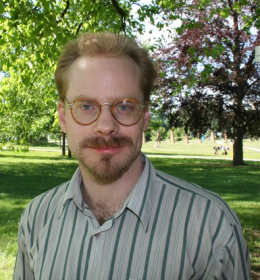
Mattias Edén is a Professor at Stockholm University's Department of Chemistry, specializing in solid-state NMR spectroscopy, molecular dynamics (MD) simulations, and density functional theory (DFT) calculations. His research focuses on structure-composition-property relationships in disordered materials like glasses, cements, and biominerals. Established new rare-earth-based aluminosilicate glasses Developed structure-based models for bioactive glass bioactivity Characterized bone-mineral-mimicking calcium phosphates Research Interests: Combining experimental NMR with computational modeling to analyze amorphous materials. Key areas include glass science, biomineralization, and structural characterization of disordered systems. Scientific Awards: Senior Research Fellow, Swedish Research Council (VR; 2007-2012) Junior Research Fellow, Swedish Research Council (VR; 2002-2006) Advising: Supervises visiting Ph.D. student Peng Lv (from Univ. of Illinois at Chicago/Weizmann Institute collaborations) and researcher Baltzar Stevensson. His group includes postdocs Chaithanya Hareendran, Dahiana Avila, and guest researcher Martins Balodis.
Dr. Rickard Karlsson works as a Lecturer at Linköping University's Department for Swedish as a Second Language, Rhetoric and Language Support (SAROS) under the Department of Culture and Society (IKOS). His teaching focuses on Swedish language didactics, grammar, and assessment of learner languages, with supervision across academic levels. PhD in Languages and Cultures of Europe Upper Secondary School Teacher in Swedish as a Second Language Research spans empirical analysis of adult language acquisition , historical linguistics , and multilingualism ideologies . Google Scholar publications reveal interdisciplinary contributions to particle filter algorithms and automotive sensor systems from 2001-2025. Notable collaborations include Fredrik Gustafsson and Per-Johan Nordlund. Recent publications (2025-2016) merge automotive engineering and historical Linguistics, covering tire diagnostics, cultural exchange patterns, and vibration-based navigation. This dual expertise reflects his transition from technical research to language education, maintaining academic connections across disciplines.
Christel Bergström is a Professor at the Department of Pharmacy; Molecular Galenic Pharmacy of Uppsala University , Sweden. Her research focuses on drug delivery systems , computational pharmaceutics , and oral absorption mechanisms . She leads studies on biorelevant dissolution media , amorphous solid dispersions , and intestinal mucus modeling . Research Interests include: Computational prediction of drug solubility and permeability 3D printed personalized dosage forms Lipid-based formulation strategies Nanostructured drug delivery systems Colonic mucus diffusion studies Molecular dynamics simulations for drug behavior Recent Publications (2024-2025) demonstrate her leadership in biopharmaceutic modeling , amorphous formulation stability , and computational tools for drug delivery . Prof. Bergström's team develops advanced in vitro models for studying drug-membrane interactions and intestinal permeation . She actively contributes to scientific workshops and international collaborations in pharmaceutical sciences.
Yuhan Chen is a Researcher at Chalmers University of Technology in the Department of Marine Technology under the College of Mechanics and Maritime Sciences . Active in the AUTOBarge project (2021–2025), funded by the European Commission , Chen focuses on intelligent shipping systems and voyage optimization . Research interests include energy-efficient maritime transport , predictive route planning , and algorithm development for collision avoidance. Key themes involve integrating meteorological and oceanographic forecasts into shipping decision support systems, with a focus on isochrone-based optimization and Pareto-optimum routing . Recent publications highlight advancements in weather routing algorithms , sensitivity analysis of energy cost models , and AI-driven maritime navigation . Collaborations include Wengang Mao (Marine Technology) and Chi Zhang (Nautical Studies).
Ingela Nyström is a Professor in Visualization at Uppsala University's Department of Information Technology. She serves as the node coordinator for InfraVis and as Director of Postgraduate Studies at the Department of Information Technology. Her interdisciplinary work bridges Uppsala University's three academic domains through collaborations with the Centre for Image Analysis (CBA), Centre for Women's Mental Health (WOMHER), Uppsala Centre for Digital Humanities (CDHU), and Medtech Science & Innovation (MTSI). Medical image analysis 3D visualization Haptics in surgery planning Interactive segmentation Digital geometry Biomedical engineering Her recent research focuses on rotation-equivariant neural networks for biomedical image classification, interactive segmentation tools for cranio-maxillofacial surgery planning, and precision evaluation of intraoral scanning technologies. Publications since 2023 demonstrate continued work on 3D imaging protocols for implant dentistry and surgical applications. 2024: Equivariant CNNs for rotation-invariant biomedical imaging 2023: In vivo precision studies of full-arch implant scans 2021: Virtual surgical planning with haptic assistance 2016-2017: Multimodal robotics perception and 3D segmentation tools 2014: Orbital morphology analysis in craniosynostoses 2005-2011: Foundational work in 3D skeletons and fuzzy object measurements
Rajeev Ahuja is a Professor at the Department of Physics and Astronomy at Uppsala University , specializing in Materials Theory . His research spans computational materials science with a focus on superconductivity , hydrogen storage , and 2D materials for energy and electronic applications. Current affiliations: Uppsala University Key research areas: Condensed matter physics, thermoelectrics, battery materials, and photocatalysis His recent work explores topological states in 2D materials , sensor design using boron rings , and adsorption behaviors of MXenes for biomedical and environmental applications. Collaborative studies with international teams have produced high-impact publications on superconducting hydrides and strain-engineered nanomaterials . Emerging trends in his publications reveal increasing emphasis on twisted heterostructures , transition metal oxides , and environmental remediation via boron nitride and graphene -based systems. Research also extends to planetary material physics (Jupiter/Saturn interiors) and biocompatible nanomaterials .
Dr. Carlos Moyses Graca Araujo is a researcher at Uppsala University's Department of Physics and Astronomy , specializing in Materials Theory . With expertise in condensed matter physics , his work focuses on renewable energy science , particularly battery materials and photo-electro-catalysis . Education : PhD in Condensed Matter Physics (Uppsala University), Postdoc (KTH Royal Institute of Technology, Yale University) His research employs density functional theory , molecular dynamics , and Monte Carlo simulations to investigate energy conversion and storage mechanisms. He has received prestigious awards including the Benzelius Prize , Ångström Premium , and Bjurzon’s Premium for his contributions to materials science. Dr. Araujo's recent publications highlight advancements in aqueous zinc-ion batteries , Li-metal anodes , and polymer solar cells , with a focus on computational materials design and electrocatalyst optimization . His work spans collaborations with institutions like Stanford and Lawrence Berkeley National Laboratory .
Ola Nylander is a Professor in Building Design at Chalmers University of Technology 's Department of Architecture and Civil Engineering (ACE) . He directs the Centre of Housing Architecture since 2017 and teaches residential architecture courses including The Room of the Home , City Housing , and Housing Inventions master studio. Research focuses on housing and living with R&D projects for HSB, Swedish Public Housing Agency, and Tenants' Association Key contributor to the AIDAH project (2014-2019) exploring architecture's role in health and aging Authored Swedish Housing 1850-2000 (2012) and co-authored multiple housing evaluation reports Active in public discourse through regular architecture writing in daily press and trade publications Recent publications address social sustainability assessment in Karlstad suburbs, participatory planning methods, and aging-in-place strategies. His work combines Swedish urban context with health-promoting architecture principles.
Bengt Lennartson is a Professor of Automation at Chalmers University of Technology and Head of the Department of Systems and Control Engineering. His research focuses on automation engineering, sustainable production, robotics, and energy optimization, with over 280 international publications. Collaborations include industry leaders like Volvo, Daimler, Kuka, and TetraPak. IEEE Fellow for contributions to automation systems Specializes in hybrid/discrete-event systems Develops energy optimization strategies for robotic production lines Recent work explores Plug-and-Produce systems , digital twin calibration , and stochastic energy optimization in robotics. His team integrates AI with formal methods for safety verification and develops open-source educational tools like biomedical exoskeletons. Scientific awards include IEEE Fellowship , with articles addressing energy-efficient robot trajectories, safety-aware multi-agent control, and formal verification of cyber-physical systems.
Ansel Berghuvud serves as an Associate Professor in the Department of Mechanical Engineering at Blekinge Institute of Technology (BTH) in Karlskrona, Sweden. His academic career is rooted in mechanical engineering with a specialization in computer-aided machine design and simulation-driven product development, as evidenced by his doctoral work at Luleå University of Technology completed in 2002. Dr. Berghuvud's research has a strong practical orientation, addressing challenges in renewable energy systems, structural dynamics, and transportation technology. Education PhD in Computer-Aided Machine Design (Simulation-Driven Product Development), Luleå University of Technology, 2002 Dr. Berghuvud's research portfolio demonstrates expertise across multiple sub-disciplines of mechanical engineering. His primary focus lies in wave energy conversion, where he has developed innovative mechanisms for smoothing mechanical energy in ocean wave harvesters. Complementing this, his work in structural dynamics has examined the vibrational characteristics of industrial machinery such as water jet cutters. Additionally, he has contributed to intelligent transportation systems through research on sensor fusion for traffic sign recognition. His methodological approach consistently emphasizes simulation-based design and optimization. Analysis of his publication record from 2004-2011 reveals a strategic research trajectory centered on sustainable energy solutions and precision engineering. The recurring themes include mechanical system design for renewable energy applications, structural analysis of dynamic systems, and the integration of digital mapping with computer vision for transportation safety. This interdisciplinary work bridges theoretical mechanics with practical industrial applications. No scientific awards or major prizes are documented in the available information. Similarly, details about research grants and funding sources are not provided, though his involvement in wave energy projects suggests potential industry or government funding in renewable energy sectors. While specific student advisees are not listed, Dr. Berghuvud likely supervises graduate students in mechanical engineering given his professorial rank. His research activities indicate leadership in projects related to ocean energy harvesting and structural dynamics, though current project details are unavailable. The absence of lab or team descriptions suggests his work may be conducted through collaborative projects rather than a dedicated research laboratory.
Mattias Dahl is a Professor at the Faculty of Engineering, Blekinge Institute of Technology, affiliated with the Department of Mathematics and Natural Sciences since 1993. His research spans systems engineering, applied mathematics, and their applications in simulation, optimization, and modeling of technical systems, particularly in intelligent transport systems (ITS) through collaborations with Swedish Transport Agency and Administration. He has developed measurement systems using drones and satellites, focusing on area-wide change analyses and commercialization of research outputs. Education: B.Eng. in Electrical Engineering, Chalmers University M.Eng. in Computer Engineering, Luleå University of Technology Licentiate in Telecommunication Theory, Lund University of Technology PhD in Applied Signal Processing, Blekinge Institute of Technology (2000) His research emphasizes optimization of technical systems, self-learning methods, and artificial intelligence, with industry collaborations resulting in patents in mobile communication and computer vision. Recent work includes AI-driven weed seed reduction, railway capacity optimization (KAJT), and charging station allocation for EVs. He has contributed to projects like ADAS and Combating Reindeer Poaching with Drones, while also reviewing grants for international journals. Key scientific awards include the Teknikbrostiftelsen scholarship and Vinnova verification funds. His 15 most recent publications focus on radar interference mitigation, traffic data analysis, drone calibration, and charging infrastructure optimization.
Daniel Andersson is a Lecturer and Postdoctoral Fellow at Linköping University's Department of Theme, specializing in Theme Environmental Change. His research critically examines the sociotechnical dimensions of climate governance, with particular focus on how computer-based simulations shape international climate policy and future visions. His educational background includes: PhD in Technology and Social Change, Linköping University (2020) Master of Political Science, Stockholm University (2014) Bachelor of Political Science, Stockholm University (2013) Andersson's research interests center on the intersection of technological cultures, political notions, and historical processes that shape how the global environment is studied and valued. He investigates how discursive formations and concepts materialize in scientific practices, with current projects examining solar radiation management as sociotechnical visions of desirable futures and negative emissions technologies within the LUNETS research portfolio. His work bridges environmental sociology, Science and Technology Studies (STS), and the history of knowledge. His recent publications reveal a strong focus on climate futures, modeling practices, and energy transitions. The articles demonstrate interdisciplinary engagement with climate science, social theory, and environmental humanities, particularly examining how temporal structures shape climate policy and how sociomaterial configurations influence energy transitions. His work consistently addresses the political and normative dimensions of technological solutions to climate change. Andersson is actively involved in several research initiatives: Lead researcher on an Energy Agency-funded project examining solar radiation management as sociotechnical visions Member of the Linköping University Negative Emission Technologies (LUNETS) research portfolio studying carbon removal's political economy Member of the Center for Climate Policy Research (CSPR) promoting just climate transitions Participant in The Seed Box: A Mistra-Formas Environmental Humanities Collaboratory His current research critically examines how climate models function as future-oriented configurations affecting present environmental governance, with the conviction that deeper understanding of modeling's role in developing visions of desirable futures is essential to prevent models from becoming gatekeepers of political deliberation.
Professor Leif Eriksson is a leading computational chemist in the Department of Chemistry and Molecular Biology at the University of Gothenburg, holding his professorship since 2011 after positions at NUI Galway and Dalhousie University. His research group comprises 1 research engineer, 2 postdocs, 1 doctoral student, and multiple Master's researchers focusing on AI-driven drug discovery. His educational background includes: Chemistry studies at Stockholm University and University of Sussex PhD in Quantum Chemistry, Uppsala University (1992) Postdoctoral Fellowship at Dalhousie University, Canada (1992-93) Research centers on theoretical biophysical chemistry with emphasis on computational modeling of DNA damage, cancer mechanisms, and antibiotic development. The group pioneers AI-based tools (MolAI, iScore) for ultrafast drug discovery, studying stress response pathways in glioblastoma/TNBC and developing inhibitors through multi-scale simulations from QM/MM to molecular dynamics. Recent work targets protein-protein interactions, membrane diffusion, and drug-loaded liposomes using integrated computational-experimental approaches. Publication trends (2022-2025) reveal strong focus on cancer therapeutics (35%), antibiotic discovery (25%), and AI-driven drug design (40%), with increasing integration of machine learning for ADMET prediction and target validation. Key journals include Journal of Chemical Information and Modeling (30%), Biochemistry (20%), and Scientific Reports (15%). Scientific recognition includes: Göta Student Union's Pedagogical Prize (2017) 300+ scientific papers and 20+ review chapters Patents for skin cancer/glioblastoma drugs leading to spin-offs (ANYO Labs, C26 Bioscience, Cell Stress Discoveries) Advising involves direct supervision of doctoral/postgraduate researchers with strong industry-academia pipelines. Grant funding is sustained through: National: Swedish Research Council, Swedish Cancer Society, Lawski Foundation International: Wenner-Gren Foundations, GBM Foundation, EU H2020 MSCA-RISE The lab maintains active collaborations with UGOT CARe for antibiotic resistance research and international networks for cancer drug validation. Research infrastructure leverages national supercomputing resources (via NAC leadership) and integrates wet-lab validation through spin-off partnerships. Current projects focus on translating computational discoveries into patentable therapeutics for aggressive cancers and antimicrobial resistance, with multiple compounds in preclinical development phases.
Professor Jan Rosenkranz serves as Professor and Head of Subject in Mineral Processing at Luleå University of Technology, where he is affiliated with the Minerals and Metallurgical Engineering division within the Department of Civil, Environmental and Natural Resources Engineering. His research focuses on sustainable mineral processing technologies with applications in resource recovery and recycling. Professor Rosenkranz's research interests span multiple critical areas in mineral processing including hydrometallurgy, flotation technologies, comminution processes, and battery recycling. His work on crown ether-based potassium extraction, Unity3D gamified flotation training tools, and thermal pre-treatment of spent lithium-ion batteries demonstrates his commitment to developing innovative solutions for sustainable resource management. Analysis of Professor Rosenkranz's recent publications reveals a strong focus on addressing contemporary challenges in mineral processing, particularly those related to the green energy transition. His research portfolio shows expertise in both fundamental process understanding and practical application development, with significant contributions to potassium recovery, battery recycling technologies, and advanced mineral processing education tools. Professor Rosenkranz maintains an active research profile with multiple publications in high-impact journals such as Hydrometallurgy and Minerals Engineering. His work frequently addresses critical sustainability challenges in resource processing, demonstrating his commitment to developing environmentally responsible technologies for mineral extraction and recycling. As an educator, Professor Rosenkranz has pioneered innovative approaches to mineral processing education, most notably through his development of a Unity3D-based gamified training tool for froth flotation. This virtual training platform enhances student learning while improving safety in process engineering education. His leadership as Head of Subject in Mineral Processing positions him at the forefront of advancing both research and education in this critical field.
Marie Leijon is an Associate Professor and Senior Lecturer at Malmö University's Centre for Teaching and Learning within the Faculty of Education and Society. She holds a PhD in Educational Science and specializes in pedagogy, educational development, and learning environment research. Her research examines: Physical and digital learning spaces Simulation-based teaching methodologies Adult learning processes Higher education pedagogy Post-pandemic teaching adaptations Teacher spatial competence development Recent publications analyze trends in hybrid learning environments, systematic reviews of educational spaces, and frameworks for teacher development. She currently leads research on simulation-based education design and post-pandemic teaching practices.