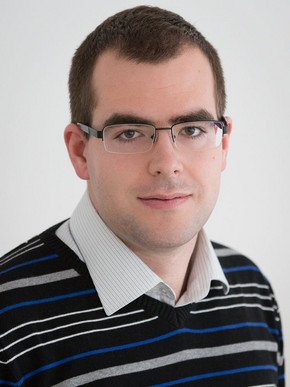
Eduard Vorobiev is a researcher affiliated with the Faculty of Earth Sciences, Geography and Astronomy, specializing in astrophysics. His work focuses on star formation, protoplanetary disks, and computational methods for high-performance astrophysical simulations. Research interests include: Protostars and accretion bursts Protoplanetary disk dynamics Gravitational instability in stellar systems Young stellar objects and disk winds Computational astrophysics with hybrid parallelization ALMA observational constraints Recent publications highlight his contributions to modeling high-mass star formation and optimizing Fortran-based simulations. He participates in academic events like the Graz Vienna Exoplanet Science Meetings and leads research projects on star formation and galaxy evolution. His work involves collaborations with institutions using ALMA surveys and gravitational instability analysis.
Martin Hrusovsky is an Assistant Professor at the Institute for Production Management within the Department of Information Systems and Operations Management at Vienna University of Economics and Business (WU) . His work bridges teaching and research, focusing on mathematical optimization models, uncertainty handling via stochastic methods, and simulation applications in transport and supply chain management. Education PhD in Production Management (2013-2018, WU Vienna) Master in Supply Chain Management (WU Vienna) Research Interests center on sustainable supply chains , logistics optimization , and quantitative decision-making . His work addresses fleet sizing under uncertainty, risk management, and sustainability integration in transportation systems. He actively explores the Physical Internet concept for SCM innovation. Recent Publications highlight trends in freight railcar optimization , blockchain for supply chain resilience , and cryptographic solutions to the bullwhip effect . His collaboration network spans institutions like the University of Innsbruck and Springer publications. Projects Backbone PI: Rail (2019-2020) - Researcher Case Study Development - Business Analytics (2018) European Wide Service Platform for Green European Transportation (2012-2015) - Researcher
Aleksandar Borković is a Researcher at the Institute of Structural Mechanics , Graz University of Technology. His work focuses on advanced computational methods in structural engineering, particularly isogeometric analysis, finite strip modeling, and van der Waals interactions in slender structures. Department: Institute of Structural Mechanics Email: aborkovic@tugraz.at His research bridges theoretical mechanics and practical engineering applications, addressing nonlinear dynamics, contact mechanics, and geometrically exact formulations. Recent publications highlight innovative approaches to modeling molecular interactions in fiber systems and optimizing computational efficiency for structural simulations. The 15 most recent articles demonstrate expertise in: Van der Waals attraction in curved beams Geometrically exact isogeometric formulations Finite strip method for stiffened plates Contact dynamics in beam-to-beam interactions Nonlinear stability analysis of thin-walled structures Moving load simulations in spatial beams He has also contributed to educational software development for structural analysis, emphasizing real-time visualization and numerical accuracy.
Katrin Ellermann is a University Professor (Professor) at the Institute of Mechanics , Graz University of Technology (TU Graz), Austria. Her research spans rotordynamics , nonlinear vibrations , biomedical engineering (particularly aortic dissection modeling), and offshore systems . She has developed advanced numerical methods like the Numerical Assembly Technique and applied fractional derivative damping models to rotor systems. Her work integrates computational mechanics with applications in industrial machinery and cardiovascular diagnostics via impedance cardiography. Her research interests include: Stability and vibration analysis of mechanical systems Computational modeling of aortic dissection and thrombosis Application of polynomial chaos expansion and sensitivity analysis Control systems using Kalman filters and mechatronic simulations Nonlinear dynamics in offshore structures Advanced damping models via fractional calculus Recent publications focus on rotordynamics (balancing techniques, damping models) and biomedical simulations (SynthAorta dataset, false lumen thrombosis). She has also contributed to fault detection in railway and offshore systems.
Florian Feist is a researcher at the Institute for Vehicle Safety (VSI) at Graz University of Technology. His work focuses on automotive materials, battery crash safety, and sustainable lightweight composites. Research Interests: Automotive engineering, crash simulation, battery lifecycle analysis, and biomechanical modeling. Recent projects include wood-steel hybrid components , Li-ion battery crash behavior , and bio-based foam for helmets . Scientific Contributions: Key themes in his publications (2024-2025) include multiscale battery modeling , stitched wood composites , and dynamic material testing . His work bridges mechanical engineering , material science , and sustainable design .
Georg Arbesser-Rastburg is a researcher at the Institute of Human-Centred Computing, Faculty of Computer Science, Graz University of Technology (TU Graz), Austria. He holds a BSc and Dipl.-Ing. in engineering and focuses on applying information technology to water infrastructure challenges and virtual reality-based energy simulation. Research Interests: Water Supply Management under Climate Change Virtual Reality for Urban Energy Data Visualization Serious Games for Water Resource Awareness Optimal Sensor Placement in Water Networks Trading Mechanisms in Digital Economies His recent publications demonstrate a clear trend toward gamified engineering tools, merging virtual reality with hydraulic modeling to address sustainability challenges in urban water systems and energy efficiency. Key projects include EWA (web-based water supply awareness) and VR4UrbanDev (immersive energy data visualization), reflecting interdisciplinary collaboration between computer science and civil engineering. Awards: ÖVGW Studienpreis 2020 for innovative water supply research Arbesser-Rastburg actively secures research funding through projects like GAIA (2024-2026) on green infrastructure impacts and contributes to public discourse through Austrian media coverage of his water management tools. His work emphasizes practical applications for climate adaptation in urban infrastructure.
Stefan Hinterholzer serves as a Professor at the University of Applied Sciences Upper Austria, based at the Research Center Hagenberg. His research bridges civil engineering and information systems, specializing in computational optimization of building construction processes for energy efficiency and cost reduction. His primary research domains include: Building Construction Design Optimization Energy Demand Modeling and Reduction Construction Cost Minimization Automated Construction Planning Systems Business Process Management for Knowledge Work Hinterholzer pioneered the “Bauoptimizer” simulation tool for architectural and material selection, enabling dual optimization of energy consumption and construction expenditures. His work establishes standardized reference frameworks for quantitative assessment in construction planning, addressing complex trade-offs between environmental impact and financial constraints through algorithmic exploration of design spaces. Analysis of his 2010-2014 publications reveals consistent application of computer-aided systems theory to sustainable construction challenges. His research demonstrates how automated simulation can navigate multi-dimensional optimization problems in building design, significantly advancing methodologies for eco-efficient construction planning within constrained computational search spaces. Professional activities include peer-review services for Wirtschaftsinformatik 2005 (eEconomy/eGovernment conference) and presentations on Business Process Management integration with enterprise software. His interdisciplinary approach connects construction engineering with information systems through practical computational solutions.
Herbert Egger is a Professor of Numerical Analysis and Scientific Computing at Johannes Kepler University (JKU) Linz and heads the Institute of Numerical Mathematics. He is also a Group Leader at RICAM (Johann Radon Institute for Computational and Applied Mathematics) and Scientific Director at the Austrian Academy of Sciences. His research focuses on advanced numerical methods for partial differential equations, including structure-preserving discretizations, inverse problems, and computational electromagnetics. Current projects include SFB F90-N (CREATOR) for electric machine co-simulation, SPP 2256 for phase-field modeling in additive manufacturing, and TRR 146 on multiscale soft matter systems. Key research areas: mixed/hybrid finite element methods, energy-based modeling, model order reduction, radiative transfer, and inverse problem stabilization. His recent work emphasizes nonlinear magnetostatics, phase separation models, and efficient solvers for time-dependent systems. Egger collaborates internationally with institutions like TU Eindhoven and TU Darmstadt.
Konstantin Schekotihin is an Associate Professor at the Department of Artificial Intelligence and Cybersecurity, Alpen-Adria University of Klagenfurt. His research focuses on artificial intelligence, machine learning, and semantic technologies with applications in industrial systems and semiconductor manufacturing. Reinforcement learning for industrial scheduling Answer Set Programming (ASP) and stream reasoning Failure analysis automation and ontology engineering Neuro-symbolic AI integration Knowledge-based systems in manufacturing Recent publications emphasize AI-driven optimization in semiconductor production, decomposition strategies for scheduling problems, and multi-agent systems for workflow management. His work combines symbolic reasoning with machine learning to address complex industrial challenges. Contact: Konstantin.Schekotihin@aau.at
Melanie Roth is a Ph.D. Research Group Leader and Health Sciences Senior Researcher at Salzburg University of Applied Sciences, with a focus on primary healthcare, interprofessional collaboration, and health technology applications. Her work contributes to several UN Sustainable Development Goals related to health and well-being. Her research interests span multiple areas of healthcare innovation: Primary care systems and interprofessional collaboration Diabetes management and mobile health (mHealth) interventions Nursing education and practice improvement Osteoarthritis progression and biomarker studies User-centered healthcare design and citizen science approaches Dr. Roth leads multiple research projects including REALISE (Collaborative, digital and green/sustainable skills via multimodal simulation), RehabHeat 2.0, and HealthMeetsSustainability, focusing on innovative approaches to healthcare delivery and professional training. Her scientific contributions have been recognized with several awards: Best Abstract (2022) Gait patterns in bilateral spastic cerebral palsy on an uneven surface (2012) Leistungsstipendium (2013) OIS:zam Preis (September 2023) Dr. Roth is actively involved in knowledge dissemination through conference presentations and media engagement, particularly around the "Ganz Salzburg Bewegen" (Whole Salzburg Moves) citizen science initiative aimed at addressing physical inactivity and promoting heart health in the Salzburg region.
Olga Mula Hernandez is a Professor of Mathematics at the University of Vienna since September 2025, holding the Chair of Computational Partial Differential Equations. Previously, she served as an Associate Professor at Eindhoven University of Technology (2022-2025) and Assistant Professor at University Paris-Dauphine (2015-2022). Her educational background includes a double master's degree in Applied Mathematics and Nuclear Engineering from École Polytechnique (France) and Escuela Politécnica (Madrid) (2005-2011), followed by a PhD in Applied Mathematics from Sorbonne University (2011-2014). She also completed a postdoctoral fellowship at RWTH Aachen (2014-2015). Professor Mula's research centers on numerical analysis of partial differential equations with data-driven integration. Her work spans mathematical foundations of scientific machine learning (including PINNs), high-dimensional nonlinear approximation for PDE solvers, data assimilation and inverse problems, numerical optimal transport, and structure-preserving numerical schemes. She develops explainable, data-efficient computational methods that leverage physical insights rather than relying on black-box machine learning approaches. Her methodologies address critical applications across 3D-printing, haemodynamics, environmental pollution modeling, epidemiology, and nuclear engineering, where accurate physics-based simulations are essential for real-world problem solving.
Maximilian Jakob Schirl serves as a Junior Researcher at the Centre for Secure Energy Informatics within the Department of Computer Science, Faculty of Natural and Mathematical Sciences at Paris Lodron University of Salzburg. His work focuses on cybersecurity, energy informatics, and data-driven solutions for smart energy systems, contributing to multiple funded research projects including FTZ CyberSec and ECOSINT. His research spans cybersecurity in energy infrastructure, smart meter data analytics, industry 4.0 adoption, and digital readiness assessment. He employs advanced techniques like reinforcement learning and privacy-preserving algorithms to address challenges in local energy communities, supply chain resilience, and sociodemographic profiling from energy consumption patterns. Key methodologies include microaggregation for data anonymization, load profile analysis, and interoperability frameworks for Austrian energy systems. Recent publications demonstrate a strong trend toward machine learning applications in energy informatics, particularly reinforcement learning for production systems and privacy risk assessment in smart grids. His work bridges theoretical algorithms with practical industrial implementations, emphasizing data-driven optimization of low-voltage networks and secure energy community integration. Dr. Schirl actively participates in major funded projects including FTZ CyberSec (2025-2028) for cybersecurity evaluation, DAWN (2025-2026) for data-driven network optimization, ECOSINT (2021-2024) for energy community integration, and DIH West (2019-2023) supporting SME digitalization. These initiatives involve cross-institutional collaborations with researchers like G. Eibl and D. Radovanovic across Austria. As a core member of the Centre for Secure Energy Informatics, he contributes to developing secure, interoperable energy community frameworks through the ECOSINT project and advances privacy-preserving techniques for smart meter data within the FTZ CyberSec initiative.