Brian Ingalls is a Professor in the Department of Applied Mathematics and cross-appointed to Biology at the University of Waterloo. His research applies mathematical and control-theoretic approaches to biological systems, including genetic regulatory networks, microbial communities, and cellular metabolism. Institutional Affiliation: Faculty of Mathematics, University of Waterloo Contact: bingalls@uwaterloo.ca His work focuses on systems biology and synthetic biology , particularly sensitivity analysis of biochemical networks, optimal experimental design, and mathematical modeling of cellular processes. Research funding comes from NSERC and CIHR . Notable contributions include the textbook Mathematical Modeling in Systems Biology (MIT Press, 2013) and the Ingalls Quantitative Cell Biology Lab , which investigates intracellular and intercellular network dynamics through computational and experimental methods. Key Collaborations: iGEM Waterloo, Chemical Engineering, and international synthetic biology networks Advising: Mentored 15+ graduate students and postdocs across applied math, biology, and engineering fields
Kash Barker serves as the John A. Myers Professor and David L. Boren Professor at the University of Oklahoma in the Department of Industrial & Systems Engineering within the College of Engineering. As Graduate Liaison, he leads research on network resilience, supply chains, and systems engineering for societal good, with applications spanning infrastructure, supply chains, and community systems. His lab has produced 11 Ph.D. graduates (10 in academia) and 31 M.S. graduates. Research Domains: Resilient networks and interdependent systems Risk and decision analytics Supply chain survivability Pandemic economic impact modeling Climate migration optimization Cyber-Physical-Social Systems Article Trends emphasize disinformation defense , network restoration optimization , and multi-layer resilience modeling across infrastructure, supply chains, and community systems. His work combines game theory , machine learning , and decision analysis frameworks. Scientific Awards & Roles: Fellow, Institute of Industrial and Systems Engineers Senior Member, IEEE Fellow, Fulbright Finland Foundation (2023) Associate Editor roles in IISE Transactions and Naval Research Logistics Editorial Board Member for Risk Analysis and Scientific Reports Faculty Advisor, OU INFORMS student chapter Educational Background: Ph.D., Systems Engineering, University of Virginia M.S., Industrial Engineering, University of Oklahoma B.S., Industrial Engineering, University of Oklahoma
Jinjin Ha serves as an Assistant Professor in the Department of Mechanical Engineering at the University of New Hampshire, with her office located in Kingsbury Hall, Room W101a, Durham, NH. She teaches core mechanical engineering courses including Statics (ME 525), Materials Processing in Manufacturing (ME 742/842), Theory of Plasticity (ME 927), and Doctoral Research (ME 999), demonstrating active engagement in both undergraduate and graduate education. Her research program integrates computational mechanics with advanced manufacturing, focusing on: Machine learning applications for plasticity modeling and fracture prediction Deformation mechanics in incremental sheet forming processes Martensitic phase transformations in stainless steels Anisotropic material behavior and yield function development Ductile fracture characterization of titanium and aluminum alloys Analysis of her 2023-2024 publications reveals a decisive shift toward AI-driven mechanics, where neural networks solve complex constitutive modeling challenges in metal forming. This interdisciplinary approach bridges fundamental material science with industrial manufacturing optimization, particularly in toolpath design and phase transformation control. No scientific awards were documented in the provided profile information. While doctoral research supervision is indicated through ME 999 course listings, specific student names, grant funding details, laboratory facilities, or collaborative team structures were not disclosed in the available text.
Yingying Wang is an Assistant Professor in the Computing and Software department at McMaster University , where she joined in January 2022. Her research focuses on generating expressive animations for AR/VR applications and games through interdisciplinary approaches combining Computer Graphics , Artificial Intelligence , and Human Behavior Analysis . Education : Bachelor and Master degrees from Nanjing University , Ph.D. from University of California, Davis (2017) Her research explores: Generative models for human motion style transfer Physics-based motion simulation Audio-driven character synthesis Dance choreography for virtual characters Cartoon animation perception Conversational character gesture synthesis Markerless hand motion capture Recent publications focus on 3D hand pose estimation , motion style transfer , gesture-locomotion coordination , and personality perception in virtual agents . Key methodologies include deep learning , multimodal data analysis , and real-time animation systems . Scientific contributions recognized through: $240,000 Labarge Catalyst Grant in Mobility in Aging (interdisciplinary team award) US Patent 10,796,482 (3D hand pose estimation) US Patent 9,811,937 (gesture-locomotion coordination) Teaching includes graduate and undergraduate courses in Computer Animation (CAS 737), Computer Graphics (COMPSCI 3GC3/SFWRENG 3GC3), and Software Development (COMPSCI 2ME3). Research group actively recruits Ph.D. and Master's students in graphics + deep learning domains.
Prof. Dr.-Ing. Johannes Henrich Schleifenbaum is a Professor and Chair of Digital Additive Production at RWTH Aachen University, where he leads research in the Profile area Production Engineering (ProdE). His work advances additive manufacturing (AM) through interdisciplinary approaches combining materials science, process engineering, and digital technologies. His research encompasses: Laser powder bed fusion (LPBF) process optimization and defect mitigation Development of novel alloys/composites for AM applications Sustainable manufacturing practices including material recycling Integration of AI/ML for accelerated material and process design Digital tools for automated design and distributed manufacturing Recent publications (2023-2025) demonstrate a strong focus on: Multi-material processing and microstructure control Machine learning-driven alloy development Standardization and scalability of AM processes Advanced simulations for meltpool dynamics and thermal behavior Applications in aerospace, construction, and biochemical engineering He leads the Chair of Digital Additive Production, collaborating with industry partners to translate research into industrial solutions for next-generation manufacturing.
Dr. Xiaopeng Li is the Harvey D. Spangler Professor in the Department of Civil and Environmental Engineering at the University of Wisconsin-Madison, with an affiliation in the Department of Electrical and Computer Engineering. He leads the USDOT Rural Autonomous Vehicle Program and previously directed the National Institute for Congestion Reduction. He earned his B.S. in Civil Engineering from Tsinghua University (2006), M.S. in Civil Engineering (2007), M.S. in Applied Mathematics (2010), and Ph.D. in Civil Engineering (2011) from the University of Illinois at Urbana-Champaign. His research focuses on modeling and field experiments for connected, electric, and automated vehicles (CAVs), infrastructure systems analysis, and interdependent network modeling. He has pioneered physics-enhanced machine learning frameworks for vehicle control and developed simulation tools for CAV deployment. His 2025-2024 publications highlight advancements in Connected vehicle trajectory modeling Energy consumption optimization Edge computing for autonomous operations Residual learning control systems Equity analysis in AV deployment Communication technologies for V2X Awards include: TRB Best Paper Award (2025) NSF CAREER (2015) ASCE Fellow (2024) IEEE Senior Member (2022) Multiple institution-specific fellowships He has advised 15+ graduate students, secured $35M+ in grants from NSF, USDOT, and industry partners, and chairs the IEEE ITSS Emerging Transportation Technology Testing committee. His work addresses real-world AV implementation, safety validation, and sustainable transportation systems.
Dr. Hwan-Sik Yoon is an Associate Professor in the Department of Mechanical Engineering at The University of Alabama, where he focuses on applying Artificial Intelligence (AI) and Machine Learning (ML) to automotive, transportation, and manufacturing systems. His research spans modeling, simulation, and control of dynamic systems, with a strong emphasis on connected and automated vehicles (CAVs), energy-efficient routing, and sensor fusion technologies. Ph.D., Mechanical Engineering, Ohio State University, 2002 M.S., Mechanical Engineering, Ohio State University, 1998 B.S., Physics Education, Seoul National University, Korea, 1994 Dr. Yoon’s research integrates AI/ML into applications such as traffic signal control , excavator manipulator pose estimation , hybrid electric vehicle powertrain control , and factory floor safety monitoring . He is also involved in additive manufacturing , vision-based control systems , and reinforcement learning -driven automotive innovations. Recent publications highlight trends in deep reinforcement learning for vehicle energy efficiency, sensor fusion for traffic surveillance, and neural networks for dynamic system control. His work addresses challenges in multi-component failure analysis and real-time edge computing platforms . NSF Outstanding Faculty Advisor Award (2019) College of Engineering Faculty Productivity Award, Tennessee Tech University (2012) Dr. Yoon leads the Intelligent Structures and Systems Laboratory and serves as the lead CAVs faculty advisor for the University of Alabama’s EcoCAR student team, which has achieved national recognition in advanced vehicle technology competitions.
Yuanyuan Shi is an Assistant Professor in the Electrical and Computer Engineering Department at the University of California, San Diego (UCSD), with affiliations at the Center for Energy Research and the MICS. Her research integrates machine learning with control theory, focusing on energy systems, cyber-physical systems, and PDE-governed systems, aiming to provide reliable and efficient decision-making in complex environments like power grids and buildings. Assistant Professor, UCSD (2021–present) Postdoctoral Fellow, Caltech (2020–2021) Ph.D., Electrical and Computer Engineering, University of Washington (2020) M.Sc., Electrical Engineering and Statistics, University of Washington B.Eng., Nanjing University, China Her work spans machine learning, optimization, and control theory, with applications in power systems, PDEs, and intelligent systems. She develops algorithms that combine learning with control guarantees, enabling robust solutions for energy management and grid stability. Recent publications highlight her focus on neural operators for PDE and delay systems, stability-constrained reinforcement learning, and multi-agent control in sustainability contexts. These works advance physics-informed models, grid frequency regulation, and commercialized energy storage integration. She has received prestigious awards, including: NSF CAREER Award (2025) Schmidt Sciences AI2050 Early Career Fellowship (2025) Hellman Fellowship (2023) Jacobs School Early-Career Faculty Acceleration Award (2024) MIT Rising Star in EECS (2018) Clean Energy Institute Scientific Achievement Award (2020) At UCSD, her lab collaborates on projects like FedNeMO (federated neural operators) and BEAR-Data (multi-zone building dataset). She co-organized Control Meets Learning seminars and serves as guest co-editor for the Applied Energy special issue on Trustworthy Machine Learning.
Associate Professor Chengguo Zhang is a researcher at the University of New South Wales (UNSW Sydney) specializing in Mining Engineering and Geomechanics . His work focuses on improving mining safety and sustainability through fundamental and applied research on dynamic rock mass failures , groundwater-mining interactions , and data-driven visualization technologies . He currently serves as the Postgraduate Research Coordinator for the School of Mining Engineering. PhD in Mining Engineering from UNSW Sydney (2015) Coordinates postgraduate research programs Recipient of multiple teaching and research awards Research Interests: Zhang's work addresses critical mining industry challenges through: Quantification of energy sources and dissipation in rock masses for rockburst management Integration of AI data analytics and 3D visualization for geotechnical risk assessment Mine subsidence and coupled hydro-mechanical behavior of rock discontinuities Development of digital ground control management systems Article Trends: His recent publications demonstrate expertise in: Numerical modeling of rock fracturing mechanisms Nonlinear fluid flow analysis in fractured rock masses Shotcrete and ground support system evaluation Hydro-mechanical coupling during shear processes Energy-based coal burst risk classification Scientific Awards: Tim Shaw Award for Innovation in Teaching (2024) International Outstanding Young Scholar Award (2023) UNSW Education Excellence Award (2021) UNSW Research Excellence Award (2018) Research Supervision: Supervises 12 active PhD students (9 as primary/joint supervisor) and has guided 11 PhD completions (7 as primary/joint supervisor), including 3 Dean's Award recipients. Focuses on numerical modeling, data visualization, and machine learning applications in mining geomechanics.
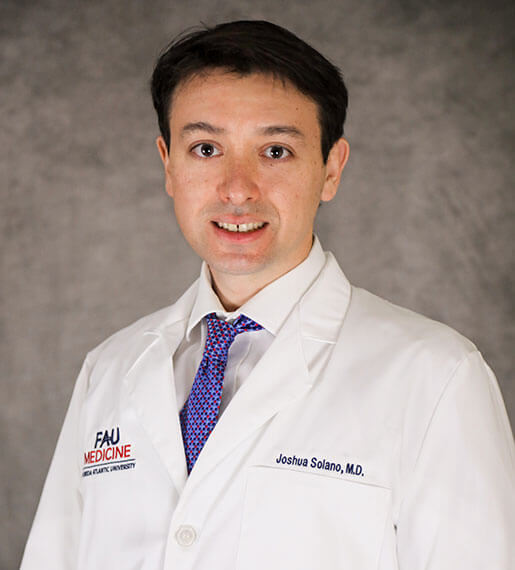
Joshua J. Solano, M.D., FAAEM is an Associate Professor of Emergency Medicine and Clerkship Director for the Emergency Medicine Residency program at the Florida Atlantic University Charles E. Schmidt College of Medicine. As Clerkship Director, he works alongside residents to promote best practices for emergency department patient care. Dr. Solano is board certified in emergency medicine and maintains active membership in the American College of Emergency Physicians and the American Academy of Emergency Medicine. Dr. Solano's educational background includes a BS in Biology and BA in History from Duke University, followed by his MD from the University of Florida. He completed his emergency medicine residency at Beth Israel Deaconess Medical Center in Boston and served on faculty at Harvard Medical School as an instructor and assistant program director before joining FAU. In his final year in Boston, he completed the Rabkin Medical Education Fellowship. Dr. Solano's research focuses on geriatric emergency medicine, particularly head trauma management in elderly patients, anticoagulation risks, and emergency department quality assurance. His recent publications demonstrate a strong emphasis on developing clinical decision rules for geriatric head trauma and understanding medication interactions in older emergency patients. He has also contributed significantly to medical education literature, developing innovative residency training curricula. His scholarly work shows a clear progression toward establishing evidence-based guidelines for geriatric emergency care, with numerous publications on intracranial hemorrhage risk assessment, anticoagulation management, and fall prevention strategies. Dr. Solano's research bridges clinical practice with educational innovation, making significant contributions to both patient care protocols and emergency medicine training. 2017: Attending Role Model Award, Beth Israel Deaconess Medical Center 2016-2017: Rabkin Medical Education Fellowship 2011: Alpha Omega Alpha Medical Honor Society 2011: Chapman Humanism Society 2010: Equal Access Clinic Service Award 2010: Lawrence M. Goodman Award for Medical Student Research 2010: Community Service Award As Clerkship Director, Dr. Solano oversees medical student education in emergency medicine and has implemented electronic evaluation systems that have increased the quality and quantity of student assessments. His clinical work includes staff positions at Bethesda East Hospital and Delray Medical Center. Dr. Solano's research program demonstrates strong institutional support through multiple publications and ongoing investigations into geriatric emergency care protocols.
Max Pellert is a computational social scientist and cognitive scientist with faculty appointments at multiple institutions. Since 2022, he has served as an Assistant Professor at the Chair for Data Science in the Economic and Social Sciences at the University of Mannheim . He previously held an interim Professor position at the University of Konstanz and an Assistant Researcher role at Sony Computer Science Laboratories Rome. His work bridges computational methods with social science theory. Education M.Sc., University of Vienna (2017) in Middle European interdisciplinary Master's program in Cognitive Science (with distinction) Ph.D., Medical University of Vienna (2022) in Medical Informatics, Biostatistics & Complex Systems Research interests center on Computational Social Science , Digital Traces , and Natural Language Processing for emotion and sentiment analysis. He develops Temporal Adapters for tracking longitudinal emotional patterns and FAULTANA pipeline for polarization studies. His AI Psychometrics framework assesses personality-like traits in large language models. Recent publications include: (1) 2025 ACL work on political bias in LLMs; (2) 2025 ICWSM study of temporal emotion analysis; (3) 2024 Perspectives on Psychological Science paper on LLM psychometrics; (4) 2024 PNAS Nexus polarization analysis; (5) 2023 Emotion cross-cultural study of pandemic emotions. Scientific Awards Habilitation candidate status at University of Mannheim Teaching includes IS 616: Large Scale Data Analysis , IS 809: Advanced Text Mining Lab , and IS 723: Data Science Seminar at master’s and PhD levels. His Barcelona Supercomputing Center role focuses on principal investigator duties for computational social science projects.
Mostafa Ammar is a Regents' Professor and Interim Chair at the School of Computer Science , Georgia Institute of Technology. He holds a Ph.D. from the University of Waterloo and degrees (S.B., S.M.) from MIT. His career spans academia, industry collaboration, and leadership in networking research. Research Interests : Network architectures, protocols, and services; multicast communication; multimedia streaming; content distribution networks; disruption-tolerant networks; mobile cloud computing; network virtualization; HTTP adaptive streaming; video quality of experience (QoE); encrypted traffic analysis; vehicular networks; peer-to-peer systems; overlay networks. Funding : Supported by NSF, DARPA, AFOSR, CISCO, IBM, Intel, BellSouth, Sprint, and others. His research focuses on video QoE estimation using network measurements, mobile cloud computing , and network agility through virtualization. Recent work includes machine learning approaches for encrypted traffic analysis and scalable techniques for network performance. Key scientific awards include: IBM Faculty Partnership Award (1996), Best Paper at WWW '98, IEEE Fellow (2002), ACM Fellow (2003), GT Outstanding Doctoral Thesis Advisor (2006), IEEE TCCC Service Award (2010), ACM Mobihoc Best Paper (2012), College of Computing Awards (2015, 2018), IFIP Best Paper (2018), and multiple teaching excellence awards (2013-2017, 2022 CIOS Award). Dr. Ammar has advised 39 PhD students , many of whom hold prominent positions at institutions like UC Santa Barbara, Emory University, and companies including Google, Microsoft, and Facebook. His editorial leadership includes Editor-in-Chief of IEEE/ACM Transactions on Networking (1999-2003) and roles in conference committees.
Julian Adamek is a computational cosmologist and lead developer of gevolution , a general-relativistic N-body code for cosmological simulations. His work focuses on modeling relativistic effects in cosmic structure formation to better understand gravity’s role on large scales and dark energy. Research Interests: Computational Cosmology, Theoretical Cosmology, Large-scale structure of the Universe, Relativistic N-body simulations. Technical Leadership: Lead developer of gevolution , a public cosmological simulation code available via GitHub. Recent publications span diverse applications of deep learning in geospatial analytics, environmental monitoring, and computer vision, including phenology modeling, biomass mapping, conflict assessment, and 3D reconstruction from point clouds. Key Trends: Integration of AI/ML for environmental tasks, cross-domain applications (cosmology, ecology, forestry), and satellite data processing. Technical Focus: Transformer networks, diffusion models, super-resolution imaging, and ensemble learning for uncertainty quantification. Julian collaborates with researchers in cosmology and geospatial science, though specific students or awards are not mentioned in the provided texts.
Professor Quanmin Zhu is a Professor in Control Systems at the School of Engineering, University of the West of England (UWE), Bristol, UK, holding this position since 2004. His academic career spans over four decades, including roles as Lecturer at Qiqihar University (China, 1983-1986), Post-doctoral Researcher at University of Sheffield (UK, 1989-1994), Lecturer at University of Brighton (UK, 1994-1997), and Lecturer/Reader at Aston University (UK, 1997-2004). His educational background includes: MSc in Engineering from Harbin Institute of Technology, China (1980-1983) PhD from University of Warwick, UK (1986-1989) Professor Zhu's research centers on dynamic system modeling, identification, control, and simulation, with pioneering contributions to nonlinear control systems, robust control methodologies, and U-model based control frameworks. His work bridges theoretical advances with practical applications in robotics, renewable energy systems, and industrial automation, emphasizing model-free and adaptive control solutions for complex nonlinear dynamics. Analysis of his 2021-2025 publications reveals a dominant focus on robust control for uncertain nonlinear systems, with significant contributions to sliding mode control, multi-agent coordination, and cyber-physical security. His research increasingly integrates machine learning techniques (e.g., actor-critic reinforcement learning) while maintaining core expertise in optimization-based control algorithms applied to UAVs, robotic manipulators, and wind energy systems. His professional honors include: Chartered Engineer (CEng) Fellow of the Institution of Engineering and Technology (FIET) Fellow of the Higher Education Academy (FHEA) As an academic leader, Professor Zhu serves as President/Founder of the International Conference on Modelling, Identification and Control (ICMIC), Editor/Founder of Elsevier's Book Series on Emerging Methodologies in Modelling and Control, and University Ambassador for UK-China educational collaboration. His research group secures substantial grants in control theory applications, with ongoing projects in U-model control platforms and international partnerships. He leads the Control Systems research group at UWE, driving innovation in the U-control platform and its industrial applications. His team maintains strong international collaborations, particularly with Chinese institutions, and actively develops the Elsevier Book Series as a key publication channel for emerging control methodologies.
Tessa H.S. Eysink is a Full Professor in Instructional Technology, affiliated with the Digital Society Institute. Her research focuses on educational technology, inquiry-based learning, and technology-enhanced STEM education for children. 2024 Research Highlights : Investigated physiological and gaze metrics for learner emotions in Frontiers in Psychology Studied hypothesis generation in simulation-based learning in the Journal of Research in Science Teaching Co-developed the gamified Science Chaser app for STEM engagement at the ACM Interaction Design and Children Conference Her work bridges psychology, computer science, and education, emphasizing multimedia learning and cognitive modeling. No scientific awards or student supervision details were explicitly mentioned in the provided texts.