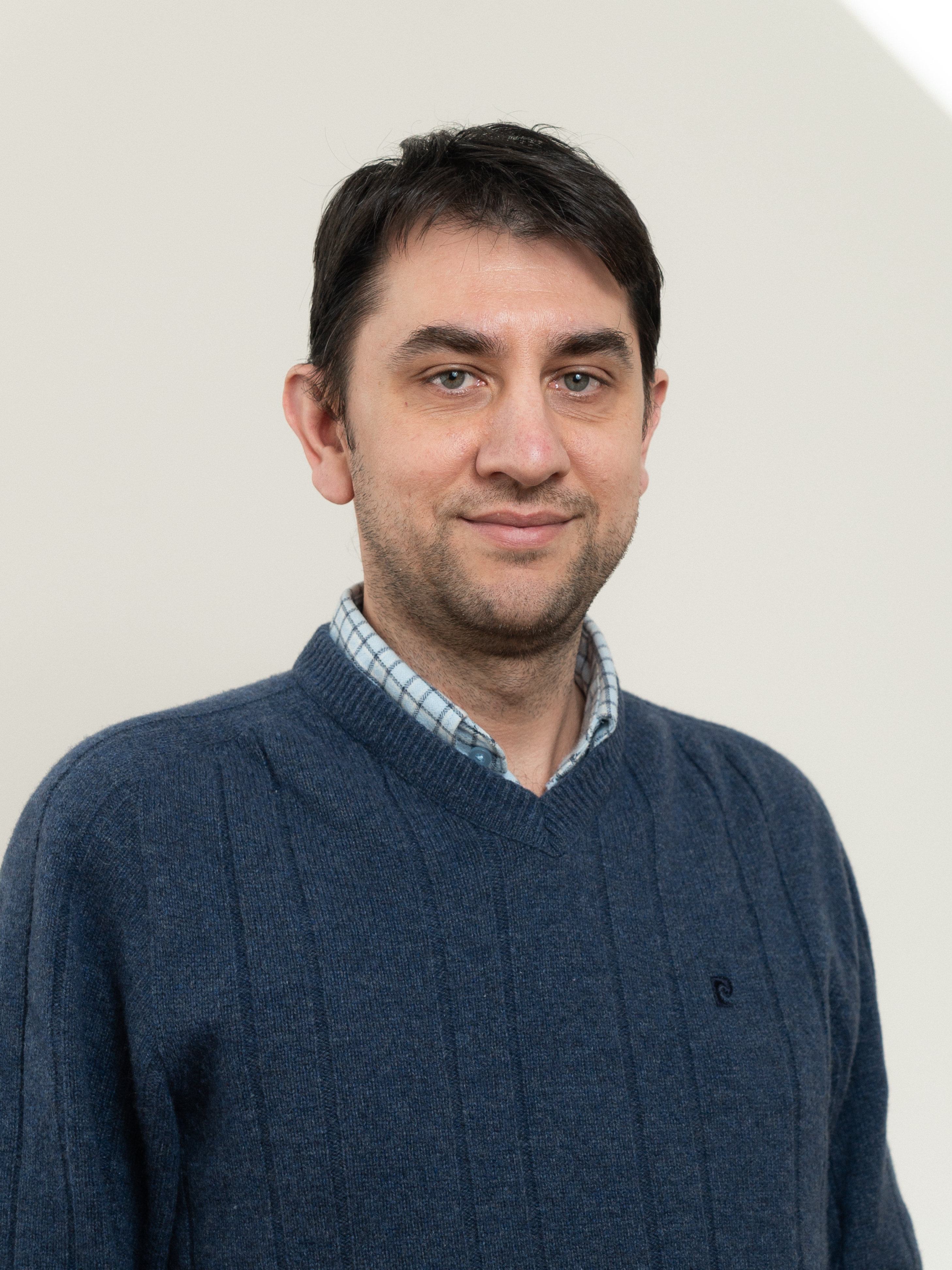
Dr. Daniele Ettore Otera is a Senior Researcher at the Institute of Data Science and Digital Technologies (DMSTI) and the Faculty of Mathematics and Informatics of Vilnius University , Lithuania. His work is centered on geometric group theory, low-dimensional topology, and group theory, with a focus on asymptotic topology and topological tameness of groups and manifolds. Education: He earned a Mathematics degree from the University of Palermo (1999), a DEA (Master’s) from Université Paris-Sud 11 (2001), and a co-tutored PhD from both University of Palermo and Université Paris-Sud 11 (2006). Research Interests: Geometric group theory: quasi-isometries, ends of groups, lattices in Lie groups Low-dimensional topology: topological tameness, simple connectivity at infinity, geometric simple connectivity Group theory: subgroup permutability, commutativity degrees, probability in group theory Publications: His recent work spans graph theory, spectral invariants, group actions, and geometric topology, reflecting a deep interdisciplinary approach combining algebra, topology, and combinatorics. Labs & Teams: He is affiliated with the Interdisciplinary Statistical Research Group within DMSTI, contributing to collaborative research in mathematical sciences.
Mikael Vejdemo-Johansson is an Associate Professor of Data Science and Mathematics at the Department of Mathematics, CUNY College of Staten Island, with concurrent roles as Executive Officer of Computer Science and Director of Data Science at the CUNY Graduate Center. His work bridges applied algebraic topology, computational mathematics, and data science, with a focus on topological data analysis (TDA) and its applications to diverse domains. He has contributed extensively to software development in TDA, notably creating JavaPlex, and has co-authored foundational work on persistent homology, cohomology, and the Mapper algorithm. His research explores topological modeling of political data, motion capture, and biomedical applications, while advocating for mental health awareness in academia through initiatives like the Depressed Academics blog. His recent publications emphasize persistent cohomology, error classification in predictive models, and distributed algorithms for evasion problems. He mentors graduate students in computational topology, machine learning, and data science, and his artistic endeavors include mathematical art exhibitions at major conferences like the Bridges Mathematical Art Conference.
Khanh Duy Trinh is a Professor (non-tenure-track) at Waseda University's Global Center for Science and Engineering, specializing in probability theory and its applications to random matrix theory and stochastic topology. He holds a PhD from Osaka University (2012) and has held academic positions at Tohoku University and Kyushu University. Current affiliation: Waseda University (2025-present) Past roles: Associate Professor at Waseda (2019-2025), Tohoku University, Kyushu University Research areas: Beta ensembles, Random topology, Spectral measures, Stochastic geometry His work demonstrates universal behavior in random matrix models through spectral analysis and topological persistence. Key contributions include central limit theorems for eigenvalue statistics, Poisson approximations in high-temperature regimes, and geometric interpretations of persistence diagrams. His recent papers focus on generalized beta processes and higher-dimensional complex structures. Current projects include: JSPS Grant 2024-2029: Universal approaches in random matrix theory Past JSPS Grant 2019-2023: Multi-aspects of beta ensembles Teaching activities at Waseda include: Introduction to Probability and Statistics Advanced Probability and Statistics Master's Thesis advising in Pure and Applied Mathematics
PENKA IVANOVA IVANOVA is a Lecturer at the Technical University - Gabrovo working in the Department of Language and specialized training. She has maintained an active academic career at the institution since at least 2017. Her research focuses on Mathematics Education with specialization in teaching methodologies for engineering students. Dr. Ivanova has developed expertise in applying computer algebra systems like Wolfram Mathematica and Maple to enhance understanding of complex mathematical concepts. Her work spans calculus instruction, particularly the Mean Value Theorems and extremum problems, as well as broader educational technology applications including web accessibility and discrete structures. Dr. Ivanova's publication pattern shows consistent development from foundational work on multiple solution approaches (2018) to specialized computational teaching methods (2019-2022), culminating in comprehensive nonlinear teaching frameworks for core calculus concepts (2024). A recurring theme throughout her research is the practical application of mathematical methods for engineering education. She has participated in six significant research projects at TU Gabrovo: Modern engineering solutions for environmental management and protection (Stages I-III, 2022-2024) Multidimensional pyramidal and simplicial finite elements (2021) Innovative educational technologies, discrete structures and web-accessibility (2019) Modern educational technologies, cultural heritage and WEB accessibility (2018) Working as a participant in teams of 12-17 researchers, she has contributed to the university's research initiatives while maintaining her teaching responsibilities. Her involvement in the CompMath Competition highlights her commitment to promoting computational problem-solving approaches in mathematics education, bridging theoretical concepts with practical engineering applications.
Professor István Z. Kiss is a Professor of Network Science at the Network Science Institute, Northeastern University London. His research bridges network science, dynamical systems, and stochastic processes with applications in epidemic modeling, computational neuroscience, and complex systems analysis. He leads the Systems Processes and Networks Lab (SPAN Lab) and maintains active collaborations across multiple institutions globally. Current position: Professor of Network Science Institution: Northeastern University London Research unit: Network Science Institute (SPAN Lab) Key collaborators: Péter L. Simon (Eötvös Loránd University), Joel C. Miller (La Trobe University), Gregory A. Rempała (Ohio State University) His research focuses on theoretical and data-driven problems at the intersection of network science and dynamical processes. Key areas include network inference, exactness of mean-field models, temporal and higher-order networks, adaptive/dynamic networks, and resilience of power networks. He has made significant contributions to understanding epidemic dynamics on complex networks, developing mathematical frameworks that connect approximate models with rigorous counterparts. Recent work emphasizes higher-order network structures, network inference from system-level data, and applications to public health and infrastructure resilience. His publication record demonstrates consistent output in top journals including Journal of Mathematical Biology, Bulletin of Mathematical Biology, and Physical Review E. The research shows a clear progression toward increasingly complex network structures, with recent publications focusing on higher-order interactions, temporal dynamics, and practical applications in epidemiology and infrastructure networks. His work bridges theoretical mathematics with real-world applications in disease control and network resilience. Professor Kiss actively supervises postdoctoral researchers and PhD students, with current advisees including Federico Cosimo Malizia (higher-order network contagion), Kevin Teo (shipping networks), and Yan Li (trade dynamics). His supervision spans mathematical theory, computational modeling, and data analysis across multiple domains. Leverhulme Trust grant RPG-2017-370: Bayesian Inference and Approximations in High-dimensional Network Models Network Science Institute Boston funding for higher-order network research EPSRC grant EP/H001085/1 for information diffusion modeling He leads the Systems Processes and Networks Lab (SPAN Lab), which develops mathematical frameworks for complex networked systems. The lab focuses on both theoretical advancements in network science and practical applications to epidemiology, neuroscience, and infrastructure networks. Current projects include developing tools for sequential temporal network analysis, understanding failure prediction in utility networks, and disentangling contact network structure effects on system-level outputs.
Daniel McCormick is a Research Fellow in the Department of Mathematics (including Mathematical Statistics) at Stockholm University. His academic work bridges the fields of commutative algebra and algebraic topology. McCormick's primary research interests involve applying DG (differential graded), derived, simplicial, and spectral methods to investigate the homological and homotopical properties of commutative rings. He has particular expertise in studying singularities of local commutative rings. His approach emphasizes the bidirectional application of concepts between modern algebraic topology and commutative algebra, creating innovative connections between these mathematical domains. His publications demonstrate a consistent focus on advanced algebraic structures, with his 2023 paper exploring cohomological jump loci and duality in local algebra, and his 2017 work addressing realizability problems in linear algebra contexts. These works reflect both theoretical depth and practical applications of algebraic theory. McCormick completed his doctoral studies at the University of Utah under the supervision of Srikanth Iyengar and Benjamin Briggs, establishing the foundation for his current research trajectory in algebraic structures and their topological implications.