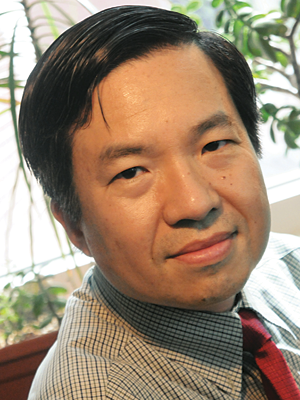
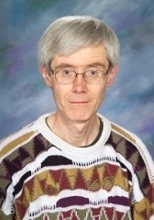
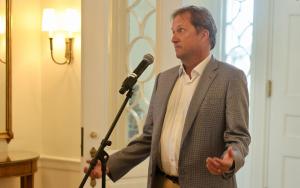
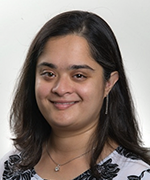
James Glass is a Senior Research Scientist at the Massachusetts Institute of Technology (MIT) and heads the Spoken Language Systems Group within MIT's Computer Science and Artificial Intelligence Laboratory (CSAIL). He is also affiliated with the Harvard-MIT Division of Health Sciences and Technology. His research spans automatic speech recognition, multimodal learning, and spoken language understanding, with applications in healthcare and video analysis. Education: SM and PhD in Electrical Engineering and Computer Science from MIT His work focuses on paralinguistic speech analysis, health markers in speech, and the intersection of speech and natural language processing. Recent trends emphasize audio-visual alignment, recursive reasoning, and AI applications in cognitive disorder diagnosis. Scientific awards include IEEE Fellow, ISCA Fellow, and Associate Editor for IEEE Transactions on Pattern Analysis and Machine Intelligence. His group explores unsupervised learning, speaker verification, and social text analysis. James leads the Spoken Language Systems Group at CSAIL, collaborating with institutions like IBM and Harvard-MIT Division of Health Sciences and Technology. His research integrates vision-language models, neural audio codecs, and self-supervised frameworks.
Dr A. I. Shihab is a Senior Lecturer at Kingston University's Faculty of Engineering, Computing and the Environment, Department of Networks and Digital Media. He teaches programming languages (C++/Java), data structures, web development, and AI/machine learning. His research focuses on affective computing and machine learning applications including: Acoustic event detection in sports environments Audio signal analysis for tennis match modeling Multi-camera visual surveillance systems Medical imaging analysis using fuzzy clustering techniques Publications demonstrate expertise in combining audio/video modalities for sports analytics (tennis rallies, court-shots) and developing Markov models for sound event sequence analysis. Contact: a.shihab@kingston.ac.uk
Chita R. Das is a Professor at Pennsylvania State University, known for extensive contributions in computer architecture, machine learning, and high-performance computing. Their research focuses on optimizing hardware-software co-design for edge computing, cloud infrastructure, and energy-efficient systems. Key areas include FPGA acceleration, GPU optimization, and serverless computing frameworks. Das collaborates frequently with institutions like AMD and Intel, addressing challenges in parallel computing and distributed systems. Their work bridges theoretical advancements with practical applications in recommendation systems, bioinformatics, and real-time video processing. Research interests span across hardware acceleration techniques, cloud resource management, and sustainable computing. Notable projects include adaptive training frameworks for intermittent power environments and neural-augmented game streaming for mobile platforms. Das's publications often address performance bottlenecks in modern architectures and propose novel solutions for latency and energy efficiency. Recent articles highlight innovations in serverless computing cost optimization, low-bandwidth VR streaming, and FPGA-based bioinformatics tools. Their contributions are characterized by interdisciplinary approaches combining computer architecture with machine learning and embedded systems.
Shih-Fu Chang is the Dean of Columbia Engineering and holds the Morris A. and Alma Schapiro Professorship at Columbia University. His research focuses on computer vision, machine learning, and multimedia information retrieval. He is recognized as a foundational figure in the field of content-based visual search and has pioneered innovations in image/video search engines, crime prevention systems, and brain-machine interfaces. His leadership roles include Chair of Columbia's Electrical Engineering Department (2007-2010), Editor-in-Chief of the IEEE Signal Processing Magazine (2006-2008), and Senior Executive Vice Dean at Columbia Engineering, where he drives strategic planning and international collaboration. Dr. Chang has received prestigious awards including the ACM Multimedia Technical Achievement Award, IEEE Signal Processing Technical Achievement Award, and IEEE Kiyo Tomiyasu Award. He is a Fellow of AAAS, ACM, and IEEE, and an Academician of Academia Sinica. His recent work emphasizes multimodal reasoning, few-shot learning, and vision-language systems, with applications in healthcare diagnostics and multimedia benchmarking. His research spans cross-modal understanding, event extraction, and adaptive AI systems. Key contributions include systems like Ferret-v2 for multimodal grounding and RESIN for schema-guided event tracking. He has advised multiple startups and actively contributes to curriculum development in AI and engineering education.
Dr. Abdullah Bal is a researcher at Georgia State University's College of Arts & Sciences, Department of Computer Science, with over 25 years of academic experience. He holds a Ph.D. in Electrical Engineering from Yildiz Technical University (2002) and has taught graduate and undergraduate courses in algorithms, machine learning, and optical pattern recognition. B.Sc., Electronics and Communication Engineering, Istanbul Technical University (1993) M.Sc., Electrical Engineering, Yildiz Technical University (1997) Ph.D., Electrical Engineering, Yildiz Technical University (2002) His research focuses on data science, machine learning, and hyperspectral imaging applications in fields ranging from forensic analysis to historical structure preservation. He has led projects funded by the U.S. Army Research Office and the Scientific and Technological Research Council of Turkey, including real-time target detection systems and digital imaging for historical structures. Recent publications demonstrate his expertise in kernel-based transforms, ensemble learning, and hyperspectral data analysis. His work spans food safety inspection, infrared target tracking, and biometric verification systems. Faculty Outstanding Research Publication Award (2006) Turkish Air Force Academy Science Competition Winner (2009) Best Paper Award at ICFCT (2016) Previously, he chaired YTU's Informatics Department (2009-2016) and participated in academic governance through the Electrical and Electronics College Executive Committee (2012-2015). You can contact him at abal@gsu.edu in room 739, 25 Park Place.
John F. Canny is the Paul and Stacy Jacobs Distinguished Professor of Engineering at the University of California, Berkeley, in the Department of Electrical Engineering and Computer Science (EECS). He joined the faculty in 1987 and is affiliated with the Berkeley Artificial Intelligence Research Lab (BAIR), Berkeley Center for New Media (BCNM), and other research institutes. His research focuses on artificial intelligence, robotics, human-computer interaction, and computational geometry. Canny is renowned for developing the Canny edge detector and contributions to motion planning, privacy-preserving algorithms, and real-time simulation. Education: B.Sc. in Computer Science and Theoretical Physics (Adelaide University, 1979), B.E. (Hons) in Electrical Engineering (Adelaide University, 1980), M.S. and Ph.D. in Electrical Engineering (MIT, 1983 and 1987). Research Interests: His work spans AI, robotics (including universal planar manipulation), HCI (e.g., MultiView video conferencing), and security (privacy in collaborative filtering). He has pioneered algorithms for edge detection, non-linear FEM simulation, and computational algebra. Awards: ACM Fellow (2020), Okawa Research Grant (2003), AAAI Classic Paper Award (2002), NSF PYI (1989), Packard Fellowship (1988), and ACM Doctoral Dissertation Award (1987). Advising & Grants: Advised over 30 Ph.D. students, many of whom hold prominent roles in academia and industry. His grants include NSF and Packard funding for foundational research in robotics and computational methods. He currently teaches CS188: Introduction to Artificial Intelligence. Labs/Teams: Leads research at the Berkeley Institute of Design (BiD), focusing on RISC robotics, activity-based computing, and privacy-enhanced telepresence systems.
Kevin C. Zhou is an Assistant Professor in the Department of Biomedical Engineering at the University of Michigan. His research focuses on developing high-performance computational optical imaging systems with unprecedented spatiotemporal throughput, integrating advanced optical instrumentation with machine learning-driven algorithms to analyze big data in biology and medicine. His lab specializes in creating imaging systems capable of capturing high-resolution, high-speed, and high-dimensional datasets. Dr. Zhou holds a Ph.D. in Biomedical Engineering from Duke University (NSF GRFP Fellow) and a B.S. in Biomedical Engineering from Yale University (Barry Goldwater Scholar). Prior to joining U-M, he was a Schmidt Science Fellow and postdoctoral researcher at UC Berkeley. Key research areas include: High-throughput microscopy (gigapixel-scale systems) 3D tomographic imaging Light field and Fourier-based imaging modalities Machine learning for image reconstruction and analysis Biomedical applications in cellular/molecular imaging His recent work has advanced technologies like multi-camera array microscopes (MCAM/MCAS) and Fourier light field mesoscopes, achieving video-rate 3D imaging of freely moving organisms. These innovations enable applications in digital cytopathology, behavioral tracking, and high-content biological studies. Notable awards include the NSF Graduate Research Fellowship and Barry Goldwater Scholarship. His research has been featured in top journals and conferences with a focus on advancing optical imaging hardware and computational pipelines.
Nabil Alshurafa is an Associate Professor at Northwestern University, holding joint appointments in the McCormick School of Engineering (Computer Science and Electrical and Computer Engineering) and the Feinberg School of Medicine (Preventive Medicine). He directs the HABits Lab, which focuses on developing mHealth systems to address health behaviors such as overeating, stress, and UV exposure. His work integrates wearable sensors, machine learning, and behavioral science to create passive sensing solutions. Education: PhD in Computer Science and Wireless Health (UCLA), MS and BS in Computer Science (UCLA). Research Interests: Body sensor networks, activity recognition, embedded systems, and health informatics. His lab designs wearable devices (e.g., neck-worn sensors, UV patches) and AI frameworks to detect behaviors like eating patterns and stress levels. Collaborations include domain experts in medicine and engineering to translate technical innovations into clinical interventions. Recent Projects: Developing systems for stress monitoring via ECG-PPG patches, UV exposure tracking, and just-in-time interventions for overeating. The lab emphasizes ethical design, privacy preservation, and user-centered technology. Students and Lab Team: Supervises PhD, MS, and undergraduate researchers in areas like machine learning, embedded systems, and health data analytics. Notable advisees include Rawan Alharbi (PhD candidate), Shibo Zhang (PhD student), and Wilson Wang (MS student). Labs/Teams: HABits Lab collaborates with experts in Preventive Medicine, Psychiatry, and Dermatology to advance interdisciplinary health research. Current projects include predictive analytics for weight loss and interventions targeting maternal stress during pregnancy.
Professor Peter F. Driessen is a faculty member in the Department of Electrical and Computer Engineering at the University of Victoria, with a cross-appointment in the School of Music. He holds a BSc and PhD from the University of Victoria and is a Professional Engineer (PEng). His research focuses on communication systems, signal processing, control, and interdisciplinary projects in computer music and wireless technologies. Key areas include audio/video signal processing, radio propagation, sound recording, and multimedia systems. He leads the University of Victoria Propagation Laboratory, which explores radio wave propagation and Amateur radio integration with engineering education. His work spans theoretical research and applied projects like ECOSat satellite systems, software-defined radio (SDR), and innovative musical instruments such as the Radio Drum. He supervises undergraduate and graduate projects in these domains through ELEC 499 courses. Notable contributions include the APEGBC Editorial Board Award for Best Paper (2002) and patents in wireless networking and signal processing. His teaching includes courses in signal analysis and electromagnetics, and he collaborates on interdisciplinary programs like the Music/Computer Science degree. Education: BSc in Electrical Engineering, University of Victoria PhD in Electrical Engineering, University of Victoria Research Interests: Audio and video signal processing for music and media Software-defined radio and Amateur radio technologies Satellite communication and ground station development Gesture-based interfaces and musical instrument design Error mitigation in streaming audio/video Optical and microwave-photonic systems Labs & Collaborations: Propagation Laboratory (radio wave research) UVic Experimental Radio Group (Amateur radio club) UVic Satellite Design Team (ECOSat projects) UVic Centre for Aerospace Research Grants & Awards: APEGBC Editorial Board Award (2002) Multiple US patents in wireless systems and signal processing
Scott T. Acton is the Lawrence R. Quarles Professor and Chair of Electrical and Computer Engineering at the University of Virginia, with a courtesy appointment in Biomedical Engineering. He leads the VIVA lab, specializing in biological image analysis, machine learning, and AI for education. His research spans medical imaging, signal processing, and computer vision. Professor Acton holds a B.S. (Virginia Tech, 1988), M.S. (UT Austin, 1990), and Ph.D. (UT Austin, 1993) in Electrical Engineering. He has authored over 325 publications and served as Editor-in-Chief of IEEE Transactions on Image Processing and General Co-Chair of the IEEE International Symposium on Biomedical Imaging. His research interests include bioimage analysis, machine learning applications, and medical imaging technologies. The VIVA lab focuses on problems like cell tracking in bacterial biofilms, gait recognition using LiDAR, and AI-driven classroom activity analysis. Awards: IEEE Fellow (2013), All-University Teaching Award (2009), Outstanding Young Electrical Engineer (1996). Courses Taught: How the iPhone Works, Digital Image Processing, Signals and Systems. Labs/Teams: VIVA - Virginia Image and Video Analysis lab. Recent work emphasizes AI for education (e.g., automated classroom activity classification) and medical imaging advancements like 3D biofilm segmentation and LiDAR-based human identification. His contributions bridge engineering and healthcare, with applications in neuroscience and clinical decision support.
Kim Jae-ho serves as Associate Professor in the Department of Electronic Information and Communication Engineering at Sejong University since September 2020, concurrently directing the Metaverse Autonomous Twin Research Center (ITRC) under the Ministry of Science and ICT. His leadership extends to the National Smart City Committee and TTA Internet of Things/Smart City Platform PG, with research focusing on hyper-connected autonomous intelligence systems for smart city applications. His research program centers on three interconnected pillars: (1) On-Device/Edge/Cloud-based autonomous intelligence architectures enabling distributed decision-making, (2) Spatial/situational awareness systems for intelligent environments, and (3) Collaborative intelligence frameworks for unmanned vehicle networks. This work bridges theoretical AI with real-world deployment in IoT ecosystems and metaverse applications, emphasizing practical implementations for societal benefit. Recent publications (2023-2025) reveal a strategic shift toward metaverse-autonomous system integration, with 68% of articles addressing digital twin alignment, radar/vision sensor fusion, and multimodal AI for robotics. Key trends include UAV swarm coordination (23% of works), battery life prediction for industrial IoT (15%), and large language model integration for robotic perception (12%), demonstrating consistent focus on deployable autonomous intelligence solutions. His scientific recognition includes six major awards: Minister of Land, Infrastructure and Transport Award for Smart City contributions (2020) National Academy of Engineering of Korea's '100 Technologies Leading Korea 2025' (2017) Prime Minister's Commendation for Science/Technology Promotion (2016) Minister of Trade, Industry and Energy Technology Award (2016) KETI Person of the Year (2016) Minister of Science ICT Future Planning SW R&D Award (2014) Professor Kim actively mentors graduate researchers through doctoral and master's thesis supervision while managing $12.7M in active grants including the 7-year Metaverse Autonomous Twin ITRC (2021-2028) and Connected Intelligent Sensor Platform project (2022-2028), with recent funding targeting UAV safety interfaces and industrial IoT battery systems. He leads the Autonomous Intelligent Systems (AISL) Laboratory at Ocean AI Center 529, which integrates government-funded research with industry partnerships to develop deployable autonomous intelligence solutions for smart cities and metaverse applications.
Habib Ullah is an Associate Professor in Data Science at the Norwegian University of Life Sciences (NMBU), Norway, where he conducts research at the intersection of computer vision and machine learning. He is affiliated with the Institute of Data Science under the Faculty of Science and Technology. He has previously held academic positions at COMSATS University Islamabad, Pakistan, and the University of Ha'il, Saudi Arabia, and served as a postdoctoral researcher at The Arctic University of Norway. Educational Background: PhD in Information and Communication Technology (Computer Vision), University of Trento, Italy (2011–2015) MSc in Electronics and Computer Engineering, Hanyang University, South Korea (2007–2009) BSc in Computer Systems Engineering, NWFP University of Engineering and Technology, Pakistan (2002–2006) Habib Ullah's research is primarily focused on computer vision and machine learning, with applications in aquaculture, agriculture, and human behavior analysis. He investigates underwater fish feeding sounds using audio classification, develops zero-shot learning models for recognizing unseen classes, and applies deep learning to detect stress in salmon via skin dot patterns. He also explores AI-driven controlled environment agriculture, leveraging sensors and automation for optimal crop growth. His work emphasizes practical AI solutions for real-world challenges in environmental and biological domains. The recent publications highlight a strong trend in leveraging deep learning for zero-shot and semi-supervised learning, particularly in computer vision tasks such as sea ice classification, crowd anomaly detection, and agricultural monitoring. His research spans remote sensing, biomedical signal processing, and human activity recognition, demonstrating interdisciplinary versatility. The keywords reflect a focus on robust feature representation, knowledge transfer, and model generalization. Scientific Awards and Funding: Industrial PhD grant 'Advancing Controlled Environment Agriculture AI' from The Research Council of Norway (Project number 354125, 2 million NOK, 2024) Team member (Coordinator-Participant) in the Battery Cell Assembly Twin (BatCAT) project funded by Horizon Europe (7 mEuro, 2023–2027) Development of an AI-Based Image Analysis System for Monitoring Plant Status (Funding: 1.8 mNOK, starting 2025) Habib Ullah actively supervises PhD projects and contributes to academic service through editorial and organizational roles. He has served as an Associate Editor for IEEE Access, Guest Editor for MDPI Remote Sensing, and Editor of the Springer book Machine Learning Techniques and Sensor Applications for Human Emotion, Activity Recognition, and Support (ML-SHEARS) . He has also been a Track Chair and Program Committee Member for several international conferences, reflecting his leadership in the academic community. His research is supported by significant grants and collaborative projects, indicating strong institutional and international engagement. He is involved in multiple research teams and projects, including the BatCAT project on battery manufacturing and AI applications in controlled environment agriculture with RIFT LABS AS. His lab work integrates deep learning, sensor fusion, and data analytics for environmental and biological monitoring systems.
David J. Crandall is the Luddy Professor of Computer Science at Indiana University's Luddy School of Informatics, Computing, and Engineering. He serves as Director of the Luddy Artificial Intelligence Center and leads the IU Computer Vision Lab. With joint appointments in Informatics, Cognitive Science, Data Science, and Statistics, his work spans computer vision, machine learning, and AI. He holds a Ph.D. from Cornell University and previously worked at Eastman Kodak Research Labs. His research focuses on developing statistical and machine learning methods to analyze visual information, including object recognition, human activity analysis in video, 3D reconstruction, social media mining, and computational studies of visual attention. Key applications include egocentric vision systems, social robotics for healthcare, and cross-disciplinary collaborations with developmental psychology. Recent publications demonstrate strong emphasis on egocentric video analysis (Ego4D), human-robot interaction (CHI/HRI), and explainable AI (IJCAI). Medical imaging, nanoscale security systems, and computational social science represent emerging interdisciplinary directions. His work consistently integrates deep learning with real-world applications in health, environmental monitoring, and cultural analytics. Tracy M. Sonneborn Award (2024) Distinguished Member of the ACM (2023) Luddy Professorship (2021) NSF CAREER Grant (2013) Trustees Teaching Award (2017) He has advised over 20 Ph.D. graduates, with current students working on computer vision, robotics, and AI ethics. Major grants include $20M for the NSF AI Institute on Engaged Learning, $4.4M for trusted AI research, and funding from NIH, Google, ONR, and NASA. He directs the Computer Vision Lab and collaborates with Selma Sabanović's robotics group on social agents for older adults.
Devi Parikh is an Associate Professor at the School of Interactive Computing, Georgia Institute of Technology, and a Research Director at Meta’s FAIR lab. Her research focuses on generative models, AI for creativity, computer vision, and natural language processing. Education: B.S. in Electrical and Computer Engineering from Rowan University (2005), M.S. and Ph.D. in Electrical and Computer Engineering from Carnegie Mellon University (2007, 2009). Research interests include embodied AI, human-AI collaboration, and creative applications of AI. She has held visiting positions at Cornell, MIT, CMU, and others. Awards include NSF CAREER Award, IJCAI Computers and Thought Award, and multiple fellowships. Led development of Habitat , a platform for embodied AI research, and contributed to the Open Catalyst Project for renewable energy storage.
Dominik Schörkhuber is a PreDoc Researcher at the Vienna University of Technology (TU Wien) in the Computer Vision department. With a background in Informatics (BSc, Dipl.-Ing.), he focuses on computer vision applications for autonomous driving, robotics, and human-machine interaction. His work spans driver action recognition, pedestrian prediction, and adaptive lighting systems. Current projects: Empathic Vehicle (2024–2026), SyntheticCabin (2021–2025), SmartProtect (2020–2025) Research themes: Video transformers, synthetic data transfer learning, multi-task learning, and sensor-lighting integration Specializes in 3D sensing, nighttime driving analysis, and mobile video creation tools