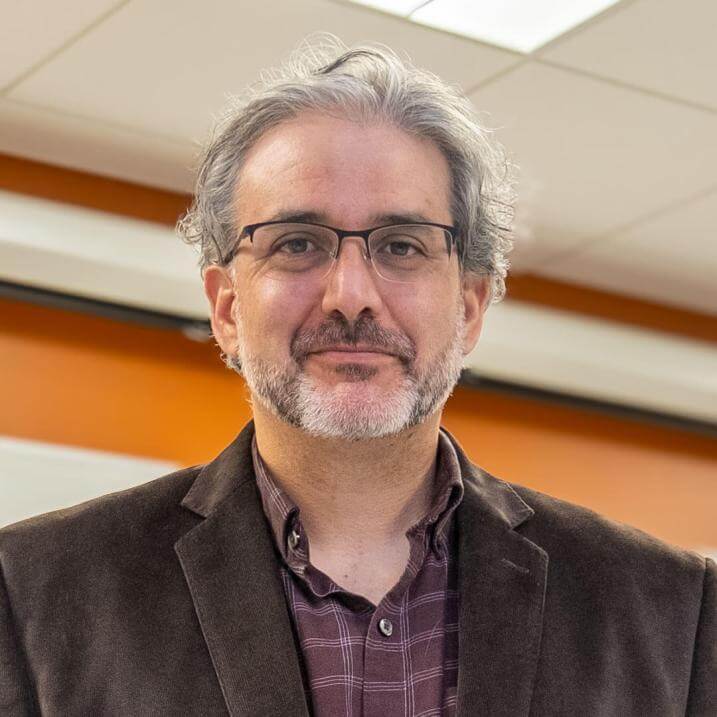
Miguel Ángel Sotelo Vázquez is a full Professor at the University of Alcalá, leading the INVETT Research Group (Intelligent Vehicles and Traffic Technologies). He holds the Department of Automatic Control and specializes in autonomous systems, particularly in path planning, sensor fusion, and human-vehicle interaction. His research integrates machine learning, robotics, and control theory to address challenges in intelligent transportation systems. He earned his Ph.D. in 2001 with a thesis on autonomous vehicle navigation in partially known environments. His work emphasizes real-world deployment, explainable AI, and safety-critical systems. Recent projects focus on lane change prediction, pedestrian behavior modeling, and cybersecurity for autonomous systems. Key contributions include neuro-symbolic frameworks for decision-making, real-time multi-physics field reconstruction, and cross-cultural studies of pedestrian interactions. He collaborates internationally on urban mobility resilience and hydrogen refueling infrastructure. Research Highlights : Development of knowledge graph-based prediction architectures Experimental validation of human-vehicle interaction in VR environments Creation of the SCOUT trajectory prediction framework
Pankaj Mehta is a Professor in the Department of Physics at Boston University, with additional affiliations in the Department of Biomedical Engineering. His research bridges statistical physics, theoretical biology, and interdisciplinary systems approaches. Key areas include ecological dynamics, synthetic biology, and the application of machine learning principles to biological systems. His work focuses on understanding emergent phenomena in biological systems, such as cell fate decisions, ecosystem stability, and signal processing in cellular networks. He has pioneered methods combining physics-based modeling with computational tools to study complex systems, including gene circuits, microbial communities, and cancer dynamics. Recent contributions highlight the use of order parameters for interpreting cellular states, geometric frameworks for ecological niches, and machine learning analogies to ecological principles. His interdisciplinary approach integrates experimental data with theoretical models to address questions in biomedicine, environmental science, and fundamental physics.
Jiayun (Peter) Wang is a Postdoctoral Scholar Research Associate in the Department of Computing and Mathematical Sciences at the California Institute of Technology (Caltech). His research focuses on advancing AI-driven solutions in medical imaging, computational imaging, and computer vision. Current projects emphasize applying deep learning to diagnose ocular conditions like dry eye syndrome and improving 3D reconstruction techniques. Collaborations with institutions such as UC Berkeley, Microsoft, and NVIDIA highlight his interdisciplinary approach to solving real-world medical and imaging challenges. Research Interests: Medical AI and Healthcare Analytics Deep Learning Applications in Ophthalmology 3D Reconstruction and Scene Understanding Physics-Informed Neural Networks Compressed Sensing MRI Key Contributions: Developed machine learning models predicting dry eye-related outcomes using meibography images Pioneered physics-aware neural operators for ultrasound lung aeration mapping Advanced open-vocabulary 3D object detection systems Labs/Teams: Collaborates with Caltech's AI4Health initiative and NVIDIA's research group, contributing to medical imaging advancements through interdisciplinary teams.
Prof. Dr.-Ing. habil. Gero Mühl is a W2-Professor at the University of Rostock, where he holds the chair for "Architecture of Application Systems" since October 2009. His academic journey includes positions as a Heisenberg Fellow at the Technical University of Berlin (2009), postdoctoral research at TU Berlin (2002-2009), and doctoral studies at TU Darmstadt where he received his Dr.-Ing. degree with distinction in 2002. He completed dual Diplomas in Computer Science (Dipl.-Inform.) and Electrical Engineering (Dipl.-Ing.) from FernUniversität in Hagen in 1998. Prof. Mühl's research focuses on Self-Organizing Distributed Systems , with particular expertise in distributed systems, distributed algorithms, event-based systems, middleware, energy-efficient systems, organic computing, sensor networks, web services, and electronic commerce. His work bridges theoretical foundations with practical implementations in real-world distributed environments. His recent publications show a strong trend toward time-sensitive networking, content-based publish/subscribe systems, and P4 programmable data planes. These works address critical challenges in industrial communication, real-time systems, and network reliability. His research group has made significant contributions to making distributed systems more autonomous, reliable, and efficient. Scientific awards and recognitions include: Nomination for the Berlin Science Award for Young Scientists (2008) Heisenberg Fellowship by the German Research Foundation (DFG) (2008) Best paper award in System Software and Security at SAC 2015 Prof. Mühl has been actively involved in numerous research projects and collaborations, particularly focusing on self-organizing and self-stabilizing systems. His work on the REBECA publish/subscribe middleware represents a significant contribution to autonomous distributed systems. He has supervised numerous students and researchers, contributing to the development of the next generation of computer scientists specializing in distributed systems. His laboratory at the University of Rostock focuses on practical implementations of self-organizing distributed systems, with current projects investigating time-sensitive networking, publish/subscribe systems, and energy-efficient distributed computing. The team combines theoretical analysis with practical system development to address real-world challenges in industrial and commercial applications of distributed systems.
Suren Jayasuriya is an Associate Professor at Arizona State University's The GAME School, with joint appointments in the School of Electrical, Computer and Energy Engineering (ECEE) and the Department of Arts, Media and Engineering (AME). He is also an Affiliate Faculty Member at the Mary Lou Fulton College for Teaching and Learning Innovation. His lab, the Imaging Lyceum, focuses on transdisciplinary research bridging computational imaging, computer vision, sensors, and STEAM education. Education Ph.D. Electrical and Computer Engineering, Cornell University (2017) M.S. Electrical and Computer Engineering, Cornell University (2015) B.S. Mathematics, University of Pittsburgh (2012) B.A. Philosophy, University of Pittsburgh (2012) Research Focus Dr. Jayasuriya's work integrates optics, computational photography, and machine learning to develop novel imaging systems. His research spans: Computational cameras and light transport analysis Atmospheric turbulence modeling and video restoration Neural volumetric reconstruction for sonar/radar STEAM education frameworks for K-12 teachers Philosophical aspects of imaging and representation His lab emphasizes interdisciplinary collaboration across engineering, arts, and humanities. Publication Trends Recent publications demonstrate strong focus on computational imaging (45%), AI/ML applications (30%), and educational technology (25%). Dominant themes include turbulence mitigation in videos, neural rendering for sonar/radar, sensor fusion, and AI curriculum development for middle schools. Work frequently appears in top venues like CVPR, SIGGRAPH, and IEEE Transactions. Awards Image Electronics Technology Excellence Award (IIEEJ, 2021) Best Demo Awards: IEEE ICCP 2019, MIRU 2018 Best Paper Award: IEEE ICCP 2014 ASEE Diversity Paper Finalist (2020) Teaching Honors: Fulton Top 5% Award (2019, 2021), ASU Game Changing Faculty (2021) Teaching & Advising Teaches graduate/undergraduate courses including Machine Vision (EEE 515), Minds and Machines (AME 400), and thesis supervision. Leads NSF-funded projects on computational imaging education and AI teacher training. Mentors students through the Imaging Lyceum lab with projects spanning optics, philosophy, and educational technology. Lab & Collaborations Directs the Imaging Lyceum, emphasizing Aristotle-inspired collaborative research. The lab works on: computational cameras, STEAM education, sensor development, and philosophical inquiries into imaging. Collaborates with Carnegie Mellon Robotics Institute and international partners. Funded by NSF, NEH, and industrial partners for projects in sonar imaging, heat resiliency sensing, and educational AI.
Carlos Brody is the Wilbur H. Gantz III '59 Professor of Neuroscience at Princeton University, where he leads a research group at the Princeton Neuroscience Institute. His laboratory employs a unique combination of computational, behavioral, and electrophysiological techniques to investigate the neural mechanisms underlying cognitive abilities. Dr. Brody's research focuses on understanding how the brain processes information during cognitive tasks, particularly examining short-term memory, decision-making, and time perception. His lab trains rats to perform complex cognitive tasks while recording neural activity, and develops computational models to explain the experimental findings. They have pioneered the study of 'internal signals' in neural activity that constitute 'the internal conversation of the mind,' with their key discovery being 'nTc' (Neurally-inferred Time of Commitment), a biomarker that indicates decision commitment before overt behavioral responses. Dr. Brody's laboratory has been continuously supported by HHMI (Howard Hughes Medical Institute) with renewal until 2032. They are currently conducting groundbreaking research using multiple Neuropixels probes for large-scale recordings across the brain while rats perform cognitive behaviors, representing what Dr. Brody considers the future of cognitive systems neuroscience that combines advanced recording technology, AI-based analysis, and well-controlled behavioral paradigms. Scientific Awards HHMI Investigator (renewed until 2032) Advising and Research Support Dr. Brody has mentored numerous successful researchers who have secured faculty positions and leadership roles: Marino Pagan (Nature publication, SFARI Bridge to Independence Award) Edward Nieh (faculty position at University of Virginia) Manuel Schottdorf (Nature publication) Sue Ann Koay (publications in Neuron and eLife, Group Leader at Janelia) Brian DePasquale (faculty position at Boston University) Emily Dennis (Group Leader at HHMI's Janelia) Ahmed El Hady (Group Leader at Max Planck Institute) Abby Russo (joined CTRL-Labs startup) Diksha Gupta (Best Paper Award at RLDM conference) His lab is currently supported by HHMI funding and is planning to implement next-generation Neuropixels probes in Spring 2025 to record from 6,000-12,000 neurons simultaneously across multiple brain regions. Research Team and Facilities The Brody Lab features a diverse team ranging from purely computational to purely experimental researchers. The lab emphasizes minimizing barriers between computational and experimental approaches, encouraging researchers to move freely along this spectrum based on their interests. They maintain state-of-the-art facilities for behavioral training, electrophysiological recordings, and computational analysis, with plans to implement next-generation Neuropixels recording technology in Spring 2025.
Huy T Tran is an Assistant Professor in the Department of Aerospace Engineering at the University of Illinois at Urbana-Champaign's College of Engineering, with additional appointments at the Applied Research Institute. His research focuses on the intersection of robotics, artificial intelligence, and multi-agent systems, with applications spanning autonomous navigation, critical infrastructure resilience, and intelligent transportation. Dr. Tran earned his Ph.D. in Aerospace Engineering from Georgia Institute of Technology in 2015, following advanced degrees from Georgia Tech and University of Wisconsin-Madison. His academic journey includes research assistant professor positions before achieving his current assistant professor role in 2021. He previously worked as a Senior Multi-Disciplinary Systems Engineer at The MITRE Corporation and served as a Visiting Scholar at the Air Force Institute of Technology. His research interests encompass Autonomy, Reinforcement Learning, Artificial Intelligence, Machine Learning, Robotics, Multiagent Systems, Intelligent Transportation Systems, and Critical Infrastructure Resilience. As director of the Lab for Intelligent Robots and Agents (LIRA), he leads cutting-edge research in autonomous systems that interact with humans and other robots. His work has evolved from foundational resilience modeling in aerospace systems toward increasingly sophisticated AI applications in multi-robot coordination and explainable decision-making. Dr. Tran's publication record demonstrates a clear trajectory toward explainable AI and human-AI collaboration, with recent work focusing on generating explanations for reinforcement learning policies, coordination in ad hoc teams, and neuro-symbolic approaches to robot policy interpretation. His research bridges theoretical advances with practical applications in air traffic control, field robotics, and critical infrastructure management. Best Paper Award: Theoretical (2016 Complex Adaptive Systems Conference) Selected for oral presentation at IROS 2023 Workshop 27% full paper acceptance rate at AAMAS 2022 44% acceptance rate at ICRA 2020 As an educator, Dr. Tran teaches core aerospace courses including Computational Systems Engineering, Aerospace Numerical Methods, and Reinforcement Learning. He has secured significant research funding from NASA's Transformational Tools and Technologies program, ARL A2I2 program, ONR Science of AI program, and DARPA. His current projects span ad hoc teaming in multi-robot systems, collective autonomous air mobility, hierarchical reinforcement learning, and interpretable AI agents.
Graham T. Allison, Jr. is the Douglas Dillon Professor of Government at Harvard Kennedy School, where he has taught for five decades. He previously served as the Founding Dean of Harvard's John F. Kennedy School of Government and as Director of the Belfer Center for Science and International Affairs until 2017. His career spans academia, government service, and international policy analysis, with significant contributions to national security studies and international relations. Dr. Allison's educational background includes: Davidson College Harvard College (B.A., magna cum laude, in History) Oxford University (B.A. and M.A., First Class Honors in Philosophy, Politics, and Economics) Harvard University (Ph.D. in Political Science) As a leading analyst of national security, Dr. Allison specializes in nuclear weapons policy, US-Russia relations, US-China relations, and decision-making processes in international crises. His research has profoundly influenced how scholars and policymakers understand great power competition and conflict prevention. He is particularly renowned for developing the concept of the "Thucydides Trap" to analyze the historical patterns when a rising power threatens to displace an established power. Dr. Allison's recent scholarly output demonstrates consistent focus on contemporary geopolitical challenges, particularly US-China strategic competition, nuclear weapons policy, and conflicts in the Middle East and Eastern Europe. His publications bridge academic rigor with policy relevance, often providing historical context to current crises while offering concrete recommendations for policymakers. The breadth of his work spans traditional academic journal articles, policy briefs, and commentary in major media outlets, demonstrating his commitment to engaging both scholarly and public audiences. Dr. Allison has received numerous prestigious awards for his contributions to national security: Defense Department's highest civilian award, the Defense Medal for Distinguished Public Service Distinguished Public Service Medal (awarded twice - first by Secretary Cap Weinberger and second by Secretary Bill Perry) Throughout his career, Dr. Allison has advised multiple presidential administrations, serving as Assistant Secretary of Defense in the Clinton Administration and Special Advisor to the Secretary of Defense under President Reagan. He has been a member of the Secretary of Defense's Advisory Board for every Secretary from Weinberger to Mattis. His work has been supported by significant sponsored projects including the "Russia Matters Web Portal" funded by the Carnegie Corporation of New York and programs to help students train for Russia-related jobs funded by the U.S. Russia Foundation. Dr. Allison has maintained strong connections with the Belfer Center for Science and International Affairs, which he directed until 2017 and which remains ranked as the "#1 University Affiliated Think Tank" in the world. Through the Belfer Center, he has fostered relationships with international security experts from around the world, particularly with Israeli security officials and analysts with whom he has collaborated extensively.
Koray Tahiroglu is a University Lecturer at Aalto University's School of Arts, Design and Architecture, specializing in Sound and Music Computing. His work bridges artificial intelligence, digital musical instruments, and embodied interaction, with a focus on deep learning applications in audio synthesis and human-AI creative collaboration. His research explores New Interfaces for Musical Expression (NIME), sonic interaction, and physical computing. He collaborates with SOPI Research Group and Google Brain Team (Magenta) on AI-driven artistic innovation. Recent Publications : 2024 studies on dance-sound cross-correlation and intra-action frameworks; 2023 work on AI-terity and deep learning syllabi; 2022 explorations of GAN synthesis, musical expectations, and lifeworld sonification. Scientific Awards : Co-Creative Artificial Intelligence of Music (2022) 2010 grant for scientific publications and artistic activities 2017 Honorable Mention for mobile cultural heritage research Tahiroglu contributes to digital art education and leads projects at Media Lab Helsinki, advancing sonic interaction and generative audio systems.
Irena Koprinska is a prominent researcher at the University of Sydney with over 150 publications from 1996 to 2025. Her work spans multiple interdisciplinary domains with significant contributions to machine learning applications in educational technology, time series forecasting, and health informatics. She maintains strong research collaborations, particularly with Kalina Yacef (38 joint publications), Mashud Rana (26 papers), and Bryn Jeffries (22 papers), indicating leadership in her research group. Her research interests focus on practical applications of machine learning across diverse domains. In educational data mining, she has pioneered methods for predicting student performance in programming courses, analyzing syntax errors, and developing automated hint generation systems. Her work in time series forecasting has made significant contributions to solar power prediction using advanced neural network architectures. Additionally, she has applied machine learning techniques to medical domains, particularly in sleep disorder detection and analysis. The analysis of her 15 most recent publications (2022-2025) reveals a continued focus on educational technology and time series analysis, with increasing attention to interpretable methods and health applications. Her work demonstrates a consistent trajectory of applying sophisticated machine learning techniques to solve real-world problems across multiple domains, with particular emphasis on creating practical tools for education and renewable energy management. Notable Research Contributions: Development of the HINTS framework for automated programming hint generation Innovative approaches to multistep-ahead time series forecasting Applications of deep learning to sleep disorder detection Methods for predicting student performance in programming education Her publication record in top venues including Machine Learning journal, AIED, EDM, and IJCNN demonstrates significant impact in both machine learning and educational technology communities. The consistent output of high-quality research over nearly three decades indicates sustained scholarly productivity and leadership in her fields of expertise.
Professor Lyudmila Mihaylova is a distinguished academic at the University of Sheffield's School of Electrical and Electronic Engineering, where she holds the position of Professor of Signal Processing and Control. She has established herself as a leading researcher in the fields of signal processing, Bayesian methods, and autonomous systems, with significant contributions to particle filtering techniques for intelligent transportation systems. Her work bridges theoretical developments with practical applications across multiple domains including transportation, healthcare, and industrial automation. Prof. Mihaylova's research interests center on nonlinear filtering, sequential Monte Carlo methods, statistical signal processing, and sensor data fusion. Her work spans both theoretical advancements and practical implementations, with particular focus on high-dimensional problems including vehicular traffic flow estimation, image processing, and localization in sensor networks. She has extensive experience with various image modalities such as optical, thermal, LIDAR, SAR, and hyperspectral imaging. Her group actively develops novel methods for autonomous intelligent systems focusing on sensing, tracking, decision making, and machine learning applications. Analysis of Prof. Mihaylova's recent publications reveals a strong trend toward uncertainty quantification in machine learning models, particularly for safety-critical applications. Her work increasingly integrates traditional signal processing techniques with modern deep learning approaches, with applications spanning sewer inspection robotics, medical diagnostics (particularly sleep apnea detection), UAV swarm tracking, industrial manufacturing, and autonomous vehicle systems. A significant portion of her recent research focuses on developing robust methods that can handle incomplete or outlier-corrupted data while providing reliable uncertainty estimates. Among her notable professional achievements: President of the International Society of Information Fusion (ISIF) Senior member of the IEEE Signal Processing Society Associate Editor for IEEE Transactions on Aerospace and Electronic Systems Associate Editor for Elsevier Signal Processing Journal Prof. Mihaylova has successfully mentored numerous PhD students and postdoctoral researchers, many of whom have gone on to prominent academic and industry positions. Her research has been supported by major funding bodies including EPSRC, EU, MOD/DSTL, and industry partners, with recent projects including 'Protecting Environments with UAV Swarms' (InnovateUK, 2022-2024), 'ShiRAS: Towards Safe and Reliable Autonomy in Sensor Driven Systems' (NSF-EPSRC, 2019-2023), and 'Confident safety integration for Cobots' (Lloyd's Register Foundation, 2019-2020). Her research group follows a collaborative approach with the philosophy 'We share knowledge, we grow.' Prof. Mihaylova maintains active research collaborations with institutions worldwide and has held previous academic positions at Lancaster University (2006-2013) and University of Bristol (2004-2006), along with research visiting positions at the University of Ghent, Katholic University of Leuven, and the Bulgarian Academy of Sciences.
Prof. Dr. Matthias Weidlich is a faculty member at Humboldt University of Berlin within the Institute of Computer Science under the Faculty of Mathematics and Natural Sciences . His research focuses on Process Mining , Complex Event Processing , and Data Privacy with applications in Business Process Management and Scientific Workflows . Research Interests: Business Process Management and Process Mining Complex Event Processing and Stream Data Analysis Data Privacy and Security in Process Systems Scientific Workflow Systems and User Behavior Heterogeneous Network Embeddings Algorithm Design and Optimization Recent Publications (2023-2025) demonstrate expertise in: Efficient stream processing techniques Privacy-preserving process mining frameworks Scientific workflow analysis tools Graph neural network applications Multi-modal data integration Adaptive querying systems Contact: Office: Unter den Linden 6, 10099 Berlin Phone: 030 2093-41277 Email: matthias.weidlich@hu-berlin.de Web: hu.berlin/data
Dr. Gabriella Lindberg is an Assistant Professor in the Department of Bioengineering at the University of Oregon's Knight Campus, leading the Lindberg Lab. Her research focuses on developing bioinks, hydrogels, and bioresins to engineer musculoskeletal tissues that replicate native biological environments. She holds a PhD from the University of Otago and previously served as a Research Fellow in the Christchurch Regenerative Medicine and Tissue Engineering (CReaTE) Group. Dr. Lindberg has secured significant grants, including a New Zealand Health Research Council Emerging Researcher Grant, and has won multiple awards such as the ISBF Young Investigator Award (2019) and CMDT/MedTech CoRE awards. Her work spans collaborative projects with institutions in New Zealand, Germany, Netherlands, and Australia. Current lab members include researchers like Vinni Thoms (Lab Manager) and Tim Wheeler (Postdoctoral Scholar). The lab is recruiting for postdoctoral and graduate positions in immunomodulation for osteoarthritis and bone marrow tissue engineering. Key research platforms include biofabrication, biomaterials, and organoid development. Dr. Lindberg’s research emphasizes clinical relevance, with projects addressing patient variability and disease progression modeling. Her team explores oxygen control in 3D-printed constructs and integrates inflammatory biology with biomaterials science. The lab’s long-term goals include advancing 3D bioassembly for musculoskeletal repair and hematological disease treatments. Notable contributions include work on vitreous humor as a biomaterial, automated 3D bioassembly, and the development of photoclickable gelatin bioinks. She has mentored numerous students, including PhD candidates Axel Norberg and Bram Soliman, and supervised master’s and undergraduate researchers in tissue engineering and biofabrication techniques.
Summary Luis A. Duffaut Espinosa is an Assistant Professor in the Department of Electrical and Biomedical Engineering at the University of Vermont (UVM), affiliated with the College of Engineering and Mathematical Sciences. His research focuses on control theory, estimation, robotics, and nonlinear systems with applications in autonomy, quantum control, and environmental monitoring. He holds a Ph.D. in Electrical and Computer Engineering from Old Dominion University (2009) and has held academic positions at George Mason University and postdoctoral roles at Johns Hopkins University and the University of New South Wales. Education: Ph.D. in Electrical and Computer Engineering (2009), Old Dominion University M.S. in Mathematics (2005), Pontificia Universidad Católica del Perú B.S. in Physics (2003), Universidad Nacional de Ingeniería, Peru Research Interests: His work emphasizes data-driven control and estimation methodologies, including model-free approaches for power systems, environmental monitoring, and quantum control. Current projects include real-time data assimilation in harsh environments, resilient robotics in GPS-denied conditions, and SAR with small satellites. He co-directs the Autonomous and Intelligent Systems Research Laboratory (AIRLab) and is part of the CREATE center. Recognition: 2024 NSF CAREER Award for work on safety-aware data-driven control frameworks Teaching & Advising: He teaches courses in estimation theory, control systems, and signal processing. Advises a team of graduate and undergraduate students focusing on autonomy, robotics, and control systems. Notable students include Danial Waleed (Ph.D. 2024), Jacob Friz-Trillo (M.S. 2025), and Farnaz Boudaghi (Ph.D. candidate). Labs & Collaborations: AIRLab: Focuses on data-driven control for autonomy in robotics and engineered systems CREATE: Research on resilient energy and autonomous technologies
Harpreet S. Dhillon is the W. Martin Johnson Professor of Engineering and Associate Dean for Research and Innovation at Virginia Tech's College of Engineering. He holds appointments in the Bradley Department of Electrical and Computer Engineering. His research focuses on wireless communications, stochastic geometry, machine learning, and next-generation network systems. Education: Ph.D., University of Texas at Austin (2013); M.S., Virginia Tech (2010); B.Tech., Indian Institute of Technology Guwahati (2008). Research Interests: Communication Theory, Stochastic Geometry, Machine Learning for Communication Systems, Heterogeneous Networks, IoT, and Energy Harvesting. He leads projects on vision-aided localization, LEO satellite systems, and RIS-aided networks. Key Awards: IEEE Fellow (2023), AAIA Fellow (2022), IEEE Heinrich Hertz Award (2016), and numerous early-career recognitions. His work has resulted in over 150 journal/conference publications. Advising: Supervises Ph.D. students in cutting-edge research areas like 6G localization and RIS optimization. His advisees have won awards such as the VT ECE Blackwell Award for Best Dissertation. Labs/Teams: Head of the research group focusing on communication theory and localization. Collaborates on projects funded by agencies like NSF and industry partners.