Sara Konkel is a Senior Lecturer in the Department of Biology at Gallaudet University, part of the School of Science, Technology, Accessibility, Mathematics, and Public Health. She specializes in teaching foundational biology courses and has expertise in ecology and human biology. Her current teaching responsibilities include: BIO-105 Introduction to Human Biology BIO-108 Principles of Biology for Science Majors II BIO-241 Ecology MAT-45 Elementary Algebra VEE-150 Research Methods in ASL/English Bilingual Academic Contexts Konkel's work emphasizes accessible science education, particularly within bilingual (American Sign Language and English) academic environments. While no specific research awards or publications are noted in the text, her role focuses on curriculum development and student support in STEM fields. She is affiliated with Gallaudet's efforts to promote accessibility in science education and interdisciplinary learning.
Ilaria Berteletti is an Associate Professor and Dean of the Faculty at Gallaudet University. She serves as the PEN Program Director for the Ph.D. in Educational Neuroscience, leads the Numeracy and Educational Neuroscience (NENS) Lab, and oversees university partnerships. Her academic journey includes roles as an Assistant Professor at Gallaudet (2016–2022), postdoctoral research at the University of Illinois and Northwestern University, and a PhD in Cognitive Science from Università degli Studi di Padova (Italy). Her research focuses on numerical cognition, the impact of language modality on mathematical processing, and educational neuroscience. Notable grants include NSF funding for studies on bilingual numeracy and neural correlates of arithmetic. She has advised numerous PhD students and contributed to initiatives like the Bilingual ASL-English Summer School in Cognitive Neuroscience. Berteletti's work spans developmental psychology, neuroimaging, and educational interventions. She holds leadership roles in academic societies, including Secretary of the Mathematical Cognition and Learning Society. Her lab explores how language and sensory experience influence mathematical learning, with findings published in top journals.
Prof. Mine GÜVEN is a Professor and Department Chair of the Department of English Translation and Interpreting at Dogus University's Faculty of Arts and Sciences. She holds a Ph.D. in Linguistics from Boğaziçi University (2004), with prior academic roles at institutions like Beykent University and MEF University. Her research focuses on semantics, language communication, translation pedagogy, and media accessibility. Key contributions include studies on Turkish linguistics, audio description practices in media, and the intersection of music and language. Education: Ph.D. in Linguistics, Boğaziçi University (2004) MA in Linguistics, Boğaziçi University (1997) Bachelor's in Translation, Boğaziçi University (1994) Research Interests: Her work explores language structure and communication in diverse contexts, including: Translation methodologies and pedagogy Accessibility in media (audio description, subtitles) Phonological and syntactic aspects of Turkish Language in disaster reporting and media discourse Semiotics of music translation Publications: Recent studies emphasize Turkish linguistics and media accessibility, including analyses of disaster communication, audio description practices, and musical text-setting. Her work bridges theoretical linguistics with applied research in education and technology. Administrative Roles: She has led departments at Dogus University (since 2021) and Beykent University (2011–2017), demonstrating leadership in academic governance and curriculum development.
Prof. Martin Lengwiler is a Professor of Modern General History and currently serves as the Dean of the Faculty of Humanities at the University of Basel. He holds positions at the Department of History within the Faculty of Humanities. His research focuses on modern European history, welfare state development, social policy, and the history of insurance and science. Key projects include studies on social protection, demographic change, and Argentine public health in a transnational context. He has authored and edited numerous publications, including Auf dem Weg ins Jetzt. Seit 1960 (2025) and works on global history, disability studies, and health economics. Education: Doctorate in History Research Interests: 20th-century urban history, global welfare systems, insurance economics, and the cultural history of Basel. His recent articles address topics such as Sino-German arms trade, child welfare norms, and the intersection of health and finance. As dean, he oversees academic and administrative affairs in the Faculty of Humanities.
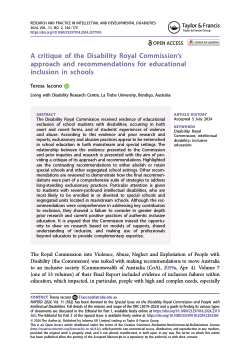
Teresa Iacono is a prominent academic researcher at La Trobe University, Australia, with a sustained focus on disability inclusion, health equity, and service delivery for people with intellectual and developmental disabilities. Her work spans education, healthcare, and social support systems, emphasizing policy reform, quality improvement, and systemic responsiveness. Her research interests center on inclusive education , intellectual disability health , active support models , telehealth , and practice leadership . She investigates how systems can better serve marginalized populations, especially through policy analysis, psychometric tool development, and intervention evaluation. Her studies often employ mixed methods, including systematic reviews, feasibility trials, and qualitative analysis. The recent publications reflect a strong trend toward improving educational and healthcare access for people with disabilities. Themes include the use of digital tools (e.g., telehealth), measurement of service quality, and equity in medical training. Her work increasingly informs national policy, particularly in Australia’s disability and health sectors. A critique of the Disability Royal Commission’s approach and recommendations for educational inclusion in schools (2024) Reliability Testing of the Reasonable Adjustments for Inclusive Education Rating Scale (2024) Intellectual disability health content within medical curriculum: an audit of what our future doctors are taught (2023) Enabling mainstream systems to be more inclusive and responsive to people with disabilities (2022) Dr. Iacono has been involved in significant research collaborations with experts like Christine Bigby, Emma Bould, and Jo Spong. She has contributed to grants and projects evaluating hospital experiences, supported accommodation, and workforce training. While no formal advising list is provided, her senior authorship and leadership in multi-year projects suggest active mentorship of junior researchers and postgraduate students. She has co-authored a major book, Disability Practice: Safeguarding Quality Service Delivery (2024), and developed psychometric instruments such as the Group Home Culture Scale. Her work is instrumental in shaping best practices in disability services and inclusive systems.
Patrick Stefan Kermit is a Professor at the Department of Mental Health, Norwegian University of Science and Technology (NTNU), where he conducts interdisciplinary research at the intersection of disability, ethics, and social inclusion. His work addresses critical challenges in special education, sign language, medical ethics, and the support of individuals with cognitive and hearing impairments. Research Interests: His primary fields include medical/dental ethics , behavioral sciences , special education , and disability studies , with a particular focus on cochlear implants and inclusive societal structures. His research emphasizes ethical frameworks and equitable access to services for vulnerable populations. The recent publications reflect a consistent trend in exploring how institutions—such as child protection services, legal systems, and healthcare—accommodate individuals with cognitive and sensory disabilities. Themes include policy evaluation, ethical service delivery, and systemic inclusion, primarily situated in Norwegian and global contexts. Scientific Contributions: Active contributor to national research initiatives on disability and inclusion Key participant in multi-institutional studies involving NTNU, UIO, FAFO, and SAMFORSK Advising and Grants: Dr. Kermit leads and participates in several active research projects funded by academic and public institutions, including Young hearing - knowledge for a better upbringing with hearing impairment and Hearing impairment and working life . These projects suggest grant acquisition and mentorship roles, though specific advisees are not listed. Labs and Teams: He collaborates extensively with multidisciplinary teams across NTNU and partner organizations, particularly in projects related to disability inclusion, ethics, and educational support. His involvement in the INCLUSCHOOL project and others highlights leadership in integrated research networks focused on equity and access.
Dr. Curtis Gautschi is a Research Fellow at the ZHAW Zurich University of Applied Sciences, affiliated with the School of Applied Linguistics and the Institute of Language Competence. His work focuses on language testing, digital literacy, and English-Medium Instruction (EMI) in higher education. He has led and contributed to projects like CEFR for Sign Languages, Digital German assessment, and Seamless Writing, which examine language competence, automated evaluation, and writing support tools. Research interests include Automated writing evaluation and feedback systems English-Medium Instruction quality assurance Scenario-based literacy education in vocational contexts Integration of natural language processing in language assessment Impact of digitalization on academic writing Development of CEFR-aligned testing frameworks His publications span journals like Reading and Writing and Bulletin suisse de linguistique appliquée , as well as peer-reviewed conference contributions at events such as the EARLI Conference, EATAW, and the International Pragmatics Conference. Recent work explores automated writing feedback, CEFR level prediction, and EMI's role in educational social spheres.
Dr. Yi-Ching Lee is a Professor at George Mason University specializing in Human Factors with research foci on transportation and medical systems , intelligent virtual agents , and multimodal interfaces . She joined GMU in Fall 2016, bringing 15+ years of experience from roles like directing the driving simulator research group at Children’s Hospital of Philadelphia. PhD in Industrial Engineering (Human Factors) from University of Iowa (2006) MS in Experimental Psychology Her research examines human-automation interaction , driver behavior , and emerging technologies , particularly autonomous vehicles and wearable systems . Recent work explores social attribution in AV interactions, driver stress induction, and chatbot user experiences. Key publication themes span machine learning for driver health detection, environmental science studies on PM2.5 exposure, and human-computer interaction frameworks for augmented reality interfaces. Her articles often bridge transportation psychology with technological innovation . 2025-2027: Graphical changeable message signs grant (VDOT) 2019-2023: Driver vigilance framework grant (NHTSA) 2015-2021: NSF grant for real-time driver condition detection Dr. Lee supervises PhD students Kyle Hickerson, Allegra Ayala, and Liam Kettle, while previously guiding Daniela Barragan. She focuses on behavioral change and quality of life improvement through methodological innovations integrating applied and basic research .
Benjamin Donald Anible is an Associate Professor affiliated with the Department of Language, Literature, Mathematics and Interpreting at the University of Western Norway, and the Department of Language and Literature at the Norwegian University of Science and Technology (NTNU). His work bridges sign language linguistics, multilingualism, and interpreting studies. Research Interests: Sign language morphology, multilingualism in Deaf communities, neurocognitive aspects of sign processing, and translation dynamics. His studies explore how sign languages integrate descriptive forms and depict actions, with implications for inclusion and communication. Projects: Principal investigator in the DEPICT project (Signed Language Depiction as an Engine for Promoting Inclusion, Communication, and Translation), focusing on sign language depiction's societal impact. Collaborated on language ecology studies in the Norwegian Deaf community. Publications: Active in cognitive linguistics, neuroscience, and linguistic innovation, with recent contributions on constructed action recognition (2025), sign-writing contact (2025), and depicting signs (2024). His work spans theoretical and applied domains.
Vadim Kimmelman is a Professor at the Department of Linguistic, Literary and Aesthetic Studies at the University of Bergen . His research integrates computational methods with sign language analysis, focusing on formal properties of nonmanual markers and depicting constructions. He collaborates internationally with institutions like the University of Amsterdam (UvA), NTNU, and the University of Western Norway. Active Project : Fundamentals of formal properties of nonmanuals: A quantitative approach (University of Bergen) Completed Projects : Whole-entity classifiers: a multiperspective approach (Center for Basic Research); Signed Language Depiction as an Engine for Promoting Inclusion, Communication, and Translation (DEPICT) (University of Western Norway) Research Trends : Recent publications highlight his interdisciplinary work combining linguistics , computer vision , and machine learning to analyze sign language syntax (e.g., classifier constructions), head pose estimation algorithms, and eye blink detection in sign language corpora. His work addresses both theoretical questions (e.g., language-specific perception of depicting signs) and technological applications. Affiliations : University of Bergen (Department of Linguistic, Literary and Aesthetic Studies), University of Amsterdam (collaborative research), NTNU, and University of Western Norway (DEPICT project).
Professor Andrzej Kasprzak is a faculty member at the Faculty of Information and Communication Technology, Wrocław University of Science and Technology, serving as Head of the Department of Systems and Computer Networks. His research spans machine learning, network optimization, and data stream processing, with applications in telecommunications, healthcare, and industrial systems. University: Wrocław University of Science and Technology School: Faculty of Information and Communication Technology Department: Department of Systems and Computer Networks Email: andrzej.kasprzak@pwr.edu.pl Kasprzak’s research focuses on integrating machine learning with network optimization, particularly in elastic optical networks and data stream environments. His work addresses challenges in multi-agent pathfinding, fake news detection, and 3D printing automation, emphasizing practical experimentation systems. Recent publications highlight trends in ensemble learning for real-time data streams, domain adaptation in AI systems, and innovative optimization algorithms for network traffic and scheduling problems. These contributions bridge theoretical advancements with industrial applications. As Head of Department, Kasprzak leads initiatives in systems and computer networks, fostering interdisciplinary collaboration in artificial intelligence and telecommunications. His career reflects a commitment to advancing computational methodologies in complex environments.
Houda Harkat is an Assistant Professor at Universidade Lusófona, affiliated with the Associação para a Investigação e Desenvolvimento em Cognição e Computação Centrado nas Pessoas. She also holds research positions as a Researcher at Université Sidi Mohamed Ben Abdellah, Faculté des Sciences et Techniques de Fès, and as an Invited Auxiliary Researcher at UNINOVA Instituto de Desenvolvimento de Novas Tecnologias. Her academic foundation includes a PhD in Engineering Sciences, a Master’s in Telecom and Network Engineering, and a Licence in Mathematics, Informatics, and Physics, all from Moroccan institutions. PhD in Engineering Sciences, Physical Sciences, Mathematics and Computer Science – Université Sidi Mohamed Ben Abdellah (2018) Master in Telecom and Network Engineering – Université Sidi Mohamed Ben Abdellah (2013) Licence in Mathematics, Informatics, and Physics – Université Sidi Mohamed Ben Abdellah (2010) Her research spans two key domains: telecommunications and antenna systems , focusing on UWB antennas, beam steering, WiMAX/WLAN, and microstrip arrays; and artificial intelligence for environmental and human sensing , including wildfire detection using aerial imagery and deep learning (e.g., Deeplabv3+, MobileNetv2), and Wi-Fi-based gesture/sign language recognition via Channel State Information (CSI). Her work integrates simulation tools like HFSS and CST with optimization techniques such as genetic algorithms. The recent publications highlight a clear shift toward AI-driven solutions in cyber-physical systems, particularly in fire detection and segmentation using deep learning models, alongside continued contributions in wireless communication and antenna design. Her interdisciplinary work bridges signal processing, machine learning, and environmental monitoring, with growing emphasis on unmanned aerial systems and IoT-based decision support. Her scientific contributions include 11 journal articles, 4 book chapters, and numerous conference papers. She has participated in multiple research projects as a PhD and post-doctoral fellow, contributing to advancements in GPR signal processing, wireless sensing, and intelligent systems. Project participation: PhD Student Fellow in 1 project Post-doc Fellow in 1 project Organized 3 academic events Houda Harkat is actively involved in interdisciplinary research labs and teams focusing on intelligent systems, including UNINOVA’s Institute for New Technologies Development and wildfire monitoring initiatives such as the FIREFRONT project, which leverages aerial vehicles and AI for firefront forecasting and disaster management support.
Professor Dr. Osman Hasan is a faculty member at the School of Electrical Engineering & Computer Science (SEECS) , National University of Sciences & Technology (NUST) , Islamabad, where he currently serves as Pro-Rector (Academics). His research primarily lies in formal methods, hardware verification, reliability analysis, and embedded systems, with applications in smart grids, robotics, and cybersecurity. His research interests include: Formal Methods and Theorem Proving Hardware and Software Verification Reliability and Safety Analysis of Critical Systems Smart Grids and Power Systems Approximate Computing and Energy-Efficient Design Robotics and Biomedical Systems His recent publications show a strong trend toward formal verification of hardware and cyber-physical systems, integration of machine learning with formal methods, and applications in power systems and robotics. He frequently employs higher-order logic theorem proving (e.g., HOL, ACL2) and model checking to ensure correctness and reliability. He has been actively involved in numerous international conferences such as FMCAD, FSEN, CICM, and ICTAC, serving on program committees and organizing workshops. His leadership as Pro-Rector highlights his commitment to enhancing academic quality and research excellence at NUST. He has supervised numerous students who have co-authored papers with him, indicating an active research group. His work bridges theoretical formal methods with practical engineering applications, particularly in safety-critical domains.
Dr. Nick Pitropakis is an Associate Professor at the School of Computing Engineering and the Built Environment (Edinburgh Napier University). He actively contributes to cybersecurity research through 39 publications, focusing on threat intelligence sharing , cloud security , IoT security , and privacy-preserving technologies . CyberHunt - Automated Threat Hunting for Critical Infrastructures (Funder: Norway RC) TRUST Platform - Crossborder Data Federation (Funder: UKRI) AI-based Biometric Authentication (Funder: Data Lab) His research combines graph theory for attack path analysis and blockchain for secure threat intelligence sharing. Key publication areas include: LLMs in threat hunting Chaotic encryption schemes Adversarial machine learning Distributed ledger applications Scientific contributions span 19 journal articles, 15 conference proceedings, and 2 book chapters. Collaborates with Prof Bill Buchanan and Dr Pavlos Papadopoulos on cybersecurity standardization and trusted computing .
Lin Geng Foo is a postdoctoral researcher at the Max-Planck Institute for Informatics under the Visual Computing and Artificial Intelligence (VCAI) Department, supervised by Prof. Christian Theobalt. He earned his PhD and Bachelor's from the Singapore University of Technology and Design (SUTD) with the President's Graduate Fellowship and top honors. His research focuses on video analysis , activity understanding , diffusion models , and dynamic neural networks , particularly for 3D human generation/editing . His work includes groundbreaking papers on adversarial attacks, human mesh recovery, and pose estimation. Key trends in his recent publications include applications of diffusion models dynamic networks 3D human modeling video analysis action recognition neural rendering for tasks like mesh recovery, controllable video editing, and sign language translation. Scientific awards include PREMIA Best Student Paper 2023 Commendation Prize Keppel Awards of Excellence (2018, 2019) EY Business Analytics Award He serves as a reviewer for major conferences (CVPR, ICCV, NeurIPS, ICML) and has presented talks at ICME 2024 Metaverse Workshop and SDSC Industry & Demo Day 2024.