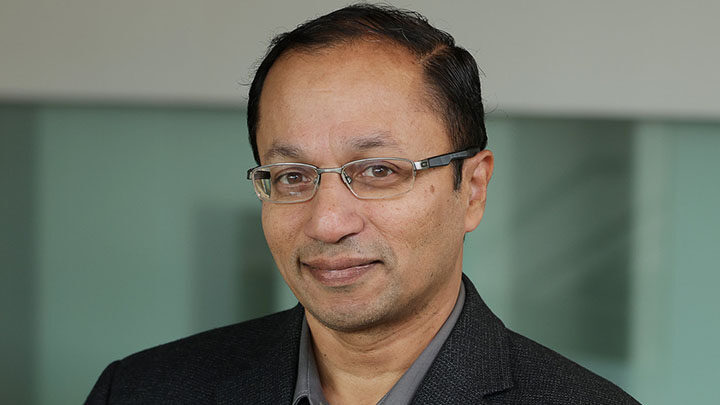
Gianluca Iaccarino is a Professor of Mechanical Engineering at Stanford University and the Robert Bosch Chairholder. He serves as Director of the PSAAP Center and leads large-scale computational research initiatives in uncertainty quantification, exascale computing, and multiphysics simulations. His academic journey includes a PhD in Mechanical Engineering from Politecnico di Bari (2005), postdoctoral work at Stanford's Center for Turbulence Research, and progression from Research Engineer to full Professor. Education : PhD (Politecnico di Bari), MS/BS in Aeronautical Engineering (University of Naples) Research : Computational engineering, turbulence modeling, uncertainty quantification, biomedical fluid dynamics, and exascale-ready algorithms Publications : 15+ recent articles focus on turbulence modeling, data-driven simulations, and uncertainty quantification across diverse applications in aerospace, biomedical, and energy systems Awards : PECASE (2010), APS Fellow (2019), multiple best paper awards (AIAA, ASME), Terman Fellow (2007) Students : Advises doctoral and master's students in mechanical engineering and computational methods Leadership : Director of PSAAP Center (2014-present), Chair of Mechanical Engineering Department (2024-present)
Dr. Krishnan Mahesh is a Professor at the University of Michigan with joint appointments in Mechanical Engineering and Naval Architecture and Marine Engineering. He serves as Director of the Center for Naval Research and Education and leads the Computational Fluids Laboratory, where he develops advanced numerical methods for simulating multi-physics turbulent flows. Education: Ph.D. (1996), M.S. (1990) from Stanford University, B.Tech (1989) from IIT Bombay Leadership: Director, Center for Naval Research and Education (2022-present) His research focuses on high-fidelity simulations of turbulent flows with applications in marine propulsors, multiphase systems, cavitation, hydroacoustics, superhydrophobic surfaces, biofouling, fluid-structure interaction, and flow stability. His group develops the MPCUGLES software for unstructured grid simulations on parallel computing platforms. Recent work examines cavitation dynamics , tip vortex flows , and roughness-induced transition in complex marine and aerospace systems. His 15 most recent articles demonstrate expertise in LES/DNS of multi-physics flows, with emphasis on marine propulsion, bubble collapse, and turbulent noise prediction. Scientific Honors: 2021 AIAA Best Paper Award 2018 Fulbright Scholar 2017 Marine Propulsors Symposium Best Paper 2011 APS Fellow 2010 Taylor Award for Distinguished Research He mentors numerous graduate students and postdoctoral fellows, with collaborative projects spanning jet in crossflow analysis, gas turbine simulations, and shock-turbulence interactions. His research receives funding from ONR, NSF, and international naval programs.
Prof. Dr. Nikolaus A. Adams is a full professor and Chair of Aerodynamics and Fluid Mechanics at the Technical University of Munich (TUM), affiliated with the TUM School of Engineering and Design. Born in 1963, he holds a doctorate from TUM (1993) and habilitation from ETH Zurich (1999). His research focuses on numerical methods, turbulent flows, microfluidics, and multiphase systems. He has held leadership roles, including Dean of the Faculty of Mechanical Engineering since 2023 and Vice Dean (2015–2016). Education: PhD from TUM (1993), habilitation from ETH Zurich (1999) Research interests include aerodynamics, fluid-structure interaction, and numerical techniques for compressible flows. His work spans high-speed aerodynamics and computational fluid dynamics (CFD). Awards include ERC Advanced Grants (GENUFASD 2023, NANOSHOCK 2015), the Gordon Bell Prize (2013), and Fellow of the American Physical Society (2011). Grants and leadership: Spokesperson of DFG SFB/TRR 40 (2008–2020), co-author of 'Large-Eddy Simulation for Compressible Flows' (2009), and editorial roles in J. Comput. Phys.
John Evans is an Associate Professor and Jack Rominger Faculty Fellow in the Department of Aerospace Engineering Sciences at the University of Colorado Boulder, affiliated with the Applied Mathematics program. He serves as Associate Chair for Undergraduate Curriculum and is part of the Aerospace Mechanics Research Center (AMREC). His research focuses on computational mechanics, particularly fluid dynamics, fluid-structure interaction, and turbulence modeling using high-order and structure-preserving methods. Evans holds a PhD (2011) and MS (2008) in Computational and Applied Mathematics from the University of Texas at Austin, and dual BS/MS degrees in Mathematics and Applied Mathematics from Rensselaer Polytechnic Institute (2006). Before joining CU Boulder, he was a postdoctoral fellow at the Institute for Computational Engineering and Sciences (ICES). His research interests include isogeometric analysis, immersed methods, and data-driven turbulence modeling. Notable contributions include development of divergence-conforming discretizations for incompressible flows, stabilized collocation methods, and invariant subgrid stress models. He leads the AMREC lab and collaborates on plasma-fueled propulsion systems and geometrically sensitive simulations. Key Awards: 2021: Rocky Mountain AIAA Educator of the Year 2021: Gallagher Young Investigator Medal 2019-2021: Clarivate Highly Cited Researcher Professional Activities: Editor of Engineering Computations, Senior AIAA Member, Simons Visiting Professor (2019) Evans' work bridges advanced numerical methods with real-world engineering challenges. His lab develops open-source tools like XIGA for multi-material problems and focuses on immersive simulation environments. Current projects explore turbulence closure models, plasma propulsion, and topology optimization with B-spline-based approaches.
Oscar P. Bruno is a Professor of Applied and Computational Mathematics at the California Institute of Technology (Caltech). He holds a Licenciado from the University of Buenos Aires (1982) and a Ph.D. in Mathematics from New York University's Courant Institute (1989). Since 1998, he has been a Professor at Caltech, previously serving as Associate Professor (1995–98) and Executive Officer for Applied Mathematics (1998–2000). His research focuses on developing high-performance numerical methods for solving partial differential equations (PDEs), addressing challenges in complex geometries, singularities, and high-frequency phenomena. Key contributions include the Fourier Continuation (FC) method and integral-equation techniques, enabling solutions to previously intractable PDE problems in science and engineering. Prof. Bruno's expertise spans computational electromagnetics, computational fluid dynamics (CFD), solid mechanics, and mathematical physics. His work integrates numerical analysis, multiphysics modeling, and computational science to solve real-world problems in geophysics, optics, and fluid dynamics. He has received numerous awards, including membership in the National Academy of Sciences of Argentina (2020), the Vannevar Bush National Security Science and Engineering Fellowship (2016), and SIAM Fellow (2013). Bruno serves on editorial boards for journals like SIAM Journal on Scientific Computing and SIAM Journal on Applied Mathematics, and participates in national science advisory roles. His teaching includes advanced courses on applied mathematics methods (ACM/IDS 101 ab), emphasizing theoretical foundations and numerical techniques for PDEs. His research group develops cutting-edge solvers with applications in shock dynamics, optical tomography, and geophysical fluid dynamics.
Guglielmo Scovazzi is a Professor at Duke University with appointments across multiple departments including the Department of Civil and Environmental Engineering, the Thomas Lord Department of Mechanical Engineering and Materials Science, and as Professor of Mathematics. His interdisciplinary research bridges computational mechanics, scientific computing, and engineering applications. Dr. Scovazzi earned his B.S/M.S. in aerospace engineering (summa cum laude) from Politecnico di Torino (Italy), followed by an M.S. and Ph.D. in mechanical engineering from Stanford University. Prior to joining Duke, he was a Senior Member of the Technical Staff at Sandia National Laboratories' Computer Science Research Institute. His research focuses on developing advanced numerical methods for computational mechanics, particularly finite element methods for fluid and solid mechanics. Key areas include multiphase porous media flows, computational methods for materials under extreme conditions, turbulent flow computations, and instability phenomena. His work emphasizes creating accurate computational approaches that reduce design/analysis costs for complex engineering problems involving fluid-structure interactions and transient phenomena in complex geometries. Dr. Scovazzi's most significant recent contribution is the development of the Shifted Boundary Method, an innovative computational framework that enables efficient simulations on complex geometries without requiring boundary-fitted meshes. This method has found applications in geomechanics, energy systems, and resilient infrastructure design. Kavli Fellow, National Academy of Sciences & Kavli Foundation (2018) Presidential Early Career Award for Scientists and Engineers (PECASE), White House (2017) Early Career Award, U.S. Department of Energy, Advanced Scientific Computing Research Program (2014) Dr. Scovazzi teaches multiple courses in computational mechanics including Nonlinear Finite Element Analysis and Introduction to the Finite Element Method. His research has been supported by substantial federal funding, and he actively collaborates across disciplines to address challenging problems in energy, environment, and infrastructure resilience through advanced computational methods.
Dond Asha Kisan is an Assistant Professor at the School of Mathematics , Indian Institute of Science Education and Research Thiruvananthapuram (IISER TVM). His research focuses on numerical analysis and computational mathematics , particularly in finite element methods for partial differential equations. He can be contacted at ashadond@iisertvm.ac.in or via phone at +91 (0)471-2778247. PhD : Mathematics, Indian Institute of Technology Bombay M.Sc. : Mathematics, K.T.H.M. College, Nashik Kisan's research spans adaptive finite element methods , stabilized formulations for convection-diffusion problems , and optimal control governed by Stokes equations . His work includes convergence analysis, nonconforming discretizations, and hybrid numerical schemes. Recent publications (2023-2025) address stochastic modeling in liquid crystal physics, advanced WENO schemes, and adaptive algorithms for control problems. Scientific Awards : No explicit awards mentioned in the data, though he held prestigious postdoctoral fellowships including National Post-Doctoral Fellowship and NBHM Post-Doctoral Fellowship. Kisan has extensive teaching experience , including MATLAB workshops and undergraduate course assistantships. He has presented at major international conferences like ICIAM and Hyperbolic Problems, demonstrating global engagement in computational mathematics.
Jaime Peraire is the H.N. Slater Professor of Aeronautics and Astronautics at MIT, affiliated with the School of Engineering. He leads research in computational mechanics, aerodynamics, and numerical methods for partial differential equations, with key roles as former Department Head (2011-2018) and Director of the Aerospace Computational Design Lab (1993-2011). His expertise spans finite element methods, shock capturing algorithms, and high-order numerical techniques applied to hypersonic flows, space weather, and metamaterials. Education includes a Ph.D. from the University of Wales (1986) and engineering degrees from the University of Barcelona (1983, 1987). He holds prestigious awards like the T.J. Hughes Medal (2015) and the Ildefons Cerdá Medal (2015). His work bridges computational science and engineering, with contributions to discontinuous Galerkin methods, mesh adaptivity, and GPU-accelerated simulations. Research interests emphasize high-fidelity modeling of compressible flows, plasma dynamics, and terahertz spectroscopy. Notable projects include MIT’s space weather modeling initiative and metamaterial fabrication using atomic layer lithography. His labs collaborate across MIT’s Schwarzman College of Computing, IDSS, and CCSE to advance computational tools for aerospace and environmental systems. Awards: Over 10 major prizes, including NASA Exceptional Achievement (1997) and IACM Young Researchers Award (1998). Grants/Advising: Led NSF-funded space weather projects and advised numerous PhD students in computational engineering. Labs: Aerospace Computational Design Lab, MIT Schwarzman College of Computing collaborations.
Tim Colonius is the Frank and Ora Lee Marble Professor of Mechanical Engineering and Medical Engineering and holds the Cecil and Sally Drinkward Leadership Chair at the California Institute of Technology. He has been affiliated with Caltech since 1994 and currently serves as Executive Officer for Mechanical and Civil Engineering . Colonius earned his B.S. from the University of Michigan (Ann Arbor), and both his M.S. and Ph.D. from Stanford University. Research Interests: His work focuses on fluid dynamics (global instabilities, cavitation, aerodynamic sound), flow control (closed-loop control, reduced-order modeling), and biomedical applications (shock waves, lithotripsy, ultrasound). He also develops advanced numerical methods for interface capturing, immersed-boundary techniques, and high-order accuracy. Scientific Contributions: Recent publications highlight his research in multiphase flows, vortex ring collisions, turbulent jet analysis, GPU-accelerated simulations, and biomedical applications. His group uses computational and data-driven approaches to study turbulence, instabilities, and flow optimization. Scientific Awards: AIAA Aeroacoustics Award Fellow of the Acoustical Society of America Fellow of the American Physical Society (APS) NSF and DoD research grants
Xin Lu is the John M. and Mary Jo Boler Collegiate Associate Professor in the Department of Biological Sciences at the University of Notre Dame. She is a full member of the Harper Cancer Research Institute (HCRI), the Boler-Parseghian Center for Rare and Neglected Diseases (CRND), and the Tumor Microenvironment and Metastasis Program at the Indiana University Simon Comprehensive Cancer Center. Her research spans tumor immunology, immunotherapy, metastasis, and multi-omics, with a focus on prostate, breast, and rare cancers. Ph.D. in Molecular Biology, Princeton University (2004–2010) B.S. in Biological Sciences, Tsinghua University, China (2000–2004) Postdoctoral Fellow, Dana-Farber Cancer Institute and M.D. Anderson Cancer Center (2010–2016) Assistant to Associate Professor, University of Notre Dame (2017–Present) Dr. Lu's research investigates the molecular and cellular mechanisms of tumor-immune crosstalk, particularly the role of myeloid-derived suppressor cells (MDSCs) and neutrophils in promoting immunotherapy resistance. Her lab uses genetically engineered mouse models, functional genomics, single-cell and spatial transcriptomics, and high-throughput screening to uncover novel therapeutic targets. A major focus is on how cancer-cell-intrinsic oncogenic signaling shapes the immunosuppressive tumor microenvironment. Her recent publications reveal mechanisms such as Acod1-mediated ferroptosis resistance in neutrophils, Pygo2-driven immunosuppression in prostate cancer, and the efficacy of ketogenic diets in overcoming checkpoint blockade resistance. These studies span multiple disciplines including cancer biology, immunology, metabolism, epigenetics, and bioengineering, reflecting a highly integrative approach to immuno-oncology. Jane Coffin Childs Postdoctoral Fellow John M. and Mary Jo Boler Faculty Appointment Cluster Chair, Cellular & Molecular Biology, IBMS PhD Program Junior Chair, Boler-Parseghian Center for Rare and Neglected Diseases Dr. Lu mentors a diverse team of graduate students, postdoctoral fellows, and undergraduates. Her lab is actively recruiting and has secured funding from federal agencies and private foundations. She collaborates with chemists, bioengineers, and bioinformaticians to develop novel therapeutics, including antibody-drug conjugates, CAR-NK cells, and small-molecule inhibitors. Her lab also develops innovative platforms like mini-tumor chips for immunotherapy evaluation. Her lab maintains affiliations with multiple interdisciplinary centers including the Warren Family Center for Drug Discovery, Eck Institute for Global Health, and Berthiaume Institute for Precision Health, underscoring her collaborative and translational research vision.
Matthias Ihme is a Professor in the Department of Mechanical Engineering and Photon Science Directorate at Stanford University. His research focuses on large-eddy simulation (LES) of turbulent reacting flows, aeroacoustics, combustion-generated noise, numerical methods, and high-order schemes. He holds a Ph.D. from Stanford University (2008), an M.Sc. in Computational Engineering from the University of Erlangen (Germany, 2002), and a Dipl.-Ing. in Mechanical Engineering from Munich University of Applied Sciences (Germany, 2000). His work bridges computational fluid dynamics, combustion science, and photon science, with notable contributions to supercritical fluid dynamics, machine learning integration in fluid simulations, and high-fidelity atmospheric transport modeling. Recent research emphasizes ultrafast cluster dynamics, shock-induced interface behavior, and stochastic ignition mechanisms in advanced fuel systems. Publications highlight interdisciplinary advancements, including physics-informed ML frameworks for reacting flows and experimental studies using X-ray photon correlation spectroscopy. His projects often involve high-performance computing and collaboration with national labs like SLAC.
Prof. Patrick Jenny is a Full Professor at the Department of Mechanical and Process Engineering and Head of the Institute of Fluid Dynamics at ETH Zurich. His research focuses on computational fluid dynamics (CFD), numerical methods for turbulent and multiphase flows, and reservoir simulation. He has held positions at ChevronTexaco and Cornell University, and received the National Latsis Prize 2005. PhD in CFD from ETH Zurich (1997) Postdoctoral work at Cornell University (1997–1999) Senior Researcher at ChevronTexaco (1999–2003) Research interests include: turbulent reactive flows, PDF modeling, multi-scale reservoir simulation, and data assimilation in engineering systems. He teaches courses on fluid dynamics, turbulence, and computational methods. Over 100 peer-reviewed publications span topics like fracture modeling, LES/RANS coupling, and particle-laden flows. His work bridges academia and industry, addressing challenges in energy systems, environmental engineering, and numerical algorithms. Winner: National Latsis Prize 2005 Led over 20 PhD projects and collaborates with institutions globally. His lab develops open-source tools for CFD and energy systems analysis.
June-Yub Lee is a Professor of Mathematics and Vice President at Ewha Womans University, leading the Office of University Planning and Coordination. He is also a member of the Institute of Mathematical Sciences. His academic background includes a Physics major and Mathematics minor from KAIST, followed by a Ph.D. in Mathematics from New York University's Courant Institute. Prof. Lee specializes in numerical analysis, inverse problems, computational fluid dynamics, and phase-field modeling. His research focuses on developing robust numerical methods for partial differential equations, with applications in materials science and fluid dynamics. Notable contributions include work on operator splitting methods, energy-stable schemes for phase-field models, and inverse problem solutions in electrical impedance tomography. He has organized major international conferences like ICM2014 and ICIP series, and serves on editorial boards of journals such as the Journal of the Korean Society for Industrial and Applied Mathematics (KSIAM). His work bridges theoretical mathematics with computational science, emphasizing interdisciplinary applications. Prof. Lee has actively contributed to academic administration, including serving as Director of the Division of Natural Sciences at the National Research Foundation (NRF). His research lab focuses on scientific computation, with recent projects exploring long-time simulations of phase-field crystal models and high-order numerical methods for multiphase systems.
Michael Dumbser is a Full Professor at the University of Trento's Department of Civil, Environmental and Mechanical Engineering. His research focuses on computational fluid dynamics, numerical methods for hyperbolic conservation laws, and high-performance computing. He specializes in developing structure-preserving numerical schemes such as discontinuous Galerkin and finite volume methods for continuum mechanics, relativistic fluid dynamics, and multiphase flows. Teaching responsibilities include courses like Calcolo numerico e programmazione , High-Performance Computing for Multi-Functional Metamaterials , and Metodi numerici per l'ambiente . His work emphasizes thermodynamically compatible formulations and adaptive numerical methods for complex physical systems. Recent research trends involve hyperbolic reformulations of classical models (e.g., Navier-Stokes-Korteweg, Einstein equations), staggered semi-implicit schemes for incompressible flows, and GPU-accelerated algorithms. His publications span topics from geophysical fluid dynamics to relativistic astrophysics, with a focus on maintaining physical conservation principles in numerical implementations. No scientific awards are explicitly listed in the provided information. His advising record is not detailed here, though his courses suggest involvement in student mentorship. Research collaborations include projects on metamaterials and computational geophysics. Current initiatives include developing unified models for earthquake rupture dynamics, non-Newtonian fluid simulations, and adaptive mesh refinement techniques. His lab work involves high-performance computing frameworks like ExaHyPE for large-scale wave propagation studies.
David Del Rey Fernández is Assistant Professor and Pratt & Whitney Canada Chair in Industrial Artificial Intelligence in the Department of Applied Mathematics at University of Waterloo. His research develops efficient numerical algorithms for solving partial differential equations on high-performance systems. He holds a PhD from University of Toronto and previously worked at NASA Langley Research Center. Research focuses on robust numerical methods, mesh adaptation, and machine learning acceleration. His work includes entropy-stable schemes, summation-by-parts methods, and discretizations for compressible flows. Recent publications address Lyapunov-consistent discretizations and scalable reduced-order modeling.