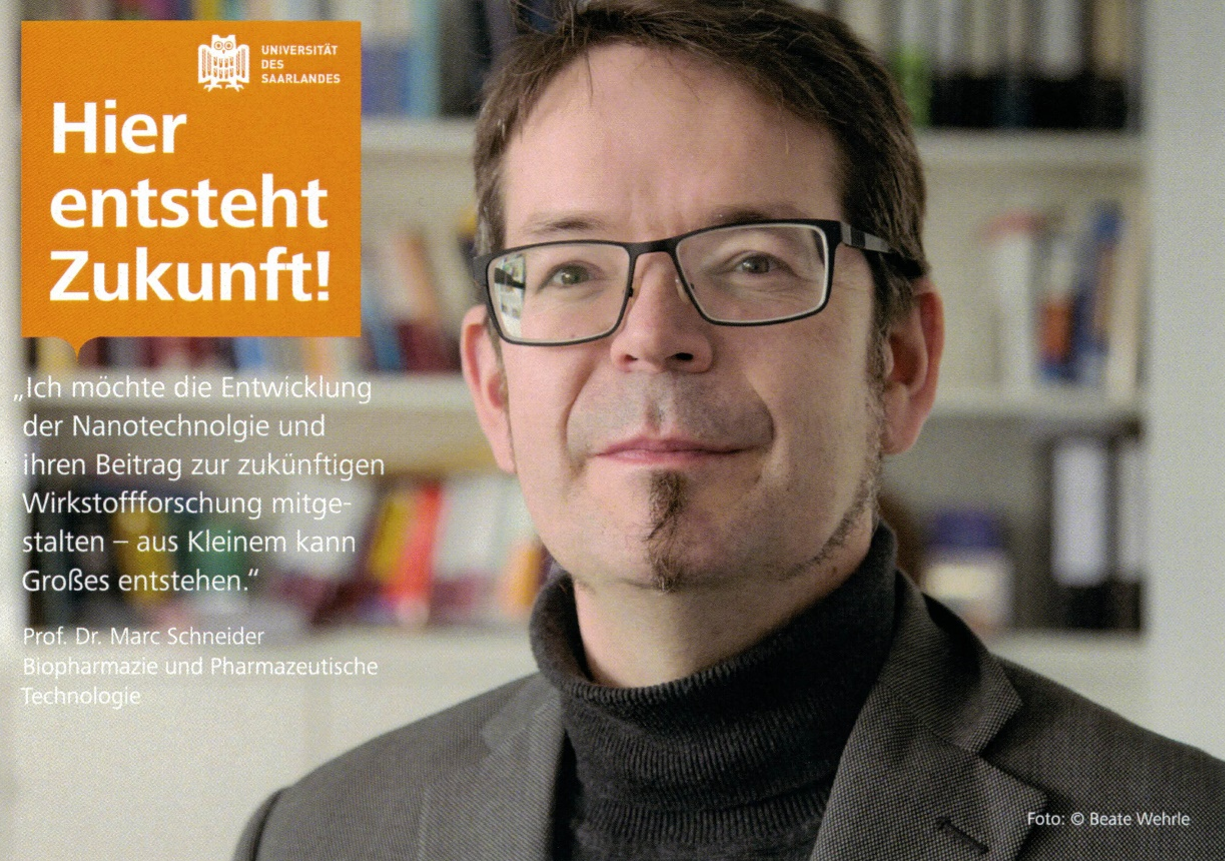
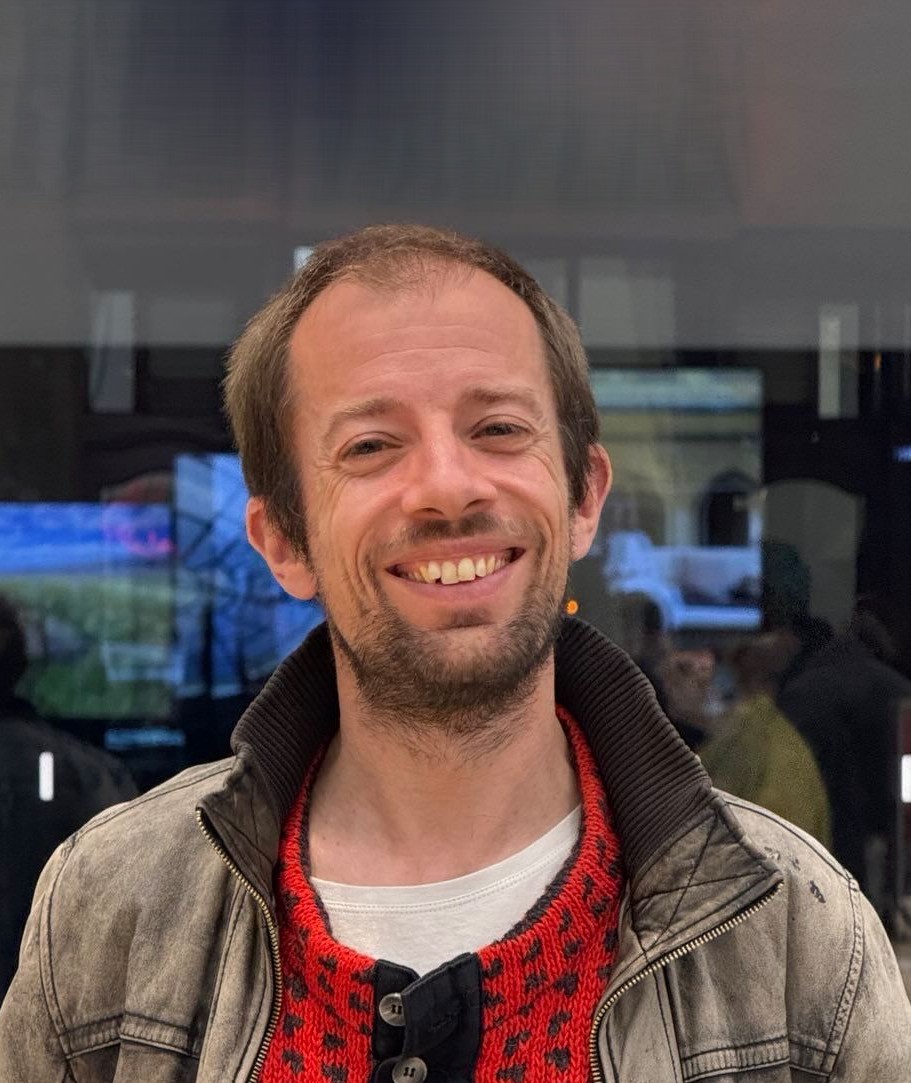
Prof. Dr. Marc Schneider holds a professorship in Biopharmaceutics and Pharmaceutical Technology at Saarland University's College of Pharmacy . His research focuses on colloidal drug delivery systems, particularly nanostructured and non-spherical particle engineering for overcoming biological barriers in pulmonary and transdermal applications. He leads an internationally recognized lab in Saarbrücken, collaborating with Helmholtz Institute for Pharmaceutical Research Saarland (HIPS) and trinational institutions. Research Highlights: Development of inhalable nano/microparticle systems Surface modification of gelatin nanoparticles Characterization of mucus-penetrating particles 3D printing for microneedle fabrication Atomic Force Microscopy (AFM) for nanoparticle analysis Selected Scientific Awards: European Journal of Pharmaceutics and Biopharmaceutics Best Paper Award (2018) for mucus-penetrating nanoparticles Recognized in 'Ausgezeichnete Orte im Land der Ideen' competition (2018) for 'Nano-Mais' drug delivery system Collaborative Networks: Co-editor for Advanced Drug Delivery Reviews special issue on biological barriers Key participant in trinational Master's program in Biomedicine with Strasbourg, Mainz, and Luxembourg Active in Controlled Release Society (CRS) conferences and local chapters
Prof. Dr. Anette Eva Fasang is a Full Professor of Microsociology at Humboldt University of Berlin, where she also serves as Director of the Department of Social Sciences and Academic Director of the Berlin Graduate School of Social Sciences (BGSS). She leads major research initiatives on life course stratification, social demography, and inequality, and has held leadership roles at the WZB Berlin Social Science Center. Her work bridges sociology, demography, and quantitative methodology, with a strong focus on comparative welfare state analysis. Ph.D. in Sociology, Jacobs University Bremen (2005–2009) B.A. and M.A. in Sociology, Ludwig-Maximilians-University Munich (1999–2004) Her research centers on life course dynamics, particularly how family formation, employment, and welfare regimes interact to shape social inequality across the lifespan. She employs advanced quantitative methods, especially sequence analysis, to study intergenerational transmission, gender disparities, and the long-term consequences of early-life trajectories. Her work spans comparative European and U.S. contexts and increasingly includes global perspectives, such as in Egypt and Senegal. The recent publications reflect a consistent focus on life course trajectories, social stratification, and methodological innovation. Key themes include the intersection of work and family, wealth and earnings accumulation, gender and racial inequality, and the impact of structural factors like welfare regimes and labor markets. Methodologically, her work advances sequence analysis and decomposition techniques for longitudinal data. Scientific Awards: Elected Fellow of the European Academy of Sociology (2024) Rosabeth Moss Kanter Award for Excellence in Work-Family Research (2023) Honorary Doctorate from the University of Turku (2022) Rosabeth Moss Kanter Award (2018) Prof. Fasang has supervised numerous doctoral students, many of whom have won top dissertation prizes. She leads significant research grants from the German Research Foundation (DFG), including the Cluster of Excellence SCRIPTS and the DYNAMICS research training group. Her advisory roles include the German Family Demographic Panel (FReDA) and scientific boards in Germany and Finland. She is actively involved in research teams and collaborative projects, such as the KOMPAKK study on household risks during the pandemic and the EQUALLIVES project on young adult life courses. Her work is deeply embedded in interdisciplinary networks across Europe and North America.
Prof. Dr. Wolfgang Nejdl is a Professor at the Institute for Data Science within the Faculty of Electrical Engineering and Computer Science at Leibniz University Hannover. He serves as Executive Director of the L3S Research Centre and Leibniz Forschungszentrum Inclusive Citizenship. Web Science Information Retrieval Artificial Intelligence Deep Learning His recent research focuses on AI applications in medicine , multimodal data fusion , and ethical AI systems . Projects include CAIMed (AI in Causal Medicine) and DAISEC (AI & Cybersecurity). His publications span conferences like AAMAS, WWW, and SIGIR. Notable awards include membership in the National Academy of Science and Engineering (acatech) . Former students hold positions at institutions like Stanford, TU Dresden, and ETH Zürich. Current projects involve climate resilience AI , federated learning for healthcare , and quantum-inspired data science .
Diogo Carbonera Luvizon is a Researcher at the Max-Planck-Institut für Informatik (MPI-INF) in Saarbrücken, Germany, and a member of the Visual Computing and Artificial Intelligence (VIA) Research Center. He holds a PhD in Computer Vision and Machine Learning from CY Cergy Paris University (2019), and Bachelor's and Master's degrees in Engineering and Applied Computing from UTFPR, Brazil. His research focuses on solving complex problems in Computer Vision, Computer Graphics, and Deep Learning, particularly in human modeling and real-time systems. Education: PhD (2019) - CY Cergy Paris University; M.Sc. (2015) - UTFPR; B.Sc. (2011) - UTFPR. Research interests include 3D human pose estimation, action recognition, multitask learning, and novel view synthesis. He has contributed to patents on multiplane image generation (Samsung) and vehicle speed measurement systems. His work has been recognized with awards like the Best Paper Honorable Mention at GCPR-VMV 2022 and Best Presentation Award at ETIS Lab (2018). He has developed open-source tools, including the deephar repository for human action recognition and pose estimation. His current affiliations include MPI-INF and the VIA Research Center, a partnership between MPI-INF and Google.
F. Ömer Ilday is a distinguished physicist and Alexander von Humboldt Professor at Ruhr University Bochum since July 2023, holding a joint appointment in the Faculty of Electrical Engineering and Information Technology and Faculty of Physics and Astronomy. His pioneering work in ultrafast laser technology has transformed non-linear laser-matter interactions, with applications spanning precision manufacturing, medical surgery, and nanofabrication. Education: PhD in Physics, Cornell University (2003) Postdoctoral Research Scientist, Massachusetts Institute of Technology (2003-2005) Ilday's research centers on ultrafast laser development and materials science, focusing on GHz-repetition-rate burst-mode systems, nonlinear laser lithography, and self-organization phenomena. His interdisciplinary approach bridges photonics, plasma physics, and materials engineering to enable breakthroughs in nanostructuring, silicon processing, and laser-based manufacturing. Current work emphasizes developing high-power laser sources and exploring fundamental laser-matter interaction mechanisms for next-generation applications. His recent publications (2023-2025) reveal dominant trends in high-repetition-rate burst-mode lasers (up to 50 GHz), ablation efficiency optimization, and nonlinear laser lithography for 3D silicon structuring. These works demonstrate strong convergence between fundamental physics and industrial applications, particularly in medical surgery, nanofabrication, and materials synthesis, with increasing emphasis on self-organization principles in laser systems. Scientific awards: Turkish Academy of Sciences Outstanding Young Scientist Award (2006) Marie Curie International Reintegration Grant (2006) ERC Consolidator Grant (2014) - Turkey's first ERC Advanced Grant (2022) Election to Academia Europaea Election to Turkish Academy of Sciences Membership in Turkish and American Physical Societies Ilday has secured major competitive grants including two ERC awards and a Marie Curie fellowship, directing research teams at Bilkent University's Ultrafast Optics & Lasers Laboratory (UFOLAB) which developed technologies adopted globally. At RUB, he is establishing the Center for Complex Laser-Matter Interactions as an interdisciplinary hub fostering collaborations between photonics, plasma research, and materials science, with explicit goals for spin-off company formation and transdisciplinary innovation in manufacturing technologies. As founding director of UFOLAB at Bilkent University, Ilday developed laser systems deployed by research institutions worldwide and established Turkey's first laser company. His RUB center integrates electrical engineering and physics expertise to advance complex laser-matter interaction research, focusing on self-organizing laser systems, nanostructuring techniques, and applications in semiconductor manufacturing and medical technology through close industry partnerships.
Prof. Dr. Nils Stieglitz is a distinguished Professor of Strategy at Frankfurt School of Finance & Management since 2012 and serves as President & CEO since 2018. He leads the Management Department (2015–2018) and held the Executive Board role as Vice President Corporate Development (2017–2018). His research spans Strategic decision-making Organizational adaptation Human-agent interaction across dynamic environments. His scholarly work appears in top-tier journals like Strategic Management Journal , Management Science , and Organization Science , focusing on complex organizational trade-offs, incentive design, and scenario planning. He also contributes strategic insights to global media outlets such as Harvard Business Review and The Economist . As Senior Editor at the Journal of Organization Design and editorial board member of Organization Science , he shapes discourse on organizational theory. His teaching emphasizes strategy formulation and organizational design principles.
Michio Sugeno is a distinguished Professor at Tokyo Institute of Technology's Graduate School of Information Science and Engineering, Department of Computational Intelligence. With a career spanning over four decades, he has established himself as a leading figure in fuzzy systems and computational intelligence. His research interests encompass Fuzzy Systems, Computational Intelligence, Nonlinear Control, Choquet Integral theory, Brain-Computer Interfaces, and Linguistic Computing. Sugeno's work has fundamentally shaped modern fuzzy control theory, particularly through his development of the Takagi-Sugeno fuzzy model which has become a standard approach in industrial applications. Analysis of his recent publications reveals a continued focus on piecewise nonlinear modeling, stability analysis of fuzzy systems, and the application of Choquet calculus to various computational problems. His work demonstrates a consistent trajectory from theoretical foundations to practical implementations in control systems and intelligent computing. IEEE Pioneer Award in Fuzzy Systems IFSA Fellow Emanuel R. Piore Award Sugeno has mentored numerous researchers who have become prominent in their own right, including Tadanari Taniguchi, Luka Eciolaza, and Anh-Tu Nguyen. His laboratory has been instrumental in developing novel approaches to nonlinear control systems using piecewise bilinear models and fuzzy logic. Current research directions include brain-computer interfaces using EEG analysis and the development of everyday language computing systems that enable more natural human-computer interaction.
Berit Greinke is an Assistant Professor of Wearable Computing at the Berlin University of the Arts (UdK) and the Einstein Center Digital Future (ECDF) since 2018, previously serving as a researcher at UdK's Design Research Lab and DFKI (2016-2018). Her academic foundation includes a PhD from Queen Mary University of London (2017), an MA from Central St Martins (2009), and a Diploma from Weissensee Academy of Art Berlin (2007). Her educational trajectory: PhD in Media and Arts Technology, Queen Mary University of London (2017) MA in Design for Textile Futures, Central St Martins College of Art and Design (2009) Diploma in Textile and Surface Design, Berlin Weissensee School of Art (2007) Greinke's research pioneers the convergence of craft, textile design, and digital technology, with core expertise in electronic textiles and smart materials. She investigates metamaterial-based 'metatextiles' for electromagnetic applications and explores transdisciplinary collaboration between designers and scientists, particularly regarding 'negative data' in creative and scientific workflows. Her current UdK work focuses on four interconnected domains: performing materials for expressive textile/fashion design; multi-modal sensing converting visual processes into haptic/audible experiences; micro-to-macro material design spanning nanostructures to final products; and transdisciplinary processes for technology-art-science collaboration. Analysis of her 2020-2025 publications reveals dominant trends in sustainable textile electronics, with emphasis on knitted/folded sensor structures, origami-inspired capacitive shape estimation, and social sustainability in e-textile communities. Her work uniquely bridges fundamental material science (e.g., textile metamaterials) with artistic applications (e.g., interactive orchestra garments) and industrial production challenges. Berit Greinke supervises PhD students including Giorgia Petri. Her junior professorship is co-financed by SAP under a public-private partnership model, supporting projects like WEAR (Wearable technologists engage with artists for responsible innovation) and STELEC (Sustainable Textile Electronics), which emphasize ethical co-design and industry-academia collaboration. She leads research within UdK's Institute for Product and Process Design and collaborates with the Design Research Lab (formerly part of Connected Textiles group), focusing on sustainable industrial production of electronic clothing and transdisciplinary innovation frameworks.
Uwe Cantner is a Full Professor of Economics at Friedrich Schiller University Jena and holds a professorship at the University of Southern Denmark/Odense. He has held significant roles such as Vice President for Young Researchers and Diversity Management at FSU Jena (2014–2024), Chairman of the German Federal Government's Commission of Experts for Research and Innovation (EFI), and Spokesman of the DFG-GRK 1411 Research Training Group. His work focuses on the economics of innovation, evolutionary economics, industrial economics, productivity measurement, and public finance. Education : Dipl.oec. in Business Administration/Economics (1985) from University of Augsburg; MA in Economics (1984) from Wayne State University; Dr.oec.publ. (1990) and Dr.rer.pol.habil. (1996) from Ludwig-Maximilians-University Munich. Cantner's research bridges theoretical and empirical analyses of innovation systems, technological sovereignty, and entrepreneurial ecosystems. He has contributed to debates on missions-oriented innovation policy, productivity dynamics in global value chains, and the role of institutional transparency in regional development. His recent publications analyze industrial policy frameworks (2023), digitalization challenges in European higher education (2022), and corruption-innovation linkages (2020). Articles span evolutionary economics, environmental economics, and policy analysis, with cross-cutting themes in sustainability, governance, and regional development. Cantner actively shapes academic discourse as President of the International Joseph A. Schumpeter Society (since 2015) and editorial roles in journals like the Journal of Evolutionary Economics . He has directed graduate programs and contributed to EU energy transition research through expert surveys.
Prof. Dr. Michael Schramm serves as an Extraordinary Professor of Classical Philology at the University of Göttingen's Faculty of Humanities. His academic journey spans prestigious institutions including Heidelberg, Jena, Leipzig, and Bielefeld, with doctoral and habilitation degrees establishing his expertise in ancient philosophical traditions. Research interests center on Neoplatonism, Greek tragedy reception, and Late Antique political-religious dynamics, particularly focusing on Julian the Apostate's theological works and Euripides' influence in imperial philosophy. His publications demonstrate rigorous engagement with textual criticism, philosophical exegesis, and intercultural dialogue between pagan and early Christian thought. Current research includes DFG-funded projects on Julian's religious philosophy (2015-2019) and Euripidean tragedy's relationship to providence (2020-2021), alongside a Gerda Henkel Foundation research fellowship (2020-2021). His editorial leadership in volumes like Euripides-Rezeption in Kaiserzeit und Spätantike (2020) shapes contemporary scholarship in classical reception studies. Advisory roles include postdoctoral mentoring through DFG research groups, with institutional service comprising temporary professorships at Bamberg, Bonn, Tübingen, and Jena since 2012. His methodological approach integrates philological precision with philosophical analysis across monographs, critical editions, and interdisciplinary handbooks.
Lucio Baccaro is Director at the Max Planck Institute for the Study of Societies (MPIfG) and was Full Professor of Macrosociology at the University of Geneva, where he also served as Deputy Dean for Research (2016–2020). He has held academic positions at MIT, Case Western Reserve University, and visiting roles at the University of Turin and the University of Vienna. His primary affiliations are with MPIfG and the University of Geneva, both central to his research in political economy and sociology. Education: PhD in Management and Political Science, Massachusetts Institute of Technology (MIT), 1999 Doctorate in Labor Law and Industrial Relations, University of Pavia, 1997 Master of Business Administration, Stoa' (IRI-MIT joint venture), 1991 Laurea in Philosophy, summa cum laude, University "La Sapienza", Rome, 1989 Lucio Baccaro’s research focuses on comparative political economy, labor relations, global worker rights, and deliberative governance . His work integrates economic sociology and political sociology to analyze institutional change, social dialogue, and the impact of globalization on labor and welfare systems. He has led major comparative studies on employment models, pension reforms, and international labor standards. His scholarship emphasizes the interplay between institutions, ideas, and power in shaping economic governance. His recent publications reveal a consistent focus on institutional change, deliberative processes, labor market reforms, and global justice . Themes include path dependence in international organizations, the transformation of collective bargaining, and the role of expertise in democratic governance. His interdisciplinary approach bridges sociology, political science, and economics, with strong methodological rigor in comparative and qualitative analysis. Scientific Awards and Honors: Honorary Professor, University of Duisburg-Essen (2023) Professeur honoraire, University of Geneva (2020) International Geneva Award (2011) Outstanding Young Scholar Award, IRRA (2003) Founder's Prize, SASE (2001) Maurice F. Strong Career Development Chair, MIT (2006–2009) Multiple fellowships from SSRC, Harvard, MIT, and CUNY Alfiere del Lavoro, awarded by the President of Italy (1984) Advising and Grants: While specific student advisees are not listed, Baccaro has supervised research and mentored scholars through his roles at MPIfG and the University of Geneva. He has secured substantial research funding, including grants from the Swiss National Science Foundation (SNF) and the Swiss Network for International Studies (SNIS), supporting projects on post-Fordist growth models, employment policy, and deliberative governance. His leadership in co-principal investigator roles highlights his collaborative research approach and institutional influence. Labs and Research Teams: As Director at MPIfG, Baccaro leads a major research institute focused on the study of societal and economic institutions. He has been instrumental in shaping research agendas on political economy and governance, fostering interdisciplinary collaboration and international scholarly exchange.
Christian Wald is a Post-doctoral researcher at Technical University Berlin working under Professor Gabriele Steidl, focusing on generative modeling, flow matching, and stochastic processes in machine learning. His research bridges theoretical probability with practical medical imaging applications, particularly in MRI reconstruction and analysis. He completed his PhD at Humboldt University of Berlin in 2017 with a thesis on p-adic quantum groups. His academic journey transitioned from pure mathematics to interdisciplinary machine learning research, reflecting his versatile expertise. Wald's primary research explores generative models through the lens of optimal transport and flow matching, with significant contributions to Wasserstein geometry and conditional distance metrics. His work frequently integrates stochastic processes to enhance medical image reconstruction, demonstrating strong cross-disciplinary impact in both theoretical machine learning and clinical applications. Recent publications highlight innovations in sliced MMD flows, Bayesian OT methods, and uncertainty-aware medical image analysis. Analysis of his 15 most recent publications (2019-2025) reveals a consistent trajectory toward unifying geometric probability with deep learning. Key themes include flow-based generative modeling for medical time-series data, optimal transport applications in image reconstruction, and novel kernel methods for distribution matching. His work spans both foundational theory (e.g., Fisher-Rao curves) and high-impact medical applications (e.g., coronary calcium scoring). No specific scientific awards are documented in the provided text, though his publications appear in prestigious venues including ICLR, IEEE TMI, and Physics in Medicine & Biology. Wald maintains extensive collaborations with the medical imaging group at Technical University Berlin, particularly with Andreas Kofler and Gabriele Steidl. His co-authored works demonstrate consistent contributions to MRI reconstruction pipelines and segmentation frameworks, though no formal advising roles or grant leadership are indicated. Current projects focus on uncertainty quantification in active learning for medical image segmentation. He operates within Gabriele Steidl's research group at Technical University Berlin, which specializes in mathematical imaging and machine learning. The team combines expertise in optimization, probability theory, and deep learning to solve medical imaging challenges, with Wald contributing core algorithmic innovations in generative modeling and stochastic reconstruction.
Prof. Dr. Harald Reiterer is a leading researcher in Human-Computer Interaction at the University of Konstanz, where he has served as Professor since 2009. His academic journey includes a Ph.D. (1991) and habilitation (1995) from the University of Vienna, followed by roles including Senior Researcher at Fraunhofer FIT and Associate Professor at Konstanz. He currently holds multiple leadership roles: Dean of the Faculty of Sciences , Senator of Section 1 , and Consulting Dean . Ph.D. in Computer Science (University of Vienna, 1991) Venia Legendi (Habilitation) in HCI (University of Vienna, 1995) His research focuses on: Interaction Design for mixed reality environments Information Visualization in immersive contexts Hybrid User Interfaces combining physical and virtual elements 3D Object Manipulation in handheld AR Behavioral Analytics through mHealth interventions Recent work explores: Avatar representation in Augmented Reality (2024) Node selection efficiency in Virtual Reality (2024) Peripheral vision toolkits for Head-Mounted Displays (2023) Hybrid interface optimization for Mixed Reality (2023) Smartphone AR extensions for Spatial Memory (2023) Key scientific contributions: Landeslehrpreis 2021 for interdisciplinary exhibition design Development of Colibri cross-reality toolkit (2023) Foundational work on Re-locations for remote collaboration (2022) He leads numerous projects including: SMARTACT (Smart Mobility, 2015-2023) SFB TRR 161 (2009-2027) on XR interface measurement Blended Library (2011-2015) for future library design
Dr. Alexander Paulus serves as a Researcher at the Chair of High-Frequency Engineering within the Department of Electrical Engineering at the Technical University of Munich (TUM), School of Computation, Information and Technology. Working under Prof. Dr.-Ing. Thomas Eibert, he contributes to advanced electromagnetic research and measurement systems development at TUM's Arcisstr. 21 campus in Munich. Research Expertise His core specialization lies in near-field antenna measurement and transformation techniques, with significant contributions to phase retrieval algorithms, inverse source methods, and UAV-based electromagnetic field measurements. He addresses critical challenges including probe correction with unknown antennas, sparse sampling for directive antennas, and electromagnetic modeling of environmental effects like rain attenuation. His work bridges theoretical electromagnetics with practical antenna characterization solutions. Publication Trends From 2014-2025, Paulus has published 25+ papers focusing on near-field to far-field transformations, particularly in phaseless and multi-probe scenarios. Recent work (2023-2025) demonstrates innovation in spectral filtering, sparse reconstruction, and UAV-based systems for defect localization and wet antenna modeling. His research increasingly integrates computational techniques to solve complex inverse problems in antenna measurements. Scientific Recognition No formal awards documented in available information Academic Contributions Student Mentoring: No advisees listed in provided materials Research Funding: Grant details not specified in source text Research Environment Paulus operates within TUM's Chair of High-Frequency Engineering facilities, which include advanced near-field measurement ranges, UAV-based electromagnetic characterization systems, and laboratories for metamaterials research and electromagnetic compatibility testing. His work supports applications in 5G/6G communications, aviation navigation systems, and precision antenna diagnostics.
Univ.-Prof. Dr. rer. nat. Michael Vorländer is a full Professor and Chair of Technical Acoustics at the Institute of Technical Acoustics (ITA), Faculty of Electrical Engineering and Information Technology, RWTH Aachen University, Germany. He has been the head of the institute since 1996 and is a leading figure in acoustics research and academic leadership. His extensive service includes being President of the European Acoustics Association (EAA), the International Commission for Acoustics (ICA), the German Acoustical Society (DEGA), and elected President of the Acoustical Society of America (ASA) for 2024–2027. Education: Diplom-Physiker, RWTH Aachen (1984); Dr. rer. nat., RWTH Aachen (1989); Dr.-Ing. habil., TU Dresden (1995) Professional Leadership: Pro-Dean (2007) and Dean (2009) of Faculty of Electrical Engineering and Information Technology, RWTH Aachen; Spokesperson of Professors, RWTH Aachen (2012) Editorial Roles: Editor-in-Chief, Acta Acustica (1998–2003); Editorial Board, Applied Acoustics (since 1996) Michael Vorländer's primary research interests lie in the fields of auralization, room acoustics, building acoustics, psychoacoustics, acoustic measurement technology, and virtual acoustics . His work integrates physical acoustics with human perception, focusing on the simulation and reproduction of sound fields in virtual environments. He leads research in binaural technology, electroacoustics, and auditory scene analysis, with applications in noise research and interactive virtual environments. His group is involved in the Priority Program SPP2236 - AUDICTIVE, focusing on auditory cognition in interactive virtual settings. While specific recent publications are not listed, his research output is extensive, as indicated by links to filtered publications. His body of work consistently bridges theoretical modeling, experimental validation, and practical application in architectural and virtual acoustics, contributing to both engineering standards and perceptual understanding. Michael Vorländer has received numerous scientific awards recognizing his contributions to acoustics, including the prestigious RWB Stephens Medal, W.C. Sabine Medal, and Rayleigh Medal . He is a Fellow of the Acoustical Society of America and holds honorary memberships and awards from acoustical societies in Europe and beyond. He advises doctoral students and leads a multidisciplinary research team at the ITA, fostering collaboration in areas like acoustic virtual reality and spatial audio. His leadership in international societies and editorial boards highlights his role in shaping the global acoustics community. He has been instrumental in advancing research infrastructure and academic collaboration in technical acoustics. The research at his institute is organized into key areas: Acoustic Virtual Reality and Auralization, Binaural Technology and Spatial Audio, Auditory Scene Analysis, Psychoacoustics and Noise Research, Electroacoustics, and Room Acoustics. These labs and teams work on projects ranging from fundamental auditory perception to applied engineering solutions for noise control and virtual sound environments.