Mostafa Hadadian Nejad Yousefi is a Researcher at the Faculty of Science and Engineering , University of Groningen , specializing in Distributed Systems . His work bridges machine learning and distributed computing, focusing on adaptive systems and digital twins. His research interests include: Machine Learning Service-Oriented Computing Neural Networks Distributed Systems Digital Twins Big Data Bioinformatics Recent publications highlight his work on: Digital twin architectures for water distribution networks (2024) Self-adaptive service selection in ML pipelines (2024) Service-oriented principles for ML development (2023) Dynamically reconfigurable distributed pipelines (2021) Neural network-based genomics analysis (2021) Contact: m.hadadian@rug.nl
Lysanne Lessard is an Associate Professor at the Telfer School of Management, University of Ottawa, specializing in the design of digitally-enabled services. Her work bridges information systems and healthcare, focusing on telehealth, e-commerce, and online government services. She is affiliated with the LIFE Research Institute and Institut du Savoir Montfort, contributing to interdisciplinary research. Ph.D., Information Systems (University of Toronto, 2013) M.Sc., Information Technology (Téluq-UQAM, 2007) B.A., Communications (UQAM) Her research explores digitally-enabled service systems as socio-technical arrangements, emphasizing stakeholder needs, theoretical foundations, and modeling techniques. Key areas include telemonitoring, learning health systems, and service personalization. Recent publications address simulation modeling in healthcare, trust requirements for peer support systems, and AI applications in service design. Her work integrates Service-Dominant Logic and human-centered approaches to address challenges in virtual care access and preventive health behaviors. Lessard collaborates with NSERC, CIHR, and CNFS-funded projects, advancing methodologies for requirements engineering and system architecture design in health contexts.
Ulrik Pagh Schultz is a Professor at the University of Southern Denmark, specializing in generative programming, domain-specific languages, and embedded systems. His research focuses on automatic code generation, real-time systems, and reconfigurable robotics, with applications in autonomous drone operations and energy modeling for embedded systems. He has served as a committee member and session chair for numerous conferences including PEPM, GPCE, SPLASH, and POPL since 2011. Notable contributions include work on Idris programming language, reversible computing, and service-oriented architectures for drones. His career spans active involvement in programming language design and practical implementation challenges in robotics software engineering, particularly through collaborations at ACM SIGPLAN conferences. While specific students and awards aren't listed, his extensive service roles demonstrate significant academic engagement.
Gioldasis Nektarios is a Lecturer in the School of Electronic and Computer Engineering at the Technical University of Crete , affiliated with the Distributed Information Systems and Applications Laboratory (TUC/MUSIC) . He has been a permanent member of the laboratory since 2006 and has contributed to numerous Research & Development projects. MSc in Informatics, School of Electronic and Computer Engineering, Technical University of Crete (2002) BSc in Applied Informatics, University of Macedonia (1999) His research interests span critical domains including: Semantic Web technologies and Open Linked Data Software engineering for Service Oriented and Multi-Tier Architectures Data modeling, metadata management, and semantic interoperability Digital libraries and multimedia management systems The article portfolio demonstrates expertise in XML-Semantic Web integration, query mediation, and cultural data systems, with a 2023 publication on location-based game platforms. Key trends include: Interoperability frameworks (2015-2012) Ontology-driven data access (2010-2009) Geospatial and cultural heritage applications (2011-2007)
Tobias Wulfert, Ph.D., serves as a Research Fellow at the University of Duisburg-Essen's Faculty of Computer Science, specifically within the Department of Business Informatics and Integrated Information Systems under Prof. Dr. Reinhard Schütte. His academic journey includes a Master of Science in Business Information Systems from the University of Münster (2015-2017) and a Bachelor of Science from the Baden-Württemberg Cooperative State University in Mannheim (2012-2015), with additional professional experience at Atos in various technical and project management roles. Dr. Wulfert's research focuses on the intersection of digital platforms, enterprise systems, and retail transformation, with particular expertise in e-commerce ecosystems, sustainable business practices, and machine learning applications in retail environments. His work examines how digital platforms transform traditional value chains, particularly in construction, retail, and e-commerce sectors, analyzing boundary resource management, ecosystem standardization, and sustainable development initiatives within platform ecosystems. His publication record demonstrates consistent scholarly output in top-tier journals including Electronic Markets, Information & Management, and HMD Praxis der Wirtschaftsinformatik, with a clear trend toward increasingly sophisticated analysis of platform ecosystems, sustainability integration, and the application of artificial intelligence in retail contexts. Recent work shows a progression from foundational studies on platform architecture to more complex analyses of sustainability impacts and agent-based modeling of ecosystem dynamics. Through his teaching of Retail Enterprise Systems and Impact and Economics of IT Systems, Dr. Wulfert bridges theoretical research with practical applications, emphasizing the economic implications of IT investments and the strategic management of digital transformation. His supervision of numerous bachelor's and master's theses reflects his commitment to developing the next generation of business informatics professionals, with thesis topics spanning blockchain applications, smart services, platform governance, and digital transformation across various industries. Dr. Wulfert's collaborative research approach is evident in his extensive co-authorship network, particularly with colleagues at the University of Duisburg-Essen, demonstrating strong institutional integration while maintaining connections with international research communities through conference presentations at venues including ECIS, PACIS, and HICSS.
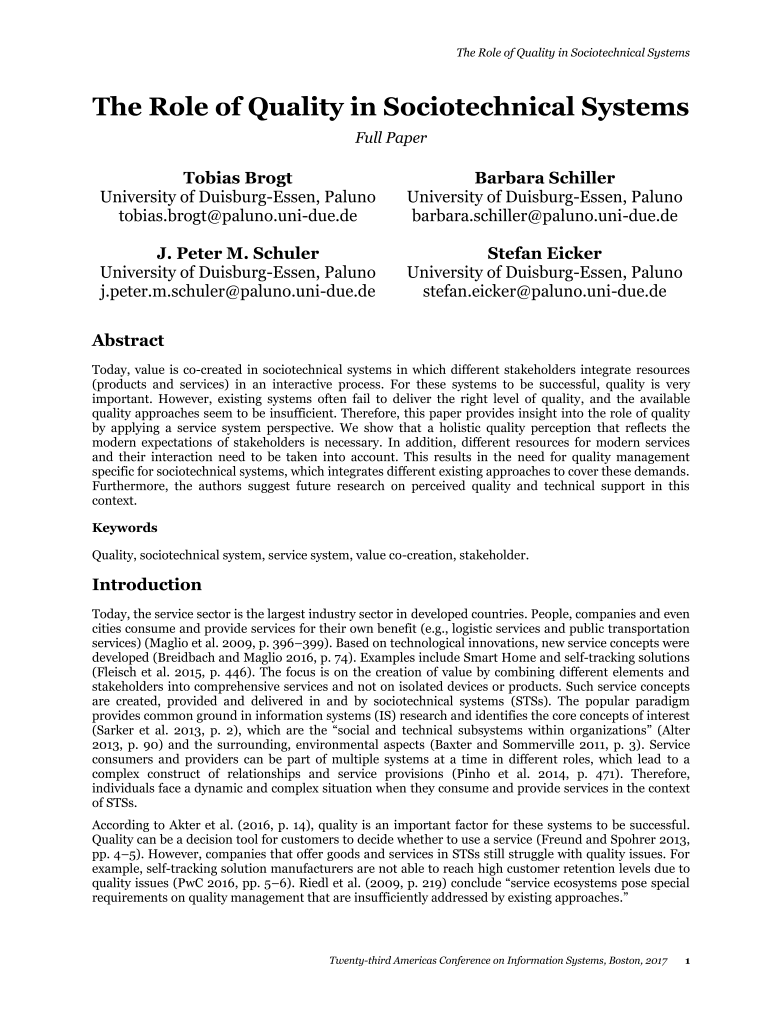
Tobias Brogt is an External Ph.D. Student and Research Assistant at the Chair of Business Information Systems and Software Engineering within the Faculty of Business and Economics at the University of Duisburg-Essen. He combines academic work with practical experience as a Software Engineer at IT-Objects GmbH since 2015. Ph.D. research in Service Systems Engineering and Smart Connected Products Active lecturer in DBIT (Digital Business Innovation and Transformation) and VAWi (Virtual Continuing Education Program) since 2019 and 2016 Published extensively in ECIS , HICSS , and Springer Gabler publications Research Focus includes digital transformation , smart product architectures , and quality management in sociotechnical systems . His work applies service-dominant logic to analyze value creation through resource integration, particularly in IoT-enabled environments. Key Publications Trends reveal expertise in: Smart service system taxonomies Quality factors for self-tracking solutions Hybrid process models combining agile and plan-driven approaches Industry 4.0 transformation strategies Academic Contributions include: Supervision of 54+ Bachelor’s and Master’s theses since 2016 Design of courses like Advanced Programming Concepts and Software Development Paradigms Collaboration on the WIWI-chairT3 web content management solution
Dr. Željko Jovanović is an Assistant Professor at the Department of Computer and Software Engineering , Faculty of Technical Sciences in Čačak , University of Kragujevac , Serbia. He holds a PhD in Electrical Engineering and Computing (2020) from the University of Niš, with a focus on Application of IT in improving the quality of patient transport , and a Diploma Engineer in Computer Science (2008) from the University of Kragujevac. Current roles: Head of Department (2023–present), Coordinator of Undergraduate Studies (2021–present) Teaching areas: Programming basics, Object-oriented programming, Software engineering, Medical informatics (PhD studies) His research focuses on Computer Engineering and Software Engineering , with applications in Medical Informatics , Intelligent Transportation Systems , IoT , and Smart Cities . He has contributed to 15+ publications in journals and conferences, including IEEE Transactions on Intelligent Transportation Systems , Electronics , and Transactions in GIS , emphasizing artificial neural networks , data mining , and comfort assessment in healthcare and transportation contexts. Projects include the national TR32043 initiative on low-power computing systems and the international NeReLa project for remote labs. He has developed technical solutions for thermal comfort monitoring , smart suspension control , and IoT-based systems , and serves on academic committees for software engineering and computer science education.
Dr. Carlos Galera Zarco is an Associate Professor in Project Management and Business Analytics at University College London (UCL), where he leads the MSc Digital Engineering Management programme. He is affiliated with The Bartlett School of Sustainable Construction, a leading institution in sustainable built environment research and education, located at 1-19 Torrington Place, London. His academic credentials include: PhD in "Servitisation and Digitalisation in Project-Based Organisations" MSc in Economics & International Management MEng in Civil Engineering Dr. Galera Zarco's research focuses on navigating the complexities of the digital economy, exploring business model innovation, operational transformations, and the development of new organizational structures to address challenges and opportunities of rapid technological change. His work specifically examines how AI, data analytics, and emerging digital technologies such as Digital Twins can drive innovation and create value for businesses and clients. He investigates data-driven value creation and capture, as well as the implementation of advanced services across multiple sectors including construction, supply chain management, and humanitarian operations. His research aligns with Sustainable Development Goals 9 (Industry, Innovation and Infrastructure) and 12 (Responsible Consumption and Production). Analysis of his recent publications reveals a strong focus on digital transformation across various sectors with increasing emphasis on sustainability and circular economy principles. His work demonstrates a clear progression from theoretical frameworks to empirical studies and practical applications, particularly in the areas of digital twins, AI applications, and sustainable supply chain management. His professional recognition includes: Fellow of the Higher Education Academy (since May 1, 2018) External Examiner at various institutions in the UK and abroad As an educator, Dr. Galera Zarco teaches modules in Big Data and Business Analytics and Agile and Hybrid Project Management for the MSc in Digital Engineering Management program which he leads. Prior to his academic career, he worked with a global construction company on different infrastructure projects, bringing practical industry experience to his teaching and research. He is proficient in Spanish (native) and Italian, supporting his international collaborations and research.
Keith Bartholomew is a Professor in the Department of City & Metropolitan Planning at the University of Utah's College of Architecture + Planning. He previously served as Associate Dean of the College of Architecture + Planning from 2011 to 2022. His academic journey at the University of Utah began in 1999 with adjunct appointments in Geography and Family & Consumer Studies, progressing through various academic ranks before becoming a full Professor in 2020. Professor Bartholomew's educational background includes: Juris Doctor and Graduate Certificate in Environmental Law from the University of Oregon (1987) Certificate in Ocean & Coastal Law from the University of Oregon (1987) Bachelor of Music in Percussion Performance from Northern Illinois University (1983) Professor Bartholomew's research centers on community-based decision making processes, with a primary focus on the development and application of integrated land use-transportation scenario analysis. His work serves as the foundation for community visioning, long-range transportation planning, and transportation project analysis. He has conducted nationally recognized research on the interactive effects of land use development and travel patterns, initially through the "Making the Land Use, Transportation, Air Quality Connection" (LUTRAQ) program. His recent research has expanded to examine scenario planning projects across more than 100 U.S. metropolitan areas, with a particular emphasis on using scenario analysis for climate action plans in states like California and Oregon. His most current work investigates the ridership and equity impacts of small-scale design decisions at bus stops. An analysis of Professor Bartholomew's scholarly output reveals a consistent focus on the intersection of urban form, transportation systems, and environmental sustainability. His publications demonstrate expertise in scenario planning methodologies, accessibility metrics, and the relationship between land use patterns and transportation outcomes. A significant thread throughout his work examines how compact development can reduce vehicle miles traveled and associated carbon emissions, contributing to climate change mitigation efforts. His research also consistently addresses issues of social equity in transportation planning, particularly regarding the impacts of fare structures and accessibility on different demographic groups. Professor Bartholomew's contributions to the field have been recognized with numerous awards: Transportation Research Board, Charley V. Wootan Award for the best paper in transportation policy and organization (2024) University of Utah Distinguished Teaching Award (2021) College of Architecture + Planning Professor of the Year (2015 and 2010) Northern Illinois University Honors Program Alumnus of the Year (2015) University of Utah Service-Learning Class of the Year (2008) University of Utah University Professorship (2006) As an educator, Professor Bartholomew has advised numerous students through honors theses, undergraduate research projects, and dissertations. His teaching portfolio includes courses on Land Use Law, Land, Law & Culture, and Ecological Planning Workshop. He has secured significant research funding from federal agencies including the Federal Highway Administration, National Science Foundation, and the U.S. Department of Transportation through the National Institute for Transportation and Communities (NITC). His grant portfolio demonstrates a sustained focus on transportation planning, scenario analysis, and the relationship between land use and transportation outcomes. Professor Bartholomew has been actively engaged with community organizations and professional boards, including serving on the Envision Utah Policy Board and the Utah Transit Authority Board of Trustees from 2004 to 2017. His work bridges academic research with practical application in metropolitan planning organizations across the United States, helping to translate theoretical concepts into actionable planning practices.
Dr Anthony J H Simons is a Senior Lecturer in the Department of Computer Science at the University of Sheffield, where he serves as Deputy Director of UG Admissions. He is a member of the Testing research group and has been affiliated with the university since completing his PhD there. His academic journey spans several decades, moving from speech recognition systems to object-oriented programming languages and currently focusing on model-based testing and cloud computing applications. Dr Simons holds an MA in Modern Languages from the University of Cambridge and a PhD in Computer Science from the University of Sheffield. His educational background in both humanities and technical fields has informed his interdisciplinary approach to software engineering research. His primary research interests center around turning formal verification results into practical software engineering benefits. Currently, he investigates Model-Based Testing and Model-Driven Engineering with applications to Cloud Computing. Earlier in his career, he made significant contributions to object-oriented software engineering, including type theory and software development methods. He is the inventor of the JWalk automatic software testing tool for Java and the JAST library for processing XML in Java, and co-author of the OPEN Toolbox of Techniques. His work bridges theoretical computer science with practical software development needs. Analysis of his recent publications reveals a clear trajectory from foundational work in object-oriented type theory to applied research in cloud computing and model-based testing. His scholarship demonstrates consistent focus on formal methods applied to practical software engineering challenges, with increasing emphasis on cloud infrastructure testing and verification in recent years. Dr Simons has secured significant research funding as Principal Investigator, including the Broker@Cloud project (EC-FP7, £323,688, 2012-2015), Future Engineering System (InnovateUK, £199,874, 2016-2019), and Ferromone Trails Concept (Department for Transport, £24,635, 2017). He has supervised numerous undergraduate and masters' projects throughout his career and continues to mentor students despite being semi-retired. He leads the Testing research group at Sheffield and has developed several research projects including CatWalk (a software testing tool for Java), ReMoDeL (a conceptual modeling language), and tools for verifying specifications and generating tests for software services in the cloud. His research has practical applications in cloud service brokerage and quality assurance.
Damian Tamburri is an Associate Professor (Part-time) at Eindhoven University of Technology and the Jheronimus Academy of Data Science (JADS) in s'Hertogenbosch, Netherlands. His work bridges technical, social, and organizational dimensions of DevOps, DataOps, and AI-driven data engineering. Affiliated with JADS' Data Governance group ACM TOSEM Associate Editor Secretary of TOSCA TC, IFIP TC2/TC6/TC8 WG Research Focus: His research explores the intersection of data-intensive systems, service-oriented architectures, and ethical AI. Key areas include: LLMOps and DevOps maturity in industry Federated Learning optimization via SOA principles Decentralized data architecture (data mesh) Dark web illicit content detection using neural networks Publication Trends: Recent work emphasizes operationalizing AI/ML systems in distributed environments, with 80% of 2025 publications addressing services computing challenges. Topics span federated learning (2025), dementia detection (2025), and data mesh governance (2025). Grants & Collaborations: Active in EU-funded research with involvement in Horizon Europe projects (grant 101137301) and Innovative UK partnerships. His studies combine academic rigor with industry insights from major logistics providers. Key Contributions: He has developed novel approaches to: SOA-enhanced federated learning frameworks Hybrid models for dementia early detection Reference architectures for data mesh Label-agnostic neural networks for dark web monitoring
Ksenia Onufrey is a Senior Lecturer at Chalmers University of Technology, affiliated with the Department of Technology Management and Economics and the Division of Innovation and R&D Management. Her work bridges theoretical and applied research in industrial transformation and sustainable systems. Academic Rank: Senior Lecturer Department: Division of Innovation and R&D Management University: Chalmers University of Technology Research Interests focus on: Innovation Management in mature industries Customer involvement in energy service design Strategic alignment of business and technological transitions Sustainable industrial transformation Multi-system linkage dynamics Recent Publications (2019-2026) span topics in: Electric vehicle agenda-setting Activated carbon for CO2 capture Railway brake system thermal analysis DNA-intercalating ruthenium complexes Food material microstructure engineering Biomass-derived adsorbent technology
Kemafor Anyanwu Ogan serves as Associate Professor in the Department of Computer Science at North Carolina State University's College of Engineering, where he directs the Semantic Computing Lab. His research bridges theoretical foundations with practical applications in data-intensive systems, supported by continuous funding from major agencies since 2012. His educational foundation includes: Ph.D. in Big Data and Knowledge Management, Semantic Web, and Internet of Things from the University of Georgia (2007) Dr. Ogan's research program centers on scalable semantic technologies, with evolving focus from foundational Semantic Web and knowledge graph processing (2014-2019) to blockchain-integrated systems (2021-2024). His work develops novel frameworks for RDF query optimization, knowledge graph analytics, and blockchain transaction primitives that address critical challenges in distributed data management. Current efforts emphasize agricultural supply chain transparency and smart manufacturing applications. Publication trends reveal strategic progression from MapReduce-based RDF processing to blockchain-enhanced architectures, reflecting adaptation to emerging computational paradigms while maintaining core expertise in semantic data management. Recent work demonstrates increasing industry relevance through manufacturing and agricultural applications. His scientific recognition includes: Three IBM Faculty Awards (2008, 2009, 2016) Best Paper Award at JIST 2012 Best Student Paper Award Nominee at ISWC 2014 Dr. Ogan has secured $2.3M+ in competitive funding across 10 major grants, with current projects focused on blockchain for agricultural resilience (USDA), declarative blockchain transactions (Cisco), and crop productivity analytics (GRIP4PSI). His Semantic Computing Lab actively collaborates with RENCI, IBM, and agricultural industry partners to translate research into real-world impact, particularly in food supply chain optimization and smart contract reliability. The Semantic Computing Lab drives innovation through NSF-funded projects like SmartChainDB and SERPENT, developing semantically-enhanced blockchain platforms that enable trustless smart marketplaces while addressing critical performance limitations in existing systems.
Claus Pahl is a Full Professor of Software Engineering at the Free University of Bozen-Bolzano , Italy, affiliated with the Faculty of Computer Science . He leads the CECL Cloud and Edge Computing Lab and is a member of the SEAS Software Engineering and Autonomous Systems research group. Ph.D. from the University of Dortmund Academic positions in Germany, Denmark, Ireland, and Italy since 2016 Principal Investigator at Irish Centre for Cloud Computing and Commerce (IC4) and Lero Software Research Centre Over 5 million Euro in research funding 440+ publications with 364,714 reads and 9,736 citations His research focuses on Software Architecture for Cloud and Edge Computing , Autonomous and Adaptive Systems , and Blockchain-based architectures . He explores Model-driven development and AI-driven controllers for self-adaptive systems, emphasizing dependability and quality management . Recent publications highlight trends in blockchain scalability , zero-knowledge proofs , container orchestration , and AI quality engineering for edge environments. He has served as PC Chair for ECOWS 2007 and ICSOC 2018, and General Chair for CLOSER 2017-2018. His work appears in 7 editorial boards, and he leads educational initiatives in software engineering principles.
Michaël van Buuren is a Researcher at Wageningen University & Research within the Applied Spatial Research department. His work focuses on Nature-Based Solutions , Energy Transition , Climate Change , and Land Use . He actively contributes to policy-oriented research and public engagement through seminars, reports, and media appearances. Key Research Areas: Nature-Based Solutions for climate adaptation Energy transition strategies in rural contexts Integrating environmental quality into spatial planning Flood protection and urban landscape design Recent Trends in Publications : His research output centers on long-term environmental visions (e.g., Netherlands 2120), interdisciplinary design practices, and policy frameworks for sustainable land use. Keywords include 'climate resilience,' 'rural transition,' and 'ecosystem services.' Scientific Awards: Grote Maaskant Prijs 2024 NVTL Award 2022 WUR Impact Award 2023 Projects : He leads 'Lokstroom II' (2024-2025) and 'KD-2022-072' (2022), focusing on enhancing environmental quality through policy innovation and stakeholder collaboration.