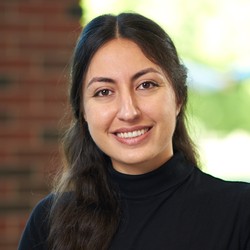
Animesh Garg is an Assistant Professor at the School of Interactive Computing at Georgia Tech, where he leads the People, AI, and Robotics (PAIR) research group . He holds a Senior Researcher position at Nvidia Research and has courtesy appointments at the University of Toronto and Vector Institute. Previously, he served as Chief Scientific Officer at Apptronik (2024-2025) and Senior Staff Research Scientist at Nvidia Research (2018-2024). Education : Ph.D. in Operations Research from UC Berkeley (2011-2016), MS in Computer Science and Industrial Engineering from Georgia Tech and University of Delhi. Research Focus : Building Generalizable Autonomy through Reinforcement Learning , Control Theory , and 3D Vision , with applications in Surgical Robotics , Self-Driving Labs , and Manufacturing . Key Article Themes : His recent work emphasizes Foundation Models for robotics, Differentiable Simulation , Language-Guided Autonomy , and Structured Inductive Biases in sequential decision-making. Scientific Awards : Stephen Fleming Early Career Professorship at Georgia Tech. Teaching : Courses on AI, Deep Reinforcement Learning, and Algorithmic Intelligence in Robotics at Georgia Tech. Labs & Collaborations : Affiliated with Institute for Robotics and Intelligent Machines (IRIM) and ML@GT at Georgia Tech; collaborates intensively with Nvidia Robotics.
Dinesh Jayaraman is an Assistant Professor at the University of Pennsylvania, with primary and secondary appointments in the Department of Computer and Information Science (CIS) and Electrical and Systems Engineering (ESE), respectively. He leads the Perception, Action, and Learning (PennPAL) Research Group at the GRASP Laboratory, focusing on interdisciplinary research at the intersection of robotics, machine learning, and computer vision. Research Interests: Robotics, computer vision, reinforcement learning, and autonomous systems. Recent Publications: His work explores vision-language models for robotic tool use, symmetry-based control acceleration, articulated object modeling, and in-context learning frameworks. Awards: Recipient of the 2022 NSF CAREER Award for innovative contributions to robotics and AI. Teaching: Co-teaching a robot-learning seminar (CIS 7000/ESE 6800) with Antonio Loquercio in Spring 2025. Students: Advising PhD candidates including Edward Hu, Arjun Krishna, and co-advised students with Osbert Bastani, Vijay Kumar, and Rajeev Alur.
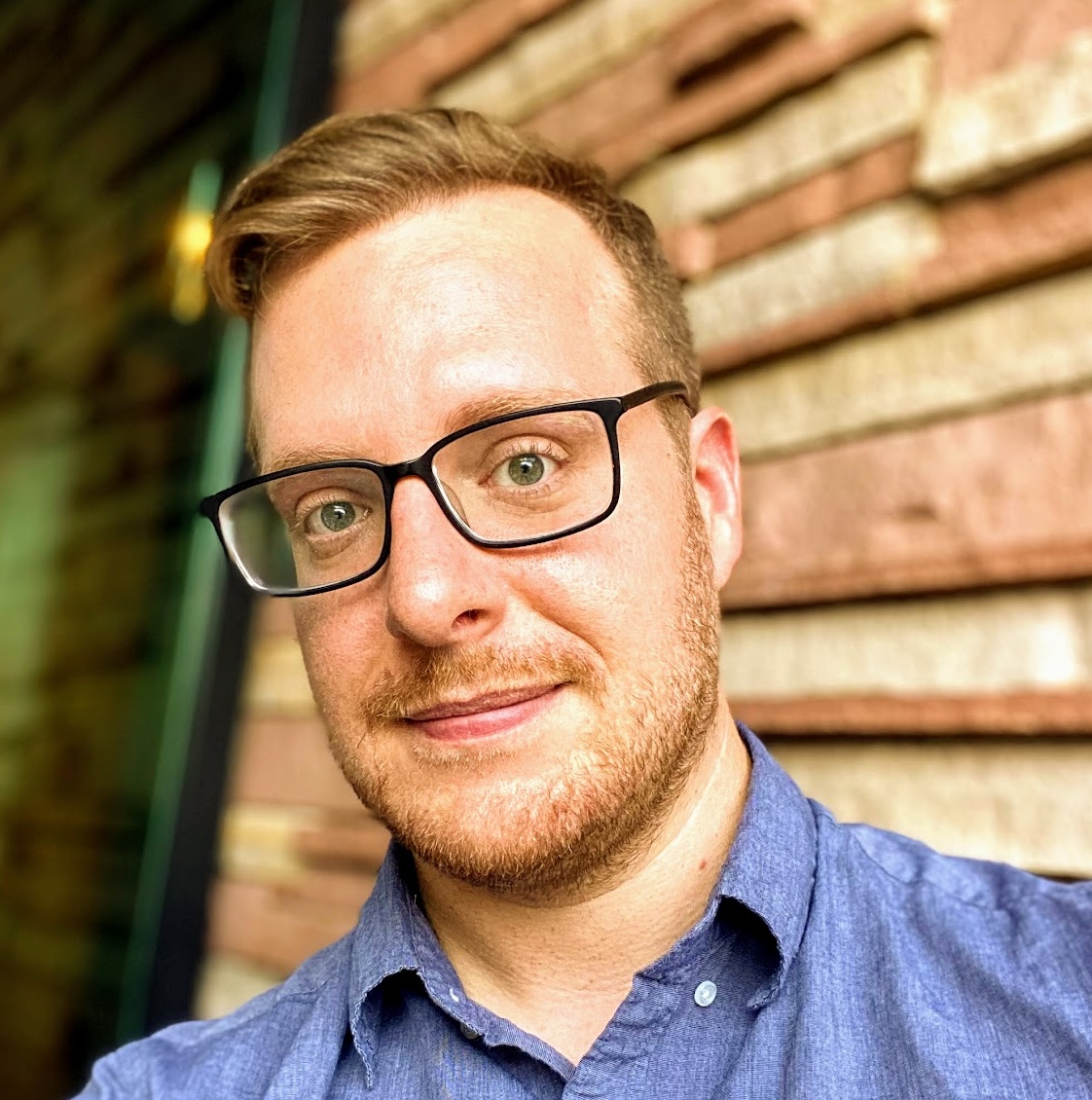
Brad Hayes is an Associate Professor of Computer Science at the University of Colorado Boulder within the College of Engineering and Applied Science, where he directs the Collaborative AI and Robotics (CAIRO) Laboratory. He also serves as Chief Technology Officer at Circadence, leading efforts in developing AI-enabled products for cybersecurity training and assessment. Undergraduate degree from Boston College PhD in Computer Science from Yale University Postdoctoral Associate at MIT Professor Hayes' research focuses on developing techniques that enable autonomous agents and robots to learn from and collaborate with humans safely, reliably, and productively. His work occurs at the intersection of pervasive and personalized artificial intelligence, human-robot teaming, and decision support. He has made significant contributions to collaborative robotics, dependable explainable AI, and imitation learning, with applications spanning manufacturing, healthcare, disaster response, autonomous vehicles, and space exploration. His recent publications reveal a strong emphasis on human-robot interaction, with particular focus on improving predictability in collaborative tasks, developing explainable AI systems that build trust, leveraging augmented and virtual reality for enhanced collaboration, and creating more efficient learning algorithms from human demonstrations. His work increasingly integrates large language models and advanced neural network architectures while maintaining a strong human-centered design approach. Sustainability Recognition (2025) for computational efficiency in motion planning Best Student Paper Runner-up at AAMAS 2022 Nominated for Best Technical Paper at HRI 2024 Best Technical Paper Runner-up at HRI 2019 Hayes has successfully mentored numerous graduate students through the CAIRO Lab, including multiple PhD graduates in 2024 alone. His lab receives funding from various organizations supporting research in human-robot interaction and collaborative AI. He frequently collaborates with industry partners and has established connections with major technology companies through his research and speaking engagements. The CAIRO Lab, under Hayes' direction, is a vibrant research environment focused on turning theoretical concepts into practical applications through hands-on work with real robots and human participants. The lab's research spans multiple domains including manufacturing, disaster response, autonomous vehicles, and space exploration, with a consistent emphasis on safe and effective human-machine teaming.
Maurice Smith serves as the Gordon McKay Professor of Bioengineering at Harvard University's School of Engineering and Applied Sciences (SEAS), where he leads the Neuromotor Control Lab. His primary appointment resides within the Department of Bioengineering, focusing on the computational and neural mechanisms underlying human movement control. Smith's research centers on sensorimotor learning , motor adaptation , and neuromotor control systems . He investigates how the brain forms and retains motor memories, particularly examining cerebellar contributions to long-term sensorimotor memory and the dissociation between implicit and explicit learning pathways. His work frequently employs computational modeling to dissect neural tuning properties and motor variability regulation. Analysis of his recent publications reveals a strong emphasis on temporal dynamics in motor learning , cerebellar function in memory consolidation , and Bayesian frameworks for understanding sensorimotor adaptation . His research demonstrates consistent focus on how error processing, uncertainty, and neural plasticity shape motor memory formation across multiple timescales. Smith maintains active collaborations with researchers including Wilsaan M. Joiner, Yohsuke R. Miyamoto, and Nathan Sandholtz, as evidenced by frequent co-authorship patterns. His laboratory investigates fundamental questions in motor control with implications for neurorehabilitation and adaptive robotics.
Max Planck Institute for Evolutionary AnthropologyGermany
Mahsa Ghasemi is an Assistant Professor in the Elmore Family School of Electrical and Computer Engineering at Purdue University, leading the AKADEMI Group. Her research focuses on theoretical advancements in trustworthy sequential decision-making for autonomous systems, emphasizing human-aware collaboration and adaptation to dynamic environments. She is affiliated with the Institute for Control, Optimization and Networks (ICON). Education: PhD in Electrical and Computer Engineering from The University of Texas at Austin (2021), MSE in Mechanical Engineering (2017), and BSc in Mechanical Engineering from Sharif University of Technology (2014). Research Interests: Reinforcement learning, control theory, active perception, multi-agent systems, robotics, and online learning. Applications span disaster response, healthcare, and autonomous systems design. Key methodological directions include compositional learning, human-AI collaboration, and adaptive decision-making under uncertainty. Teaching: Courses include Reinforcement Learning Theory (ECE 59500), Introduction to Reinforcement Learning (ECE 49595), and Python for Data Science (ECE 20875). Awards: Finalist for Student Best Paper Award at the 2018 American Control Conference (ACC). Students: Current advisees include Maheed H. Ahmed, Jayanth Bhargav, and Somtochukwu Oguchienti. Past members include Lai Wei and Juan Sebastian Mateo Ruiz Bulla. Service: Editorial roles at ICRA, ICCPS, and IFAC workshops. Reviewer for top conferences (NeurIPS, ICML) and journals (Automatica, IEEE TAC). Labs/Teams: Leads the AKADEMI Group, focusing on algorithmic and theoretical research in autonomous decision-making systems.
Professor Sara Bernardini is a leading academic in Artificial Intelligence at the University of Oxford's Department of Computer Science, where she holds a joint appointment as a Tutorial Fellow at Mansfield College. Her research specializes in decision-making for autonomous systems, automated planning, and robotics, with applications in extreme environments like space missions, nuclear decommissioning, and offshore energy. She bridges theoretical AI with real-world challenges through projects funded by Innovate UK, EPSRC, NERC, and the Alan Turing Institute. Her research interests span: Autonomous Systems : Developing agents that support humans in complex cognitive tasks. Automated Planning : Algorithms for goal recognition, pathfinding, and multi-agent coordination. Robotics : Solutions for subterranean exploration, offshore wind farms, and UAV operations. AI Safety : Risk-aware autonomous systems and interpretable decision-making. Bernardini's publications emphasize algorithmic robustness in path planning, multi-agent coordination , and real-world AI deployments . Recent work explores goal legibility in uncertain environments, energy-efficient robotics, and AI education tools. Her 65+ papers in top venues (e.g., AIJ, JAIR, ICAPS) show a trend toward safety-critical applications and human-AI collaboration. Awards & Leadership: ICAPS-2020 Best Paper Honorable Mention Executive Council Member, Association for the Advancement of Artificial Intelligence (AAAI) Program Chair, International Conference on Automated Planning and Scheduling (ICAPS 2024) Associate Editor, Artificial Intelligence Journal She leads interdisciplinary teams for projects like autonomous offshore wind farm maintenance and modular robots for extreme environments. As Principal Scientist at the UK National Oceanography Centre, she advanced marine robotics. She mentors PhD candidates and collaborates globally (e.g., NASA Ames, MIT).
Naratip Santitissadeekorn is a Senior Lecturer in Data Assimilation at the School of Mathematics and Physics, University of Surrey, where he is affiliated with the Mathematics at the Interface Group. His work bridges mathematics, data science, and real-world applications in urban planning, crime analysis, and geophysical fluid dynamics. Dr. Santitissadeekorn received his PhD from Clarkson University in 2008, with a dissertation titled "Transport Analysis and Motion Estimation of Dynamical Systems of Time-Series data." His doctoral research was supervised by Professor Erik Bollt. Following his PhD, he completed two significant postdoctoral positions: from 2008-2011 at the University of New South Wales, Sydney, Australia, working with Professor Gary Froyland on numerical techniques for finite-time Lagrangian coherent set identification, with applications to delimiting the polar vortex and Agulhas rings; and from 2011-2014 at the University of North Carolina-Chapel Hill, working with Professor Chris Jones on data assimilation projects. Dr. Santitissadeekorn's research focuses on inverse problems and data assimilation in geophysical fluid dynamics, the applications of Lagrangian Coherent Structures (LCS), and computational ergodic theory. His work combines theoretical mathematics with practical applications, particularly in urban growth modeling and crime analysis. He has developed innovative methods for identifying coherent structures in fluid flows, estimating transition probabilities from spatiotemporal data, and creating data-driven frameworks for urban expansion scenarios. His research demonstrates how mathematical techniques can be applied to solve real-world problems in environmental science, urban planning, and public safety. An analysis of Dr. Santitissadeekorn's recent publications (2020-2023) reveals a strong focus on urban expansion modeling and network analysis. His work on urban growth has evolved from basic cellular automata models to sophisticated frameworks that manage uncertainty through parameter clustering and growth mode identification. His research on Hawkes processes has advanced ensemble-based filtering techniques for analyzing count data in large networks. These publications demonstrate a consistent pattern of applying mathematical rigor to complex spatiotemporal phenomena, with increasing emphasis on data-driven approaches and practical applications. Dr. Santitissadeekorn has made significant contributions to data assimilation methods, particularly through the development of the extended Poisson-Kalman filter (ExPKF) for urban crime modeling. His teaching includes courses in Algebra and Bayesian Statistics, reflecting his expertise in both theoretical and applied mathematics. While specific awards are not mentioned in the available information, his extensive publication record in high-impact journals demonstrates recognition within his field. Dr. Santitissadeekorn's research has practical implications for urban planning and law enforcement. His work on urban expansion models helps planners understand different growth trajectories, while his crime modeling research contributes to improved police patrolling strategies. His interdisciplinary approach, combining mathematics, computer science, and domain-specific knowledge, positions him at the forefront of applying data science to societal challenges.
Erin Comartin is a Professor at Wayne State University School of Social Work, where she has served on faculty since 2016 after transitioning from Oakland University. Her scholarship critically examines social welfare policies and interventions for vulnerable populations within the criminal legal system, with particular emphasis on behavioral health needs and systemic reform initiatives. Her educational foundation includes: Ph.D. in Social Work from Wayne State University MSW from Wayne State University Post-Graduate Diploma of Arts in Community & Family Studies from University of Otago, New Zealand BA in Sociology from Oakland University Comartin's research program integrates clinical expertise from her prior work with homeless youth and domestic violence survivors to address critical gaps in justice-involved behavioral health services. She specializes in sex offender management policies, jail diversion interventions, and Behavioral Threat Assessment teams designed to prevent mass violence. Her methodological expertise spans qualitative, quantitative, and mixed-methods program evaluation with strong community engagement components. Analysis of her 15 most recent publications (2023-2025) reveals intensified focus on suicide prevention in correctional settings, overdose response systems, and law enforcement behavioral health training efficacy. Her work increasingly employs journey mapping and multi-site trial designs to evaluate systemic interventions across rural-urban divides, reflecting evolving priorities in criminal legal health services research. As principal investigator for Center for Behavioral Health and Justice initiatives, Comartin leads community-engaged projects including veteran reentry evaluations and Sequential Intercept Model implementation assessments. Her teaching portfolio encompasses advanced policy analysis, macro practice theory, and program evaluation within Wayne State's social work curriculum.
Professor Dietrich Darr is a faculty member at Hochschule Weihenstephan-Triesdorf (HSWT), specifically within the Department of Agriculture, Food, and Nutrition. His academic journey includes previous professorship at Hochschule Rhein-Waal (2012-2024) and visiting positions at Universidade de Brasília (2023-2024), Vietnam National University of Forestry (2020), and ICRAF Central Asia office (2018). Dr. Darr's research focuses on sustainable and resilient farming and food systems with particular expertise in agribusiness, corporate management, and sustainable resource utilization. His work prominently features baobab tree applications in African and European food industries, agroforestry systems, non-timber forest products, and sustainable land management. His international research projects span Sub-Saharan Africa, Central Asia, and Southeast Asia. His recent publications reveal strong trends in sustainable value chain development, climate-smart agriculture, and innovative approaches to rural livelihood improvement. The articles demonstrate consistent focus on practical applications of agroforestry systems, analysis of non-timber forest products commercialization, and sustainable land management solutions for smallholder farmers in developing regions. Dr. Darr leads numerous research projects including SUFACHAIN (2022-2025) on sustainable agroforestry value chains in Central Asia, CONFARMED (2024) on edible insects for circular food economy in Uganda, and previously led BAOQUALITY (2019-2022) on baobab quality improvement for food security in Africa. His projects are primarily funded by German institutions including BMBF, BMEL, and DFG. As an active member of professional organizations including ATSAF, EFARD, IUFRO, DeFAF, and EURAF, Dr. Darr contributes to international agricultural research communities with focus on tropical and subtropical agriculture, agroforestry, and forest research.
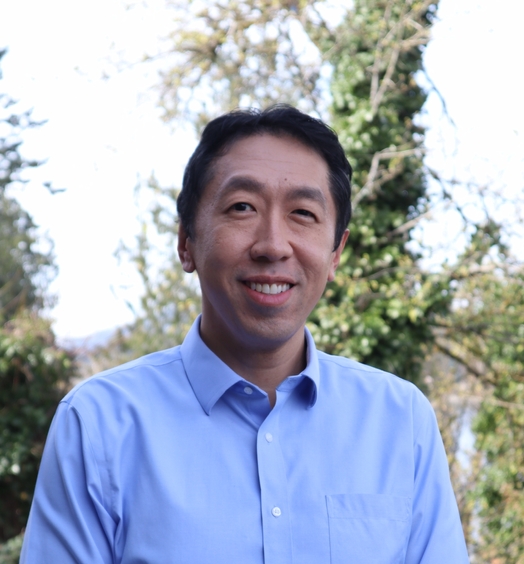
Andrew Ng is an Adjunct Professor at Stanford University's Computer Science Department and a globally recognized leader in AI. He is the Founder of DeepLearning.AI, Executive Chairman of LandingAI, General Partner at AI Fund, and Co-Founder of Coursera. His work has revolutionized machine learning and online education, with over 200 research papers in AI, robotics, and related fields. He was named to the 2023 Time100 AI list of most influential figures in AI. Ng's research focuses on machine learning, deep learning, reinforcement learning, and their applications in robotics and education. He pioneered the development of massive open online courses (MOOCs), notably through Stanford's early experiments in 2011 that attracted hundreds of thousands of learners. His contributions include foundational work in algorithms like Latent Dirichlet Allocation (LDA) for text analysis and advancements in spectral clustering and inverse reinforcement learning. His publications span topics from robotic hand design to scalable deep learning systems, emphasizing practical and scalable solutions. Ng's educational initiatives, such as the Machine Learning and Deep Learning Specializations, have educated millions worldwide. He advocates for accessible AI education and ethical AI development, emphasizing collaboration between academia and industry.
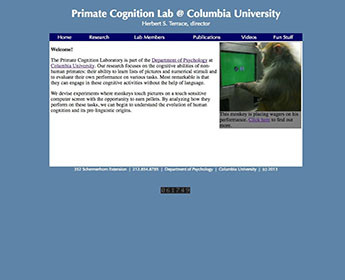
Herbert Terrace is a Professor of Psychology at Columbia University, where he directs the Primate Cognition Lab within the Department of Psychology in the Faculty of Arts and Sciences. His research focuses on animal cognition, particularly primate cognition and the evolution of language. Dr. Terrace received his Ph.D. from Harvard University in 1961. His academic journey has been dedicated to understanding cognitive processes that do not require language, with a particular focus on rhesus monkeys' ability to learn serial tasks, numerical sequences, and social learning paradigms. His research interests span across animal cognition, cognitive psychology, primate cognition, and the evolution of language. Dr. Terrace has made significant contributions to understanding how non-human primates process numerical information, learn through observation, and develop cognitive skills that may represent precursors to human language. His work on the evolution of intelligence examines cognitive processes that can be performed without language, providing insights into what language adds to those fundamental cognitive abilities. Notably, he has written extensively on the evolution of language, particularly in his 2019 book "Why Chimpanzees Can't Learn Language and Only Humans Can," where he argues that separating the evolution of language into the origin of words and the origins of grammar makes an intractable problem more manageable. Dr. Terrace has taught courses including Evolution of Intelligence and Consciousness, Evolution of Cognition, and Evolution of Language at Columbia University. His laboratory, the Primate Cognition Lab, devises experiments where monkeys interact with touch-sensitive computer screens to earn food rewards, allowing researchers to analyze their cognitive performance and understand the pre-linguistic origins of human cognition. Among his notable scientific contributions are the development of the simultaneous chaining methodology for studying serial learning in animals, groundbreaking work on numerical cognition in non-human primates, and research on cognitive imitation that has implications for understanding autism spectrum disorders. His research has been published in top journals including Science, Nature, and Psychological Science. Dr. Terrace has mentored numerous researchers in the field of comparative cognition and has directed the Primate Cognition Lab at Columbia University for many years. His work continues to influence our understanding of the cognitive capabilities of non-human primates and their relevance to human cognitive evolution.
Massachusetts Institute of TechnologyUnited States
Bradley Hayes is an Associate Professor of Computer Science and Director of the Collaborative AI and Robotics (CAIRO) Laboratory at the University of Colorado Boulder. His work focuses on enabling autonomous agents and robots to collaborate safely and effectively with humans through techniques in human-robot interaction, explainable AI, and learning from demonstration. PhD in Computer Science, Yale University (2015) Postdoctoral Associate, MIT Interactive Robotics Group Research interests span collaborative robotics, dependable AI systems, and imitation learning for human-robot teaming, with applications in manufacturing, healthcare, and autonomous vehicles. His lab develops methods for task planning, motion prediction, and trust calibration in human-machine partnerships. Recent publications emphasize explainable sequential decision-making, neuromorphic learning architectures, and augmented reality interfaces for robotic training. Awards include Sustainability Recognition (2025) for motion planning efficiency Best Student Paper Runner-up (AAMAS 2022) Best Technical Paper Runner-up (HRI 2019) As lab director, he has mentored 12 PhD/Master students to completion, including Matthew Luebbers, Aaquib Tabrez, and Christine Chang. Funding sources include NSF grants and industry partnerships like Circadence, where he serves as Chief Technology Officer.
Denny Yu is an Associate Professor at the Edwardson School of Industrial Engineering, Purdue University. His work bridges human factors, neuroergonomics, and healthcare safety through advanced sensor systems and AI. Primary Affiliation : Edwardson School of Industrial Engineering, Purdue University Research Themes : Surgical ergonomics, autonomous vehicle human factors, cognitive workload assessment, multimodal physiological sensing Dr. Yu's research focuses on neuroergonomics and human-robot interaction , particularly in surgical and transportation contexts. His team develops sensor-based systems for workload monitoring, including: EEG-eye tracking fusion for situation awareness Wearable exoskeletons for surgical posture support Computer vision tools for lifting task risk analysis Smart infusion pump usability frameworks AI-driven surgical coaching systems Recent publications emphasize deep learning applications in soft tissue deformation estimation and real-time adaptive systems for robotic surgery augmentation. His work spans both occupational health (veterinary surgeons, airport workers) and medical device innovation domains.
Marc Toussaint is Full Professor leading the Learning & Intelligent Systems Lab at TU Berlin's EECS Faculty. His research integrates machine learning, optimization, and AI reasoning to solve fundamental robotics problems like physical reasoning and human-robot interaction. He holds a physics diploma from University of Cologne and PhD from Ruhr-Universität Bochum. Key research themes include: Task-motion planning integration Reinforcement learning for robotics Physical simulation and control Probabilistic inference methods Recent publications focus on efficient kinodynamic planning, belief space planning under uncertainty, and neural policy learning. He develops open-source robotic tools like the 'robotic python package' used in academic courses worldwide. Toussaint collaborates with Amazon Robotics and MIT CSAIL, and has held positions at Max Planck Institute and University of Stuttgart.
Joseph Galea is Professor of Motor Neuroscience and Head of Research at the School of Psychology, University of Birmingham (UK). He holds a PhD and BSc from the University of Birmingham. His research integrates behavioral experiments, brain imaging (fMRI), non-invasive brain stimulation (TMS, tDCS), and computational modeling to investigate motor control, learning mechanisms, and rehabilitation in both healthy individuals and neurological patients (e.g., Parkinson's disease, dystonia). Research interests focus on: Reward-based motor learning and decision-making Sequential action planning and execution Neurophysiological mechanisms of motor control Dopaminergic modulation of movement Sensorimotor integration in virtual environments Clinical applications for stroke and movement disorders His publications demonstrate consistent focus on reward/punishment effects on motor behavior, cerebellar-basal ganglia interactions, and neuroplasticity. Recent work explores pharmacological interventions, VR technology validation, and cortical excitability dynamics during learning. Scientific Awards: Early-career award (British Association of Cognitive Neuroscience, 2018) Elected member of Young Academy of Europe (2016) Klein-Vogelbach Prize for human movement research (2012) Leads a productive research group with multiple postdoctoral fellows and PhD students. Secured major grants including ERC Starting Grant, MRC, BBSRC, and ERC Proof-of-Concept funding. Current projects involve developing hand-based rehabilitation robotics and investigating reward mechanisms in motor disorders.