Prof. Hans Peters is Professor Emeritus of Mathematical Economics at Maastricht University's School of Business and Economics, and Honorar Professor at Rheinisch-Westfälische Technische Hochschule (RWTH) Aachen. His primary research focuses on game theory and social choice theory, with notable contributions to mechanism design, cooperative game theory, and axiomatic analysis. He served as President of the Society for Social Choice and Welfare (SSCW) from 2018-2020, and holds fellowships from the Society for the Advancement of Economic Theory (SAET) and the Game Theory Society (GTS). He is an advisory editor for Social Choice and Welfare , Games and Economic Behavior , and Mathematical Social Sciences , and leads the Springer Theory and Decision Library Series C . His recent work explores division problems with single-dipped preferences, core games, and strategic-proof rules in multidimensional domains. Key contributions include foundational studies on nucleolus computation, network power indices, and sequential claim mechanisms. His research bridges theoretical economics with practical applications in operations research and social choice, emphasizing axiomatic rigor and real-world relevance.
Daniel Roy is a Full Professor at the University of Toronto, holding cross-appointments in the Department of Statistical Sciences, Computer Science, Electrical and Computer Engineering, and the Department of Computer and Mathematical Sciences at UTSC. He is also a Canada CIFAR AI Chair and Research Director at the Vector Institute, reflecting his leadership in AI and machine learning research. His educational background includes a PhD, MEng, and BSc in Computer Science from MIT, where his doctoral work earned the MIT EECS Sprowls Award. Prior to joining Toronto, he was a Newton International Fellow at the Royal Society and a Research Fellow at Emmanuel College, University of Cambridge. His research centers on foundational principles in machine learning, statistics, and probabilistic reasoning. Key interests include statistical learning theory, Bayesian nonparametrics, probabilistic programming, and information-theoretic generalization. His work bridges theoretical computer science, mathematical logic, and applied probability. His recent publications, appearing in ICML, NeurIPS, COLT, and JMLR, reflect a strong focus on theoretical advances in generalization, online learning, and stochastic optimization. Themes include minimax rates, conditional mutual information, and the role of data in PAC-Bayes bounds. His group has made foundational contributions to probabilistic programming, including work on Church and the computability of conditional probability. NSERC Discovery Accelerator Supplement Ontario Early Researcher Award Google Faculty Research Award Newton International Fellowship MIT EECS Sprowls Award Daniel Roy advises numerous PhD students and postdoctoral researchers, many of whom have gone on to prestigious positions in academia and industry. His group actively collaborates with leading researchers in machine learning and statistics. He is also an Action Editor for the Journal of Machine Learning Research and Transactions of Machine Learning Research, underscoring his role in shaping the field. He leads a vibrant research group focused on theoretical machine learning and probabilistic modeling, and maintains active collaborations with institutions such as MIT, Cambridge, and the Vector Institute. He is also the founder and maintainer of the probabilistic-programming.org wiki, a key resource in the community.
Claire Vernade is a Group Leader at the University of Tübingen in the Cluster of Excellence Machine Learning for Science. She leads an active research group focused on theoretical aspects of sequential decision making, with particular expertise in bandit problems and reinforcement learning theory. Her work bridges theoretical foundations with practical applications in scientific discovery. Her research interests span sequential decision making, bandit problems, theoretical Reinforcement Learning, Learning Theory, and principled learning algorithms. She has made significant contributions to understanding non-stationary environments, lifelong learning frameworks, and the theoretical foundations of bandit algorithms. Her work on "Eigengame: PCA as a Nash Equilibrium" received an Outstanding Paper Award at ICLR 2021. Dr. Vernade has been awarded prestigious grants including an Emmy Noether award (2022) for her FoLiReL project and an ERC Starting Grant (2024) for her ConSequentIAL project. Her current ERC project explores the role of Reinforcement Learning in developing Continual Learning agents, with applications to scientific domains like drug discovery and micro-chemistry. Emmy Noether award under the AI Initiative call (2022) ERC Starting Grant (2024) Outstanding Paper Award at ICLR 2021 She currently supervises three PhD students and actively recruits postdocs and PhD candidates through the IMPRS-IS and ELLIS doctoral programs. Her group collaborates extensively with the broader machine learning community, organizing workshops like FoRLaC at ICML 2024 and serving as co-chairs for tutorials at major conferences. Dr. Vernade is also deeply committed to diversity and inclusion in machine learning, co-leading initiatives like Women in Learning Theory and Tübingen Women in Machine Learning.
Sylvain Lombardy is a Professor at the University of Bordeaux, affiliated with the Laboratoire Bordelais de Recherche en Informatique (LaBRI) and the Enseirb-Matmeca engineering school within the Institut Polytechnique de Bordeaux. His research focuses on automata theory, formal languages, and theoretical computer science, particularly in weighted automata, formal methods, and algebraic properties of automata. He leads the Formal Methods research team at LaBRI and contributes to projects like the Awali and Vaucanson software platforms for automata manipulation. Education: PhD in Computer Science (2001, ENST Paris), Habilitation à Diriger des Recherches (2005, University of Paris Diderot). His work bridges theoretical foundations with practical tools, emphasizing algorithmic and algebraic aspects of automata. Notable contributions include studies on automata minimization, determinization, and the interplay between rational expressions and automata constructions. Research Interests: Automata Theory, Formal Power Series, Weighted Automata, Tropical Semirings, Algebraic Automata Theory, and Computational Models for Discrete Systems. His recent work explores two-way automata, Hadamard series, and applications in formal verification. Publications highlight contributions to the structure and properties of automata, with a focus on formal methods and algorithmic decidability. Key works address unambiguity, determinism, and the minimization of weighted automata across various semirings. Collaborations include projects on automata-based kernels for machine learning and XML formats for automata descriptions. He has developed influential software tools such as Awali (finite-state machine platform) and Vaucanson (automata manipulation framework), demonstrating practical applications of theoretical research. His work is supported by grants exploring automata in computational linguistics and discrete mathematics.
Christophe Andrieu is a Professor in Statistics within the School of Mathematics at the University of Bristol. His research bridges theoretical probability, computational statistics, and applied mathematics, with significant contributions to Markov Chain Monte Carlo methodologies and Bayesian inference frameworks. He maintains active collaborations across engineering and data science domains. His educational background includes: M.A. from List.Natnl.Scis.App.Lyon Additional M.A. (institution unspecified) Ph.D. from Paris Andrieu's research focuses on Markov Chain Monte Carlo theory , where he develops convergence guarantees and efficiency bounds for complex samplers. His work extends to non-reversible MCMC algorithms , piecewise deterministic processes , and gradient-free optimization techniques. Recent publications demonstrate innovative approaches to state-space models and numerical integration, often addressing high-dimensional statistical challenges through stochastic approximation methods. His fingerprint reveals deep specialization in Markov chain convergence analysis and computational Bayesian statistics. His 15 most recent publications (2021-2025) exhibit consistent focus on theoretical foundations of Monte Carlo methods, particularly convergence analysis of Markov chains and novel sampler designs. Key trends include the application of weak Poincaré inequalities to pseudo-marginal MCMC, development of self-organizing state-space models, and exploration of hypocoercivity in piecewise deterministic processes. The work spans both theoretical advancements and practical implementations for engineering and statistical applications. Andrieu has secured significant research funding including: COmputational Statistical INference for Engineering and Security (COSINES) (2018-2023) New Approaches to Data Science (2018-2023) He has supervised 5 research students and maintains active collaborations in computational statistics and machine learning. His network shows strong connections with probability theory and engineering research groups.
Steven Brams is a Professor of Politics at New York University's Department of Politics within the College of Arts & Science. His research focuses on game theory, social choice theory, fair division, voting systems, and international politics. He holds a B.S. from MIT (1962) and a Ph.D. from Northwestern University (1966). Brams' work emphasizes fair allocation mechanisms, including envy-free division algorithms, voting system reforms, and rule design in sports and conflict resolution. He has collaborated extensively with researchers like D. Marc Kilgour and Mehmet S. Ismail on topics such as fair shootouts in soccer, equitable chess openings, and gerrymandering solutions. Education: B.S., Massachusetts Institute of Technology, 1962 Ph.D., Northwestern University, 1966 His research explores how game-theoretic models can address real-world problems, such as improving voting systems, resolving disputes, and enhancing fairness in sports. Notable contributions include the 'Catch-Up' rule for service sports and the 'Excess Method' for multiwinner approval voting. Awards: American Association for the Advancement of Science Fellow (1992) Guggenheim Fellow (1986–1987) Russell Sage Foundation Visiting Scholar (1998–1999) Elinor Ostrom Prize (2013) Brams has advised on electoral reforms and contributed to policy discussions on fair division in international conflicts, such as the Spratly Islands dispute. His interdisciplinary work bridges mathematics, political science, and philosophy, addressing both theoretical and applied challenges in decision-making.
Patrick Jaillet is the Dugald C. Jackson Professor in the Department of Electrical Engineering and Computer Science at MIT's School of Engineering. He holds joint appointments with the Laboratory for Information and Decision Systems (LIDS), the Operations Research Center (ORC), the Operations Research and Statistics Group at MIT Sloan, and the Department of Civil and Environmental Engineering. Previously, he served as Head of Civil and Environmental Engineering at MIT (2002-2009) and Chair of the Department of Management Science and Information Systems at UT Austin (1997-2002). Dr. Jaillet's research focuses on online optimization and learning, sequential decision-making under uncertainty, and security and resilience in complex networks. His work spans theoretical foundations in optimization and machine learning with applications in transportation, online market analytics, and network security. He has developed mathematical frameworks for problems involving uncertainty, dynamic resource allocation, and strategic behavior in complex systems. His recent publications reveal strong trends in bridging theoretical optimization with practical machine learning applications. Key themes include Bayesian optimization for black-box functions, online learning with limited information, mechanism design for resource allocation, and network security applications. His work increasingly integrates large language models with traditional optimization techniques, reflecting the evolving landscape of AI-driven decision-making systems. Fulbright Scholar (1990) Fellow of the Institute for Operations Research and Management Science (INFORMS) Best Applications Paper Award at ICAPS 2019 Long-standing Associate Editor for top journals including Operations Research and Transportation Science Dr. Jaillet has advised over 40 doctoral students who now hold prominent positions in academia and industry, including faculty positions at MIT, Georgia Tech, and ETH Zurich, and research scientist roles at Amazon, Microsoft Research, and Google. His research has been consistently funded by major agencies including NSF, ONR, AFOSR, and international partners like Singapore NRF, with current projects focusing on learning algorithms for autonomous security and fundamental tradeoffs in optimization. He leads a vibrant research group spanning MIT's EECS department and ORC, with current funding supporting work on neural bandits, federated optimization, and network security applications. His research group operates at the intersection of theory and practice, with strong connections to industry through collaborations with IBM, Microsoft, Google, and various transportation and technology companies. The group maintains active partnerships with international institutions, particularly through SMART in Singapore, reflecting Dr. Jaillet's global research impact.
David Castañón is a Professor of Electrical and Computer Engineering (ECE) and Systems Engineering (SE) at Boston University. He holds a PhD from MIT (1976) and has held leadership roles including Department Chair of BU ECE (2010-2014) and President of the IEEE Control Systems Society (2008). His research focuses on stochastic control, optimization, game theory, and distributed computing, with applications in sensor management, inverse problems, and autonomous systems. Education: PhD, Massachusetts Institute of Technology (1976). Key affiliations include the Center for Information and Systems Engineering, the Rafik B. Hariri Institute for Computing, and the ALERT Department of Homeland Security Center of Excellence. He teaches courses such as EC702 Recursive Estimation and EC719 Statistical Learning Theory. Research interests span stochastic control, estimation theory, optimization algorithms, and multi-agent systems. Notable contributions include work on sensor management, cooperative operations, and inverse problem solutions for medical and security imaging. His work often integrates theoretical frameworks with practical applications in autonomous systems and distributed computing. Scientific achievements include IEEE Fellow status (2006), CSS Distinguished Member Award, and leadership roles in major conferences like the IEEE Conference on Decision and Control (2007 as General Chair). He has also served on the Air Force Advisory Board and the IEEE Society Review Committee. Grants and lab affiliations include the NSF Engineering Research Center for Subsurface Sensing (2001-2013) and the SENTRY DHS Center of Excellence (2021-present). His interdisciplinary collaborations bridge robotics, medical imaging, and security systems.
Tim Baldenius serves as the Paul M. Montrone Professor of Private Enterprise in the Accounting Division of Columbia Business School at Columbia University. He rejoined Columbia in 2017 after serving as Chair of NYU Stern's Accounting Department (2011-2016), and previously held faculty positions at Columbia Business School (1998-2011) where he chaired the Accounting Division (2009-2011). His teaching portfolio includes MBA courses in Financial Planning & Analysis, PhD seminars on managerial accounting, and executive education programs. His academic credentials include a Diploma in Business Administration from the University of Hamburg and a PhD in Accounting from the University of Vienna. Baldenius maintains editorial leadership as Associate Editor of Management Science and serves on the editorial boards of The Accounting Review , Review of Accounting Studies , and Review of Managerial Sciences . Professor Baldenius's research centers on managerial accounting systems, performance measurement frameworks, and corporate governance structures. His work examines how accounting information drives organizational decision-making, incentive design, and resource allocation. Key themes include transfer pricing mechanisms, cost allocation methodologies, and the interplay between managerial and tax objectives within multidivisional firms. His theoretical models often integrate contract theory with organizational economics to address real-world coordination challenges. His publication record spans top-tier journals in accounting, finance, and economics, revealing consistent focus on performance measurement systems (35%), transfer pricing (25%), corporate governance (20%), and incentive design (20%). The research demonstrates strong methodological diversity, employing game theory (40%), mathematical modeling (30%), and empirical analysis (30%) to investigate organizational decision processes. Baldenius has held significant leadership roles including Accounting Division Chair at Columbia (2009-2011) and Accounting Department Chair at NYU Stern (2011-2016). His teaching spans MBA, MS, PhD, and executive education programs with courses covering Financial Planning & Analysis, Accounting for Consultants, and Analytical Models in Accounting. His case studies on Sub-Micron Devices Inc. and Beanie Kids Holiday Camp are widely used in accounting pedagogy.
David P. Helmbold is a Professor in the Computer Science Department at the University of California, Santa Cruz. He received his PhD in Computer Science from Stanford University in 1987, where he specialized in parallel algorithms and debugging of parallel programs. He has been a faculty member at UC Santa Cruz for over 25 years. Research Focus Helmbold's research centers on theoretical machine learning and computational learning theory. His primary interests include: Boosting methods and ensemble learning Online learning algorithms and regret minimization Theoretical foundations of semi-supervised learning Applications in computer vision, game AI, and power optimization Analysis of irrelevant variables in learning systems Publication Trends Helmbold's recent work (2009-2012) focuses on advancing theoretical machine learning, particularly in semi-supervised learning, Monte Carlo methods for game AI, and feature relevance analysis. His publications demonstrate a consistent bridge between theoretical frameworks and practical applications, spanning computer vision, geospatial analysis, and algorithmic game theory. Professional Recognition Helmbold is a long-standing member of the computational learning theory community, having hosted the COLT conference and served on its steering committee. No specific awards are mentioned in the source material.
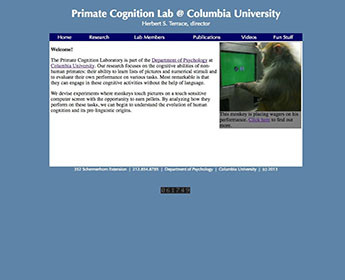
Herbert Terrace is a Professor of Psychology at Columbia University, where he directs the Primate Cognition Lab within the Department of Psychology in the Faculty of Arts and Sciences. His research focuses on animal cognition, particularly primate cognition and the evolution of language. Dr. Terrace received his Ph.D. from Harvard University in 1961. His academic journey has been dedicated to understanding cognitive processes that do not require language, with a particular focus on rhesus monkeys' ability to learn serial tasks, numerical sequences, and social learning paradigms. His research interests span across animal cognition, cognitive psychology, primate cognition, and the evolution of language. Dr. Terrace has made significant contributions to understanding how non-human primates process numerical information, learn through observation, and develop cognitive skills that may represent precursors to human language. His work on the evolution of intelligence examines cognitive processes that can be performed without language, providing insights into what language adds to those fundamental cognitive abilities. Notably, he has written extensively on the evolution of language, particularly in his 2019 book "Why Chimpanzees Can't Learn Language and Only Humans Can," where he argues that separating the evolution of language into the origin of words and the origins of grammar makes an intractable problem more manageable. Dr. Terrace has taught courses including Evolution of Intelligence and Consciousness, Evolution of Cognition, and Evolution of Language at Columbia University. His laboratory, the Primate Cognition Lab, devises experiments where monkeys interact with touch-sensitive computer screens to earn food rewards, allowing researchers to analyze their cognitive performance and understand the pre-linguistic origins of human cognition. Among his notable scientific contributions are the development of the simultaneous chaining methodology for studying serial learning in animals, groundbreaking work on numerical cognition in non-human primates, and research on cognitive imitation that has implications for understanding autism spectrum disorders. His research has been published in top journals including Science, Nature, and Psychological Science. Dr. Terrace has mentored numerous researchers in the field of comparative cognition and has directed the Primate Cognition Lab at Columbia University for many years. His work continues to influence our understanding of the cognitive capabilities of non-human primates and their relevance to human cognitive evolution.
Elena Katok is the Ashbel Smith Professor of Operations Management at the University of Texas at Dallas, where she serves in the Naveen Jindal School of Management. She is also Co-Director of the Laboratory for Behavioral Operations and Economics (LBOE) and has been a Visiting Scholar at the University of Cologne, Germany (2007-2018). Previously, she held faculty positions at Penn State University, Harvard University, and Colorado School of Mines. Dr. Katok earned her Ph.D. in 1996 and MBA in 1992 from Penn State University, and her B.S. in Business Administration with emphasis on Finance and Economics from the University of California, Berkeley in 1987. Dr. Katok is a pioneer in Behavioral Operations Management (BOM), a field that studies how human behavior factors into managerial decisions. Her research focuses on market design, strategic procurement, auctions, and supply chain management. She has made significant contributions to understanding how behavioral factors influence supply chain coordination, contract design, and procurement auctions. Dr. Katok helped establish the Behavioral Operations Management section of INFORMS and organizes the annual Behavioral Research in Operations Management conference. Her recent publications (2018-2022) show a continued focus on trust mechanisms in procurement, contract design under behavioral considerations, auction theory, and supply chain coordination. Her work often combines theoretical modeling with laboratory experiments, demonstrating how behavioral insights can improve operational decision-making. She has particularly examined fairness considerations in supply chains, trust dynamics in procurement relationships, and the impact of behavioral factors on auction outcomes. Franz Edelman Award for achievement in the practice of OR&MS (2000) As Co-Director of the Laboratory for Behavioral Operations and Economics, Dr. Katok leads research on how human behavior affects operational decisions. She has developed numerous classroom simulations to teach supply chain management concepts and has written several case studies used in business education. Her work bridges academic research and practical application in operations management.
Quan Zhou is an Assistant Professor in the Department of Statistics at Texas A&M University, part of the College of Arts & Sciences. His research focuses on developing advanced sampling methods, particularly Markov chain Monte Carlo (MCMC) algorithms, with applications in Bayesian methodology, variable selection, stochastic optimization, and statistical genetics. He holds a BS from Fudan University and a PhD from Baylor College of Medicine, followed by a postdoctoral fellowship at Rice University. He teaches courses such as Mathematical Probability, Multivariate Analysis, and Advanced Stochastic Processes. Notable contributions include work on informed MCMC samplers, Schrödinger bridge theory, and high-dimensional structure learning. He advises PhD students like Hyunwoong Chang (now at UT Dallas) and Guanxun Li (Beijing Normal University). Active in academic service, he served as President of the Southeastern Texas Chapter of the American Statistical Association (SETCASA).
Noah Gans is the Anheuser-Busch Professor of Management Science at the Wharton School of the University of Pennsylvania, where he serves as Professor in the Operations, Information and Decisions department. His research focuses on service operations with particular emphasis on call center management, stochastic processes, and queueing system control. Department Editor, Stochastic Models and Simulation at Management Science President of Manufacturing and Service Operations Management Society (MSOM) PhD Program Coordinator for the OID Department His academic work spans diverse domains including healthcare technology pricing, container inspection security, workforce optimization, and revenue management. He has pioneered adaptive clinical trial designs and developed novel models for customer demand sensitivity in overbooking scenarios. Key research areas include: Bayesian sequential learning for multi-arm clinical trials Value-based pricing under uncertainty Stochastic control in service systems Security policy analysis for global supply chains Risk-sharing mechanisms in healthcare Scientific honors include NSF CAREER Award (1998), INFORMS George E. Nicholson Prize (1995), and multiple teaching awards from the Wharton MBA program (2004, 2010-2011, 1997-2001). His publications bridge theoretical operations research with practical implementation across healthcare, transportation, and service industries.
Selçuk Karabatı is a Professor of Operations Management at the College of Administrative Sciences and Economics, Koç University (Turkey). His research spans retail operations, sustainable supply chains, and production systems optimization. He holds a PhD from the University of Texas at Austin and has previously taught graduate courses in Service Operations Management , Operations Strategy , and Sustainable Operations Management at Koç University. Education : PhD (University of Texas at Austin), MS (University of Southern California), BS (Boğaziçi University) Editorial Roles : Senior/Associate Editor at Production and Operations Management and IIE Transactions His research focuses on Supply Chain Management , Retail Operations , and Sustainable Operations , with applications in inventory control, pricing strategies, and production planning. Recent and historical publications reveal expertise in optimization frameworks , dynamic pricing , portfolio rebalancing , and retail analytics . While no explicit scientific awards are listed in the provided text, his work has consistently addressed challenges in inventory substitution, auction mechanisms, and logistics coordination.



.jpg)