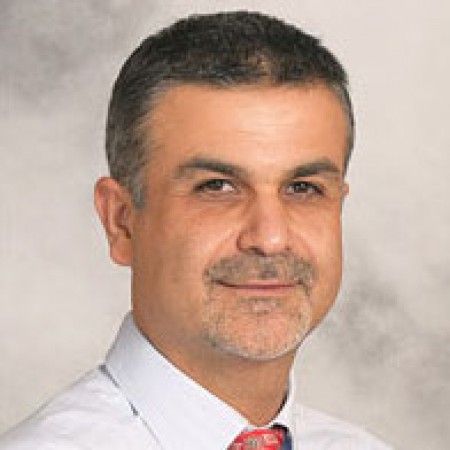
Mark Bocko is a Distinguished Professor of Electrical and Computer Engineering at the University of Rochester, affiliated with the Hajim School of Engineering & Applied Sciences. He holds roles as Director of the Center for Emerging and Innovative Sciences (CEIS) and Director of Audio & Music Engineering. He earned his PhD in Physics from the University of Rochester in 1984, focusing on gravitational wave detectors. His research spans audio signal processing, sensors, superconductivity, and quantum computing. Notable contributions include flat-panel loudspeaker development, non-contact ECG sensors, and quantum coherence studies in Josephson junctions. Research interests include audio and acoustic signal processing, computer audition, and sensor technologies. His work integrates interdisciplinary approaches, combining electrical engineering, physics, and computer science. Awards include the 2012 Goergen Award for Teaching and Mercer Brugler Distinguished Teaching Professor (2008–2011). Recent publications address modal crossover networks for loudspeakers, vibrational touch sensing, and room impulse response modeling. He has advised PhD students on topics like spatial audio rendering and musical vibrato analysis. His labs focus on advancing audio engineering and smart sensor systems through collaborative industry partnerships.
Dr. Shunqiao Sun is an Assistant Professor in the Department of Electrical and Computer Engineering at The University of Alabama, College of Engineering. He joined the faculty in August 2019 as a tenure-track professor after working at Aptiv’s radar core team in Malibu, California. His research focuses on advanced signal processing, machine learning, and optimization for automotive and MIMO radar systems in autonomous vehicles. Ph.D. : Electrical and Computer Engineering, Rutgers University, 2016 M.S. : Electrical Engineering, Fudan University, 2011 B.S. : Electrical Engineering, Southern Yangtze University, 2004 Dr. Sun's research lies at the intersection of statistical and sparse signal processing , mathematical optimization , and machine learning , with applications in automotive radar , MIMO radar , and autonomous driving . His work emphasizes sparsity-oriented frameworks, AI-powered radar perception, and high-resolution 4D sensing. He leads a dynamic research group focused on next-generation radar technologies for intelligent transportation systems. His recent publications demonstrate a strong trend in deep learning for radar signal recovery , collaborative radar imaging , direction-of-arrival estimation with sparse arrays , and integrated sensing and communication . Several of his papers are among the most downloaded and cited in IEEE journals, including top articles in IEEE Signal Processing Magazine and IEEE Journal of Selected Topics in Signal Processing. Scientific Awards and Honors: NSF CAREER Award (2024) NSF CRII Award (2022) IEEE AESS Robert T. Hill Best Dissertation Award (2016) Best Student Paper Award at IEEE SAM Workshop (2020) Rutgers ECE Academic Achievement Award (2015–2016) University of Alabama Hewson Engineering Faculty Fellow (2025) Dr. Sun is actively involved in academic service and leadership. He is an Associate Editor for IEEE Signal Processing Letters and IEEE Open Journal of Signal Processing . He serves as Vice Chair of the IEEE Signal Processing Society’s Autonomous Systems Initiative and is an elected member of the IEEE Sensor Array and Multichannel (SAM) Technical Committee and the Integrated Sensing and Communication (ISAC) Technical Working Group. He has co-organized numerous workshops and special sessions at ICASSP, EUSIPCO, and IEEE Radar Conference. His lab has secured significant research funding from the National Science Foundation , NXP Semiconductors , MathWorks , and NOAA . He mentors multiple Ph.D. students, several of whom have interned at leading industry labs such as NXP and GM Cruise. He has co-organized the Workshop on Signal Processing for Autonomous Systems (SPAS) at ICASSP and EUSIPCO and delivered invited seminars at institutions including TU Delft, UC Davis, and Lehigh University.
Ralph Etienne-Cummings is the Julian S. Smith Professor of Electrical and Computer Engineering at Johns Hopkins University (JHU), where he also serves as Vice Provost for Faculty Affairs. He holds secondary appointments in Computer Science and is affiliated with JHU's Applied Physics Lab. His work spans three decades, pioneering advancements in neuromorphic engineering, neural prosthetics, and biomorphic robotics. Etienne-Cummings leads the Computational Sensory Motor Systems Laboratory and has developed systems for closed-loop neural interfaces, prosthetics, and biomedical sensors. Education: BSc in Physics (1988), Lincoln University MSEE (1990) and PhD (1994) in Electrical Engineering, University of Pennsylvania Research Interests: His work focuses on neuromorphic systems, bio-inspired algorithms, and neural prosthetics. Key areas include spinal cord stimulation for mobility restoration, wearable health monitoring, and ultrasonic imaging for infertility treatment. He has contributed to silicon Central Pattern Generators (CPGs) for bipedal robotics and developed the first large-scale neural computer using VLSI chips. His lab explores organoid intelligence and biohybrid systems, blending neuroscience with engineering. Impact & Recognition: Named Fellow of AIMBE (2021) and IEEE (2012) Recipient of JHU Discovery Awards (2018–2019) and NSF CAREER Award (1996) Developed the 'Microbead'—a 0.009mm³ wireless neural stimulator Industry & Outreach: Served as founding director of JHU's Institute of Neuromorphic Engineering and advised firms like Panasonic and Avago. Testified in federal court on intellectual property disputes. Recognized as a 'ScienceMaker' in the HistoryMakers Archive for contributions to African American STEM leadership. Labs & Collaborations: Directs the Computational Sensory Motor Systems Lab. Collaborates with DARPA on prosthetics and the NIH on bioelectronic medicine. His work bridges academia and industry, emphasizing practical applications of neural engineering.
Dr. Nathan Goodman is a Professor in the School of Electrical and Computer Engineering at the University of Oklahoma, part of the Gallogly College of Engineering. He holds a Ph.D. in Electrical Engineering from the University of Kansas (2002). His research focuses on radar systems and signal processing, including cognitive radar, ground-moving target indication (GMTI), synthetic aperture radar (SAR), and compressive sensing applications in radar technology. Education : Ph.D., Electrical Engineering, University of Kansas (2002) M.S., Electrical Engineering, University of Kansas (1997) B.S., Electrical Engineering, University of Kansas (1995) Research Interests : Cognitive radar with adaptive waveform design GMTI and SAR imaging techniques Compressive sensing for radar signal processing Phased array radar systems and resource management Dr. Goodman’s recent publications explore topics like compressive sensing for time delay estimation, dynamic radar resource allocation, and phased array radar integration. His work emphasizes practical applications in weather monitoring and biomedical imaging. He has been recognized with the Madison A. and Lila Self Graduate Fellowship (1998). He advises at the Advanced Radar Research Center and leads the Radar Innovations Lab, focusing on cutting-edge radar technologies. His editorial roles include Associate Editor for IEEE Transactions on Aerospace & Electronic Systems and Finance Chair for the 2012 Sensor Array and Multichannel Signal Processing Workshop.
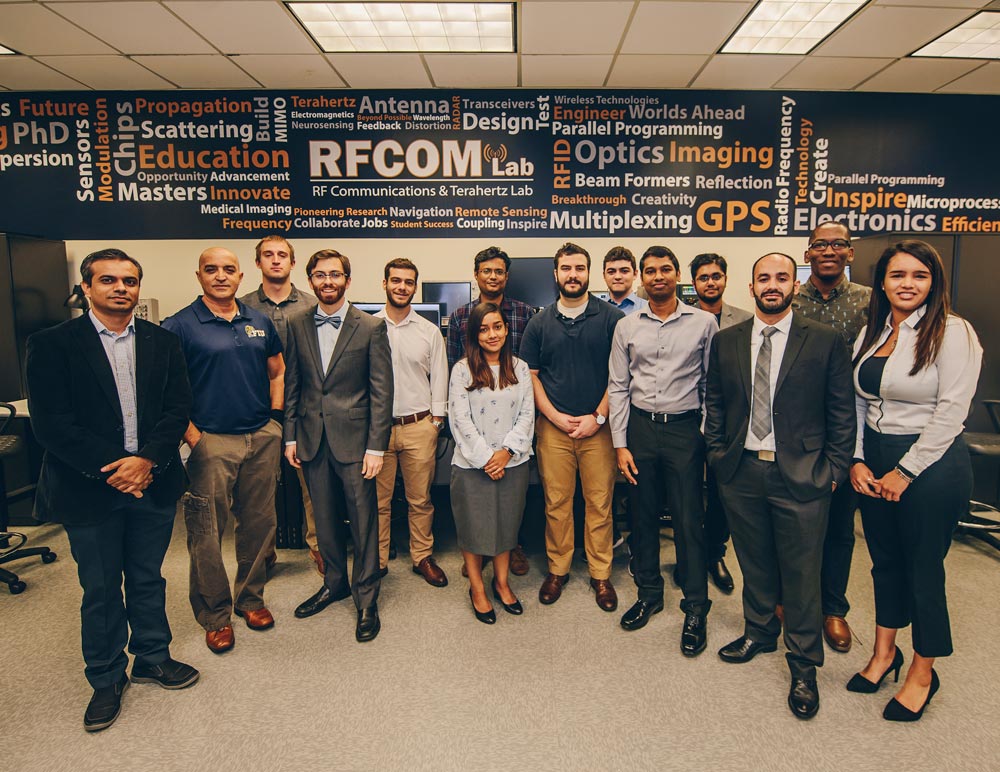
John L. Volakis is a Professor of Electrical & Computer Engineering at Florida International University (FIU) and former Dean of the College of Engineering and Computing (2017-2023). He is an IEEE, ACES, AAAS, NAI, and URSI Fellow. His career spans over four decades, including roles at Boeing, University of Michigan, Ohio State University, and FIU. He has pioneered advancements in antennas, electromagnetic compatibility, and biomedical sensing. His research group has produced over 400 journal papers, 800 conference papers, and 8 books. He has mentored 95 PhD/postdoc students, many of whom became faculty or industry leaders. Education: Ph.D. (1982), M.S. (1979), B.E. (1978) from The Ohio State University and Youngstown State University. Key Roles: Former Director of Ohio State's ElectroScience Laboratory, Co-Director of FIU's RFCOM Lab. Research Interests: Focuses on wearable antennas, ultra-wideband systems, metamaterials, neurosensing, and electromagnetic compatibility. His work includes innovations in millimeter-wave arrays, EMI shielding, and bioelectromagnetics. Recent projects involve battery-free neural recording systems and STAR radio interference cancellation. Publications: Over 1,200+ publications across antennas, computational electromagnetics, and biomedical engineering. His 2025 papers address EMI shielding, LPD waveforms, and TCDA arrays. Awards: IEEE Antennas & Propagation Society Distinguished Award (2014), Chen-To Tai Educator Award (2011), and leadership roles in URSI and IEEE. Advising & Grants: Guided 43 students to best paper awards and secured $125M in external funding during his deanship. His RFCOM Lab develops advanced fabrication and measurement capabilities for phased arrays and biomedical sensors.
Ali Abdi is a Professor of Electrical and Computer Engineering at the New Jersey Institute of Technology. He holds a Ph.D. in Electrical Engineering from the University of Minnesota-Twin Cities (2001), an M.S. from the University of Tehran (1996), and a B.S. from Iran University of Science and Technology (1991). His research spans underwater acoustic communications, signal processing, wireless systems, and neural network modeling. Recent work focuses on multichannel signal detection, MIMO systems, and molecular network analysis. His publications demonstrate consistent innovation in signal processing theory and experimental validation for underwater and wireless systems, with emerging applications in molecular communication and decision modeling.
Ryan M. Corey is an Assistant Professor of Electrical and Computer Engineering at the University of Illinois Chicago and a Research Scientist at the Discovery Partners Institute (DPI), a Chicago-based innovation hub focused on equitable economic development. His work bridges academic research with industry and community engagement, particularly emphasizing technologies for marginalized groups. Ph.D., Electrical and Computer Engineering, University of Illinois Urbana-Champaign (2019) M.S., Electrical and Computer Engineering, University of Illinois Urbana-Champaign (2014) B.S., Electrical Engineering (Highest Honors), Princeton University (2012) Professor Corey’s research focuses on audio and acoustic signal processing to enhance hearing technologies in noisy environments. Key areas include spatial signal processing, microphone arrays, distributed sensor networks, and wireless audio systems. As the first dual-appointed faculty member at DPI, he develops cooperative architectures for multi-device audio sensing and immersive sound remixing applications for augmented reality and assistive systems. His current projects involve creating intelligent audio networks that leverage wearable and mobile devices for improved acoustic inference, and an automated acoustic research system at DPI for generating dynamic datasets. His work emphasizes practical applications in hearing assistive technology, pandemic-related communication barriers, and emergency medical devices. 2022 Future of Science Award (Oak Ridge Institute for Science and Education) 2020 Best Student Paper Award (Acoustical Society of America Meeting) 2019 Best Student Paper Award & IC Postdoctoral Fellowship 2014 NSF Graduate Research Fellowship As a hearing aid user himself, Corey prioritizes real-world usability in assistive technologies while maintaining rigorous academic research standards through collaborations with the Audio Engineering Society, IEEE Signal Processing Society, and Acoustical Society of America.
Jerome Sanes is a Professor of Neuroscience at Brown University, where he also serves as the Director of MRI Research. His academic career spans several decades, beginning with graduate studies at the University of Rochester and post-doctoral work at the National Institute of Mental Health. From 1997-2000, he directed the Functional Neuroimaging Laboratory at Foundation Santa Lucia in Rome, Italy. He has published over 90 peer-reviewed papers and served on editorial boards of major neuroscience journals including the Journal of Neuroscience and NeuroImage. Dr. Sanes received his PhD in 1979 and MA in 1977 from the University of Rochester, and his BA in 1974 from the State University of New York at Binghamton. His educational background laid the foundation for his research career focused on understanding brain mechanisms underlying movement and cognition. Dr. Sanes' research initially focused on brain mechanisms of voluntary movement and motor learning, with particular interest in how multiple brain regions including the frontal and parietal lobes, basal ganglia, and cerebellum coordinate to produce skilled movements. More recently, his research has expanded to investigate non-image forming visual pathways and their influence on human behavior and cognition. His laboratory employs advanced neuroimaging techniques including functional Magnetic Resonance Imaging and Electroencephalography to study these questions. His recent publications demonstrate a continued focus on motor neuroscience while expanding into new areas including the effects of light on mood and cognition, neural mechanisms in Alzheimer's disease, and social neuroscience examining neural responses to peer interactions. This evolution reflects both the maturation of his research program and the interdisciplinary nature of modern neuroscience. United States Public Health Service Trainee Rush Rhees Fellow, University of Rochester National Research Service Award Honorary Master of Arts, Brown University Dr. Sanes has secured substantial research funding throughout his career, currently serving as PI on an NIH COBRE Center for Central Nervous System Function grant totaling approximately $7.5 million. He also serves as Co-PI on an NIH grant for developing Quantum Magnetic Tunneling Junction Sensor Arrays for Brain MEG, and as Co-I on a US Veterans Administration Center for Neurorestoration and Neurorehabilitation grant. His past funding includes significant awards from the National Science Foundation, Department of Energy, and DARPA, demonstrating the breadth and impact of his research program. As Director of the Brown University MRI Research Facility, Dr. Sanes oversees a major neuroimaging resource that supports numerous research projects across the university. His laboratory has been at the forefront of investigating brain mechanisms of voluntary movement, motor learning, and action intention, contributing significantly to our understanding of how the brain controls skilled behavior.
Zoi-Heleni Michalopoulou is Professor in Mathematical Sciences at New Jersey Institute of Technology, specializing in ocean acoustics and signal processing. Her research develops advanced algorithms for underwater signal detection, geoacoustic inversion, and ocean parameter estimation. Current projects include Navy-sponsored investigations into shallow water inversion using machine learning and optimization methods. Research integrates Gaussian processes, genetic algorithms, and Bayesian methods for solving inverse problems in uncertain ocean environments. Recent publications focus on multichannel signal detection in distorted underwater channels, direction-of-arrival estimation, and particle filter optimization. Maintains active collaborations with Navy research divisions. Publications demonstrate consistent methodological innovation in statistical signal processing, with applications to underwater sensor networks and acoustic characterization. Currently leads NSF-funded nanotechnology education initiatives.
Murat Torlak is a Professor in the Department of Electrical Engineering at the University of Texas at Dallas (UTD), affiliated with the Erik Jonsson School of Engineering and Computer Science. He holds a Ph.D. in Electrical Engineering from the University of Texas at Austin (1999), an M.S. from The University of Texas at Austin (1995), and a B.S. from Hacettepe University (1992). His research focuses on wireless communications, signal processing, MIMO systems, and automotive radar technologies. He has led projects on 4G/5G network optimization, spectrum sensing, and RF interference mitigation. Research interests include optimizing radio link protocols, cognitive radio networks, and antenna array design. Notable contributions include advancements in beamforming, MIMO testbed development, and real-time implementation of wireless systems. He has received grants totaling over $2M, including funding from NIH, NSF, and Texas Instruments. His work on automotive radar signal processing and mmWave imaging has been highlighted in news articles, emphasizing innovations in multi-user MIMO and global roaming technologies. Awards include the 2004 IEEE Outstanding Service Award and a 2001 Best Paper Award. His lab collaborates on projects like the 'Generic Autonomous Platform for Sensor Systems' (GAP4S) and cochlear implant stimulation systems. Grants: Over 15 funded projects, including NIH grants for cochlear implant research and Texas Instruments grants for OFDM systems. Awards: IEEE honors, NSF fellowships, and industry accolades. Projects: Developed MIMO-SAR mmWave imaging testbeds and advanced interference mitigation techniques.
Emily Arnold is an Associate Professor in the Department of Aerospace Engineering at the University of Kansas, where she also serves as Graduate Program Director. Her research centers on multifunctional aerospace structures, remote sensing technologies, and unmanned aerial systems (UAS) for glaciological applications. Key trends in her recent publications highlight advancements in reconfigurable radar systems for UAS-based ice and snow sounding, wing-mounted antenna design under flight stress, and 3D-printed microwave components. She merges aerospace structural analysis with electromagnetic simulation to enhance UAV sensor performance in polar environments. NSF CAREER Award (2019) for UAS radar systems NSF MRI Grant (2022) for radar instrumentation Her work at CReSIS (Center for Remote Sensing of Ice Sheets) supports Operation IceBridge and COLDEX projects, focusing on oldest ice core exploration. She explores the intersection of structural dynamics, microwave engineering, and environmental monitoring via airborne platforms.